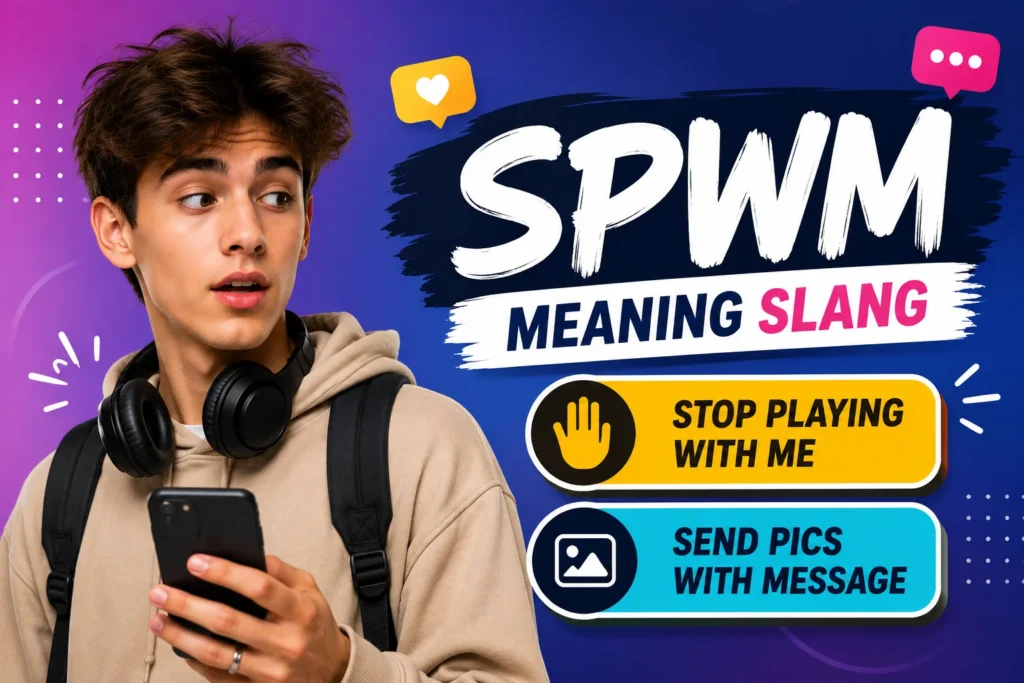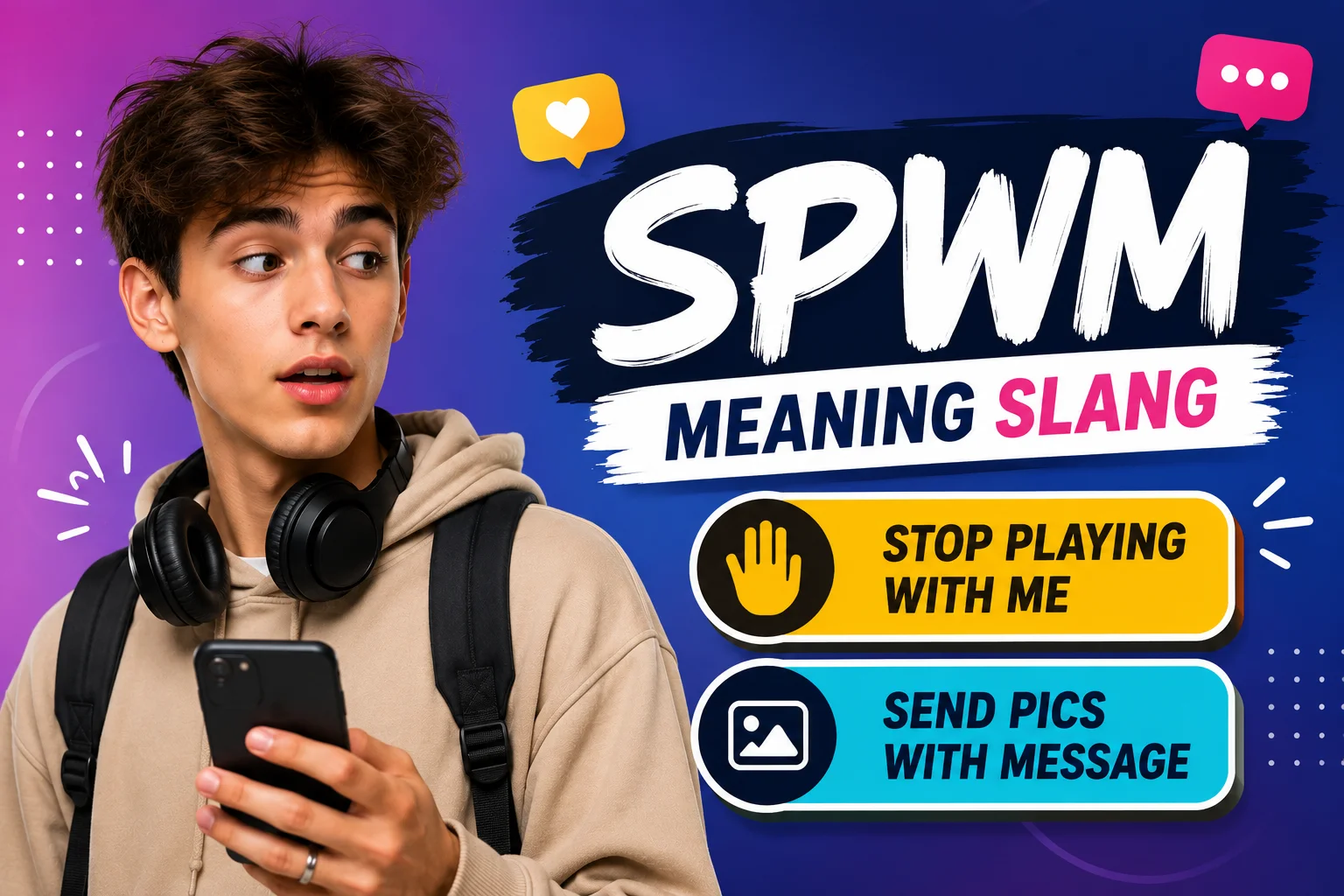
If you’ve searched for SPWM meaning slang, the most common meaning is “Stop Playing With Me.” It’s a popular texting abbreviation used to express disbelief, frustration, surprise, or playful annoyance. In some niche contexts, SPWM can also have other meanings, but “Stop Playing With Me” is by far the most widely recognized slang usage.
People often search for SPWM after seeing it in a text message, TikTok comment, Snapchat chat, or Instagram DM and wondering whether the sender is joking, serious, or upset. This guide explains the verified meanings, where the slang is actually used, and how to understand it in everyday conversations.
What Does SPWM Mean in Slang?
The abbreviation SPWM has one dominant slang meaning that appears consistently across texting guides, slang dictionaries, and social media.
SPWM = “Stop Playing With Me” (Primary Meaning)
In internet slang, SPWM stands for “Stop Playing With Me.”
People use it when someone says or does something that seems unbelievable, shocking, funny, or difficult to believe. Depending on the conversation, it can mean:
- You’re joking, right?
- Be serious.
- Quit messing with me.
- I can’t believe what you just said.
- Don’t tease me.
Rather than expressing anger, SPWM is often used with a playful or exaggerated tone among friends.
Example:
A: I won front-row concert tickets for free.
B: SPWM! Did you really?
Here, SPWM shows disbelief rather than actual frustration.
SPWM = “Send Pics With Message” (Less Common)
Some texting resources list “Send Pics With Message” as an alternative expansion.
This meaning appears in certain messaging communities but is far less common than “Stop Playing With Me.”
Because it lacks widespread usage, readers should rely on context before assuming this definition.
Other Reported Meanings
You may occasionally encounter other expansions for SPWM, including community-specific or non-slang uses.
For example:
- Spam With Pictures of Me (reported in some TikTok fan communities)
- Technical or engineering abbreviations unrelated to texting
These meanings are niche and shouldn’t be confused with the primary internet slang meaning.
Is SPWM an Acronym, Abbreviation, or Slang?
SPWM fits into all three categories.
- Acronym: Yes. It is formed from the first letters of the phrase “Stop Playing With Me.”
- Text abbreviation: Yes. It shortens a longer sentence into four letters for faster typing.
- Internet slang: Yes. The phrase has become part of casual online conversations and social media culture.
Although technically an acronym, most people simply recognize SPWM as modern texting slang.
How SPWM Is Used on Different Platforms
SPWM appears across several popular social media and messaging platforms, but its purpose remains largely the same: reacting to something surprising, unbelievable, or amusing.
TikTok
TikTok is one of the biggest reasons many people encounter SPWM.
Users frequently include it in:
- comments
- captions
- replies
- reaction videos
It usually responds to something shocking or unexpected.
Example:
“SPWM… you actually met your favorite singer?”
Here, the writer is expressing disbelief rather than accusing someone of lying.
On Instagram, SPWM often appears in comments and direct messages.
Friends use it when reacting to impressive photos, unexpected news, or funny stories.
Example:
“SPWM… you graduated already?”
The phrase communicates surprise while keeping the conversation casual.
Snapchat
Snapchat conversations move quickly, making abbreviations like SPWM especially common.
Friends often use it after receiving surprising snaps or messages.
Example:
A: I accidentally deleted all my vacation photos.
B: SPWM.
The response means:
“Please tell me you’re joking.”
SPWM appears less frequently on WhatsApp than on TikTok or Snapchat, but it’s still used in casual chats among friends who are familiar with internet slang.
Because WhatsApp often includes conversations with family members and coworkers, many users prefer writing the full phrase instead of the abbreviation.
X (formerly Twitter)
On X, SPWM is usually found in replies to surprising news, celebrity posts, sports highlights, or viral content.
Example:
“SPWM… that comeback was unbelievable.”
Unlike hashtags or trending slang, SPWM typically serves as a conversational reaction rather than the focus of the post.
Read More: Pink Roses Meaning: Symbolism, Shades & When to Give Them
When People Use SPWM
Although the wording literally means “Stop Playing With Me,” it usually isn’t meant as a command.
Instead, it communicates an emotional reaction.
When Someone Shares Big News
Friends often use SPWM after hearing exciting announcements.
Example:
A: I got accepted into my dream university.
B: SPWM! Congratulations!
Here, the phrase expresses excitement and disbelief at the same time.
When Something Sounds Impossible
People naturally respond with SPWM when a story seems too unbelievable to be true.
Example:
A: I found $200 lying on the sidewalk.
B: SPWM.
The abbreviation means:
“There’s no way.”
When Friends Are Teasing Each Other
SPWM is also common during playful conversations.
Example:
A: I could beat you at basketball with one hand.
B: SPWM.
Rather than starting an argument, the response keeps the joke going.
Tone Variations
One reason SPWM has become popular is that it works in several conversational tones without changing its basic meaning.
Playful Tone
This is the most common use.
Conversation
A: I finished the whole pizza myself.
B: SPWM.
A: I’m serious!
B: That’s impressive.
Surprised Tone
People also use SPWM when unexpected news catches them off guard.
Conversation
A: I won the grand prize.
B: SPWM!
A: I couldn’t believe it either.
B: That’s amazing.
Slightly Frustrated Tone
Sometimes SPWM expresses mild annoyance when someone keeps teasing.
Conversation
A: I’m not telling you where we’re going.
B: SPWM.
A: You’ll find out later.
B: Fine… I’ll wait.
Notice that the frustration remains lighthearted rather than hostile.
Real Chat Examples
Example 1 – Best Friends
A: I just met my favorite actor at the airport.
B: SPWM!
A: I even got a selfie.
B: No way—that’s incredible.
Example 2 – Gaming Group
A: We finally beat the hardest level.
B: SPWM.
A: First attempt too.
B: That’s wild.
Example 3 – Family Chat
A: Dad said we’re going on vacation next month.
B: SPWM!
A: He booked everything already.
B: I can’t wait.
Example 4 – TikTok Comments
A: I made this cake in under 20 minutes.
B: SPWM… it looks professionally made.
A: Thanks! It took lots of practice.
B: I’m definitely trying this recipe.
Example 5 – Snapchat Conversation
A: I accidentally sent the message to my boss instead of my friend.
B: SPWM…
A: I wish I was joking.
B: That’s every employee’s nightmare.
Example 6 – College Friends
A: I finished the entire assignment in one night.
B: SPWM.
A: Coffee did all the work.
B: I need that kind of motivation.
Example 7 – Instagram Direct Messages
A: I just booked tickets for Japan!
B: SPWM!
A: I’ve wanted to go for years.
B: That’s going to be an unforgettable trip.
Example 8 – Sports Group Chat
A: Our team scored three goals in the last five minutes.
B: SPWM… I turned the TV off too early!
A: You missed the best part.
B: I’m never leaving a game early again.
Grammar and Language Role
Although SPWM is an abbreviation, it behaves like a conversational expression rather than a standard dictionary word.
Part of Speech
SPWM functions as an interjection or discourse marker. It expresses the speaker’s emotional reaction—usually surprise, disbelief, or playful frustration—rather than describing an object or action.
Sentence Position
You’ll usually see SPWM in one of three places:
- At the beginning of a sentence
- As a standalone reply
- At the end of a statement for emphasis
Examples:
- SPWM… did that really happen?
- A: I won the giveaway.
B: SPWM! - You’re serious? SPWM.
Can It Replace a Full Sentence?
Yes, in casual conversations.
If the context is clear, SPWM alone communicates a complete reaction.
Example:
A: I got VIP tickets.
B: SPWM!
The listener immediately understands the response means something like “You’re kidding!” or “Seriously?”
Formal vs. Informal Register
SPWM is highly informal.
It’s appropriate for:
- Text messages
- TikTok comments
- Snapchat chats
- Instagram DMs
- Friendly group conversations
It isn’t appropriate for:
- Business emails
- School essays
- Professional reports
- Formal presentations
How to Reply to SPWM
Because SPWM expresses a reaction, your reply should match the mood of the conversation.
Funny Reply
If someone responds with SPWM after your story:
“I promise I’m not making this up!”
or
“Receipts available if needed. 😂”
Serious Reply
If the conversation is genuine:
“I’m serious. It really happened.”
or
“I know it sounds unbelievable, but it’s true.”
Flirty Reply
SPWM isn’t a romantic phrase, but it can fit naturally into playful flirting.
A: You’re the cutest person I’ve met.
B: SPWM?
A: Not joking—I mean every word.
The flirtation comes from the compliment, not the abbreviation itself.
Neutral Reply
If you simply want to continue the conversation:
- “Seriously.”
- “I’m telling the truth.”
- “It’s real.”
- “I know—it surprised me too.”
SPWM vs. Similar Slang Terms
| Term | Meaning | Usage Context | Tone | Popularity | Confusion Risk |
|---|---|---|---|---|---|
| SPWM | Stop Playing With Me | Surprise, disbelief, playful frustration | Casual | High | Medium |
| FR | For Real | Agreement or sincerity | Casual | Very High | Low |
| No Cap | I’m not lying | Honest statement | Casual | Very High | Low |
| JK | Just Kidding | Clarifies a joke | Casual | Very High | Low |
| ONG | On God | Strong emphasis or sincerity | Casual | High | Low |
| Seriously (opposite response to joking) | Genuine statement | Everyday conversation | Neutral | Universal | Very Low |
SPWM vs. FR
Both expressions appear in texting, but they serve different purposes.
- FR usually agrees with someone or asks, “For real?”
- SPWM reacts to something surprising by saying, “Stop joking with me.”
Example:
FR: “That movie was amazing.”
SPWM: “You met the actor? SPWM!”
SPWM vs. JK
These abbreviations are almost opposites in conversation.
- SPWM questions whether someone is joking.
- JK confirms that something was a joke.
Example:
A: I quit my job.
B: SPWM.
A: JK.
Who Uses SPWM?
Age Groups
Available evidence suggests that SPWM is most common among:
- Teenagers
- High school students
- College students
- Young adults active on social media
Older adults are less likely to recognize the abbreviation unless they regularly interact with younger users or follow internet trends.
Gen Z vs. Millennials
Gen Z
Gen Z uses SPWM naturally alongside expressions like:
- No Cap
- FR
- ONG
- Bet
For many younger users, SPWM feels like a normal part of casual online conversation.
Millennials
Millennials generally recognize more traditional abbreviations such as:
- LOL
- BRB
- IDK
- IMO
Some Millennials know SPWM through TikTok, Instagram, or younger family members, but it isn’t as universally familiar within this generation.
Regional Usage
Reliable public data doesn’t show that SPWM belongs to one specific English-speaking country.
Its usage appears primarily across online English-speaking communities, especially in North America, before spreading more broadly through social media.
Claims that SPWM is unique to a particular city, region, or country aren’t supported by strong evidence.
Platform Summary
| Platform | Most Common Meaning |
|---|---|
| TikTok | Stop Playing With Me |
| Snapchat | Stop Playing With Me |
| Stop Playing With Me | |
| Stop Playing With Me (less frequent) | |
| X | Stop Playing With Me |
Alternative meanings appear only in niche communities and shouldn’t be considered the default interpretation.
Origin and Internet Culture
The exact origin of SPWM isn’t documented with a single first use, but the phrase “Stop Playing With Me” has existed in spoken English long before it became an internet abbreviation.
As texting and social media encouraged shorter messages, users began reducing familiar expressions to initials. Over time, SPWM became a convenient way to react to unbelievable stories, shocking announcements, and playful teasing.
Language references and social media reporting indicate that the abbreviation gained wider visibility through platforms such as TikTok, Snapchat, and Instagram, where quick reactions and comment-based conversations encourage short slang expressions.
Cultural Background
The spoken phrase “Stop playing with me” has long appeared in conversational English and is also documented in AAVE-influenced speech, where expressive phrases often spread into mainstream internet culture through music, comedy, and social media.
It’s important not to overstate this connection. While SPWM is associated with slang that became more visible through online communities, there is no verified evidence identifying a single creator, viral video, or influencer responsible for popularizing the abbreviation.
TikTok’s Role
TikTok helped introduce SPWM to a broader audience by exposing users to reaction-style comments and short videos where exaggerated expressions of surprise are common.
Unlike slang terms tied to one viral dance, hashtag, or sound, SPWM spread gradually through everyday conversations rather than one defining internet trend.
That steady growth explains why many people now encounter SPWM in comments or direct messages, even if they haven’t heard the full phrase spoken aloud.
Safety & Appropriateness
Is SPWM Rude or Offensive?
No. SPWM (“Stop Playing With Me”) is not profanity or inherently offensive. In most conversations, it’s simply an expressive way to react when something sounds unbelievable, surprising, or playful.
However, tone matters. Depending on how it’s written and the relationship between the people chatting, SPWM can sound:
- Playful
- Surprised
- Slightly frustrated
- Skeptical
Because text messages don’t include facial expressions or voice tone, adding emojis or extra context can help prevent misunderstandings.
Does SPWM Contain Explicit Language?
No.
The abbreviation doesn’t include profanity, hate speech, or explicit language. It’s generally considered safe for casual online conversations.
Is It Appropriate for School or Work?
For conversations with classmates or close friends, SPWM is usually fine.
In professional settings, however, it’s better to write the complete phrase or choose clearer alternatives like:
- “Are you serious?”
- “Really?”
- “I can’t believe it.”
Business emails, workplace chats, and academic writing should avoid internet slang whenever clarity is important.
Cultural Sensitivity
The spoken expression “Stop playing with me” has long existed in everyday English and is also associated with AAVE-influenced conversational speech, which has influenced many modern internet slang terms.
Using SPWM casually is common online, but it’s best to understand the expression in its natural conversational context rather than treating it as a novelty or trend.
Real-World Observation
One reason SPWM has remained popular is that it captures a very common reaction in everyday conversations: disbelief. Instead of typing a full sentence like “You’re joking, right?” or “I don’t believe that,” people can respond with just four letters. The abbreviation feels conversational, expressive, and quick—qualities that fit perfectly with modern messaging apps.
Unlike slang that depends on a single viral meme or trend, SPWM reflects a natural spoken phrase that was simply shortened for digital communication. That gives it more staying power than many short-lived internet expressions, especially among younger users who regularly communicate through text and social media.
Frequently Asked Questions
What does SPWM mean in slang?
The most common slang meaning of SPWM is “Stop Playing With Me.” People use it when reacting to something surprising, unbelievable, or hard to accept. Depending on the situation, it can express playful disbelief, excitement, or mild frustration rather than genuine anger.
What does SPWM mean on TikTok?
On TikTok, SPWM usually appears in comments and replies when viewers react to shocking videos, surprising stories, or impressive achievements. It often means, “You’re kidding, right?” or “I can’t believe that actually happened.” The abbreviation is typically used in a humorous or exaggerated way rather than as an insult.
What does SPWM mean in text messages?
In texting, SPWM almost always stands for “Stop Playing With Me.” Friends use it to question unbelievable news, respond to teasing, or show surprise. Because texting is informal, abbreviations like SPWM help people react quickly without typing full sentences.
Does SPWM always mean “Stop Playing With Me”?
No, but that’s by far the most common interpretation. Some sources mention alternative meanings such as “Send Pics With Message,” while niche online communities use other expansions. In most social media conversations, however, “Stop Playing With Me” is the intended meaning.
Is SPWM the same as “No Cap”?
Not exactly. No Cap means “I’m telling the truth” or “I’m not lying.” SPWM, on the other hand, is a reaction that questions or responds to something surprising. While both appear in casual internet slang, they serve different purposes in conversation.
Can I use SPWM in professional communication?
It’s generally better not to. Although SPWM isn’t offensive, many people outside internet culture won’t recognize it. In workplace or academic communication, writing “Are you serious?” or “Really?” is clearer and more appropriate.
Is SPWM popular with Gen Z?
Yes. Available evidence suggests that SPWM is most commonly used by Gen Z and younger social media users, particularly on platforms like TikTok, Snapchat, and Instagram. While some Millennials recognize it, it’s less common among older generations.
Why are people searching for “SPWM meaning slang”?
Many people encounter SPWM in a text, social media comment, or viral post without knowing what it means. Since the abbreviation isn’t as universally recognized as LOL or IDK, users often search for it to understand whether the sender is joking, serious, or expressing surprise.
Conclusion
If you were searching for SPWM meaning slang, the answer is straightforward: SPWM most commonly stands for “Stop Playing With Me.” It’s a casual internet abbreviation used to express disbelief, surprise, playful frustration, or excitement when something sounds difficult to believe.
Although a few alternative meanings exist, they are far less common and usually limited to specific communities or contexts. In everyday texting and social media conversations, “Stop Playing With Me” is the meaning you’ll encounter most often.
Understanding the context—and the relationship between the people chatting—is the easiest way to interpret SPWM correctly. When used naturally, it’s a quick and expressive way to react without typing a full sentence.
Usage Tips
- Use SPWM in casual conversations with friends or people familiar with internet slang.
- Read the surrounding messages before assuming its meaning.
- Pair it with emojis if you want to emphasize a playful tone.
- Spell out the full phrase if there’s a chance the other person won’t recognize the abbreviation.
Common Mistakes
- Assuming SPWM has only one meaning in every situation.
- Confusing SPWM with abbreviations like FR, No Cap, or JK.
- Using it in formal emails or professional communication.
- Thinking it’s meant to sound rude or aggressive in every conversation.
When to Use SPWM
- Text messages with friends.
- TikTok comments and replies.
- Snapchat conversations.
- Instagram direct messages or casual comments.
- Group chats where internet slang is commonly understood.
When to Avoid SPWM
- Business emails.
- Workplace communication.
- Academic assignments.
- Conversations where the abbreviation could confuse the reader.
- Formal or professional social media posts.