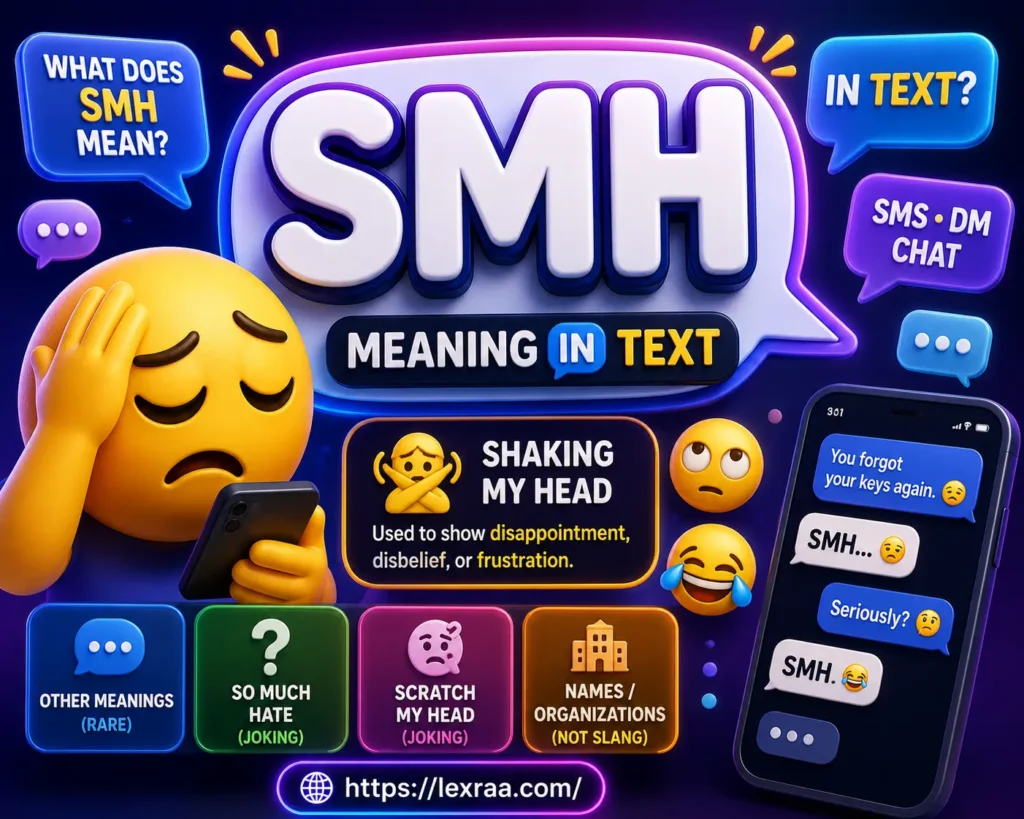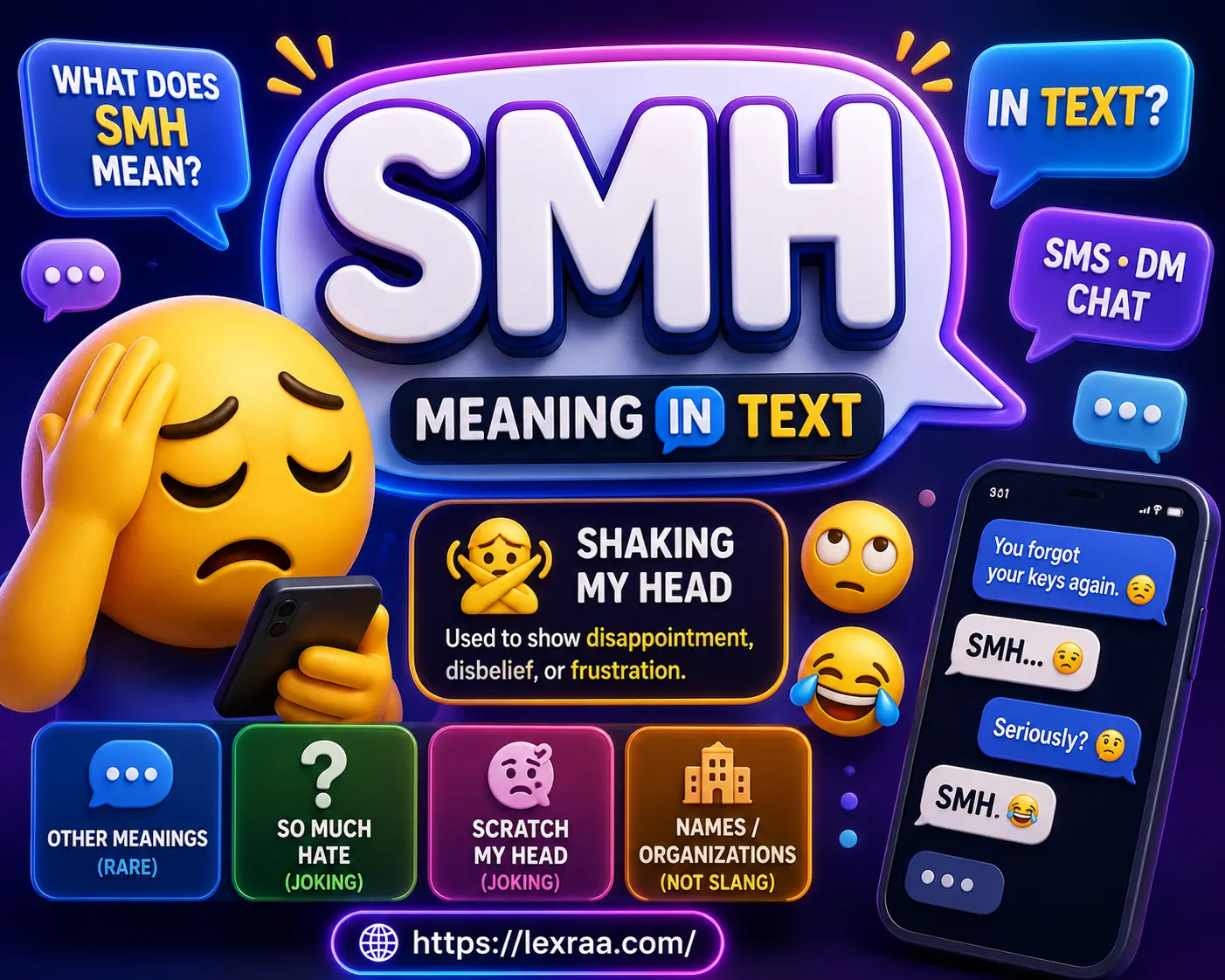
SMH most commonly means “Shaking My Head.” When someone texts you SMH, they’re expressing disappointment, disbelief, frustration, or mild embarrassment about something. People search for “SMH meaning in text” because the abbreviation often appears by itself, making its emotional tone easy to misunderstand.
What Does SMH Mean in Text?
In texting, SMH stands for:
Shaking My Head
It is an internet abbreviation and slang expression used to show that someone finds a situation silly, frustrating, disappointing, or unbelievable.
Unlike many abbreviations that replace a sentence, SMH communicates a reaction. Instead of writing:
- “I can’t believe that happened.”
- “That’s disappointing.”
- “Seriously?”
- “What were you thinking?”
People simply type:
SMH
The phrase represents the physical action of shaking your head when you’re disappointed or amazed by someone’s behavior.
Is SMH an Acronym, Abbreviation, or Slang?
SMH is an initialism (a type of abbreviation) that has become part of modern internet slang.
Each letter represents one word:
- S = Shaking
- M = My
- H = Head
Unlike abbreviations such as LOL, which often express happiness, SMH usually signals frustration, disbelief, or exasperation.
The Main Meaning of SMH
Shaking My Head (Most Common)
This is by far the meaning you’ll encounter most often.
People use SMH when something is:
- Disappointing
- Silly
- Annoying
- Hard to believe
- Obviously a bad decision
Examples:
SMH… you forgot your keys again.
You spent all your money already? SMH.
They canceled the concert at the last minute. SMH.
Notice that SMH isn’t necessarily angry. Often, it expresses mild frustration mixed with disbelief.
Does SMH Have Other Meanings?
In everyday texting and social media, “Shaking My Head” is overwhelmingly the accepted meaning.
Outside casual messaging, the letters SMH may stand for organizations, medical terms, or business names, but those are unrelated to internet slang.
Occasionally, people jokingly invent alternative expansions such as:
- So Much Hate
- Scratch My Head
However, these are humorous reinterpretations rather than recognized slang definitions. If someone sends SMH in a text, you should almost always read it as “Shaking My Head.”
Why People Use SMH Instead of Writing the Full Phrase
The abbreviation is quick and immediately recognizable.
Instead of typing:
I honestly can’t believe you did that.
Someone simply writes:
SMH.
It communicates emotion while keeping messages short, making it ideal for fast conversations.
Common Situations Where SMH Appears
People commonly send SMH when reacting to:
- Someone forgetting something important
- A surprising mistake
- Bad decisions
- Unexpected news
- Frustrating situations
- Funny failures
- Sports disappointments
- Everyday inconveniences
The abbreviation works because most readers instantly understand the emotion behind it.
SMS and iMessage
Traditional text messages remain one of the most common places to see SMH.
Friends and family often use it when reacting to something disappointing or unbelievable.
Example:
A: I locked my keys in the car again.
B: SMH 😂
Here, SMH expresses playful disbelief rather than genuine anger.
You’ll also see it in group chats whenever someone shares an unfortunate or funny story.
On WhatsApp, SMH functions almost exactly the same way.
People use it in:
- Family chats
- Friend groups
- School groups
- Casual one-on-one conversations
Example:
A: We missed the bus because Jake overslept.
B: SMH.
Sometimes users pair it with emojis:
- SMH 😂
- SMH 🤦
- smh lol
These additions soften the criticism and make the tone friendlier.
Read More: ISTG Meaning in Text: You’re Probably Using It Wrong
Instagram Direct Messages
In Instagram DMs, SMH usually reacts to screenshots, stories, or messages.
Example:
A: Look what he posted.
B: SMH.
It often communicates:
- “That’s embarrassing.”
- “I can’t believe this.”
- “Seriously?”
The abbreviation is especially common among younger users who prefer quick reactions instead of long explanations.
Snapchat
On Snapchat, SMH frequently appears in casual conversations between friends.
Examples include reactions to:
- Missed plans
- Funny mistakes
- Unexpected drama
- Strange messages
Example:
A: I accidentally sent the photo to my teacher.
B: SMH 😂
The abbreviation often combines with laughing emojis because many situations are frustrating but still funny.
Discord
Discord users commonly type SMH during live conversations, especially in gaming communities.
Examples:
We lost because nobody defended.
SMH.
or
SMH, we almost had it.
Because Discord conversations move quickly, abbreviations like SMH fit naturally.
TikTok
Although your focus is texting, SMH also appears in TikTok comments and replies.
Users write it when reacting to:
- Unexpected videos
- Poor decisions
- Funny fails
- Viral arguments
Example:
SMH… how did nobody notice this?
The meaning remains exactly the same as in text messages.
X (Formerly Twitter)
On X, SMH is extremely common in reaction posts.
People use it when commenting on:
- Breaking news
- Sports results
- Celebrity drama
- Politics
- Viral moments
Examples:
SMH, that referee missed an obvious foul.
SMH… people really believe this?
The abbreviation allows users to express frustration while staying within short post formats.
Is SMH Written Differently Across Platforms?
The meaning stays the same almost everywhere.
You’ll commonly see:
- SMH
- smh
- Smh
Capitalization usually does not change the meaning.
However, lowercase smh often feels slightly softer or more conversational.
People also combine it with punctuation:
- smh…
- SMH!
- smh lol
- smh 😂
- smh 🤦
These additions help readers understand the sender’s tone.
Grammar and Language Role
Part of Speech
SMH functions primarily as an interjection.
It expresses the writer’s emotional reaction rather than providing factual information.
Example:
SMH.
It can also act as a parenthetical reaction within a sentence.
Example:
I forgot my wallet again, SMH.
Sentence Position
You’ll commonly find SMH:
- At the beginning
SMH, that was unnecessary.
- At the end
You missed the meeting again. SMH.
- By itself
SMH.
Each position carries the same basic meaning but creates a slightly different emphasis.
Can SMH Replace a Full Sentence?
Yes.
One of the reasons SMH remains so popular is that it can stand completely on its own.
Instead of writing:
I can’t believe you did that.
People simply send:
SMH.
The emotional reaction is immediately understood by most internet users.
Capitalization Conventions
Both forms are acceptable:
- SMH
- smh
All caps can feel slightly stronger or more emphatic, while lowercase often feels casual and conversational.
Unlike some abbreviations, capitalization does not change the definition.
Is SMH Typed Alone or Inside Sentences?
Both.
Examples:
By itself
SMH.
At the beginning
SMH, I forgot my homework.
At the end
You left your phone at home again, SMH.
In the middle
That was, SMH, one of the worst decisions I’ve seen.
Although the middle position is less common, it still appears in informal conversations.
Formal or Informal?
SMH is entirely informal.
It’s appropriate when texting:
- Friends
- Family
- Classmates
- Gaming teammates
- Social media contacts
It’s generally not appropriate in:
- Business emails
- Professional reports
- Academic assignments
- Formal workplace communication
In professional settings, writing out your thoughts directly is clearer and more respectful.
SMH in Different Tones
Although SMH always means “Shaking My Head,” its emotional tone changes depending on the conversation. It can be humorous, sarcastic, playful, or genuinely disappointed.
Funny
Friends often use SMH to laugh at harmless mistakes.
A: I spent ten minutes looking for my glasses.
B: Where were they?
A: On my head.
B: SMH 😂
Sarcastic
Sometimes SMH gently mocks an obvious mistake.
A: I studied for the wrong exam.
B: SMH.
A: Don’t remind me.
B: At least you’ll be ready next time.
Playful
Among close friends, SMH is often affectionate rather than critical.
A: I accidentally ordered spicy instead of mild again.
B: SMH 😂
A: I never learn.
B: Apparently not.
Serious
The abbreviation can also express genuine disappointment.
A: They canceled the event without telling anyone.
B: SMH. That’s really unprofessional.
A: Everyone showed up for nothing.
B: I’d be frustrated too.
Real Chat Examples
1. Friends (SMS)
A: I left my wallet at home.
B: SMH 😂
A: Guess I’m going back.
B: Better now than later.
2. Siblings (WhatsApp)
A: Mom caught me eating the cake.
B: SMH. You couldn’t wait one day?
A: I got hungry.
B: That’s what you always say.
3. Coworkers (Teams Chat)
A: I forgot to attach the file again.
B: SMH 😅
A: Sending it now.
B: We’ve all done it.
4. Partners (iMessage)
A: I locked myself out of the apartment.
B: SMH ❤️
A: Can you bring the spare key?
B: On my way.
5. Gaming Friends (Discord)
A: I fell off the map again.
B: SMH 😂
A: That jump gets me every time.
B: Practice makes perfect.
6. Parent and Teen (Text)
A: I forgot my lunch.
B: SMH. I’ll bring it after work.
A: Thanks!
B: Try to remember tomorrow.
7. Instagram DM
A: He posted the wrong photo.
B: SMH. Did he notice yet?
A: Not yet.
B: Someone should tell him.
8. College Friends
A: We went to the classroom on the wrong floor.
B: SMH 😂
A: At least we weren’t alone.
B: Half the class did the same thing.
9. Sports Fans (Group Chat)
A: We missed that easy goal.
B: SMH.
A: That should’ve been an easy finish.
B: Completely agree.
10. Neighbor Chat
A: The delivery driver left my package next door again.
B: SMH. That keeps happening.
A: Luckily you found it.
B: Happy to help.
How to Reply to SMH
The right response depends on why the other person sent it.
Funny Reply
If they’re teasing you:
I know… I’m keeping life interesting.
or
My talent is making avoidable mistakes. 😂
Serious Reply
If they’re expressing disappointment:
You’re right. I’ll be more careful next time.
or
I understand why you’re frustrated.
Flirty Reply
If the conversation is lighthearted:
Stop shaking your head and come hang out with me. 😉
or
You’ll forgive me eventually… right? 😊
Neutral / Unbothered Reply
Fair enough.
or
Yeah, that wasn’t my best moment.
or
It happens.
SMH Compared With Similar Texting Terms
| Term | Meaning | Usage Context | Tone | Popularity | Confusion Risk |
|---|---|---|---|---|---|
| SMH | Shaking My Head | Disappointment, disbelief, frustration | Negative / amused | Very High | Low |
| SMDH | Shaking My Damn Head | Stronger version of SMH | More frustrated | High | Medium |
| OMG | Oh My God | Surprise or shock | Positive or negative | Very High | Low |
| BRUH | Expression of disbelief or frustration | Casual reactions | Playful | Very High | Low |
| LOL | Laughing Out Loud | Humor or amusement | Positive | Very High | Low |
| W | Win / Success | Celebration | Positive | High | Low |
W is the closest practical opposite in tone because SMH usually reacts to disappointment, while W celebrates success.
Who Uses SMH?
Teenagers (13–18)
Teenagers use SMH frequently in text messages, Snapchat, Discord, and group chats. It’s often paired with emojis to soften criticism or make a joke feel less serious.
Young Adults (18–30)
College students and young professionals use SMH in everyday messaging, especially when reacting to awkward situations, news stories, or small mistakes. It’s common across multiple social platforms because it’s short and immediately recognizable.
Adults Over 30
Many adults understand SMH, particularly those who regularly text or use social media. However, some prefer writing out phrases like “I can’t believe it” instead of using abbreviations.
Gen Z vs. Millennials
Gen Z
Gen Z tends to use SMH naturally alongside other abbreviations such as:
- LOL
- FR
- TBH
- BRUH
- W
It’s often combined with emojis:
smh 😭
smh 😂
Millennials
Millennials also use SMH, especially in texting and Facebook Messenger conversations. Compared with Gen Z, they’re slightly more likely to capitalize it (SMH) or include it at the end of a sentence rather than sending it alone.
Regional Usage
There is no strong evidence that SMH belongs to one English-speaking country. It is widely recognized across the United States, Canada, the United Kingdom, Australia, and many other English-speaking communities.
Its popularity comes from internet culture rather than regional dialects, so the meaning remains consistent across most English-language platforms.
Origin and Internet Culture
Where Did SMH Come From?
SMH emerged during the early days of internet messaging, online forums, and SMS texting in the late 1990s and early 2000s. As character limits encouraged shorter messages, users began shortening common expressions into abbreviations.
Unlike slang created by a single viral trend, SMH spread gradually through chat rooms, instant messaging services, blogs, and later social media platforms.
Connection to Texting Culture
Because “shaking my head” describes a physical reaction rather than spoken dialogue, it translated perfectly into text. Instead of explaining disappointment in a full sentence, users could simply type SMH and let readers imagine the reaction.
That efficiency helped it survive even as texting evolved beyond strict character limits.
Role in Internet Culture
Today, SMH appears in conversations about:
- Everyday mistakes
- Viral videos
- Sports
- Entertainment news
- Politics
- Gaming
- Family group chats
Unlike many internet expressions that rise and disappear quickly, SMH has remained relevant for more than two decades because it describes an everyday human reaction that never goes out of style.
Is SMH Rude or Offensive?
SMH is generally not considered rude or offensive, but its tone can come across as critical depending on the situation.
When someone texts SMH, they’re usually expressing:
- Disappointment
- Disbelief
- Mild frustration
- Second-hand embarrassment
- Exasperation
Among close friends, it’s often playful or humorous. However, if you send SMH to someone you don’t know well, they may interpret it as judgmental or dismissive.
Is SMH Profanity?
No.
The standard expansion—“Shaking My Head”—contains no profanity or explicit language.
Be aware that a related abbreviation, SMDH, expands to “Shaking My Damn Head,” making it stronger and more emphatic. Even so, SMH itself remains clean and appropriate for most casual conversations.
Is SMH Appropriate for School or Work?
That depends on how formal the conversation is.
Appropriate for:
- Friends
- Family
- Classmates
- Casual team chats
- Gaming communities
Better avoided in:
- Business emails
- Job applications
- Academic assignments
- Formal customer communication
- Messages to teachers or supervisors unless you already have a very casual relationship
In professional settings, writing a complete sentence communicates your point more clearly and respectfully.
Cultural Sensitivity
There are no documented cultural or linguistic concerns associated with SMH itself. It is a broadly used internet abbreviation across English-speaking communities.
The only thing to be mindful of is tone. Because SMH signals disapproval, using it in sensitive conversations can unintentionally make you sound dismissive.
Real-World Observation
One reason SMH has lasted for more than two decades is that it captures a universal human reaction in just three letters. Instead of explaining disappointment every time something frustrating happens, people can simply type SMH and immediately communicate the emotion. In everyday texting, it’s often less about criticizing someone and more about sharing a moment of disbelief together. That flexibility has helped SMH remain relevant even as many older internet abbreviations have faded from common use.
Frequently Asked Questions
What does SMH mean in a text message?
In almost every text conversation, SMH means “Shaking My Head.” People use it to express disappointment, disbelief, frustration, or mild embarrassment about a situation. The exact tone depends on the context, but the meaning itself is remarkably consistent across messaging apps.
Is SMH always negative?
Not necessarily.
Although SMH usually expresses disappointment, it can also be playful when friends tease each other. For example, someone might text “SMH 😂” after a harmless mistake to show they’re laughing rather than genuinely upset.
Can SMH be used by itself?
Yes.
One of the reasons SMH became so popular is that it works as a complete response. Instead of typing a full sentence, many people simply reply:
SMH.
The reader immediately understands the emotional reaction.
Does SMH mean the same thing on every platform?
Almost always.
Whether you see SMH in SMS, iMessage, WhatsApp, Instagram DMs, Snapchat, Discord, TikTok comments, or X posts, it nearly always means “Shaking My Head.” Unlike some abbreviations, its meaning changes very little across platforms.
Is SMH still popular?
Yes.
Even though internet slang changes quickly, SMH has remained widely recognized for years. New abbreviations continue to appear, but SMH is still one of the most understood reactions in online conversations.
Is SMH the same as rolling your eyes?
They’re similar but not identical.
Both express disbelief or frustration, but SMH usually suggests disappointment rather than annoyance alone. You can think of it as the text version of quietly shaking your head after seeing something surprising or frustrating.
Is it rude to reply with just SMH in a text?
It depends on your relationship with the other person. Among close friends, replying with SMH is usually understood as playful or lightly critical. In more serious conversations, however, it can feel dismissive because it doesn’t explain what you’re thinking.
What’s the difference between texting SMH and saying “shaking my head” out loud?
When spoken aloud, people rarely say “shaking my head” unless they’re joking about internet slang. In texting, SMH functions as a quick emotional reaction that replaces body language. Saying it out loud often sounds more deliberate or humorous than typing it.
Does SMH mean the same thing in a group chat versus a one-on-one text?
Yes, the meaning stays the same, but the effect can differ. In a group chat, SMH often reacts to a shared event or funny mistake, inviting others to join in. In a private conversation, it can feel more personal because the reaction is directed at one person.
Conclusion
If someone texts you SMH, they almost always mean “Shaking My Head.” It’s one of the internet’s longest-lasting abbreviations and remains a popular way to express disappointment, disbelief, frustration, or amused exasperation without writing a full sentence.
Because its meaning is so well established, SMH is easy to understand in most conversations. The key is paying attention to the surrounding messages, emojis, and relationship between the people chatting.
Usage Tips
- Use SMH to react to surprising, frustrating, or disappointing situations.
- Pair it with emojis if you want to make the tone feel lighter or more playful.
- Read the surrounding conversation before assuming the sender is genuinely upset.
- Use the full phrase in formal communication instead of the abbreviation.
Common Mistakes
- Assuming SMH is always angry rather than sometimes humorous.
- Confusing SMH with SMDH, which expresses stronger frustration.
- Using SMH in professional emails or formal writing.
- Misreading playful teasing as serious criticism.
When to Use SMH
Use SMH when:
- Reacting to a funny mistake.
- Expressing disbelief about surprising news.
- Responding to a friend’s harmless bad decision.
- Chatting casually on messaging apps or social media.
Avoid SMH when:
- Writing professional emails.
- Communicating with someone unfamiliar with internet slang.
- Discussing sensitive topics where your tone could be misunderstood.
- A clear, detailed response is more appropriate than a quick reaction.