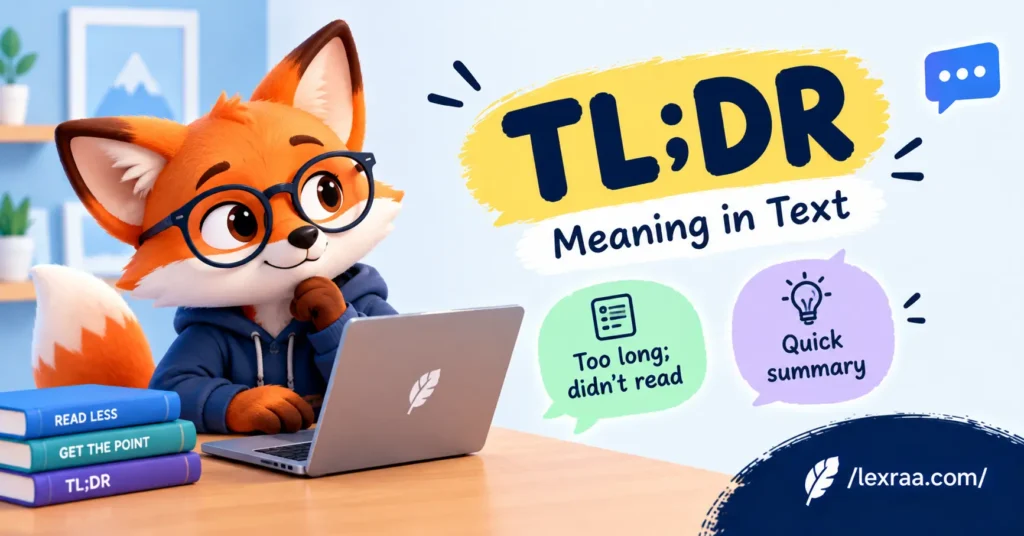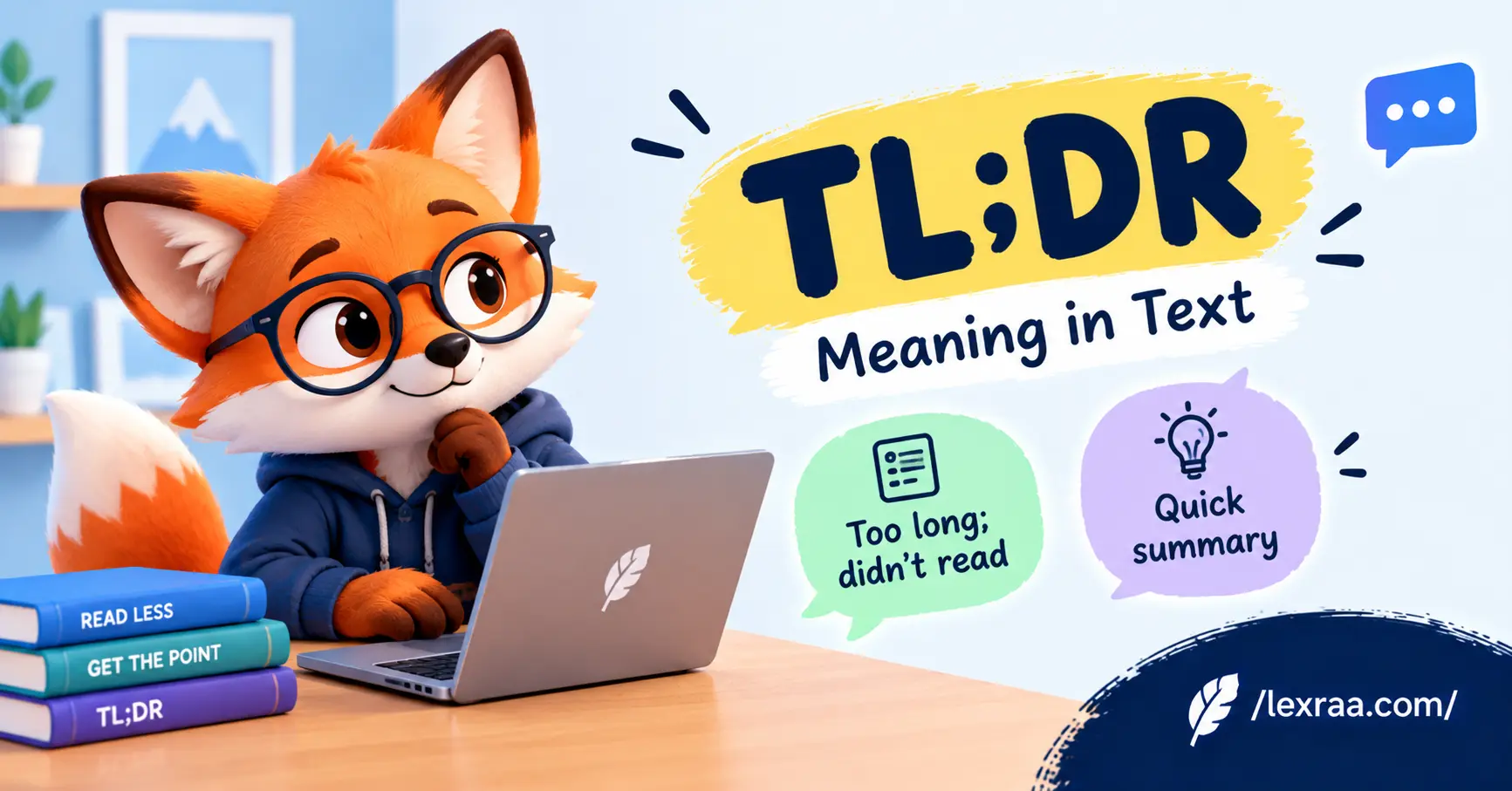
TL;DR means “too long; didn’t read.” In texts and online conversations, it has two main uses: telling someone that a message was too long to read, or introducing a summary of a longer post. The first can sound dismissive; the second is usually a practical way to get to the point.
What Does TL;DR Stand For?
TL;DR is an internet abbreviation formed from “too long; didn’t read.” You may also see it written as TLDR, tl;dr, or tldr. The punctuation and capitalization can change, but the basic meaning stays the same.
The interesting part is that people use it in two almost opposite ways:
- As a reaction: “TL;DR” can mean a message was so long that the reader skipped it.
- As a summary label: “TL;DR:” introduces the main point in a few words or sentences.
For example, if your friend sends a screen-filling explanation about why they missed a party, you might jokingly reply “TL;DR 😭.” If they write a long update and finish with “TL;DR: I’m moving next month,” they are giving you the short version.
The context matters more than the punctuation.
The Two Meanings You’ll See Most Often
1. “Too long; didn’t read” — a reaction
This is the literal expansion. Someone uses TL;DR to suggest that a post, message, or explanation is too lengthy to read in full.
Depending on the relationship and conversation, it can be playful, impatient, or openly dismissive.
Friend: sends 14 paragraphs about a dating disaster
You: “girl I need the TL;DR 😭”
Here, the sender isn’t necessarily being insulted. The reader wants the main point without every detail.
But replying only “TL;DR” to someone who has shared a serious personal story can come across as rude. It may suggest that their experience wasn’t worth your time.
2. “Here’s the summary” — a shortcut
TL;DR is also used as a label before or after a long piece of writing. In this sense, the writer is helping readers understand the main point quickly.
You’ll often see it at the end of a lengthy post, article, explanation, or discussion. Some writers put it at the beginning when they want readers to get the takeaway immediately.
For example:
TL;DR: The meeting has moved to Friday, and everyone needs to submit their reports by Thursday.
This isn’t a complaint about reading. It’s a compact version of the important information.
“You’ll often see TL;DR placed right after a long message, a bit like how people use ICYMI to point back to something they might have scrolled past.”
How to Tell Whether TL;DR Is Rude or Helpful
The easiest clue is to check who wrote it and where it appears.
| Where you see it | Likely meaning | How it comes across |
|---|---|---|
| As a reply to someone’s long message | The message was too long to read | Potentially rude or teasing |
| Before a short paragraph | A quick summary follows | Helpful and direct |
| At the end of a long Reddit post | A condensed version of the post | Usually practical |
| In a work update | The key takeaway or decision | Efficient, if the tone fits |
| After a friend’s dramatic story | A request for the short version | Playful or impatient, depending on context |
“Don’t worry if you’re new to online slang, even experienced users started out as noobs once.”
One important distinction: “TL;DR?” and “TL;DR:” don’t always do the same job. A question mark can make it a request for a summary, while a colon commonly signals that the summary is about to follow. Neither punctuation mark guarantees the writer’s tone, though.
If you’re unsure how someone meant it, read the surrounding message rather than assuming they’re being disrespectful.
TL;DR Meaning in Text: Realistic Conversation Examples
These examples show how the abbreviation can work in different relationships and situations.
1. iMessage — friends joking around
Mia: Okay so first he said he was busy, then posted from a concert, then texted me at 2 am 💀
Zoe: WAIT WHAT
Mia: it’s a whole story
Zoe: girl give me the TL;DR 😭
Why it works: Zoe wants the short version, not a detailed account of every message.
2. WhatsApp — family plans
Dad: The restaurant is full, parking is limited, and your uncle wants to leave early, so we might need to change the plan…
You: TL;DR? Where are we eating?
Dad: The place near the station.
You: Perfect 😂
Why it works: Here, TL;DR is a quick request to get to the decision.
3. Group chat — sharing important news
Sam: I spoke to the landlord. The rent is going up in December, but we can renew early if we agree this week.
Alex: TL;DR: are we staying or moving?
Sam: We need to decide by Friday.
Why it works: The abbreviation helps the group focus on the action they need to take.
4. Reddit — summarizing a long post
User 1: I’ve written out everything that happened with my roommate, including the bills, the missed payments, and the messages…
User 2: I haven’t read the whole thing yet. Is there a TL;DR?
User 1: TL;DR: I paid their share twice, and now they’re refusing to pay me back.
Why it works: The question asks for a summary rather than insulting the original poster.
5. Workplace chat — quick project update
Manager: The client reviewed the design, requested two changes, and wants the revised version before Thursday’s meeting.
Colleague: Thanks. TL;DR for the task list: two design changes due Wednesday?
Manager: Exactly.
Why it works: The colleague turns a longer explanation into a clear action item. In professional settings, spelling out “summary” can be safer if the audience may not know internet abbreviations.
TL;DR vs. TLDR, BLUF, and Other Similar Terms
TL;DR belongs to a wider family of online shorthand. These terms overlap, but they don’t all communicate the same thing.
| Term | Meaning | Tone | Popularity | Confusion Risk |
|---|---|---|---|---|
| TL;DR | Too long; didn’t read; also labels a summary | Helpful or dismissive | Commonly documented in dictionaries and online discussions | Medium |
| TLDR | Same meaning as TL;DR, without the semicolon | Casual and informal | Established variant | Low |
| BLUF | Bottom line up front | Direct and task-focused | Established in military and professional communication | Medium |
| TIL | Today I learned | Informative or curious | Established online abbreviation | Low |
| ICYMI | In case you missed it | Informative; often used to reshare information | Established online abbreviation | Medium |
| FYI | For your information | Neutral or informative | Established in everyday and workplace communication | Low |
The biggest difference is between TL;DR and BLUF. A TL;DR usually condenses something that has already been written, while BLUF emphasizes putting the main conclusion up front.
If you’re writing a long update for work, you can use the BLUF approach by leading with the decision and then explaining the details. If you’re wrapping up a long post, a TL;DR at the end can serve readers who want the takeaway after the full explanation.
People sometimes pair TL;DR with IMHO when they’re giving a quick take: “TL;DR: this movie is overrated, IMHO.””
Where Did TL;DR Come From?
TL;DR emerged from early internet discussion culture. Wikipedia’s TL;DR entry traces documented use back to at least 2002, including an early appearance on a Usenet newsgroup.
The abbreviation reflects a familiar online problem: someone writes a long post, and other readers want the point without working through every detail. Over time, the expression developed into a convenient label for a summary, not just a complaint about lengthy writing.
The history of the term supports its internet-slang classification. It is an initialism used as an abbreviation, rather than a separate word with an unrelated slang meaning.
“Slang evolves fast, and TL;DR has stuck around much longer than trendier terms like slime, which carries a completely different meaning depending on context.”
FAQs
Is TL;DR the same as a summary?
Not exactly. The letters stand for “too long; didn’t read,” but the expression is also commonly used to introduce a summary. The summary itself is the shortened explanation that follows.
Should TL;DR go at the beginning or end?
Either position can work. Put it at the beginning when readers need the key point immediately, or at the end when it summarizes a longer explanation. Follow the format that makes the information easiest to use.
Can I use TL;DR in a work email?
Yes, if the workplace culture is comfortable with informal internet shorthand. For a formal email or an unfamiliar audience, “Summary” or “Key takeaway” is clearer and more professional.
Is TL;DR an acronym or an abbreviation?
It is generally described as an abbreviation or initialism formed from the words “too long; didn’t read.” People often call it an acronym casually, but an initialism is more precise because its letters are usually pronounced individually.
How should I respond when someone sends “TL;DR”?
If they are asking for a summary, give them the main point in one or two sentences. If they use it dismissively, you can clarify the key information, ask what they need to know, or leave the conversation there if it doesn’t deserve more effort.
Does TL;DR mean the person didn’t read anything?
Not necessarily. It can be a literal admission that someone skipped a long post, but it can also be a label for a summary written by the original author. Look at the sentence and placement to work out which use applies.
The Takeaway
Use TL;DR when you want a quick summary of a long message or when you’re asking someone to get to the main point. It works well in casual chats, online discussions, and many informal updates. Avoid using it as a blunt response to something personal unless you know the other person will understand the joke. And remember the most common mistake: TL;DR doesn’t always mean someone ignored the entire message—sometimes they’re simply making the information easier to digest.