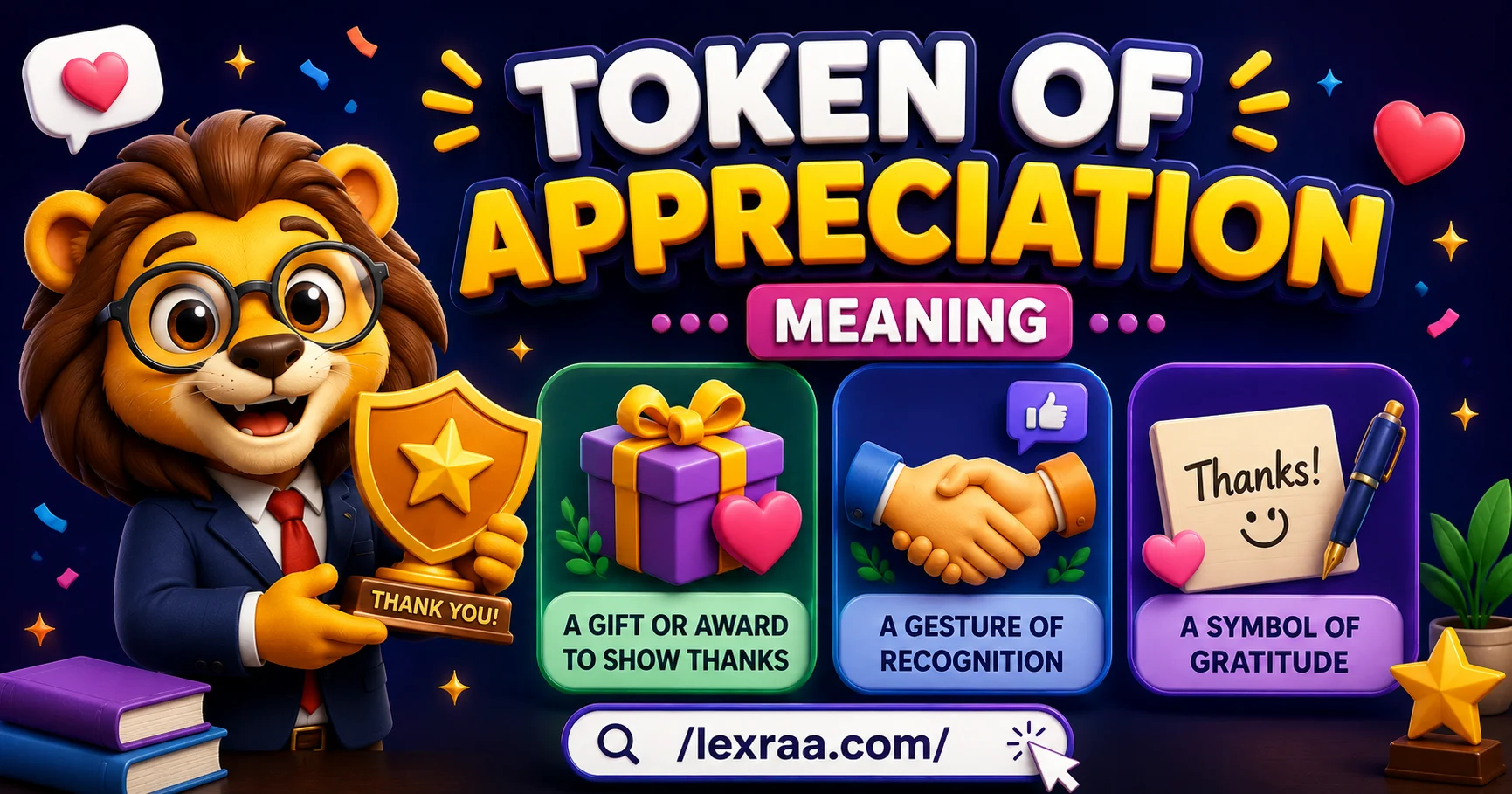
A token of appreciation is a small gift, gesture, message, or symbolic act given to show gratitude for someone’s help, effort, kindness, support, or contribution. The phrase focuses more on the meaning behind the gesture than its monetary value. Cambridge defines “token of something” as a small gift or action given to show gratitude, and gives “token of appreciation” as a standard example.
For example, if a manager gives an employee a handwritten card and a small gift after a difficult project, the gift can be called a token of appreciation. Likewise, flowers given to a teacher, a thank-you note sent to a helpful neighbor, or a small keepsake presented to a volunteer can all serve as tokens of appreciation.
Despite sometimes appearing in searches for “meaning” or “phrase,” token of appreciation is not slang, an acronym, or an internet abbreviation. It is a conventional English noun phrase, and it tends to sound polite, respectful, and somewhat formal.
What Is the Exact Meaning of “Token of Appreciation”?
The phrase combines two ordinary English words:
- Token: something that represents or symbolizes something larger.
- Appreciation: recognition of someone’s value, effort, qualities, or kindness, often with a sense of gratitude.
Put together, a token of appreciation is something small that represents a larger feeling of thanks.
The important word is token. The gift itself does not necessarily represent its full financial or practical value. A $5 notebook, for instance, can be a meaningful token of appreciation if it is given to recognize someone’s effort.
Cambridge’s examples include money, gifts, refreshments, and other small gestures offered as appreciation. Its corpus examples show the phrase being used for everything from compensation for someone’s time to a small gift recognizing effort.
That is why saying:
“Please accept this as a token of appreciation.”
does not necessarily mean:
“This gift is worth a lot.”
It means:
“This small gesture is meant to show how much we appreciate what you have done.”
Is “Token of Appreciation” a Phrase, Idiom, or Slang Term?
It is best described as a standard noun phrase or collocation, not slang.
A collocation is a combination of words that commonly appear together. Cambridge specifically lists token of appreciation as a collocation and explains the meanings of its two components.
It also isn’t an acronym like “TY” or “IDK,” and it doesn’t have a hidden internet meaning.
You may see it in:
- workplace emails
- award ceremonies
- thank-you letters
- school events
- volunteer recognition
- customer appreciation
- retirement presentations
- community events
- personal thank-you notes
- speeches
Its formal sound is one reason it appears frequently when someone is presenting a gift or recognition publicly.
Read More: What Does X Mean in Text? The Meaning May Surprise You
What Can Be a Token of Appreciation?
A token of appreciation does not have to be an object.
It can be almost any meaningful gesture intended to communicate gratitude.
A Small Gift
A coffee voucher, book, flowers, chocolates, plant, journal, or other modest present can be a token of appreciation.
For example:
“The team gave Sarah a small gift as a token of appreciation for organizing the event.”
The gift is tangible, but the real purpose is recognition.
A Handwritten Note
A handwritten thank-you card can sometimes be more appropriate than an expensive present.
For example:
“This note is a small token of appreciation for everything you’ve done for the students.”
The note itself has little monetary value. Its importance comes from the message.
An Award or Certificate
At a school, workplace, or community event, a certificate or plaque can serve as a token of appreciation.
For example:
“The volunteers received certificates as tokens of appreciation for their service.”
This type of usage is especially common when recognition is public.
A Shared Experience
A meal, team lunch, invitation, or complimentary experience can also function as a token of appreciation.
A workplace might invite employees to lunch after completing a demanding project. The meal is not necessarily a reward proportional to the work; it is a gesture acknowledging their contribution.
A Simple Act of Kindness
The phrase can even describe something that costs almost nothing.
A sincere thank-you, personal recommendation, public acknowledgment, or thoughtful message can express appreciation without involving a physical gift.
Does a Token of Appreciation Have to Be Small?
Not necessarily, although small or symbolic is an important part of the phrase’s usual meaning.
The word “token” suggests that the item or gesture represents a larger feeling. Cambridge’s definition specifically describes a token as a small gift or something done to show gratitude.
That means a modest gift fits the phrase particularly well.
For example:
“Please accept this watch as a token of appreciation for your years of service.”
The watch may be valuable, but the phrase emphasizes its symbolic purpose rather than its price.
If an employer gives someone a substantial financial bonus specifically as compensation for exceptional performance, calling it a token of appreciation might undersell what it actually is. “Bonus,” “award,” or “performance reward” may be more precise.
Token of Appreciation vs. Gift
A gift and a token of appreciation can be the same physical object, but the phrases emphasize different things.
A gift is something given to another person. Its reason can be almost anything: a birthday, wedding, holiday, celebration, friendship, or simple generosity.
A token of appreciation is specifically connected with gratitude or recognition.
Compare:
“I bought her a gift.”
This tells us that something was given.
Now compare:
“I bought her a gift as a token of appreciation for her help.”
This tells us why it was given.
That distinction is useful when choosing the phrase. If gratitude is the central purpose, “token of appreciation” makes that purpose explicit.
Token of Appreciation vs. Thank-You Gift
These expressions are closely related, but their tone differs.
Thank-you gift sounds natural and conversational:
“I brought you a little thank-you gift.”
Token of appreciation sounds more polished:
“Please accept this as a token of appreciation.”
The first would feel perfectly normal between friends. The second is more likely to appear in a workplace, ceremony, formal letter, or presentation.
Neither is inherently better. The right choice depends on the relationship and setting.
Token of Appreciation vs. Token of Gratitude
These two phrases are almost interchangeable.
A token of gratitude emphasizes thankfulness.
A token of appreciation emphasizes recognition and gratitude for someone’s contribution, effort, support, or value.
For example:
“The organization presented him with a token of gratitude.”
and:
“The organization presented him with a token of appreciation.”
Both communicate thanks. “Token of appreciation” may sound especially natural when recognizing someone’s work or contribution.
Comparison Table
| Term | Meaning | Tone | Popularity | Confusion Risk |
|---|---|---|---|---|
| Token of appreciation | A small gesture representing gratitude | Formal, warm | High | Low |
| Thank-you gift | A gift given to say thanks | Casual, friendly | High | Low |
| Token of gratitude | A symbolic gesture of thankfulness | Formal, sincere | Moderate | Low |
| Gesture of appreciation | An action showing recognition or thanks | Neutral, professional | High | Low |
| Sign of gratitude | Something that represents thankfulness | Formal, neutral | High | Low |
| Compensation | Payment given for work, loss, or service | Professional, transactional | Very high | Medium |
The last distinction is particularly important. A token of appreciation is not automatically payment.
If someone receives money as agreed compensation for completing a job, calling it a token of appreciation may be misleading. But if someone receives a small gift or unexpected payment simply as a thank-you, the phrase may be appropriate.
Is “Token of Appreciation” Formal or Casual?
It is generally polite and semi-formal to formal.
You can use it in everyday life, but it may sound more polished than necessary in a very casual conversation.
For example, between close friends:
“I got you a little something to say thanks.”
sounds more natural than:
“Please accept this token of appreciation.”
The second sentence isn’t wrong. It simply creates more distance and formality.
In a workplace or ceremony, however, the formal wording may be exactly what you want.
“We would like to present this award as a token of appreciation for your dedication.”
That sentence fits a recognition ceremony naturally.
Is “Token of Appreciation” Polite?
Yes. The phrase is generally polite, respectful, and positive.
It does not contain profanity, slang, insults, or offensive language.
It can be appropriate for:
- teachers
- managers
- employees
- clients
- customers
- volunteers
- coworkers
- mentors
- community members
- family members
- friends
The only potential issue is tone. In a very personal situation, the phrase can sometimes sound overly formal or impersonal.
For example, telling your closest friend:
“Please accept this token of appreciation for being there for me.”
is grammatically fine, but a simpler:
“I got you this because I really appreciate you.”
may sound more emotionally natural.
Example Conversations Using “Token of Appreciation”
Because this phrase is not slang, it usually appears in complete sentences rather than short text-message abbreviations. These examples show how its meaning changes slightly according to context.
1. Workplace — Professional
Manager: The project took longer than expected, but you handled the final stage brilliantly.
Employee: Thank you. I really appreciate that.
Manager: We’d like you to accept this gift as a token of appreciation for your extra effort.
Here, the gift recognizes professional effort rather than serving as formal compensation.
2. Teacher — School
Student: We wanted to give you something before the semester ends.
Teacher: You really didn’t have to!
Student: It’s just a small token of appreciation for everything you’ve taught us.
The word “small” reinforces the symbolic nature of the gesture.
3. Volunteer — Community Event
Coordinator: You stayed late every evening to help us prepare.
Volunteer: I was happy to help.
Coordinator: We’d still like you to accept this as a token of appreciation.
Here, the phrase acknowledges unpaid effort.
4. Client — Business
Business Owner: Thank you for supporting our company this year.
Client: It’s been a pleasure working with you.
Business Owner: We’d like to send you a small token of appreciation.
This version is courteous and professional without implying that the gift is payment.
5. Friend — Casual
Friend A: What’s this?
Friend B: Just a little something.
Friend A: Why?
Friend B: A token of appreciation for helping me move last weekend.
The phrase sounds slightly formal here, which can itself become part of the humor.
6. Family — Warm
Daughter: I brought these flowers for you.
Mother: They’re beautiful! What’s the occasion?
Daughter: No occasion. Just a little token of appreciation for always being there.
This shows that appreciation does not have to be connected to a formal event.
7. Retirement — Ceremonial
Colleague: After twenty-five years, there’s a lot to celebrate.
Retiree: I can’t believe it’s finally time.
Colleague: Please accept this plaque as a token of appreciation from everyone on the team.
This is the kind of formal context where the phrase sounds especially natural.
8. Customer Service — Professional
Representative: We appreciate your continued support.
Customer: Thank you.
Representative: We’d like to offer this small gift as a token of appreciation.
The phrase emphasizes goodwill and recognition rather than a refund or contractual obligation.
How Do You Respond to “Token of Appreciation”?
If someone gives you something and calls it a token of appreciation, a simple thank-you is enough.
Neutral Response
“Thank you. That’s very thoughtful of you.”
Warm Response
“Thank you so much. I really appreciate the gesture.”
Professional Response
“Thank you for the kind recognition. I’m very grateful.”
Casual Response
“Aw, thank you! You really didn’t have to.”
Humorous Response
“I accept this prestigious award with great honor.”
The best response usually acknowledges the thought behind the gesture, rather than focusing immediately on its price or material value.
When Should You Use “Token of Appreciation”?
The phrase works particularly well when you want to sound respectful without making the gesture seem extravagant.
Good situations include:
Workplace recognition:
“We’d like to give you this as a token of appreciation for your dedication.”
Volunteer recognition:
“Please accept this small token of appreciation for your time.”
Thank-you letters:
“This gift is offered as a token of appreciation for your continued support.”
Ceremonies:
“We present this award as a token of appreciation.”
Personal gratitude:
“This is just a small token of appreciation for everything you’ve done.”
It is especially useful when the gesture is symbolic and the emotional message matters more than the object itself.
When Should You Avoid the Phrase?
Avoid it when a simpler expression would sound more natural.
For example, texting a close friend:
“This is a token of appreciation for your assistance.”
sounds unusually formal.
A better option might be:
“Just a little something to say thanks!”
Likewise, don’t use “token of appreciation” when you actually mean salary, reimbursement, compensation, or a contractual payment.
The phrase communicates gratitude. It should not be used to disguise an obligation or make a required payment sound like an optional thank-you.
What Is the Origin of “Token of Appreciation”?
There is no reliable evidence for a single historical moment when the complete phrase token of appreciation was coined.
Its history is better understood by looking at the two words separately.
The noun token is very old. Etymological sources trace it to Old English tācen, meaning a sign, symbol, or evidence. Etymonline notes that by around the late 14th century, “token” could refer to an act performed as recognition or a public symbolic act.
That older sense explains why a modern “token” can represent something much larger than itself. A small object can stand for gratitude, friendship, respect, remembrance, or recognition.
Appreciation has a different history. Etymonline dates the English noun to around 1600, originally relating to estimating or valuing something, with the sense of high estimation developing later. Its modern use for an expression of favorable estimation is documented from the 19th century.
Merriam-Webster gives 1605 as the first known use of “appreciation” in English.
So the phrase’s meaning makes linguistic sense: token supplies the idea of a symbolic sign, while appreciation supplies the idea of recognizing someone’s value or expressing gratitude.
What cannot responsibly be claimed is that a particular person, company, culture, or social-media platform invented the phrase.
Why Does “Token of Appreciation” Work So Well?
The phrase works because it separates the size of the gesture from the size of the feeling.
A small card can represent enormous gratitude. A modest gift can acknowledge months of hard work. A simple certificate can recognize years of service.
That is exactly what the word “token” accomplishes: it tells the recipient not to judge the gesture solely by its material value.
This is also why the phrase fits professional recognition so naturally. An organization may not be able to give every contributor a major reward, but it can still acknowledge someone’s effort with a symbolic gesture.
At the same time, sincerity matters. A generic gift paired with a completely impersonal message may technically be a token of appreciation but can feel routine. Personalizing the acknowledgment—mentioning what the person actually did—usually makes the gesture more meaningful.
FAQ About “Token of Appreciation”
What does “token of appreciation” mean in simple words?
It means a small gift or gesture given to say thank you. The important part is not how expensive the item is but what it represents. It recognizes someone’s help, effort, kindness, support, or contribution.
Is a token of appreciation always a gift?
No. It can be a physical gift, but it can also be a note, certificate, award, public acknowledgment, meal, or thoughtful act. The defining feature is that it represents gratitude or recognition.
Does “token of appreciation” mean payment?
Not usually. A token of appreciation is generally symbolic, whereas payment or compensation is given in exchange for work, services, or another obligation. Money can sometimes be used as a token of appreciation, but context determines whether it is truly a thank-you gesture or ordinary compensation.
Is “token of appreciation” professional?
Yes. It is a polite and commonly understood phrase for professional settings. It works especially well in recognition letters, workplace announcements, ceremonies, employee appreciation, and client communication.
Is “token of appreciation” grammatically correct?
Yes. It is a standard English noun phrase. Common constructions include “a token of appreciation,” “as a token of appreciation,” and “tokens of appreciation.” Cambridge specifically identifies “token of appreciation” as an established collocation.
Can words be a token of appreciation?
Yes. Appreciation does not have to be expressed through an object. A sincere letter, speech, message, or public acknowledgment can serve as a symbolic expression of gratitude, although “token” is particularly common when referring to a tangible gesture.
Is “token of appreciation” better than “thank-you gift”?
Neither is universally better. “Thank-you gift” sounds more natural and conversational, while “token of appreciation” sounds more polished and formal. Choose based on the relationship, setting, and tone you want.
What is another way to say “token of appreciation”?
Useful alternatives include gesture of appreciation, sign of gratitude, token of gratitude, thank-you gesture, small gesture of thanks, mark of appreciation, and expression of gratitude. The best choice depends on whether you want to sound formal, warm, casual, or professional.
Final Takeaway
The token of appreciation meaning is simple: it is a small gift, gesture, or symbolic act used to show gratitude and recognize someone’s effort, kindness, help, or contribution.
It is not slang or an abbreviation. It is a conventional English phrase that is particularly common in professional, ceremonial, and respectful communication. Cambridge’s dictionary examples confirm that the phrase can describe gifts, money, refreshments, awards, and other gestures given to express gratitude.
The phrase also carries an important nuance: the gesture does not need to be expensive to be meaningful. Calling something a token of appreciation highlights the sentiment behind it.
Use it when you want a polished way to acknowledge someone’s contribution. For a close friend or casual text, simpler wording such as “a little something to say thanks” may sound warmer and more natural.
In short, when someone gives you something “as a token of appreciation,” they’re essentially saying:
“This is a small way of showing you that I value what you’ve done.”