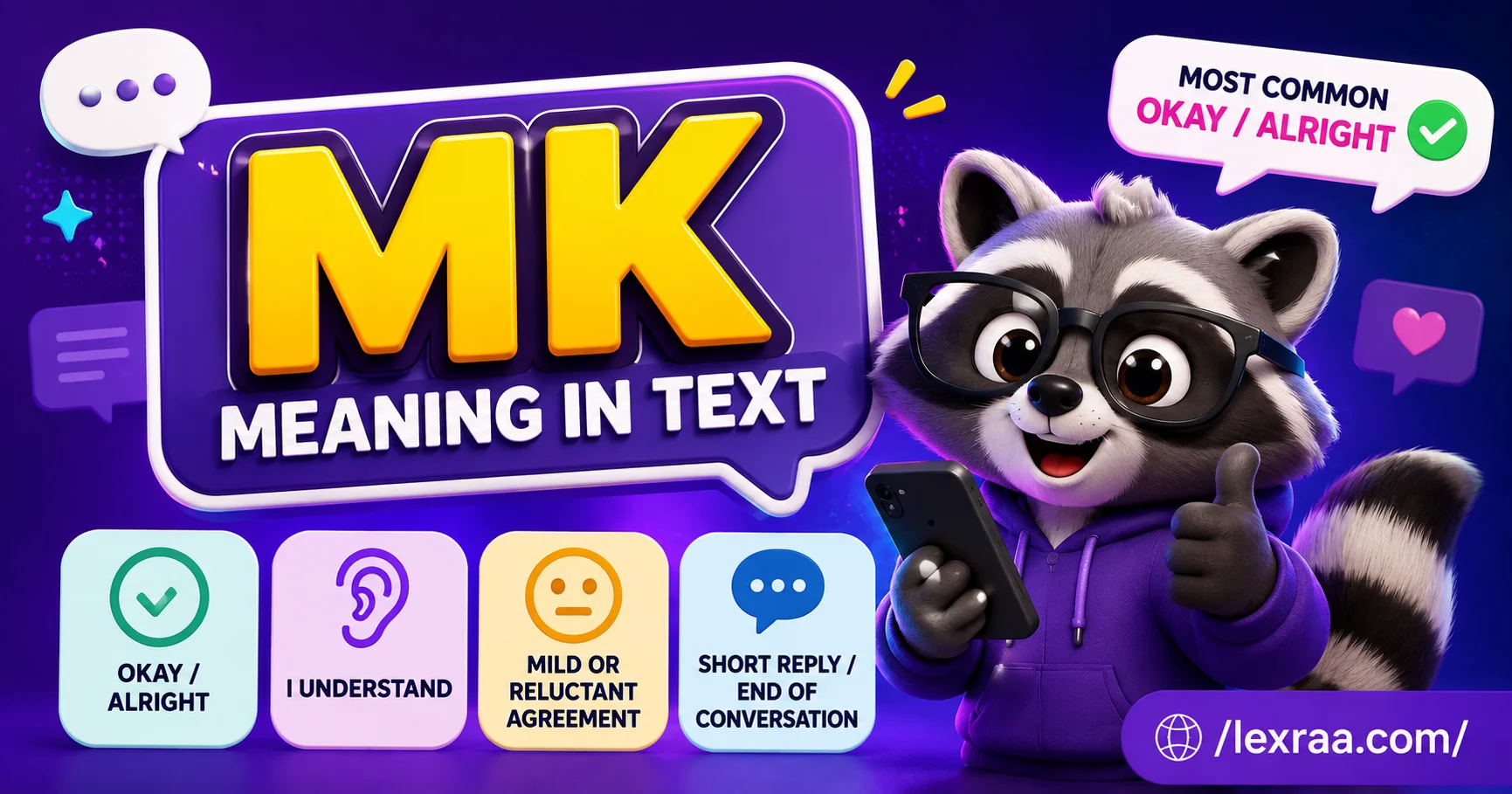
If someone texts you “mk,” it usually means “okay,” “alright,” or “mm-kay.” It is a short, informal acknowledgment, but depending on the conversation, it can sound neutral, reluctant, dry, or slightly dismissive.
What Does MK Mean in Text?
In everyday texting, MK is most commonly a shortened form of “okay” or “mm-kay.” Someone may use it to acknowledge what you said, agree to a plan, confirm that they understand, or simply close a conversation.
For example:
A: We’re meeting at 7 instead of 6.
B: mk
A: Cool, see you then.
Here, “mk” simply means “okay” or “got it.”
The tricky part is that the two letters do not communicate much emotion by themselves. A person who normally sends short replies may use “mk” without any negative intention, while someone who usually writes detailed messages may make the same reply feel unusually cold.
Current slang and texting references consistently describe “mk” as a shortened form of “okay” or “mm-kay,” with the surrounding context affecting its tone.
The Main Meanings of MK
1. Okay or Alright
This is the primary meaning in casual text conversations.
“mk” can simply acknowledge information without adding anything else.
“I’ll pick you up at 8.”
“mk.”
The response means something like “okay” or “alright.”
2. I Understand
Sometimes “mk” means that the sender has understood what you explained.
“The appointment moved to Thursday because the doctor is unavailable.”
“mk, thanks for letting me know.”
Here, there is little reason to interpret the reply negatively. It is simply an acknowledgment.
3. Mild or Reluctant Agreement
The same abbreviation can sometimes suggest “okay, fine” rather than enthusiastic agreement.
“Can we watch your movie tonight instead?”
“mk.”
The sender may be agreeing without sounding particularly excited.
That does not automatically mean they are angry. The surrounding conversation matters.
4. A Short Way to End the Conversation
A standalone “mk” can also function as a conversational stopping point.
If someone gives you a long explanation and you answer only “mk,” they may interpret it as “I heard you, but I don’t have anything else to say.”
That is why “mk” can sometimes feel colder than “okay.”
Is MK an Acronym or an Abbreviation?
In the texting sense, MK is better described as an informal abbreviation or shortened spelling rather than a conventional acronym.
It does not normally represent a phrase whose first letters form an acronym. Instead, “mk” is associated with spoken forms such as “m’kay,” “mm-kay,” or “mmkay,” which themselves represent a nasalized or drawn-out pronunciation of “okay.” Wiktionary lists mk among alternative forms of “m’kay.”
So when someone types:
mk
they generally are not decoding M + K into two separate words. They are using a compact spelling associated with “okay.”
Read More: What Does FFS Mean? Texting, Slang & Tone Explained
Why Can “MK” Sound Rude?
The meaning of “mk” usually stays the same, but its perceived tone can change dramatically.
Compare these:
“Okay 😊”
“mk :)”
“mk”
“mk.”
All four can communicate acknowledgment, but the emotional impression may differ.
A longer “okay” can feel clearer and more complete. A plain “mk” may feel detached because there is so little information attached to it. A period can make the response feel especially final in some conversations.
This does not create a universal rule. Some people naturally text in short fragments, so interpreting “mk” as anger or passive aggression without considering their normal texting style can lead to unnecessary misunderstandings.
How Context Changes the Meaning of MK
Friendly Context
A: I found those concert tickets!
B: mk niceee
A: I knew you’d be excited 😂
Here, the extra words make the tone clearly casual and positive.
Neutral Context
A: I’ll send the document tonight.
B: mk
A: Thanks.
This is simply acknowledgment.
Dry or Dismissive Context
A: I spent an hour explaining what happened.
B: mk
A: That’s all you have to say?
Here, “mk” may feel dismissive because the response is extremely short compared with the seriousness of the message.
Reluctant Context
A: You have to come with us tomorrow.
B: mk, fine
A: 😂 Don’t sound too excited.
The word still means “okay,” but the surrounding wording suggests reluctance.
Where Is MK Used?
“Mk” belongs primarily to informal digital conversation, especially text-style communication. Current online references commonly associate it with texting, chats, DMs, and social-media conversations. However, claims that it is specifically dominant on one particular platform are not supported by strong independent usage data, so it is better not to treat Snapchat, TikTok, Instagram, WhatsApp, or another platform as uniquely responsible for the expression.
In practical terms, you may encounter “mk” wherever people use casual written conversation:
- Text messages
- Private chats
- Group conversations
- Social-media DMs
- Informal online replies
Its use is more about communication style than about belonging to one specific app.
Where Did MK Come From?
The history requires a little caution.
The longer form “m’kay” or “mm-kay” is a spoken, nasalized variant of “okay.” Wiktionary describes it as a nasalized variant of “okay” and notes that earlier examples appear in linguistic transcriptions of speech. It also says the expression may have been popularized by the character Mr. Mackey in South Park.
That distinction matters because South Park did not necessarily invent “m’kay.” Rather, the character’s repeated catchphrase helped make the spelling and pronunciation highly recognizable in popular culture.
There is also evidence of “mk” being used as a shortened form of “umkay” in user-submitted slang records dating back to the early 2000s. That supports the connection between “mk” and “umkay/m’kay,” but it does not establish one exact person or platform as the inventor.
So the safest historical explanation is:
“M’kay” developed as a spoken variant of “okay,” while “mk” emerged as an abbreviated written form. Popular culture helped spread the longer form, but the exact moment when people began using the two-letter spelling is unclear.
8 Realistic MK Text Examples
1. Funny — Friends
Mia: I accidentally ordered 12 pizzas.
Alex: Twelve?!
Mia: I thought it said 2 😭
Alex: mk we’re having a party now.
Here, “mk” is playful acceptance of an absurd situation.
2. Sarcastic — Group Chat
Noah: Guys, the trip is definitely tomorrow.
Sam: You said that yesterday.
Noah: This time I checked the calendar.
Sam: mk, calendar king.
The “mk” signals acknowledgment while the following phrase adds sarcasm.
3. Playful — Dating
Ava: Don’t forget we’re getting coffee tomorrow.
Leo: mk, boss 😌
Ava: Good. I’m keeping you organized.
Leo: Apparently I need supervision.
Here, “mk” is clearly playful because of the added wording.
4. Serious — Family
Mom: Your appointment was moved to Friday morning.
Eli: Okay, what time?
Mom: 9:30.
Eli: mk, I’ll be ready.
The abbreviation is functioning as a straightforward acknowledgment.
5. Neutral — Coworkers
Jordan: I uploaded the revised spreadsheet.
Taylor: mk, I’ll check it after lunch.
Jordan: Sounds good.
Taylor: Thanks for fixing those numbers.
The context makes the response practical rather than emotional.
6. Dry — Friends
Chris: Are you still coming tonight?
Dylan: Yeah, probably around 9.
Chris: mk.
Dylan: Why does that sound angry?
Chris: It’s literally just mk 😂
This shows why short replies can be overinterpreted.
7. Reluctant — Family
Dad: You’re coming with us to the store.
Ryan: Do I have to?
Dad: Yes.
Ryan: mk, fine.
Here, “mk” is closer to “okay, fine” than enthusiastic agreement.
8. Casual — Group Chat
Lena: Movie starts at 8:15.
Max: Perfect.
Lena: Don’t be late this time.
Max: mk 😂
The emoji keeps the short reply from sounding overly serious.
How to Reply to MK
Neutral Reply
If you are unsure about the tone, simply continue the conversation normally.
“Okay, sounds good.”
This removes ambiguity without making the situation awkward.
Friendly Reply
“Mk 😄 see you then!”
Matching the casual style can work well with friends.
Funny Reply
If someone sends a dry “mk,” you can tease them lightly:
“Wow, such enthusiasm 😂”
This works when your relationship already allows playful teasing.
Serious Reply
If the conversation concerns something important and their response feels dismissive, ask directly:
“Just checking—are we good?”
That is better than guessing what the two letters mean.
Flirty Reply
If the conversation is already flirtatious, you can play with the shortness:
“Just ‘mk’? I expected a little more enthusiasm 😏”
Use this only when the existing conversation is clearly comfortable and playful.
MK vs. Similar Texting Replies
| Term | Meaning | Tone | Popularity | Confusion Risk |
|---|---|---|---|---|
| MK | Okay / mm-kay | Casual, sometimes dry | Common in informal chat | Medium |
| OK | Okay | Neutral/direct | Very common | Low |
| Okay | Agreement or acknowledgment | Clear, neutral | Very common | Very low |
| K | Okay | Often very brief or abrupt | Common | Medium |
| KK | Okay / okay, got it | Casual, friendly | Common in informal chat | Low |
| Nah | No / not really | Casual refusal | Very common | Low |
The important difference is that MK does not inherently mean “I’m annoyed.” A cold interpretation comes from context rather than from the letters themselves.
Who Uses MK in Text?
There is not strong evidence supporting a precise age, gender, or regional profile for people who use “mk.” Online slang references describe it across casual texting rather than limiting it to one demographic.
It is therefore safer to think of “mk” as a style-based abbreviation. Someone who prefers short, quick replies may use it frequently, while another person may always type “okay.”
Likewise, there is no good reason to assume that “mk” has one special meaning when sent by a particular gender. Claims that it specifically means someone is angry “when a girl sends it,” for example, come largely from user-submitted slang entries rather than reliable linguistic evidence.
Is MK Rude or Safe to Use?
MK is not inherently rude, offensive, or profane. It is generally harmless informal language.
The potential problem is tone, not the word itself.
In a casual conversation with a friend, “mk” may be perfectly normal. In a professional email, school assignment, formal request, or serious workplace discussion, writing “mk” can look overly casual or uninterested.
For formal situations, use clearer alternatives such as:
- “Okay, thank you.”
- “Understood.”
- “Sounds good.”
- “I understand.”
- “Thanks for confirming.”
These leave much less room for the recipient to wonder about your attitude.
Why MK Works So Well in Conversation
The usefulness of “mk” comes from how little it requires. Two letters can acknowledge a message without forcing the sender to repeat “okay,” while the surrounding context supplies most of the emotional information.
That economy is also what makes the abbreviation ambiguous. Because “mk” contains almost no emotional detail, readers often infer tone from punctuation, emojis, the previous message, and the sender’s normal habits. In other words, the abbreviation itself is simple; the interpretation is contextual.
Common Misunderstandings About MK
Does MK Always Mean Someone Is Annoyed?
No. MK usually just means “okay” or “mm-kay.” A dismissive interpretation is possible, but it depends on the conversation and the sender’s usual communication style.
Does MK Mean “I Don’t Care”?
Not necessarily. A person might use “mk” simply because they are busy, prefer short messages, or have nothing else to add.
If someone repeatedly gives very short responses during an emotional conversation, the overall pattern may suggest disinterest. But one “mk” is not enough evidence to make that conclusion.
Is MK the Same as Okay?
For most texting situations, yes. Both can acknowledge information or indicate agreement.
The difference is mostly style and tone. “MK” is more abbreviated and can therefore feel less warm or more casual than a full “okay.”
Is MK the Same as K?
Not exactly in perceived tone.
Both can be used as very short forms of acknowledgment, but “K” can sound especially abrupt to some readers. “MK” is often closer to “mm-kay” and may feel softer, though it can still sound dry depending on context.
Can MK Mean Something Else?
Yes, outside ordinary texting, MK can represent unrelated abbreviations or names. For example, slang references also document “MK” as an abbreviation for Mortal Kombat.
That is why context matters. If someone says “I’m playing MK tonight,” they are probably not telling you “I’m okay.”
Is MK a Gen Z Word?
It is used in contemporary casual texting, but calling it exclusively Gen Z would be too strong. The abbreviation is connected to older forms such as “m’kay” and has documented slang usage going back to the early 2000s.
Does MK Have a Secret Meaning in Relationships?
There is no universal secret relationship meaning. Depending on the conversation, it can be affectionate, neutral, reluctant, or dismissive.
If you’re trying to interpret a partner’s “mk,” look at what came before it and how that person normally texts rather than relying on a fixed slang definition.
Should I Use MK at Work?
Usually, it is better to avoid it in formal workplace communication. A simple “Okay,” “Understood,” or “Sounds good” communicates the same idea more clearly.
If your workplace chat is extremely informal, “mk” may be understood, but professionalism is generally better served by the clearer alternatives.
Final Takeaway
MK usually means “okay,” “alright,” “got it,” or “mm-kay” in casual text conversations. It is an informal abbreviation rather than a conventional acronym.
The important detail is that MK does not automatically mean someone is angry, rude, or uninterested. A standalone “mk” can feel dry because it is so short, but the real tone depends on the relationship, the preceding message, punctuation, emojis, and the sender’s normal texting habits.
The history of “mk” is also worth keeping precise: it is connected to spoken forms such as “m’kay,” a variant of “okay,” while popular culture—particularly South Park—helped make “m’kay” recognizable. The exact origin of the two-letter texting form itself is not firmly established.
So if you receive “mk,” don’t immediately assume there is an attitude behind it. In most cases, the safest first interpretation is simply:
“Okay.”