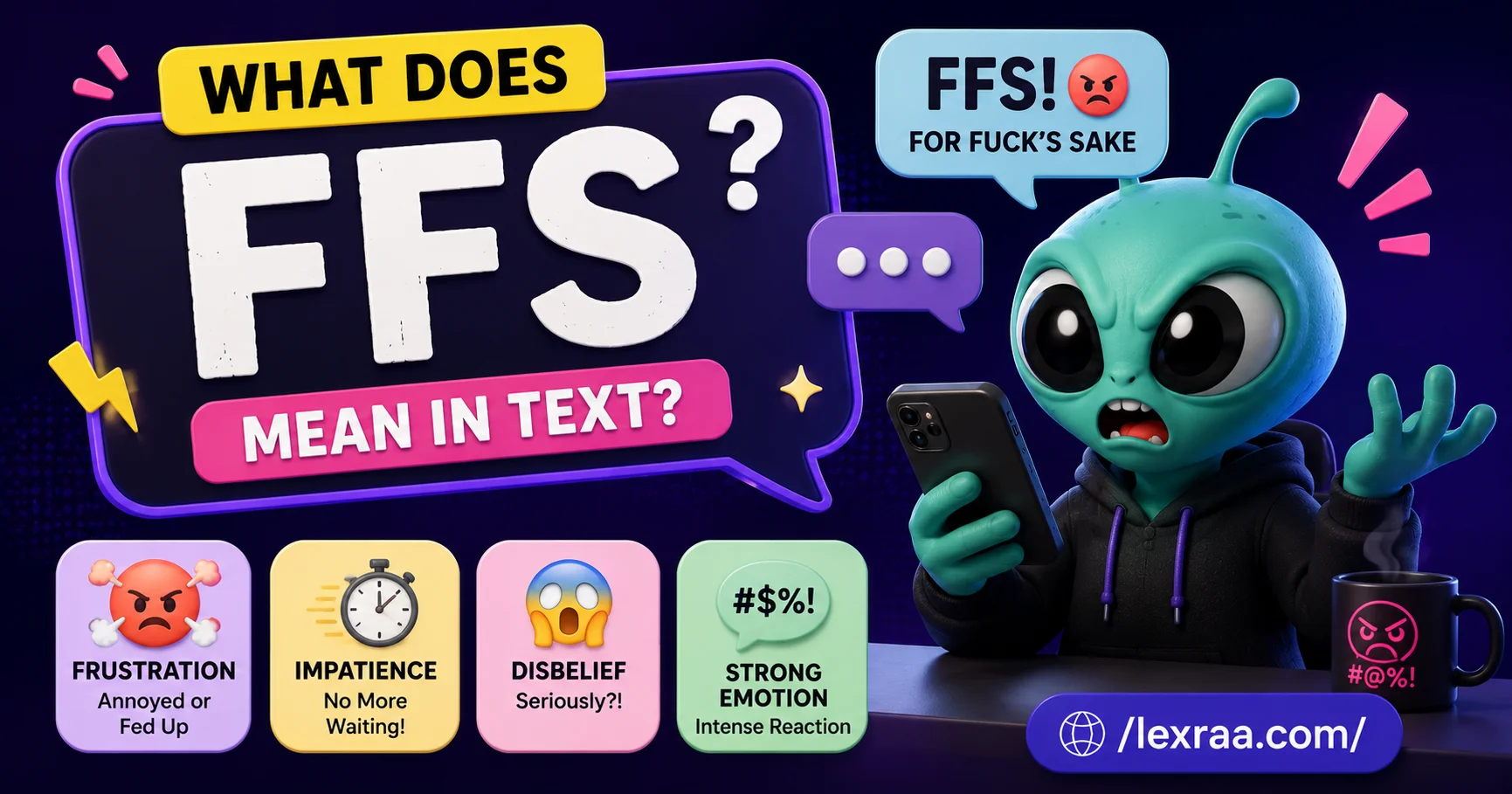
FFS usually means “for fuck’s sake” in texting, chats, and social media. It is an informal, profane expression used to show frustration, annoyance, impatience, disbelief, or exasperation.
What Does FFS Mean in Text?
In casual online communication, FFS is an initialism for “for fuck’s sake.” It works as an exclamation rather than as a normal noun or verb.
Someone might type “FFS” when something has gone wrong, someone is being frustrating, or a situation has become ridiculous. Depending on the context, it can communicate anything from mild annoyance to genuine anger.
For example:
“FFS, I forgot my keys again.”
The person is not necessarily furious. They may simply be annoyed with themselves.
Compare that with:
“FFS, I’ve told you three times already.”
Here, the same abbreviation carries considerably more irritation because it is directed at another person.
Cambridge Dictionary classifies FFS as an offensive written abbreviation and specifically describes it as something used when someone is annoyed or has lost patience. Collins likewise identifies it as slang used particularly in text messages and social media to indicate irritation.
Is FFS an Acronym or Abbreviation?
FFS is best described as an initialism or written abbreviation of “for fuck’s sake.”
The distinction matters because FFS is normally read as individual letters—F-F-S—rather than pronounced as a single word.
In everyday explanations, however, you may see websites casually call it an “acronym.” That wording is common in internet slang dictionaries, but initialism is the more precise linguistic description.
The lowercase form “ffs” means the same thing as uppercase “FFS.” Capitalization can sometimes make the message look more emphatic, but lowercase usage is extremely normal in casual texting.
The Main Meanings of FFS
Although FFS can have completely different meanings in specialized fields, the slang meaning is “for fuck’s sake.”
1. Frustration
This is probably the most straightforward use.
“FFS, the Wi-Fi is down again.”
The writer is frustrated because the same problem has happened repeatedly.
2. Annoyance
FFS can react to something that is simply irritating.
“He left the lights on again. FFS.”
The abbreviation expresses annoyance without requiring a long explanation.
3. Impatience
Someone may use FFS when they feel another person or situation is taking too long.
“Are we seriously still waiting? FFS.”
The message communicates, essentially, “Come on, this is taking forever.”
4. Disbelief or exasperation
FFS can also mean something closer to “I can’t believe this.”
“FFS, you deleted the entire folder?”
The writer is surprised and frustrated at the same time.
5. Playful or exaggerated frustration
Among people who know each other well, FFS does not always indicate serious anger.
“FFS 😂 You actually wore that to the party?”
The profanity can become part of a joking reaction. The laughing emoji changes how the message is likely to be interpreted.
That distinction is important: FFS describes an emotional reaction, but the seriousness depends on context.
FFS Can Mean Something Else
The slang interpretation is dominant in casual texting, but FFS is not exclusively an internet-slang abbreviation.
In professional, medical, technical, organizational, and other specialized contexts, FFS can represent unrelated terms. For example, fee-for-service is abbreviated FFS in healthcare and payment contexts, while other technical uses also exist.
So context matters.
If someone sends:
“FFS, this printer is broken again.”
they almost certainly mean “for fuck’s sake.”
But if a professional document repeatedly discusses healthcare payment arrangements and uses “FFS,” the intended meaning could be fee-for-service.
For a search such as “what does FFS mean in text?”, however, the slang meaning is the relevant one.
Read More: What Does TBF Mean? The Texting Meaning Explained
How FFS Is Used in Real Conversations
FFS usually appears where people are communicating quickly and informally.
Common situations include:
- reacting to an annoying mistake
- complaining about technology
- expressing disbelief
- reacting to repeated behavior
- joking about a frustrating situation
- showing impatience
- commenting on something ridiculous
It can appear at the beginning, middle, or end of a message.
Beginning:
“FFS, I missed the bus.”
Middle:
“Why does this app, ffs, keep crashing?”
End:
“I forgot the password again, ffs.”
Putting FFS at the end can make it feel more like an emotional afterthought—a written equivalent of sighing after saying the main sentence.
Example Conversations Using FFS
1. Funny — Friend Chat
Alex: Did you seriously lock your keys in the car again?
Sam: Unfortunately, yes.
Alex: FFS 😂
Sam: I prefer “consistently committed to the bit.”
Here, FFS is clearly playful rather than hostile because the surrounding exchange is humorous.
2. Sarcastic — Group Chat
Mia: The meeting has been moved to 7 a.m.
Noah: On Monday?
Mia: Yep.
Noah: FFS, love that for us.
The phrase expresses annoyance, but the sarcasm makes the message lighter.
3. Serious — Text Message
Jordan: I told him not to share the file.
Chris: He shared it anyway?
Jordan: With everyone.
Chris: FFS. That’s not okay.
Here, FFS signals genuine frustration rather than joking.
4. Playful — Dating
Lena: I accidentally ordered two desserts.
Mark: Two?
Lena: Don’t judge me.
Mark: FFS 😂 save one for me.
The expression is teasing and affectionate rather than aggressive.
5. Coworker Conversation
Daniel: The presentation file won’t open.
Priya: Again?
Daniel: Yep. Five minutes before the meeting.
Priya: FFS. Send me the backup.
This is an informal workplace conversation between people who are comfortable using profanity. It would not necessarily be appropriate in a formal email to management.
6. Family Chat
Mom: Who left the freezer door open?
Ben: Probably me.
Mom: The food is melting.
Ben: FFS, I’m sorry. I’ll fix it.
Here, FFS expresses frustration with the situation rather than disrespect toward the parent.
7. Gaming Chat
Kai: We were winning until you disconnected.
Leo: My internet died.
Kai: FFS 😭
Leo: I know, I know. I’m rebooting.
Gaming and other fast-paced online environments can make short emotional abbreviations especially convenient.
8. Social Media Reaction
Nina: Posted a photo of her new haircut.
Ella: Wait, you actually did it?
Nina: Yep.
Ella: FFS, it looks amazing 😂
This example shows how FFS can be used dramatically or jokingly rather than as a literal angry outburst.
How to Reply When Someone Says FFS
Your best response depends on whether the person sounds genuinely upset or is simply being dramatic.
If they’re seriously frustrated
Try:
“Yeah, I get why you’re annoyed.”
or:
“That’s frustrating. What happened?”
If they’re joking
You can match their humor:
“FFS indeed 😂”
or:
“You’ll survive.”
If you’re not sure
A neutral response is safer:
“What happened?”
That gives the other person a chance to explain without assuming they are angry.
If the conversation is playful
You can tease back:
“Drama level: FFS 😂”
Use this only when the relationship already supports that kind of humor.
FFS vs. Similar Expressions
| Term | Meaning | Tone | Popularity | Confusion Risk |
|---|---|---|---|---|
| FFS | For fuck’s sake; frustration/exasperation | Strong, irritated | High in informal contexts | Low |
| WTF | What the fuck; shock, confusion, disbelief | Strong, surprised | Very high | Medium |
| OMG | Oh my God; surprise or excitement | Mild to strong | Very high | Low |
| SMH | Shaking my head; disappointment/disbelief | Critical, disappointed | High | Medium |
| JFC | Jesus fucking Christ; strong disbelief/frustration | Very strong | Common online | Medium |
| Seriously? | Disbelief, annoyance, or challenge | Mild to moderate | Very high | Low |
The closest alternatives are not perfect substitutes.
FFS tends to emphasize frustration or exasperation.
WTF more strongly emphasizes shock, confusion, or disbelief.
OMG can express excitement as easily as surprise, so it is much broader.
SMH often communicates disappointment or disapproval rather than raw frustration.
JFC can overlap heavily with FFS but is generally at least as profane and can sound particularly intense.
There is no genuine single “opposite” of FFS. A phrase such as “no worries” can communicate calmness instead of frustration, but it is not a direct linguistic opposite.
Where Is FFS Used?
Reliable dictionary sources specifically document FFS in text messages, social media, and informal written communication.
It can therefore appear in casual digital conversations where profanity is acceptable.
Some internet slang references also document it in online gaming and other internet communities, but claims about one particular modern platform being the place where FFS “started” are much harder to establish.
It is better to describe FFS as established internet and texting slang than to claim it belongs exclusively to TikTok, Snapchat, Discord, or any other single platform.
Where Did FFS Come From?
There is no reliable evidence supporting the idea that FFS was invented on a particular modern social-media platform.
The underlying expression “for fuck’s sake” is older than internet slang. Its construction is associated with the family of exclamations built around expressions such as “for Christ’s sake” and “for God’s sake.” Wiktionary describes “for fuck’s sake” as being modeled on “for Christ’s sake.”
The abbreviated form belongs to the broader development of shorthand in digital communication. An Urban Dictionary entry for FFS was submitted in September 2002, providing evidence that the abbreviation was already being documented in online slang communities by that time.
That date should not be treated as the invention date. Online dictionary entries document usage; they do not necessarily establish when a term was first created.
So the safest conclusion is: the expression predates the abbreviation, and FFS became established as a convenient written shorthand in internet and text-based communication.
Who Uses FFS?
FFS is not restricted to one specific age group.
It is established enough in English-language informal communication to appear in dictionaries, social media, texting, and online communities.
Younger internet users may encounter it alongside other abbreviations such as WTF, OMG, and SMH, while older users who participate in online communication can use it as well.
There is not strong evidence that FFS is inherently associated with one gender or one particular region. Claims that it is exclusively “Gen Z slang” are therefore too narrow.
Is FFS Rude?
Yes, FFS is potentially rude because it abbreviates a phrase containing profanity.
Cambridge explicitly labels it offensive, while Collins describes the underlying expression as a taboo expression.
That does not mean every use is intended to insult someone.
There is a major difference between:
“FFS, my laptop crashed again.”
and:
“FFS, you’re completely useless.”
The first attacks a situation. The second can directly attack a person.
Is FFS Safe at Work?
Usually, no—not in formal workplace communication.
Even if your coworkers casually use profanity, writing FFS in a formal email, client message, application, report, or professional announcement can make you sound unprofessional.
For formal situations, use alternatives such as:
- “This is frustrating.”
- “Unfortunately, this happened again.”
- “Seriously?”
- “That’s disappointing.”
- “I’m having trouble with this.”
Is FFS Safe for School?
It is generally better to avoid FFS in school assignments, presentations, formal messages to teachers, and academic writing because the abbreviation represents profanity.
It may appear in a private conversation with friends, but context and school rules still matter.
Why Does FFS Work So Well in Texting?
FFS is effective because it compresses a large emotional reaction into three letters.
Instead of typing “I am extremely frustrated that this has happened again,” someone can write:
“FFS.”
The recipient immediately understands that the writer has reached a low point in their patience.
That makes FFS more than simple shorthand. It functions almost like a digital sigh or exasperated reaction. The surrounding context determines whether that reaction is angry, sarcastic, dramatic, or funny.
This emotional flexibility is one reason the abbreviation continues to work even when people already know what the letters stand for.
Common Mistakes With FFS
Assuming it always means serious anger
It doesn’t.
Friends can use FFS jokingly, especially with emojis or exaggerated situations.
Treating it as completely harmless
It isn’t. The abbreviation hides the profanity, but the profanity is still understood.
Using it in formal writing
A professional reader may interpret FFS as inappropriate even if you intended it casually.
Assuming every FFS has the same tone
Context changes everything. “FFS 😂” and “FFS, stop doing that” can communicate very different emotions.
Assuming TikTok invented it
There is no good evidence for that. The abbreviation was already documented online by 2002, long before TikTok existed.
Frequently Asked Questions
What does FFS mean in a text message?
FFS usually means “for fuck’s sake.” It is used to express frustration, annoyance, impatience, disbelief, or exasperation. The exact emotional intensity depends on the surrounding conversation.
Is FFS a swear word?
FFS itself is an abbreviation, but it represents a phrase containing a swear word. That is why dictionaries classify it as offensive or vulgar slang. Hiding the profanity behind initials does not make it fully appropriate for formal situations.
Does FFS mean “for fuck’s sake” or something else?
In texting and casual online communication, “for fuck’s sake” is the main meaning. FFS can represent unrelated technical or professional terms in other contexts, including “fee-for-service.” Always use the surrounding subject matter to determine which meaning applies.
Can FFS be used jokingly?
Yes. Friends sometimes use FFS as an exaggerated reaction to something funny, inconvenient, or ridiculous. An emoji, playful wording, or an obviously minor problem can make the humorous intent clear.
What does “ffs 😂” mean?
“Ffs 😂” usually combines frustration or disbelief with humor. The laughing emoji suggests that the writer may not be genuinely angry. It can be roughly understood as “Seriously, this is ridiculous 😂.”
Is FFS offensive?
It can be. The expression contains profanity, and dictionaries identify FFS as an offensive or taboo slang abbreviation. Whether it actually offends someone depends on the relationship, setting, and wording around it.
Is FFS appropriate for work?
It is generally better to avoid it in formal professional communication. Even in a relaxed workplace, consider whether the recipient is comfortable with profanity before using it. A phrase such as “That’s frustrating” communicates the same basic emotion without the risk.
Is FFS the same as WTF?
Not exactly. FFS primarily expresses frustration or exasperation, while WTF more often expresses shock, confusion, or disbelief. They can overlap, but they are not interchangeable in every conversation.
Final Takeaway
FFS means “for fuck’s sake” in texting and internet slang. It is an initialism used to show frustration, impatience, annoyance, disbelief, or exasperation. Depending on context, it can sound genuinely angry or completely playful.
The safest way to interpret FFS is to look at what happened, who wrote it, and what surrounds the abbreviation. “FFS 😂” from a close friend may be playful, while “FFS, I’ve told you already” is much more confrontational.
Use it when the conversation is clearly informal and profanity is acceptable. Avoid it in formal work, school, customer-facing, or unfamiliar settings. And remember that although FFS is strongly associated with internet communication today, the underlying expression is considerably older, and the abbreviation was already being documented online by the early 2000s.