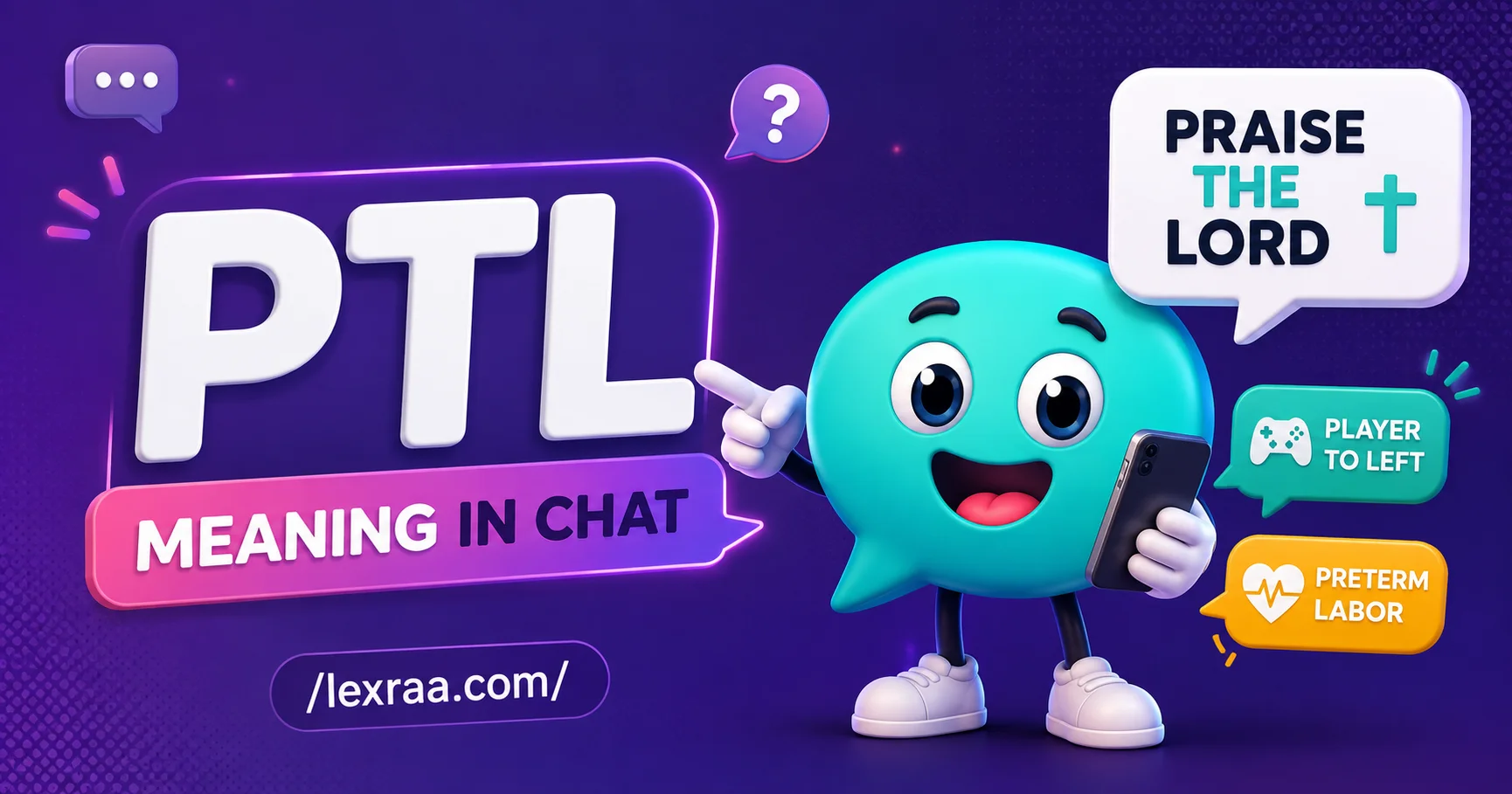
PTL usually means “Praise the Lord” in chat and texting. It is an abbreviation used to express gratitude, relief, happiness, or thankfulness, often in a Christian or faith-based context.
For example:
“I finally passed my exam. PTL!”
Here, PTL expresses relief and gratitude. Depending on the person and context, it can be a sincere reference to praising God or a more casual equivalent of “Thank God” or “Thank goodness.”
There are other meanings of PTL outside ordinary conversation—including “player to left” in gaming or poker contexts and several technical meanings—but “Praise the Lord” is the meaning most relevant to ordinary chat and texting.
What Does PTL Stand For?
PTL = Praise the Lord.
It is an acronym/abbreviation, rather than a standalone slang word.
Each letter represents a word:
- P = Praise
- T = The
- L = Lord
In Christian usage, “the Lord” generally refers to God. Someone writing PTL! is therefore expressing praise or gratitude toward God.
The abbreviation is particularly associated with informal religious communication. PC.net classifies PTL as an online acronym used in chat, messaging, and email and notes its use in church circles to give thanks to God.
What Does PTL Mean in Chat?
In a chat, PTL normally communicates a positive reaction.
It can express:
- gratitude
- relief
- happiness
- thankfulness
- celebration after good news
- appreciation for something going well
Consider:
Friend: The surgery went well.
You: PTL 🙏
The sender isn’t simply saying “good.” They are expressing relief and gratitude, with a religious dimension.
But context matters. Someone may write:
“PTL, my Wi-Fi is finally working.”
In that setting, the phrase can function almost like “Thank goodness!” The person may still intend the religious meaning, or they may be using the expression casually.
You should therefore avoid assuming that every use has exactly the same level of religious seriousness.
Is PTL Slang or an Acronym?
PTL is better described as an abbreviation or acronym used in informal communication than as conventional slang.
It can behave like slang because people use it casually in texts, comments, and messages. However, the expression itself comes directly from the ordinary religious phrase “Praise the Lord.”
CyberDefinitions lists “Praise the Lord” as the main meaning of PTL in texting and describes it as an abbreviation.
That distinction matters because PTL is not a newly invented word with a mysterious internet definition. It is a shortened form of an existing phrase.
The Main Meaning: “Praise the Lord”
The most established chat meaning is straightforward:
PTL = Praise the Lord
It can appear after something positive happens:
“I got the job, PTL!”
Or after a worrying situation ends well:
“Everyone made it home safely. PTL.”
Or when someone wants to share good news with a faith-oriented audience:
“PTL for the answered prayers!”
The phrase can therefore combine emotion + gratitude + faith in just three letters.
That is why it can feel stronger than a simple “yay” or “nice.”
Can PTL Mean “Thank God” or “Thank Goodness”?
Sometimes, yes—but this needs a little nuance.
“Praise the Lord” is the literal expansion of PTL. In casual contexts, the expression can function similarly to “Thank God” or “Thank goodness,” especially when someone is reacting to relief or good fortune. Current explanations of PTL commonly describe this emotional use as gratitude or relief.
For example:
“PTL, I thought I lost my wallet!”
The speaker may genuinely be expressing religious gratitude, or they may simply be using PTL as a familiar expression of relief.
The surrounding conversation and the sender’s normal language are the best clues.
Is PTL Always Religious?
No—not necessarily.
The phrase has an explicitly religious origin and remains strongly associated with Christianity. However, its use in informal conversation can vary.
Compare:
“PTL for answered prayers.”
This is clearly religious.
Now:
“PTL the internet is back.”
This could be religious, humorous, exaggerated, or simply an informal expression of relief.
This is one of the most useful distinctions when interpreting PTL. The abbreviation doesn’t tell you exactly how seriously religious the sender intends it to be.
If you’re unsure, don’t automatically assume either extreme.
PTL vs. “Thank God”
These expressions can overlap, but they are not identical.
| Term | Basic Meaning | Tone | Typical Context | Confusion Risk |
|---|---|---|---|---|
| PTL | Praise the Lord | Religious / grateful | Faith-based chats, informal messages | Low |
| Thank God | Express relief or gratitude to God | Religious or casual | General conversation | Low |
| Thank goodness | Express relief | Casual, nonreligious | Everyday conversation | Low |
| Hallelujah | Praise or joyful celebration | Religious / dramatic | Faith or celebration | Medium |
| TY | Thank you | Neutral | Any casual message | Low |
| OMG | Oh my God | Emotional / casual | Texts and social media | Medium |
The key distinction is that PTL specifically expands to “Praise the Lord.”
“Thank goodness” has no necessary religious meaning.
PTL vs. OMG
People sometimes notice PTL and OMG together because both are short expressions involving emotion and religious language.
But their functions are different.
PTL normally expresses praise, gratitude, or relief.
OMG is generally an exclamation of surprise, shock, excitement, disbelief, or frustration.
For example:
“PTL, I passed!”
expresses gratitude or relief.
“OMG, I passed!”
expresses surprise or excitement.
The two can even appear together:
“OMG I passed! PTL 😭🙏”
The first expresses the emotional reaction; the second adds gratitude or praise.
PTL vs. Hallelujah
Hallelujah and PTL are closer in meaning because both can express praise.
“Hallelujah” is an established religious expression meaning praise the Lord, while PTL is simply an abbreviated form of “Praise the Lord.”
In everyday messaging, “PTL” may feel quicker and more conversational:
“PTL! Everything worked out.”
“Hallelujah!” can sound more expressive or celebratory:
“Hallelujah! We finally made it!”
The exact tone depends on the speaker.
Are There Other Meanings of PTL?
Yes. PTL is not exclusive to “Praise the Lord.”
This is where context becomes important.
Slang.net lists “Player to left” as another meaning used in online gaming and card-game discussions. In that context, PTL refers to the player positioned immediately to a person’s left.
All Acronyms also lists meanings such as “Preterm Labor,” “Player To My Left,” and “Passion Tea Lemonade,” among other specialized expansions.
These should not be mixed into an ordinary texting explanation.
If someone writes:
“PTL, we got the good news!”
“Praise the Lord” is the obvious interpretation.
If someone in an online poker discussion says:
“My PTL is betting aggressively.”
“Player to left” may be the intended meaning.
The surrounding topic tells you which expansion makes sense.
PTL in Gaming and Poker
The “player to left” meaning deserves separate attention because it can look identical to the religious abbreviation.
In poker or other games where player positions matter, PTL can refer to the person sitting or positioned to a player’s left. Slang.net specifically documents this use in online poker and other games where seating order matters.
For example:
“My PTL keeps raising.”
That sentence has nothing to do with religion.
If you saw it inside a poker conversation, interpreting PTL as “Praise the Lord” would make little sense.
This is a good reminder that acronyms cannot always be decoded without context.
Where Is PTL Used in Chat?
PTL has documented use in texting, online chat, messaging, and email, particularly among religious or Christian communities. PC.net and NetLingo both identify it as online text-message shorthand.
Current slang references also describe PTL in social-media contexts. However, evidence is stronger for general digital communication than for claiming that PTL is uniquely associated with one specific platform.
So it is reasonable to encounter it in:
- private texts
- group chats
- online communities
- faith-based discussions
- social-media posts
- comments
- emails
Claims that PTL is specifically a TikTok-only, Snapchat-only, or Gen-Z-only expression would be too narrow.
What Is the Origin of PTL?
The phrase “Praise the Lord” has a long Christian and biblical history, so PTL did not originate as modern internet slang.
The exact point when people first began shortening the phrase specifically to PTL is less clear. It is safer to say that the abbreviation developed as a shorthand for an already-established religious expression rather than claim that one person invented it for texting.
There is also an important piece of documented history involving The PTL Club, a Christian television program associated with Jim and Tammy Faye Bakker.
The South Carolina Encyclopedia explains that the PTL Club began in the 1970s and that PTL stood for both “Praise the Lord” and “People That Love.”
Christianity Today reported in 1978 that when Bakker launched PTL, the initials stood for “Praise the Lord,” and that the meaning was later changed to “People That Love.”
The PTL Club became a major televangelism operation in the 1970s and 1980s.
So while The PTL Club did not invent the phrase “Praise the Lord,” its widespread use of the initials made PTL particularly recognizable in American Christian media.
A Historical Twist: “Pass the Loot”
There is another interesting historical detail, but it should not be mistaken for the normal meaning of PTL.
During controversies surrounding the PTL Club, critics used the sarcastic phrase “Pass the Loot” as a play on “Praise the Lord.” Contemporary reporting from UPI documented critics using that expression in the early 1980s.
That was a critical nickname/pun, not the ordinary meaning of PTL in texting.
It is therefore misleading to tell someone:
“PTL means Pass the Loot.”
It doesn’t in normal chat.
If you encounter “Pass the Loot,” the phrase is historical commentary or criticism connected to the PTL Club rather than standard texting slang.
How People Use PTL in Real Conversations
1. Genuine Religious Gratitude
A: The doctors said everything looks good.
B: PTL!
A: We were so worried.
B: I’m really thankful to hear that.
This is a sincere faith-based use.
2. Relief
A: Did you find your passport?
B: Yes! It was in my desk drawer.
A: PTL 😂
B: Seriously. I was panicking.
Here, PTL expresses relief.
3. Celebrating Good News
A: I got accepted!
B: PTL 🙏
A: I can’t believe it.
B: You earned it!
This use combines celebration and gratitude.
4. Family Group Chat
Mom: Everyone arrived safely.
Dad: PTL.
Daughter: ❤️🙏
Mom: Thank you all for checking in.
The religious meaning is especially natural in a family or faith-oriented conversation.
5. Playful Use
A: The Wi-Fi finally came back.
B: PTL 😭
A: We survived.
B: Barely.
Here, the expression is being used dramatically for something relatively ordinary.
6. Sarcastic
A: The meeting got canceled.
B: PTL 😂
A: Best news I’ve heard all week.
B: Same.
The speaker isn’t necessarily making a serious theological statement. PTL adds exaggerated relief.
7. Serious Faith Context
A: How did the treatment go?
B: Much better than expected.
A: PTL. I’ll keep praying for you.
B: Thank you. That means a lot.
This is clearly more personal and religious than the Wi-Fi example.
8. Dating/Flirty Context
A: I finally finished that huge assignment.
B: PTL 😂
A: Now I can actually talk to you.
B: That’s the real blessing, apparently.
The abbreviation itself isn’t flirty; the surrounding conversation creates that tone.
How Should You Reply to PTL?
Your response should match the sender’s tone.
If You Share the Religious Context
“Amen! 🙏”
or:
“Absolutely. So grateful.”
If You’re Not Religious
You can respond neutrally:
“I’m glad everything worked out!”
You don’t need to repeat a religious expression just because the other person used one.
If the Message Is Casual
“Seriously! What a relief.”
If It’s Good News
“That’s amazing! Congratulations!”
If the Sender Is Being Playful
“😂 Finally!”
If It’s Flirty
“Looks like we both have something to celebrate 😉”
A good response acknowledges the emotion without necessarily copying the exact wording.
Is PTL Rude or Offensive?
PTL is generally not rude or offensive.
It is a religious expression associated primarily with Christian language, so the main consideration is context and audience rather than profanity or offensiveness.
Among people who regularly use Christian expressions, PTL can feel completely natural.
In a mixed workplace group chat, however, a more neutral phrase such as “That’s great!” or “What a relief!” may be clearer and less likely to introduce an unexpected religious tone.
That doesn’t mean PTL is inappropriate. It simply means that audience matters.
Who Uses PTL?
There is stronger evidence connecting PTL with Christian and religious communities than with a particular age group.
Some recent slang sites describe PTL as something used by teenagers and adults, but there is no strong evidence that it belongs exclusively to Gen Z or Millennials. CyberDefinitions, for example, lists both adults and teenagers as typical users.
The more reliable distinction is community and context, not age.
Someone active in a Christian community may recognize PTL immediately, regardless of whether they’re 20 or 60.
Someone unfamiliar with Christian texting shorthand may have no idea what it means, regardless of age.
Why PTL Sticks in Conversation
PTL works because it compresses a complete emotional reaction into three letters.
Instead of writing:
“I’m really relieved and grateful that everything turned out well, and I want to give thanks to God.”
someone can simply write:
“PTL!”
That makes it particularly effective in quick messages.
It also carries more cultural information than a generic “yay.” When someone uses PTL sincerely, they are not merely describing an emotion—they are identifying the source of their gratitude as God.
At the same time, the expression is flexible enough to be used casually or humorously in some conversations. That combination of brevity, emotion, and cultural meaning helps explain why the abbreviation remains recognizable even though it is much less universal than texting terms such as LOL or IDK.
PTL Compared With Similar Expressions
| Term | Meaning | Tone | Popularity | Confusion Risk |
|---|---|---|---|---|
| PTL | Praise the Lord | Religious / grateful | Moderate | Low |
| TY | Thank you | Neutral | Very high | Low |
| OMG | Oh my God | Emotional / casual | Very high | Medium |
| TG | Thank God | Casual / grateful | Moderate | Medium |
| Hallelujah | Praise / joyful celebration | Religious / expressive | Moderate | Low |
| Whew | Expression of relief | Casual | High | Low |
There is no perfect opposite of PTL because its function is an expression of praise or gratitude rather than a simple yes/no concept.
Common Mistakes With PTL
Assuming It Always Means “Thank God”
That can capture the emotional function, but the literal expansion is “Praise the Lord.”
Assuming It Is Always Serious
Context can make PTL playful or exaggerated:
“PTL, the printer works again 😂”
Assuming It Is TikTok Slang
PTL is broader than any single social platform. It is documented as online shorthand across messaging and other digital communication.
Ignoring Context
If you’re reading a poker discussion, PTL may mean “player to left.”
Treating “Pass the Loot” as the Normal Definition
That expression was a historical criticism of the PTL Club, not the standard meaning of PTL in texting.
FAQ
What does PTL mean in a text message?
PTL most commonly means “Praise the Lord.” It is used to express gratitude, relief, happiness, or praise, particularly in Christian or faith-based communication. In some casual conversations, it can function similarly to “Thank God” or “Thank goodness.”
Is PTL a religious abbreviation?
Yes, its primary meaning in chat is religious. “Praise the Lord” refers to praising or thanking God, and the abbreviation is especially associated with Christian communication. However, some people use it more casually as an expression of relief.
What does PTL mean on social media?
On social media, PTL generally has the same meaning: “Praise the Lord.” It can appear in captions, comments, or replies when someone is celebrating good news, expressing gratitude, or reacting to something that worked out well. The exact frequency varies by community and platform.
Does PTL mean “thank goodness”?
It can serve a similar purpose, especially when someone uses it casually to express relief. However, “Praise the Lord” is the actual expansion of PTL, so it can carry a more explicitly religious meaning than “thank goodness.”
What does PTL mean in gaming?
In some gaming and poker contexts, PTL can mean “player to left.” Slang.net documents this meaning for online card games where player positions matter. The surrounding gaming context makes this meaning distinguishable from “Praise the Lord.”
Is PTL appropriate to use at work?
It depends on the workplace and audience. In a faith-oriented workplace or a conversation where religious language is already normal, it may be perfectly natural. In a formal or mixed professional setting, a neutral phrase such as “That’s wonderful” or “What a relief” may communicate the same emotion more universally.
Is PTL still used?
Yes, PTL remains documented as an online abbreviation for “Praise the Lord.” It is not as universally common as major texting abbreviations such as LOL or IDK, but it continues to appear in religious and informal digital communication.
Did PTL originate with the PTL Club?
No. “Praise the Lord” is an older religious expression, and the PTL Club adopted those initials in the 1970s. The South Carolina Encyclopedia documents the PTL Club’s use of both “Praise the Lord” and “People That Love,” but that does not make the television program the origin of the underlying phrase.
Final Takeaway
The simplest answer to “PTL meaning in chat” is:
PTL = “Praise the Lord.”
In messages, it usually expresses gratitude, relief, happiness, or praise, especially when something positive has happened. It can be sincerely religious, but context can also make it a casual or playful expression similar to “Thank God” or “Thank goodness.”
PTL is an abbreviation/acronym rather than ordinary slang, and its use is not restricted to one age group or social-media platform. It is particularly associated with Christian communication, while other meanings exist in specialized settings such as online poker, where PTL can mean “player to left.”
Its history is also older and more interesting than modern texting alone. The phrase “Praise the Lord” predates internet communication, while the initials gained additional public visibility through the PTL Club in the 1970s and 1980s.
So when you see:
“I got the job. PTL! 🙏”
the most likely interpretation is simply:
“I got the job. Praise the Lord!”
And when the context is ordinary chat, that’s the meaning to check first.