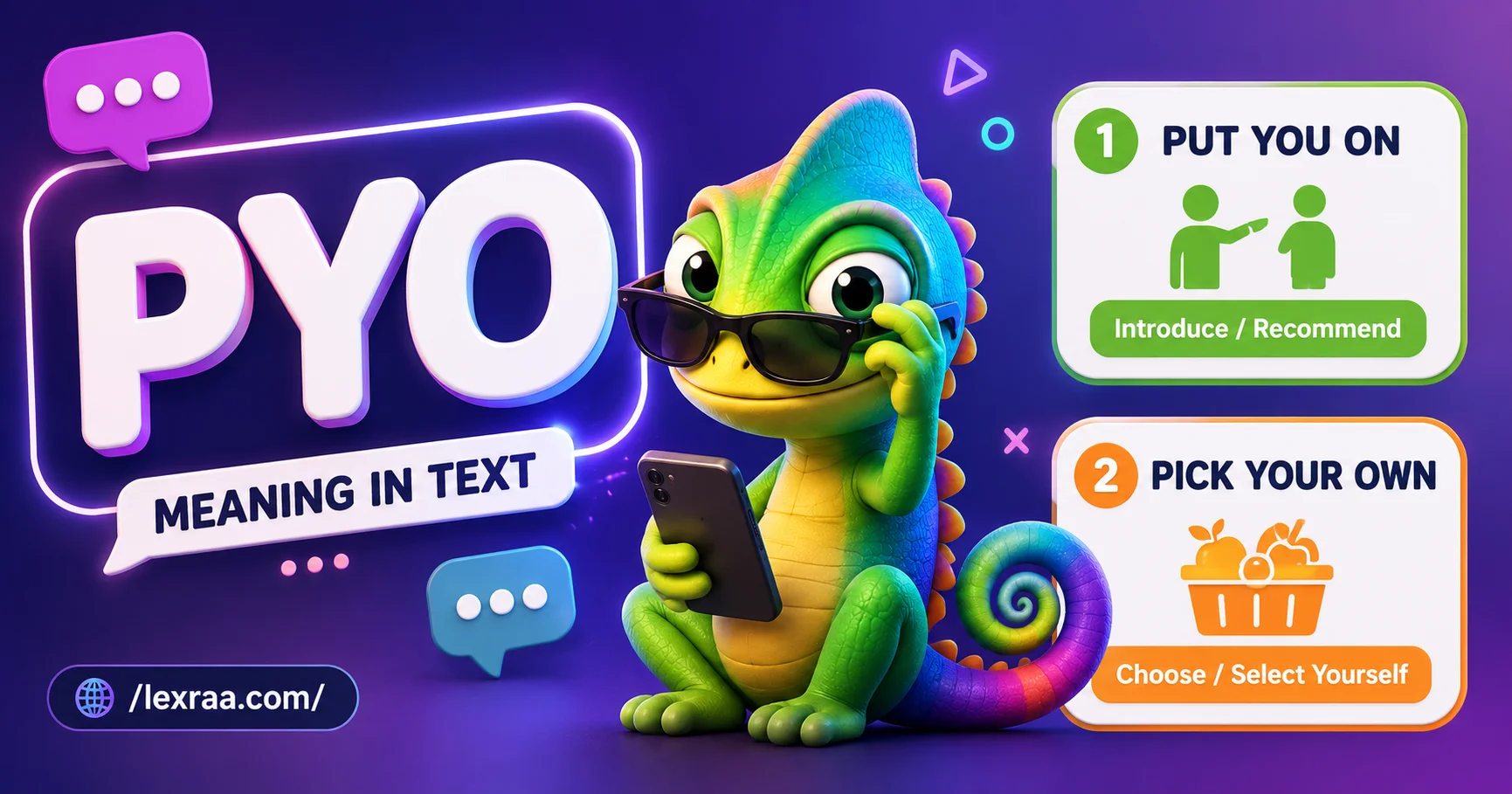
PYO most commonly means “Put You On” in casual texting when someone wants to introduce you to something, recommend something, or share something they think you should know about. For example, “Lemme PYO to this artist” means “Let me put you on to this artist.”
But PYO has another well-established meaning: “Pick Your Own.” That version is especially common around farms, food, menus, and situations where people choose something themselves. Cambridge Dictionary, for example, defines PYO as an abbreviation for “pick your own,” particularly on signs at farms where customers pick fruit or vegetables themselves.
That creates an important distinction: if you’re asking about PYO meaning in text or slang, “Put You On” is the interpretation to consider first. If the message is about choosing something, “Pick Your Own” may make much more sense.
What Does PYO Mean in Text?
In casual texting, PYO = “Put You On.”
“Put you on” means to introduce someone to something they may not know about, recommend something, or give them access to information or an opportunity.
A friend might say:
“Lemme PYO to this new artist.”
They mean:
“Let me introduce you to this artist.”
The thing being shared could be almost anything:
- a song
- an artist
- a restaurant
- a movie
- a clothing brand
- a creator
- a game
- an app
- a useful tip
- an opportunity
- a person or connection
The underlying idea is simple: “I know about something you might like, and I’m going to show you.”
Several current slang references consistently identify “Put You On” as a texting interpretation, while older user-generated entries show the phrase being used in this sense years before the recent wave of SEO articles about PYO.
Is PYO Slang or an Abbreviation?
PYO is best described as an informal texting abbreviation or initialism when it represents “Put You On.”
It isn’t really a standalone English word. Instead, the three letters compress a phrase that people already use in speech.
This is similar to how other texting shortcuts reduce longer expressions. The difference is that PYO can be particularly confusing because the same three letters already have an established non-slang meaning: “Pick Your Own.”
So PYO has two different layers:
PYO → Put You On → informal slang
PYO → Pick Your Own → established abbreviation
That is why the sentence surrounding PYO matters more than the letters themselves.
What Does “Put You On” Actually Mean?
“Put you on” can mean more than simply recommending something.
At its simplest, it means introducing someone to something they weren’t familiar with.
For example:
“You haven’t heard this singer? I’m about to PYO.”
The speaker is offering a recommendation.
But the expression can also carry a sense of sharing knowledge or giving someone access.
Someone might say:
“I’ll PYO to a good mechanic.”
That means they can connect the person with a useful resource.
The phrase can even be used when introducing people:
“I can PYO to my friend who works there.”
Here, the speaker is offering a connection rather than a song or product.
A contemporary AAVE glossary specifically records “let me put you on” as a term for recommending something, while slang references document the expression in recommendation and connection contexts.
What Does “Lemme PYO” Mean?
“Lemme PYO” usually means “Let me put you on.”
It is often followed by “to” when the person is introducing you to something.
For example:
“Lemme PYO to this playlist.”
means:
“Let me introduce you to this playlist.”
Or:
“Lemme PYO to a good pizza spot.”
means:
“Let me recommend a good pizza place.”
The phrase has a naturally conversational feel because “lemme” itself is an informal shortening of “let me.”
PYO Can Also Mean “Pick Your Own”
This is not merely a secondary slang guess. “Pick Your Own” is a long-established meaning of PYO.
Cambridge Dictionary defines PYO as an abbreviation used on signs outside farms where customers pick their own fruit and vegetables.
Examples include:
“PYO strawberries”
“PYO pumpkins”
In these cases, PYO means you choose and pick the items yourself.
The same idea can extend into other contexts involving personal selection or customization, although the farm-related use is the clearest dictionary-supported example.
So if a message says:
“PYO strawberries this weekend?”
the likely meaning is Pick Your Own, not “Put You On.”
Put You On vs. Pick Your Own
These two meanings can sound completely different once you look at the surrounding words.
| Expression | Meaning | Tone | Popularity | Confusion Risk |
|---|---|---|---|---|
| PYO | Put You On | Casual, helpful | Niche | High |
| PYO | Pick Your Own | Neutral / practical | Established | High |
| Put me on | Recommend something | Casual | Common phrase | Medium |
| Rec | Recommendation | Casual | Common | Low |
| Choose | Select an option | Neutral | Very common | Low |
| LMK | Let me know | Casual | Very common | Low |
| Gatekeep | Keep a discovery secret | Playful / negative | Common online | Medium |
The quickest distinction is this:
If PYO is about discovering something → “Put You On.”
If PYO is about selecting something → “Pick Your Own.”
For example:
“PYO to this rapper.”
is a recommendation.
But:
“PYO strawberries.”
is a selection activity.
How to Tell Which PYO Meaning Someone Intended
Don’t try to decode PYO in isolation. Look at the verb pattern and topic around it.
When It Means “Put You On”
Look for language involving:
- music
- shows
- food recommendations
- fashion
- creators
- apps
- trends
- information
- connections
Examples:
“Lemme PYO to this song.”
“I gotta PYO to this restaurant.”
“She PYO me to that brand.”
These all involve introducing or recommending something.
When It Means “Pick Your Own”
Look for:
- fruit
- farms
- toppings
- choices
- customization
- selecting items
For example:
“PYO strawberries.”
The topic immediately points toward Pick Your Own.
A useful rule is to ask: Is the sender sharing something with you, or asking you to choose something?
Sharing points toward “Put You On.”
Choosing points toward “Pick Your Own.”
Is PYO Used on TikTok and Instagram?
There is evidence of the “Put You On” usage being discussed in online slang communities and current social-media-oriented explanations, including references to TikTok and Instagram. However, the evidence is not strong enough to claim that PYO is a universally established TikTok- or Instagram-specific abbreviation.
That distinction matters.
You may encounter:
“PYO to this sound.”
in a social-media context, where the intended meaning is clearly “put you on.”
But it would be inaccurate to say that PYO has a special meaning unique to TikTok.
The same slang interpretation can appear in ordinary texting, DMs, group chats, and other informal online spaces.
Is There Real Evidence That PYO Means “Put You On”?
Yes, although it is better described as niche internet slang rather than universally recognized texting shorthand.
User-generated slang entries document “PYO” meaning “Put You On” in examples dating back to 2016, 2019, and 2021. Those examples include telling someone a story, introducing someone to another person, and recommending something.
There are also real online discussions in which people ask what “lemme PYO” means, although those discussions show that the abbreviation is not universally understood, even among native English speakers.
That mixed recognition is important. If you send PYO to someone who doesn’t know the abbreviation, they may genuinely have no idea what you mean.
Where Did PYO Come From?
There is no well-established documented origin for the three-letter texting abbreviation itself.
That is worth stating plainly because several online articles present confident explanations without providing evidence for a specific inventor, first post, or exact date.
The underlying phrase “put someone on” is much older than modern texting. It has also had several meanings over time. Collins, for example, records “put someone on to” in American English as an informal expression meaning to inform someone about something.
The modern slang sense of “put you on” as introducing someone to something is documented in user-generated slang sources and AAVE-oriented language resources. An AAVE glossary explicitly gives “let me put you on” as a phrase for recommending something.
However, that does not prove that the PYO abbreviation itself originated in AAVE or that one particular community invented the three-letter form.
The safest conclusion is:
The phrase “put you on” predates PYO, while the exact origin of shortening it to PYO is unclear.
Is “Put You On” an AAVE Expression?
The modern recommendation sense is documented in AAVE-related language resources, including an AAVE glossary that defines “let me put you on” as recommending something.
At the same time, the broader phrase “put someone on” has multiple older English meanings, including teasing or fooling someone. Cambridge and Collins both document those other meanings.
So it would be too simplistic to say:
“PYO was invented by AAVE.”
There isn’t enough reliable historical evidence to establish that claim about the abbreviation itself.
A more accurate statement is that the modern slang sense of “put you on” is associated with informal speech and is documented in AAVE-related resources, while the exact history of PYO as an abbreviation remains unclear.
Example Conversations Using PYO
1. Funny — Music
Maya: You still haven’t heard that artist?
Jordan: Nope 😂
Maya: Lemme PYO to their new album.
Jordan: Alright, prove your music taste is good.
Here, PYO means introduce me to something you recommend.
2. Playful — Food
Sam: Where did you get that burger?
Alex: This tiny place downtown.
Sam: PYO immediately.
Alex: 😂 Fine, I’ll send you the location.
“PYO” here means put me on / show me the place.
3. Sarcastic — Fashion
Nina: You keep asking where I shop.
Lena: Because your outfits are actually good for once.
Nina: Wow. Let me PYO then.
Lena: That “for once” was unnecessary 😭
The phrase is being used playfully as let me introduce you to my style.
4. Serious — Opportunity
Chris: I’m looking for internships this summer.
Dylan: I know someone at a company hiring.
Chris: Really?
Dylan: Yeah, I can PYO to them tomorrow.
Here, PYO means connect or introduce you to someone who may help.
5. Dating — Introducing Someone
Tara: You said your friend is single, right?
Mia: Yeah, why?
Tara: I might need you to PYO.
Mia: 😂 Say less.
Here, PYO means introduce or connect someone with another person.
6. Group Chat — Recommendation
Leo: I need a new show.
Chris: How have you not watched this one?
Leo: Never heard of it.
Chris: PYO. Starting episode one tonight.
The meaning is let me introduce you to this show.
7. Pick Your Own — Farm
Dad: What are we doing Saturday?
Mom: PYO strawberries.
Dad: Oh, the farm?
Mom: Yep. Bring the kids.
Here, PYO clearly means Pick Your Own.
8. Pick Your Own — Food
Server: You can customize the bowl.
Customer: So I choose everything?
Server: Exactly. PYO toppings.
Customer: Perfect.
Again, the context points to Pick Your Own, not slang.
9. Funny — Gatekeeping
Ava: What’s that song?
Riley: You wouldn’t know it.
Ava: Don’t gatekeep. PYO.
Riley: Fine 😂 I’ll send the link.
Here PYO is understood as put me on / share the recommendation.
10. Friendly — Restaurant
Ben: You always know the good food spots.
Kai: I have my sources.
Ben: PYO to your top three.
Kai: Say no more. Sending the list.
The speaker is asking for recommendations.
How Should You Reply to “PYO”?
Your response depends on which meaning the sender intended.
If They Mean “Put You On”
You can say:
“Bet, what is it?”
Or:
“Put me on 👀”
Or:
“Send it!”
If They’re Recommending Music
“Drop the song.”
If They’re Recommending Food
“Send me the location 😂”
If They’re Offering a Connection
“Yeah, I’d appreciate that.”
If You Don’t Understand
The safest response is simply:
“PYO means what here?”
There’s no reason to guess when the context isn’t clear.
If PYO Means “Pick Your Own”
You can simply make your selection:
“I’ll take the chocolate one.”
The surrounding conversation should make the intended meaning obvious.
Is PYO Rude?
No. PYO is not inherently rude, offensive, or profane.
When it means “Put You On,” it usually has a friendly or helpful quality because someone is sharing something with another person.
For example:
“Lemme PYO to this artist.”
is generally positive.
However, tone can change depending on the situation. Someone saying “I can PYO to my connections” could sound boastful if they’re emphasizing their influence.
Likewise, PYO may be confusing rather than offensive when used with someone unfamiliar with texting slang.
Is PYO Appropriate at Work?
Generally, PYO is better suited to casual communication.
A close coworker may understand:
“Lemme PYO to this tool.”
But in a formal email, clearer language would be better:
“I’d recommend this tool.”
The problem isn’t that PYO is offensive. It’s that it is informal and potentially ambiguous.
Professional communication benefits from removing ambiguity, particularly when the recipient may interpret PYO as “Pick Your Own.”
Who Uses PYO?
There isn’t strong evidence supporting a precise age or gender profile for PYO users.
Current slang references often frame “Put You On” as casual online language, and user-generated examples show the usage across several years rather than tying it to one particular age group.
It is therefore better to describe PYO as informal and context-dependent rather than calling it exclusively Gen Z slang.
Someone familiar with contemporary internet slang may recognize it immediately. Someone else may interpret it as “Pick Your Own” or simply not recognize it at all.
Why PYO Works in Conversation
PYO is useful because “put you on” carries a social meaning that “recommend” doesn’t completely capture.
When someone says:
“I recommend this artist.”
they are simply giving advice.
When someone says:
“I’m about to PYO to this artist.”
there is often a stronger feeling of sharing a discovery.
The speaker is saying, in effect:
“I know something good, and I’m letting you in on it.”
That makes PYO fit naturally into conversations about music, fashion, food, creators, trends, and other things people discover socially.
It can also carry a small sense of ownership:
“I put you on to that.”
That can mean “I introduced you to that before you knew about it.”
This social element is one reason the phrase works better in casual conversation than a formal word such as “recommend.”
PYO vs. “Put Me On”
These phrases are closely related but point in opposite directions.
“Put me on” is usually a request.
“Put me on to some good movies.”
The speaker wants someone else to recommend movies.
“PYO” meaning “Put You On” is usually an offer.
“Lemme PYO to some good movies.”
The speaker is offering to recommend movies.
So:
Put me on = recommend something to me.
Put you on = I will recommend something to you.
This distinction makes PYO much easier to understand when you see it inside a complete sentence.
Common Misunderstandings About PYO
“PYO Always Means Pick Your Own”
Not in texting slang. “Pick Your Own” is a legitimate and well-established meaning, but “Put You On” is also documented as an informal texting use.
“PYO Always Means Put You On”
Also incorrect.
If you’re looking at a farm sign that says “PYO strawberries,” the intended meaning is clearly “Pick Your Own.”
“PYO Is a TikTok-Only Term”
There isn’t enough evidence to make that claim.
The slang use appears in general online communication and user-generated slang references, while current social-media articles discuss it in TikTok and Instagram contexts.
“PYO Has a Confirmed Internet Origin”
The exact origin of the three-letter abbreviation is unclear.
The phrase “put you on” is older, and the “Pick Your Own” abbreviation is also established independently. No reliable evidence identifies one definitive creator or first social-media post for the slang abbreviation.
FAQ
What does PYO mean in text slang?
PYO usually means “Put You On” when it appears in casual texting slang. It means introducing someone to something, recommending something, or connecting them with something useful. The phrase can refer to music, food, fashion, entertainment, people, information, or opportunities.
What does “lemme PYO” mean?
“Lemme PYO” usually means “Let me put you on.” The sender is offering to introduce you to something they think you’ll like or find useful. “Lemme PYO to this artist” means “Let me introduce you to this artist.”
Is PYO the same as “put me on”?
They are related but have different directions. “Put me on” is usually a request for someone to recommend or introduce something to you, while “put you on” means the speaker is offering to introduce something to you.
Can PYO mean “Pick Your Own”?
Yes. “Pick Your Own” is a well-established meaning of PYO, especially in farming and produce contexts. Cambridge Dictionary specifically records PYO as an abbreviation used for farms where customers pick their own fruit and vegetables.
Is PYO common slang?
PYO is better described as niche or context-dependent slang rather than one of the most universally recognized texting abbreviations. Multiple slang references document “Put You On,” but online discussions also show that many people do not immediately recognize it.
Does PYO have a confirmed origin?
No definitive origin for the three-letter texting abbreviation has been established. The underlying phrase “put someone on to” is older and is documented in English dictionaries, while the modern slang recommendation sense appears in informal speech and AAVE-related resources.
Can PYO be used for a person?
Yes, depending on context. “Put you on” can involve introducing someone to another person or connecting them with someone who may be useful or interesting. In that case, PYO is about making a connection rather than recommending a song or product.
Should I use PYO in a formal email?
It’s better to avoid it in formal communication because PYO is informal and has multiple possible meanings. Writing “I recommend this” or “I can introduce you to…” is clearer and more professional. PYO works best when you’re confident the recipient understands the slang.
Final Takeaway
If you see PYO in a casual text, the first meaning to consider is “Put You On.”
It usually means:
“Let me introduce you to something.”
That could mean a song, artist, restaurant, show, trend, product, person, opportunity, or useful piece of information.
But PYO is not a one-definition abbreviation. “Pick Your Own” is an older, established meaning, particularly in farming and produce contexts.
The easiest way to tell them apart is to look at the surrounding conversation:
- “Lemme PYO to this song.” → Put You On
- “PYO to this restaurant.” → Put You On
- “PYO strawberries.” → Pick Your Own
- “PYO toppings.” → Pick Your Own
The slang meaning is genuine, but it is not universal. That is why context matters so much.
And if someone texts “lemme PYO,” they’re probably not asking you to pick anything.
They’re most likely saying:
“Let me put you on.”