Australian slang is the informal vocabulary and expressions used in Australian English. Common examples include arvo for afternoon, brekkie for breakfast, servo for service station, barbie for barbecue, mate for friend or familiar address, and no worries for “no problem.”
If you’re learning Australian English, travelling around Australia, watching Australian shows, or chatting with Australians online, slang can sometimes seem like a language of its own. The good news is that much of it follows recognizable patterns: Australians frequently shorten words, use informal nicknames, and give familiar English words meanings that can differ from American or British usage.
This guide is designed as a practical Australian slang dictionary, focusing on words and phrases you are actually likely to encounter rather than filling the page with obscure expressions simply because they appear in old slang lists.
What Is Australian Slang?
Australian slang, also called Aussie slang, is informal vocabulary and phrasing associated with Australian English. It includes shortened words, nicknames, idioms, conversational expressions, and words whose Australian meaning differs from their meaning elsewhere.
It isn’t a separate language, and there isn’t one official list of words that qualifies as “Australian slang.” Some expressions are widespread across Australia, while others are associated with particular states, generations, occupations, or social groups. The University of Queensland’s 2026 guide, for example, documents state differences such as togs, cossies, and swimmers for swimwear and parmi/parma for a chicken parmigiana.
You may also see the term Strine. It is an informal term associated with Australian English, particularly Australian pronunciation and speech, rather than being a synonym for every piece of Australian slang. Oxford dates the term to the 1960s.
The Aussie Slang Dictionary
The following list prioritizes everyday words and expressions, then moves into more context-dependent Australian vocabulary.
Everyday Australian Slang
| Aussie slang | Meaning | Example |
|---|---|---|
| arvo | afternoon | “I’ll see you this arvo.” |
| brekkie | breakfast | “What did you have for brekkie?” |
| barbie | barbecue | “We’re having a barbie tonight.” |
| servo | service/petrol station | “I’ll stop at the servo.” |
| mate | friend or familiar form of address | “Thanks, mate.” |
| no worries | no problem / you’re welcome | “No worries, I’ll do it.” |
| reckon | think or believe | “I reckon it’ll rain.” |
| heaps | a lot / very much | “Thanks heaps.” |
| good on ya | well done / good for you | “You passed? Good on ya!” |
| g’day | hello / good day | “G’day, mate.” |
| fair dinkum | genuine, true, or expressing surprise | “Fair dinkum? That’s amazing.” |
| she’ll be right | it’ll be okay | “Don’t stress, she’ll be right.” |
| chockers | very full or crowded | “The car park is chockers.” |
| stoked | very pleased or excited | “I’m stoked about the trip.” |
| ripper | something excellent | “That was a ripper of a game.” |
| crook | ill or unwell | “I’m feeling a bit crook.” |
| stuffed | very tired; sometimes full | “I’m absolutely stuffed.” |
| buggered | extremely tired or exhausted | “I’m buggered after work.” |
| deadset | genuinely / seriously | “Are you deadset?” |
| suss | suspicious or investigate/check | “That deal looks suss.” |
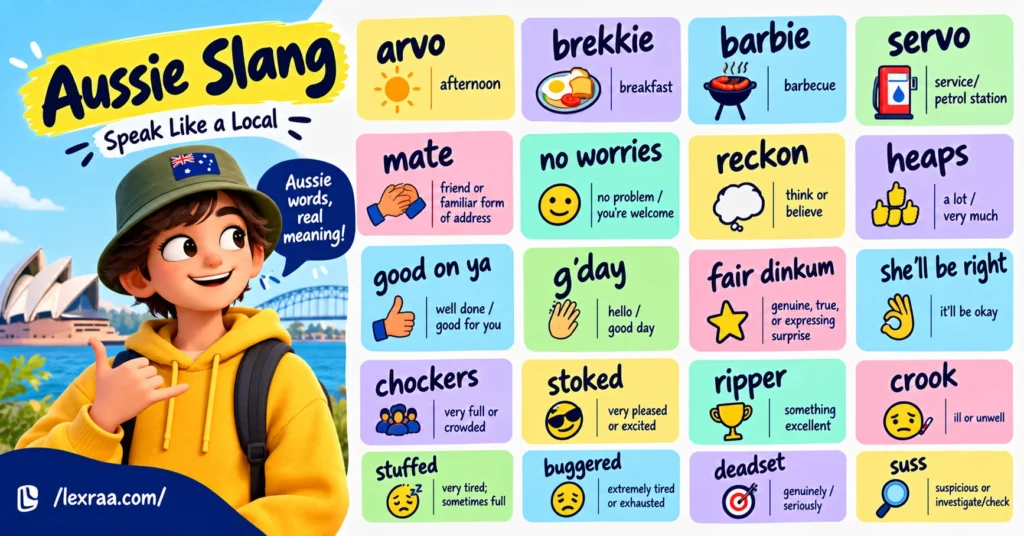
ABC Education specifically highlights arvo, brekkie, barbie, servo, fair dinkum, mate, and other expressions as part of Australian informal speech.
Food and Drink
| Aussie slang | Meaning | Example |
|---|---|---|
| snag | sausage | “Chuck a few snags on the barbie.” |
| sanga | sandwich | “I’ll make a sanga for lunch.” |
| cuppa | cup of tea, coffee, or a drink shared casually | “Come over for a cuppa.” |
| Macca’s | McDonald’s | “Let’s grab Macca’s.” |
| hot chips | French fries | “Can I get some hot chips?” |
| avo | avocado | “I’ll have avo on toast.” |
| bickie | biscuit/cookie | “Want a bickie with your tea?” |
| coldie | cold beer | “Fancy a coldie?” |
| esky | portable cooler/ice box | “Put the drinks in the esky.” |
| bottle-o | bottle shop/liquor store | “I’ll stop at the bottle-o.” |
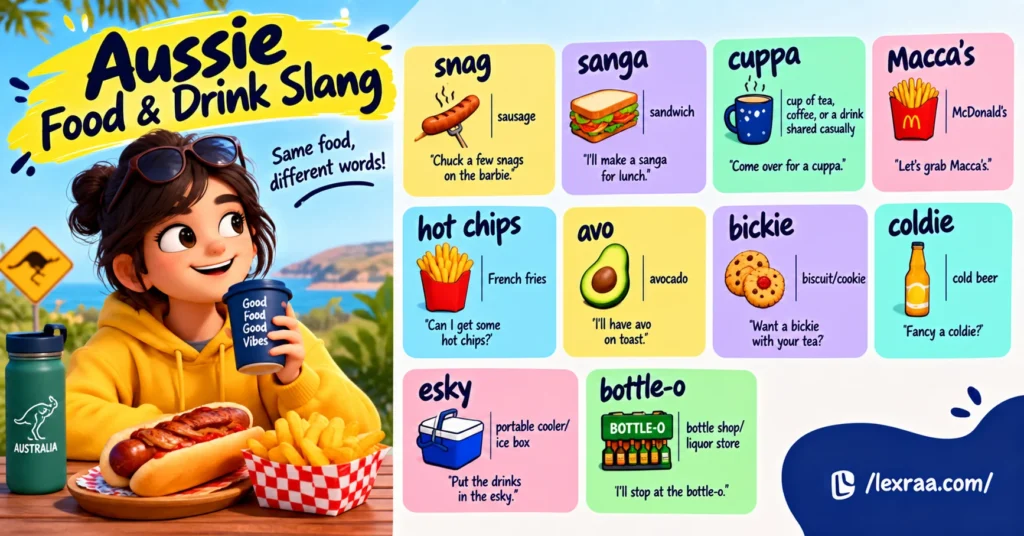
The University of Queensland’s 2026 Australian slang guide includes Macca’s, sanga, servo, cuppa, barbie, esky, and avo among expressions used in everyday Australian settings.
Shortened Australian Words
One of the most noticeable features of Australian slang is word shortening. ABC Education explains that Australians commonly cut words down and add an -o or -ie/-y ending. Examples include brekkie, barbie, uni, garbo, and pollie.
| Full word | Aussie form |
|---|---|
| afternoon | arvo |
| breakfast | brekkie |
| barbecue | barbie |
| service station | servo |
| mosquito | mozzie |
| sunglasses | sunnies |
| university | uni |
| journalist | journo |
| tradesperson | tradie |
| garbage collector | garbo |
| ambulance | ambo |
| politician | pollie |
| relatives | rellies |
| holiday | hols/hollies |
| tracksuit pants | trackies/trackie daks |
| football | footy |
| lipstick | lippie |
| Tasmania | Tassie |
| Australian | Aussie |
| documentary | doco |
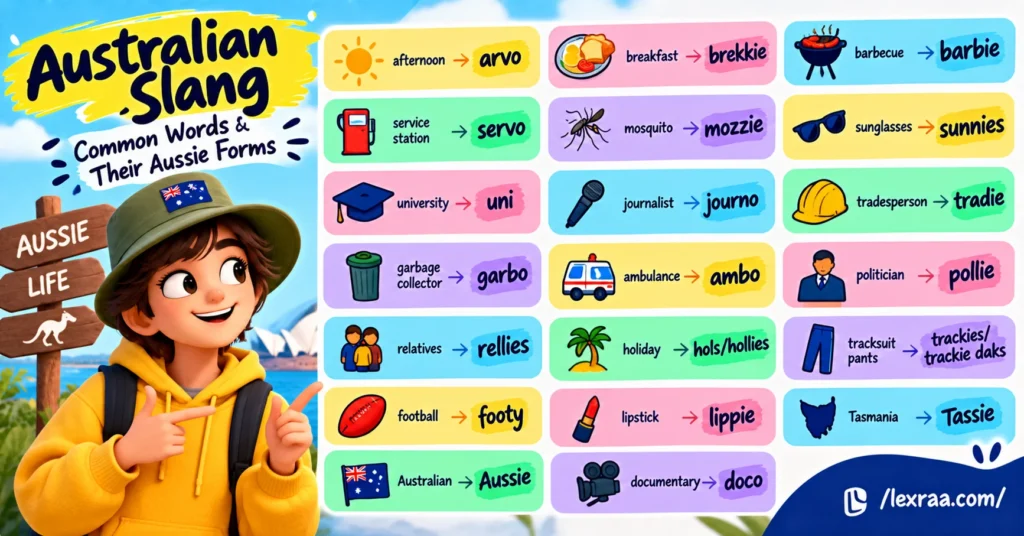
This doesn’t mean you can shorten every English word and automatically create authentic Australian slang. The forms that became established have their own histories.
Linguists Kate Burridge and Howard Manns describe -ie/-y and -o forms as particularly characteristic of Australian English. Their research also notes that these forms can help create informality and social solidarity. The -o pattern has Australian examples dating back to the 19th century.
Australian Slang for People
Some Australian words describe people rather than activities.
Bloke means a man or guy. It is ordinary informal Australian English rather than an insult.
Sheila is an older Australian slang term for a woman. You may still encounter it, but it can sound dated or stereotypical, so it isn’t the safest choice when addressing someone directly.
Bogan refers to a person stereotypically associated with unsophisticated or unfashionable behavior or tastes. It can be descriptive, humorous, or insulting depending on context.
Drongo means a foolish or incompetent person and is generally insulting.
Galah can describe a foolish or silly person, although its literal meaning is also the name of an Australian cockatoo.
Stickybeak means a nosy or overly curious person. ABC Education gives stickybeak as an example of Australian slang for someone who pries into other people’s affairs.
Larrikin is a particularly interesting Australian word for someone who behaves in a boisterous, unconventional, or mischievous way. It can have a positive cultural association as well as a negative one depending on context.
Australian Slang for Places, Travel and Everyday Life
Ute means a utility vehicle or pickup-style vehicle with an open tray at the back. The word is particularly common in Australian English.
Servo is a service or petrol station.
Bottle-o means a bottle shop, where alcoholic drinks are sold.
Bush refers broadly to rural, undeveloped, or non-urban areas. Its exact sense depends on context.
Woop Woop is humorous Australian slang for a remote or very distant place.
Runners can mean sneakers or trainers.
Brolly means umbrella.
Sunnies means sunglasses.
Thongs is one of the most important Australian-English words for visitors to understand: in Australia, it commonly means flip-flops, not underwear. Current Australian university guides still list this usage.
Australian Phrases and Sayings
Australian slang isn’t limited to shortened nouns. Some of the most recognizable expressions are complete phrases.
“No worries”
No worries means that something isn’t a problem. It can also be used in response to thanks, roughly equivalent to “you’re welcome.”
“Sorry I’m late.”
“No worries.”
“She’ll be right”
This means that things will be okay or that a problem will probably work itself out.
“The weather looks terrible.”
“She’ll be right.”
It shouldn’t always be interpreted literally; she doesn’t necessarily refer to a particular woman.
“Fair dinkum”
Fair dinkum can indicate that something is genuine or true, or express surprise when you hear something unexpected.
“He caught a fish that big.”
“Fair dinkum?”
ABC Education documents both the surprise/questioning use and the use of fair dinkum to ask whether someone is being genuine.
“Good on ya”
This is an informal way of expressing approval or congratulations.
“I finally finished the course.”
“Good on ya!”
“Have a crack”
Have a crack means to have a try or attempt something.
“I’ve never fixed one before.”
“Have a crack at it.”
“Chuck a sickie”
To chuck a sickie means to take a sick day, especially when the person is pretending to be sick to avoid work.
The University of Queensland lists this as Australian workplace slang.
“Pull your head in”
This means back off, stop what you’re doing, or behave yourself. ABC Education describes it as an older Australian expression associated with withdrawing or backing off.
“Flat out”
Flat out can mean extremely busy or working very hard.
“How was work?”
“Flat out all day.”
The expression is not exclusively Australian, so context matters.
“Taking the piss”
This means mocking, teasing, or making fun of someone or something, although the exact tone can range from friendly teasing to genuine criticism.
It is informal and contains mild profanity, so it isn’t appropriate for every workplace or formal situation.
Australian Words That Can Confuse Foreign English Speakers
Some of the most useful Australian slang isn’t necessarily the strangest. It is the ordinary English word that suddenly means something different.
Thongs
Australia: flip-flops
In American English: “thongs” commonly refers to a type of underwear.
Pissed
Australia: commonly drunk
Pissed off: angry or annoyed
This distinction can surprise American English speakers, where pissed by itself commonly means angry.
Root
In Australian slang, root can have a sexual meaning. This is worth knowing because the word has several ordinary meanings elsewhere in English.
Tea
In some Australian usage, tea can refer to the evening meal, although this isn’t uniquely Australian and usage varies.
Mate
Mate does not necessarily mean “my close friend.” Australians can use it as a general form of address, including with people they don’t know particularly well. ABC Education notes that mate can refer to both male and female friends and is not gender-specific.
Australian Slang by Situation
A useful way to learn Aussie vocabulary is to connect words to situations rather than memorize an alphabetical list.
At breakfast
brekkie, avo, cuppa
“Want some avo on toast for brekkie?”
At a barbecue
barbie, snag, coldie, esky
“Chuck the snags on the barbie and grab a coldie from the esky.”
Driving
ute, servo, chuck a U-ey, clicks
ABC Education gives chuck a U-ey for making a U-turn and clicks for kilometres.
“The servo is two clicks up the road. If you pass it, chuck a U-ey.”
At work
tradie, smoko, sickie, RDO, hard yakka
The University of Queensland currently lists RDO for rostered day off, chuck a sickie, hard yakka, and other workplace terms.
At university
uni, tute, sesh, bail, bludge
UQ’s 2026 guide specifically lists tute for tutorial, sesh for session, bail for skipping something, and bludge for putting in little or no effort.
Australian Slang Can Vary by State
Not every Australian uses exactly the same vocabulary.
A particularly clear example is swimwear. UQ notes that togs, cossies, and swimmers are used in different parts of Australia. Similarly, the potato snack commonly called a potato scallop in some places may be called a potato cake or potato fritter elsewhere.
Chicken parmigiana also provides a useful example: UQ notes parmi in Queensland and parma in many other states.
These differences are a good reminder that “Australian slang” isn’t completely uniform across the country.
10 Natural Australian Slang Conversations
1. Meeting a friend
Jack: What are you doing this arvo?
Sam: Nothing much.
Jack: Want to grab a cuppa?
Sam: Yeah, no worries.
2. At a barbecue
Mia: Are the snags ready?
Tom: Nearly.
Mia: I’ll grab the drinks from the esky.
Tom: Good on ya.
3. Driving
Alex: Where’s the servo?
Ben: Two clicks up the road.
Alex: What if I miss it?
Ben: Chuck a U-ey.
4. At work
Sarah: You look exhausted.
Dan: I’ve been flat out all morning.
Sarah: Time for a smoko?
Dan: Definitely.
5. University
Liam: Are you coming to the tute?
Ella: Nah, I’ve got too much work.
Liam: Going to bail?
Ella: Just this once.
6. Family
Dad: Did you have brekkie?
Emily: Yeah, I had toast and avo.
Dad: Want a cuppa?
Emily: Sure.
7. Shopping
Chris: Where are you going?
Megan: The bottle-o.
Chris: Need anything?
Megan: Just grab some snacks.
8. Talking about plans
Ava: Are we still going to the beach?
Noah: Reckon so.
Ava: What should I bring?
Noah: Your sunnies and thongs.
9. When something goes wrong
Ben: The barbecue won’t start.
Luke: Give it another go.
Ben: Think it’ll work?
Luke: She’ll be right.
10. Reacting to surprising news
Mia: He says he drove all the way here in two hours.
Tom: Fair dinkum?
Mia: Apparently.
Tom: That’s a long way to drive that fast.
Older Aussie Slang vs Everyday Aussie Slang
One mistake in large Australian slang lists is presenting every term as though Australians use them equally often today.
Australian slang has a long history, and some expressions survive mainly through older speakers, regional usage, humor, popular culture, or deliberate imitation. ABC Education, for example, describes g’day mate and crikey as older-fashioned slang while focusing elsewhere on shortening patterns that remain recognizable.
That means a dictionary entry should ideally tell you what the word means and how current or context-dependent it is, rather than simply placing every term in one giant “Aussie slang” pile.
This is also why expressions such as arvo, brekkie, servo, Macca’s, mate, no worries, and barbie are more useful starting points for a learner than memorizing dozens of colorful but uncommon phrases.
Where Did Australian Slang Come From?
Australian slang does not have one single inventor or starting date.
Australian English developed from multiple linguistic influences following European settlement, while later vocabulary was shaped by Australian history, migration, Indigenous languages, occupations, regional communities, and changing popular culture.
One of the most distinctive modern patterns—the shortening of words—has a long history. Linguists Kate Burridge and Howard Manns note that Australian -o forms such as milko, rabbit, and bottle-o date back to the 19th century, while -ie/-y forms remain highly productive. They describe these forms as important markers of informality and social connection in Australian English.
Some Australian vocabulary also comes from Aboriginal languages. But it is important not to treat Aboriginal English itself as simply “Australian slang”; Indigenous Australian English varieties have their own linguistic structures and histories.
Do Australians Really Use All This Slang?
No—and this is one of the most important things to understand.
An Australian can speak completely ordinary English without using slang in every sentence. The concentration of slang changes according to the speaker, audience, situation, age, occupation, region, and level of formality.
Modern Australian university guides continue to document slang as part of everyday life, while ABC’s language resources emphasize that informal Australian speech includes both shortened forms and ordinary conversational English.
So don’t try to turn every sentence into something like:
“G’day, mate! Chuck some snags on the barbie this arvo, ya drongo!”
That sounds more like a caricature than natural conversation.
A better approach is to learn individual expressions and notice when Australians actually use them.
FAQ
What is the most common Australian slang?
There isn’t one officially ranked “most common” Australian slang word. Mate, no worries, arvo, brekkie, servo, barbie, reckon, and Macca’s are among the widely documented everyday expressions found in Australian English guides.
What does “arvo” mean in Australian slang?
Arvo means afternoon. It is a shortened Australian form and is commonly used in casual conversation. For example, “I’ll call you this arvo” means “I’ll call you this afternoon.”
What does “brekkie” mean?
Brekkie means breakfast. It is one of the classic Australian shortened forms ending in an -ie sound. You might hear “What did you have for brekkie?” in casual conversation.
What does “no worries” mean in Australia?
No worries generally means “no problem” or “that’s okay,” and it can also be used as a response to thanks. The expression is strongly associated with Australian informal conversation, although it is not exclusive to Australia.
Why do Australians shorten words?
Shortening words is a longstanding feature of Australian English. Common patterns include adding -o or -ie/-y, as in servo, arvo, brekkie, and mozzie. Linguists have studied these forms as an important marker of informality and social connection in Australian English.
What does “mate” mean in Australia?
Mate can mean a friend, companion, or simply function as a familiar form of address. It does not necessarily indicate a close friendship. Its tone can also change according to the situation and the relationship between speakers.
Is Australian slang used on social media?
Yes. Australians can use their everyday slang in text messages, group chats, Instagram, TikTok, Snapchat, WhatsApp, X, and other online spaces. However, Australian slang wasn’t created by social media; many of its most recognizable expressions existed long before these platforms.
What is “Strine”?
Strine is an informal term associated with Australian English, particularly its characteristic pronunciation and informal speech. It should not be treated as a precise synonym for every Australian slang word.
Final Takeaway
Australian slang is best understood as a living collection of informal Australian English, not a fixed list that every Australian memorizes.
Start with the words you’re most likely to encounter: arvo, brekkie, barbie, servo, mate, no worries, reckon, Macca’s, snag, esky, sunnies, ute, cuppa, and fair dinkum. Then learn phrases such as she’ll be right, good on ya, have a crack, chuck a sickie, and pull your head in.
The most useful trick is to recognize the patterns. When you see an unfamiliar word ending in -o or -ie/-y, consider whether it could be a shortened form—but don’t assume every such word is automatically Australian slang. The pattern is real, but individual words have their own histories.
And when an Australian word seems strangely familiar but has a different meaning—thongs, pissed, root, tea, or mate, for example—check the Australian context before translating it according to American or British English.
That combination of dictionary definitions + context + currentness + real examples makes Australian slang much easier to understand than simply memorizing a huge list.