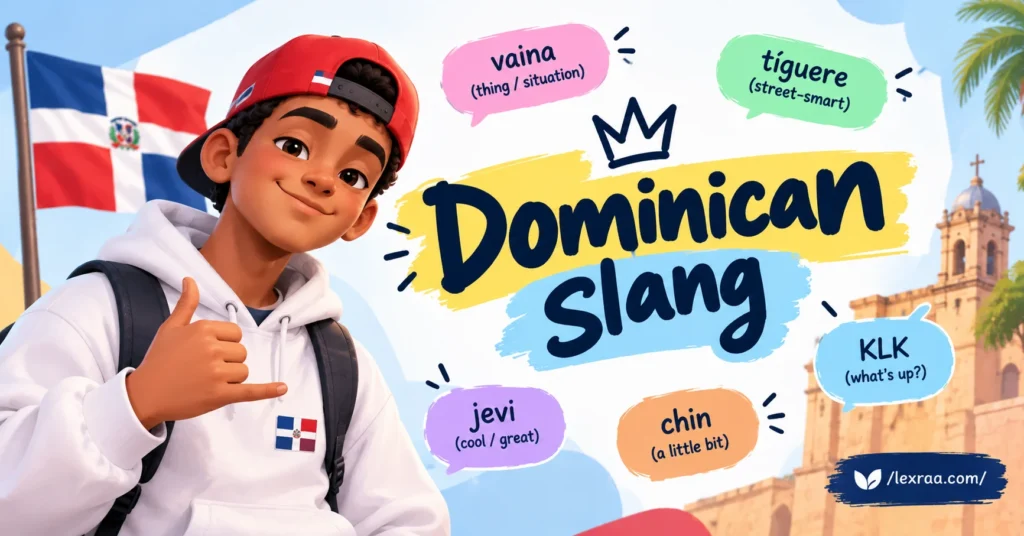
Dominican slang is the informal vocabulary and expressions used in Dominican Spanish, especially in everyday conversation, texting, music, and casual social settings. Common examples include vaina (“thing/stuff”), tíguere (“street-smart person”), chin (“a little”), jevi (“cool”), and qué lo qué / KLK (“what’s up?”).
It is not an acronym, abbreviation, or single slang word. Dominican slang is a broad category of words, shortened expressions, pronunciations, and local meanings.
What Is Dominican Slang?
Dominican slang is part of Dominican Spanish, the variety of Spanish spoken in the Dominican Republic and by Dominican communities abroad.
Some expressions are easy for other Spanish speakers to understand. Others can be surprisingly difficult because an ordinary Spanish word may have a different local meaning in the Dominican Republic.
For example, guagua can mean a bus in Dominican Spanish, while the same word has a different meaning in some other Spanish-speaking countries.
The Dominican Republic also has a particularly well-documented local vocabulary. The Diccionario del español dominicano, published by the Academia Dominicana de la Lengua, records words and meanings characteristic of Dominican Spanish rather than treating slang as a random collection of internet expressions. Its second edition was released in 2024 and is being updated digitally.
Common Dominican Slang Words and Their Meanings
Here are some of the expressions most useful for understanding everyday Dominican speech.
| Dominican term | Common meaning |
|---|---|
| Vaina | Thing, stuff, matter, situation, or problem |
| Tíguere / tigre | Street-smart, clever, savvy person; sometimes a hustler or schemer |
| Chin / un chin | A little bit |
| Jevi | Cool, good, enjoyable, excellent |
| Qué lo qué / KLK | What’s up? / What’s going on? |
| Pana | Friend, buddy |
| Cuarto | Money |
| Guagua | Bus or public transport |
| Concho | Shared/public-route taxi |
| Colmado | Neighborhood grocery/convenience store |
| Coro | Group hangout, gathering, or social plan |
| Tato / ta’ to’ | Okay, all good |
| Boche | Scolding, reprimand |
| Jumo | Drunkenness or being drunk |
| Chercha | Fun, joking around, lively socializing |
Recent Dominican-language guides consistently identify vaina, chin, pana, jevi, cuarto, guagua, and tíguere among commonly encountered terms.
Vaina
Vaina is one of the most flexible Dominican expressions.
Depending on context, it can refer to a thing, object, matter, situation, or problem. Tone can also turn it into an expression of frustration or surprise.
“Pásame esa vaina.”
can simply mean:
“Pass me that thing.”
But:
“¡Qué vaina!”
can express frustration about a situation.
The word is not exclusively Dominican; it appears elsewhere in Latin America too. What makes it especially useful for understanding Dominican speech is its broad range and frequency.
Tíguere
Tíguere literally relates to “tiger,” but its Dominican slang meaning is about a person who is street-smart, clever, savvy, or able to handle situations.
It can be complimentary:
“Ese tipo es un tíguere.”
meaning someone is sharp or knows how to get things done.
But it can also suggest someone is sneaky, opportunistic, or a hustler. Context and tone matter, so translating it simply as “guy” or “thug” misses part of the word’s range.
Chin
Chin means a little bit.
“Dame un chin de agua.”
means:
“Give me a little water.”
It can describe a small amount of food, time, money, or almost anything measurable.
The Dominican Academy’s dictionary project specifically identifies chin among characteristic Dominican vocabulary.
Jevi
Jevi means cool, good, enjoyable, or excellent in Dominican informal speech.
“La fiesta está jevi.”
means roughly:
“The party is great.”
The word is commonly described as an adaptation of English heavy, although its Dominican meaning has developed far away from the ordinary English meanings of that word.
Qué lo qué / KLK
¿Qué lo qué? is a casual Dominican greeting roughly equivalent to “What’s up?” or “What’s going on?”
In text, it is commonly shortened to KLK.
“Klk, mi pana.”
can be understood as:
“What’s up, my friend?”
KLK is therefore an abbreviation within Dominican slang, even though Dominican slang as a whole is not an abbreviation. Recent Dominican-language sources specifically describe KLK as the written shorthand for qué lo qué.
Why Dominican Slang Can Be Hard to Understand
Vocabulary is only part of the challenge.
Dominican Spanish is also known for fast conversational speech and shortened or altered pronunciations. A learner may recognize the vocabulary but still struggle to separate individual words when hearing a rapid conversation.
That means reading “¿Qué lo qué?” is often easier than hearing the expression inside a fast conversation.
The distinction between slang vocabulary and pronunciation is important. Not every unusual-sounding Dominican expression is slang; some differences are simply features of Dominican Spanish pronunciation.
Dominican Slang vs. Standard Spanish
A word can be perfectly ordinary Spanish but acquire a distinctive meaning in the Dominican Republic.
Guagua is a good example. In Dominican Spanish it refers to a bus or public transport, while the same word can mean something quite different elsewhere in the Spanish-speaking world.
Likewise, cuarto literally has meanings connected with “room” or “quarter,” but Dominican usage can use it for money.
This is why translating Dominican expressions word-for-word can produce strange results.
Dominican Slang Is Not the Same as “Bad Spanish”
This is an important distinction.
Dominican Spanish is a recognized regional variety of Spanish with its own vocabulary, pronunciation, and grammatical patterns. Informal slang is only one part of that larger variety.
The Academia Dominicana de la Lengua describes its dictionary as a record of the vocabulary used by Dominicans, including words and meanings that differ from general Spanish. The project contains both current and older expressions, showing that Dominican vocabulary is broader than whatever happens to be trending online.
Where Did Dominican Slang Come From?
There is no single source for Dominican slang.
The vocabulary of Dominican Spanish reflects the country’s long linguistic history, including Spanish inherited from the colonial period, Indigenous Taíno contributions, African linguistic influences, and later contact with languages such as English, French, Haitian Creole, and Arabic.
The National Library and Pedro Henríquez Ureña National Library’s catalog description of the 2024 Diccionario del español dominicano specifically notes these layers of influence, including Taíno, African languages, Spanish, French, Haitian Creole, and more recent English influence.
Some individual words have particularly interesting histories. For example, chin is documented as having an Indigenous Caribbean/Arawak connection, while expressions such as jevi reflect English influence. It is better to discuss these histories word by word than to claim that “Dominican slang” came from one single cultural source.
5 Natural Conversations With Dominican Slang
1. Friends greeting each other
Luis: KLK, bro?
Mateo: Todo bien. ¿Y tú?
Luis: To’ bien. ¿Qué haces?
Mateo: Voy al coro después.
Here KLK is a casual greeting and coro refers to a social hangout or group plan.
2. Asking for a small amount
Ana: ¿Quieres más café?
Sofia: Sí, dame un chin.
Ana: ¿Así?
Sofia: Un chin más y ya.
Here un chin means a small amount.
3. Talking about a clever person
Carlos: ¿Quién consiguió las entradas?
Diego: José.
Carlos: Ese tipo es un tíguere.
Diego: Siempre sabe cómo resolver.
Here tíguere is being used positively to describe someone resourceful and street-smart.
4. Reacting to a good place
Mia: ¿Qué tal el restaurante?
Nico: Está jevi.
Mia: ¿La comida también?
Nico: Sí, demasiado buena.
Here jevi means cool or good.
5. A word with a broad meaning
Sara: ¿Qué pasó con el carro?
Joel: Esa vaina se dañó otra vez.
Sara: ¿En serio?
Joel: Sí, qué vaina.
Here vaina first refers to the car-related problem and then works as an expression of frustration.
A Useful Edge Case: “Tíguere” Can Change From Compliment to Warning
One of the best examples of why Dominican slang cannot always be translated with one English word is tíguere.
Calling someone a tíguere can acknowledge that they are clever and capable. But in another situation, the same word can suggest that someone is too streetwise, sneaky, or opportunistic.
The difference is not necessarily contained in the dictionary definition. It emerges from tone, relationship, and what the person has just done.
That is a more useful way to learn Dominican slang than memorizing “tíguere = hustler” and assuming the translation works everywhere. Dominican-language references explicitly describe the word as context-dependent.
Dominican Slang vs. Similar Language Labels
| Term | Meaning | Tone | Popularity | Confusion Risk |
|---|---|---|---|---|
| Dominican slang | Informal Dominican words and expressions | Informal | High | Medium |
| Dominican Spanish | The broader Spanish variety spoken by Dominicans | Neutral | Very high | Low |
| Caribbean Spanish | Spanish varieties spoken across the Caribbean | Neutral | High | Medium |
| Puerto Rican slang | Informal vocabulary associated with Puerto Rican Spanish | Informal | High | High |
| Cuban slang | Informal vocabulary associated with Cuban Spanish | Informal | High | High |
| Standard Spanish | Broader standardized Spanish vocabulary and usage | Neutral/formal | Very high | Medium |
There is no single “opposite” of Dominican slang. Formal Spanish is a different register rather than an exact opposite.
Is Dominican Slang Used Online?
Yes. Dominican expressions appear in texting, social media, online communities, music, videos, and casual digital conversations.
KLK is particularly suited to texting because it is already a shortened written form of qué lo qué. Dominican-language resources also describe slang as part of everyday communication and online conversation.
Reddit discussions also show people asking how to understand Dominican slang and recommending country-specific resources rather than relying only on general Spanish dictionaries.
Still, not every Dominican word is “internet slang.” Guagua, colmado, chin, and vaina, for example, belong to everyday Dominican vocabulary whether or not someone is online.
Is Dominican Slang Rude?
Some expressions are completely harmless, while others can be insulting, vulgar, or strongly informal.
Words such as chin, pana, guagua, and jevi are generally much easier to use casually than insults or profanity.
Vaina is also flexible enough to be neutral in one sentence and rougher in another. Its tone can shift depending on what it refers to and how it is said.
If you’re speaking with someone you do not know well, understanding an expression first is safer than immediately copying it. Informal vocabulary can carry social meaning that a direct English translation does not capture.
How to Reply to Dominican Slang
If someone sends you “KLK?”, a simple response can be:
“Todo bien, ¿y tú?”
If someone says:
“Eso está jevi.”
you could answer:
“Sí, me gusta también.”
And if someone calls another person a tíguere, listen to the surrounding conversation before deciding whether it is praise or criticism. A response such as “¿Cómo así?” can be useful if the meaning is unclear.
FAQ
What are some common Dominican slang words?
Some widely documented examples include vaina, tíguere, chin, jevi, pana, cuarto, guagua, and KLK. Their meanings range from “thing” and “a little” to “friend,” “money,” “bus,” and “what’s up.”
What does KLK mean in Dominican slang?
KLK is a texting shorthand for ¿Qué lo qué?, a casual Dominican greeting meaning roughly “What’s up?” or “What’s going on?” It is an abbreviation within Dominican slang rather than a definition of Dominican slang as a whole.
What does vaina mean in Dominican Spanish?
Vaina can mean “thing,” “stuff,” “matter,” “situation,” or “problem,” depending on context. It can also express frustration or surprise, which is why a dictionary-style one-word translation does not capture all of its Dominican uses.
What does tíguere mean?
A tíguere can be a clever, street-smart, savvy person. Depending on tone and context, the word can also suggest someone who is sneaky or opportunistic, so it does not always have a purely positive meaning.
What does “chin” mean in Dominican slang?
Chin means “a little bit” or a small amount. For example, “dame un chin” means “give me a little.” The word is specifically documented among Dominican vocabulary by the country’s language academy.
Is Dominican slang the same as Puerto Rican slang?
No. Dominican and Puerto Rican Spanish are both Caribbean varieties and share some vocabulary, but each has its own expressions and local meanings. A word that sounds familiar across the Caribbean may still have a different frequency or meaning in the Dominican Republic.
Is Dominican Spanish the same as regular Spanish?
Dominican Spanish is a variety of Spanish, not a separate language. It shares the core language with other Spanish-speaking communities but has distinctive vocabulary, pronunciation, expressions, and meanings that make it recognizable as its own regional variety.
Final Takeaway
Dominican slang is best understood as part of the wider Dominican Spanish vocabulary rather than as a single list of trendy internet words. Expressions such as vaina, tíguere, chin, jevi, pana, and KLK are useful starting points, but their meanings become much clearer when you pay attention to the sentence and social context.
If you’re learning Dominican slang, don’t translate every word literally. Learn the expression + situation + tone together, especially with flexible terms such as vaina and tíguere.
For casual conversations, texting, and social media, these expressions can help you understand Dominican speakers more naturally. In formal Spanish, however, standard vocabulary is usually the safer choice unless you’re intentionally discussing Dominican language or culture.