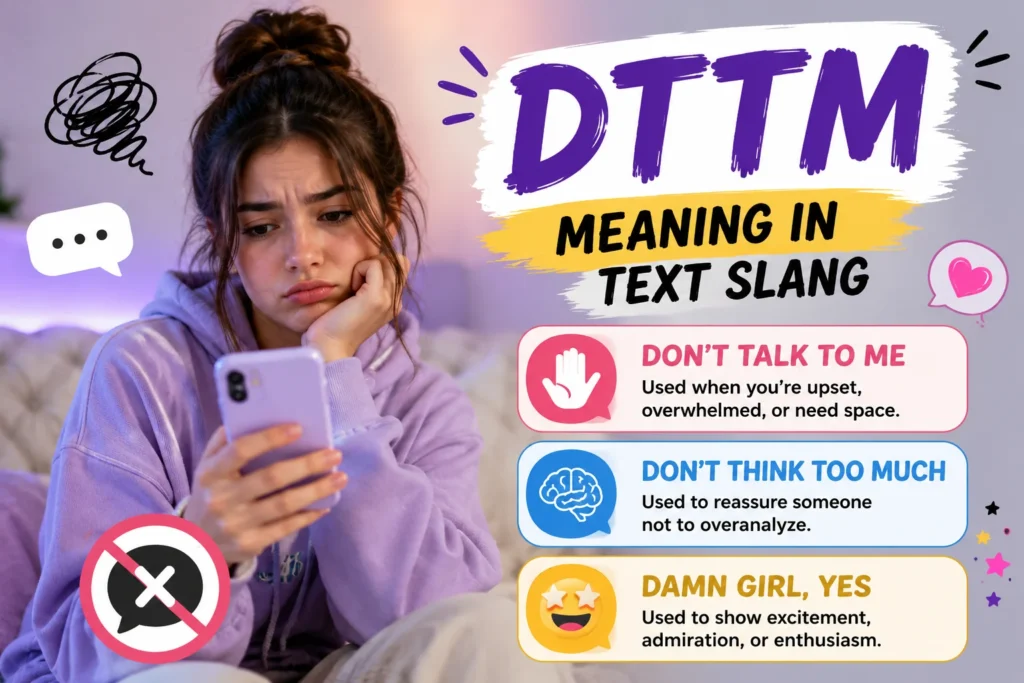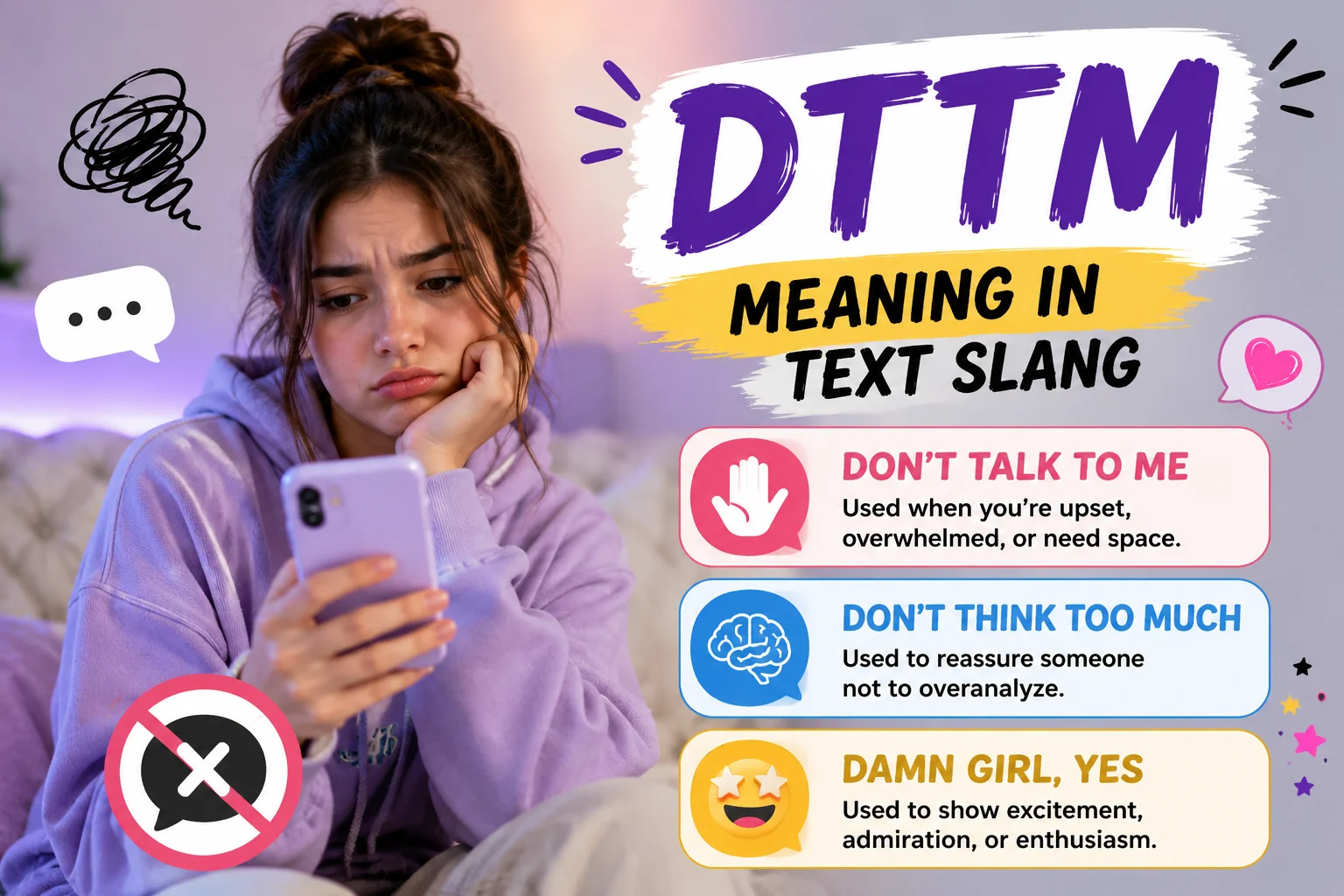
DTTM most commonly means “Don’t Talk to Me” in text slang. People use it when they’re frustrated, overwhelmed, embarrassed, tired, or simply want some space. Depending on context, DTTM can also mean “Don’t Think Too Much” or, less commonly, “Damn Girl, Yes.”
Many people search for DTTM meaning in text slang because the abbreviation can sound harsh without context. In some conversations it’s a serious request for space, while in others it’s playful exaggeration or supportive advice.
Example:
A: I just spilled coffee on my shirt before the meeting.
B: DTTM 😭
In this case, the speaker doesn’t literally want silence—they’re expressing embarrassment and frustration.
DTTM Meaning in Text Messages
DTTM = Don’t Talk to Me
The most common meaning of DTTM is “Don’t Talk to Me.”
It’s usually an abbreviation used to show:
- Frustration
- Embarrassment
- Exhaustion
- Disappointment
- Overwhelm
Most of the time, the phrase isn’t meant literally. Instead, it’s a dramatic way of reacting to something annoying or unfortunate.
Example Situations
- Failing a test
- Missing a flight
- Sending a text to the wrong person
- Losing a game
- Watching your favorite team lose
Examples:
- “I just locked myself out of the house. DTTM.”
- “Forgot my wallet at home. DTTM.”
- “That ending ruined the whole show. DTTM.”
In these examples, the speaker is expressing emotion rather than actually demanding silence.
Other Meanings of DTTM
Although Don’t Talk to Me is by far the most common interpretation, several alternative meanings appear occasionally online.
DTTM = Don’t Think Too Much
This version is used as reassurance.
Someone may send DTTM when a friend is overanalyzing a situation, relationship, message, or decision.
Example:
A: She took three hours to reply. Do you think she’s upset?
B: DTTM. She’s probably busy.
Here, DTTM means “Don’t Think Too Much.”
The tone is comforting rather than dismissive.
DTTM = Damn Girl, Yes
This meaning is much less common but occasionally appears in social media comments.
People use it to show excitement, admiration, or approval.
Example:
A: Posted a photo after a makeover.
B: DTTM 🔥🔥
In this case, the phrase means something like:
“Damn girl, yes!”
“You look amazing!”
“That’s a great look!”
Because this interpretation is niche, context is extremely important.
Is DTTM an Acronym, Abbreviation, or Slang?
DTTM is best classified as an internet abbreviation that functions as slang.
Classification
| Meaning | Type |
|---|---|
| Don’t Talk to Me | Slang abbreviation |
| Don’t Think Too Much | Informal abbreviation |
| Damn Girl, Yes | Social media slang abbreviation |
Unlike traditional dictionary words, DTTM depends heavily on online culture and context.
Platform Breakdown: Where DTTM Appears
TikTok
TikTok users often use DTTM in captions or comments after something embarrassing, shocking, or disappointing happens.
Example:
“I spent two hours getting ready and it started raining. DTTM.”
The tone is usually humorous and dramatic.
On Instagram, DTTM commonly appears:
- In Stories
- Comment sections
- Direct messages
People often use it when reacting to life updates, relationship drama, or embarrassing moments.
Snapchat
Snapchat is one of the most natural places for DTTM.
Because messages are casual and emotional, users frequently send:
- “DTTM 😭”
- “Literally DTTM rn”
- “DTTM after what happened today”
Friends use DTTM in private conversations to vent frustration.
Example:
“Missed the train again. DTTM.”
X (Formerly Twitter)
DTTM occasionally appears in reaction tweets and meme posts.
It’s most often used to exaggerate disappointment or annoyance for comedic effect.
Tone & Context Variations
The meaning of DTTM changes significantly depending on tone.
Funny Tone
A: I dropped my pizza face-down.
B: No way.
A: DTTM.
B: That’s genuinely tragic.
Sarcastic Tone
A: I ignored every deadline and now everything is due tomorrow.
B: Shocking.
A: DTTM.
B: Truly an unexpected outcome.
Playful Tone
A: My crush liked everyone’s photo except mine.
B: 😂
A: DTTM.
B: You’re being dramatic.
Serious Tone
A: Today has been really overwhelming.
B: Want to talk about it?
A: Honestly, DTTM for a bit.
B: Okay, take your time.
Real Chat Examples
1. After an Embarrassing Mistake
A: I waved back at someone who wasn’t waving at me.
B: Oh no.
A: DTTM.
B: You’ll laugh about it tomorrow.
2. Relationship Stress
A: They left me on read again.
B: Seriously?
A: DTTM.
B: Let’s not jump to conclusions yet.
3. Gaming Frustration
A: Lost the final match by one point.
B: That’s rough.
A: DTTM.
B: You’ll get them next time.
4. Exam Results
A: I studied all week and still failed.
B: Ouch.
A: DTTM.
B: Don’t give up yet.
5. Using “Don’t Think Too Much”
A: I keep replaying the conversation in my head.
B: DTTM.
A: Easier said than done.
B: I know, but it’ll be okay.
6. Work Stress (WhatsApp)
A: I accidentally sent the unfinished report to my boss.
B: That happens sometimes.
A: DTTM.
B: Just send the corrected version and explain.
7. Snapchat Streak
A: I lost my 500-day streak.
B: No way!
A: DTTM 😭
B: I’d be upset too.
8. Shopping Disaster
A: The shoes I wanted sold out while I was checking out.
B: That’s the worst.
A: DTTM.
B: Hopefully they’ll restock soon.
9. Using “Damn Girl, Yes”
A: Posts graduation photos.
B: DTTM! 🔥
A: Thank you!
B: You look amazing.
10. Late-Night Overthinking
A: Do you think I said something wrong earlier?
B: DTTM.
A: You’re probably right.
B: Try to get some sleep.
11. Sports Fans
A: Our team lost in the last minute.
B: Brutal.
A: DTTM.
B: Next season will be better.
Grammar & Language Role
Part of Speech
DTTM is an initialism (internet abbreviation). It replaces an entire phrase rather than acting as a traditional noun or verb.
Sentence Position
DTTM is flexible and can appear:
- At the beginning of a sentence
- In the middle
- At the end
- As a complete message
Examples:
- DTTM.
- Honestly, DTTM today.
- After that meeting… DTTM.
Can It Replace a Full Sentence?
Yes.
Instead of saying:
“Please don’t talk to me right now because I’m overwhelmed.”
Many people simply text:
DTTM.
The meaning is usually understood through context.
Formal vs. Informal
DTTM is strictly informal.
Use it in:
- Text messages
- Snapchat
- Instagram DMs
- Discord
- Gaming chats
- Conversations with friends
Avoid it in:
- Work emails
- School assignments
- Professional communication
Comparison Table
| Term | Meaning | Usage Context | Tone | Popularity | Confusion Risk |
|---|---|---|---|---|---|
| DTTM | Don’t Talk to Me | Frustration, needing space | Emotional | Medium | Medium |
| IDC | I Don’t Care | Indifference | Cold | High | Low |
| BRB | Be Right Back | Temporary absence | Neutral | Very High | Low |
| SMH | Shaking My Head | Disappointment | Negative | Very High | Low |
| NVM | Never Mind | Ending a topic | Neutral | High | Low |
| HMU (Opposite intent) | Hit Me Up | Invitation to chat | Friendly | High | Low |
Key Insight
Unlike IDC, which can sound dismissive, DTTM often reflects a temporary emotional reaction rather than a permanent unwillingness to communicate. Many people use it dramatically after something embarrassing or frustrating, not because they genuinely want everyone to stop talking to them.
Origin & Internet Culture
There is no documented origin showing that DTTM began on one specific website or social platform. Like many texting abbreviations, it likely developed naturally as users shortened common phrases to communicate more quickly.
The phrase “Don’t Talk to Me” itself has long been used jokingly after embarrassing or disappointing moments. Social media amplified this expression, and abbreviating it to DTTM made it faster to type in chats and captions.
There is no verified evidence linking DTTM to AAVE or any particular cultural community. Its usage is better described as general internet shorthand that appears in casual English-language conversations.
Although DTTM isn’t nearly as widespread as abbreviations like LOL, BRB, or OMG, it continues to appear in smaller online communities, particularly when people want to exaggerate frustration in a humorous way.
Real-World Observation
One reason DTTM continues to appear online is that it captures a feeling many people recognize: wanting a brief moment to process disappointment. In memes, chats, and social posts, it’s often less about literally avoiding conversation and more about expressing, “I can’t believe this just happened.” That mix of humor and emotion makes the abbreviation relatable, even though it isn’t as universally known as internet classics like LOL or SMH.
Frequently Asked Questions
What does DTTM mean in texting?
The most common meaning of DTTM is “Don’t Talk to Me.” It’s used when someone feels embarrassed, frustrated, overwhelmed, or wants a little space. In many cases, it’s meant humorously rather than literally.
What does DTTM mean on Snapchat?
On Snapchat, DTTM usually means “Don’t Talk to Me.” Users often send it after something embarrassing or disappointing happens. It’s commonly paired with emojis to emphasize emotion.
What does DTTM mean from a girl?
If a girl sends DTTM, she’s most likely expressing frustration, exhaustion, or needing some time alone. It doesn’t automatically mean she’s angry with the person receiving the message. Context is the best guide.
What does DTTM mean from a guy?
From a guy, DTTM typically has the same meaning: “Don’t Talk to Me.” It may be a dramatic reaction to a bad day, a mistake, or a disappointing event rather than a serious request to end the conversation.
Can DTTM mean “Don’t Think Too Much”?
Yes. Although much less common, some people use DTTM to mean “Don’t Think Too Much.” This version is intended as reassurance for someone who is overthinking a situation.
Is DTTM rude?
Not usually. The abbreviation itself isn’t offensive, but the tone can seem harsh if it’s sent without explanation. Between close friends, it’s often understood as playful exaggeration.
What is the full meaning of DTTM in slang?
In slang, DTTM most commonly stands for “Don’t Talk to Me.” It’s an informal abbreviation used to express frustration, embarrassment, or the need for temporary space.
Is DTTM a common texting abbreviation?
DTTM is less common than abbreviations like LOL, OMG, or BRB. Because it’s relatively niche, many people search for its meaning after seeing it in a message or social media post.
What does DTTM mean on TikTok?
On TikTok, DTTM usually appears in captions or comments after funny, awkward, or frustrating situations. It’s often used dramatically for comedic effect rather than as a literal request.
Can DTTM have multiple meanings?
Yes. Depending on context, DTTM can mean “Don’t Talk to Me,” “Don’t Think Too Much,” or, more rarely, “Damn Girl, Yes.” Reading the surrounding conversation is the best way to determine the intended meaning.
Is DTTM positive or negative?
It depends on the context. “Don’t Talk to Me” often expresses negative emotions like frustration, while “Don’t Think Too Much” is supportive and encouraging, and “Damn Girl, Yes” is enthusiastic praise.
Conclusion
DTTM most commonly means “Don’t Talk to Me” in text slang and is usually a lighthearted way to express frustration, embarrassment, exhaustion, or the need for a little personal space. While it can occasionally stand for “Don’t Think Too Much” or, more rarely, “Damn Girl, Yes,” the surrounding conversation almost always makes the intended meaning clear.
Like many internet abbreviations, DTTM works best in casual chats with people who are familiar with texting slang. If there’s any chance the other person might misunderstand it, spelling out the full phrase is often the better choice.
Usage Tips
- Use DTTM when chatting with friends in casual text messages or social media conversations.
- Read the surrounding context before assuming which meaning is intended.
- Pair it with emojis if you want to make the tone feel playful rather than serious.
- If you’re asking for genuine space, consider adding a short explanation to avoid confusion.
Common Mistakes
- Assuming DTTM always means “Don’t Talk to Me.” In some conversations, it can mean “Don’t Think Too Much.”
- Using DTTM in professional emails or workplace communication where many people won’t recognize it.
- Interpreting DTTM as rude without considering the relationship and context.
- Using it with people unfamiliar with internet slang, which can lead to misunderstandings.
When to Use DTTM
Use it when:
- You’re texting close friends.
- You’re reacting to an embarrassing or frustrating moment.
- You’re jokingly asking for a little space.
- The conversation is informal and relaxed.
Avoid using it when:
- You’re communicating with teachers, clients, or coworkers.
- The message could be misunderstood as intentionally rude.
- You’re discussing sensitive topics where clear communication is important.
- The recipient may not be familiar with texting abbreviations.
Whether you see DTTM in a Snapchat message, WhatsApp chat, Instagram DM, or TikTok comment, remembering that context is everything will help you understand—and use—the abbreviation confidently.