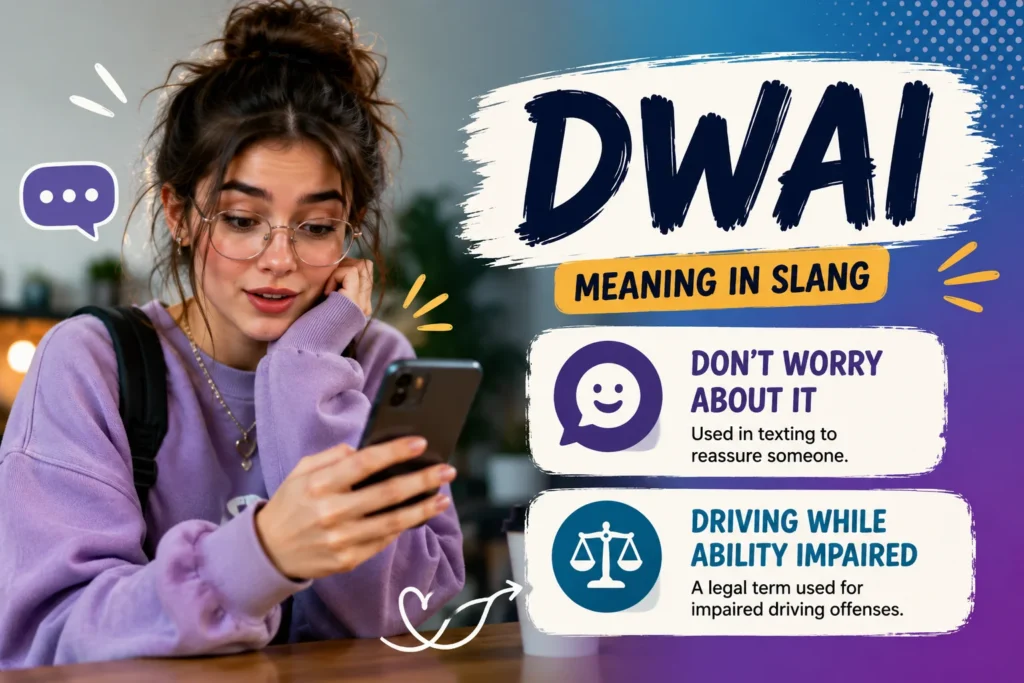
What Does DWAI Mean in Slang?
DWAI most commonly means “Don’t Worry About It” in text slang. It’s a reassuring abbreviation people use in chats to let someone know that everything is okay, there’s nothing to apologize for, or a problem isn’t a big deal. Outside of texting, DWAI can also stand for “Driving While Ability Impaired,” a legal term used in certain U.S. states.
Many people search for DWAI meaning slang after seeing it in a text, Snapchat message, or social media comment and wondering whether it has the friendly meaning or the legal one. In casual conversations, it almost always means “Don’t Worry About It.”
Example:
A: Sorry I replied so late!
B: DWAI 😊
Here, DWAI simply reassures the other person that there’s no problem.
DWAI Meaning in Text Messages
DWAI = Don’t Worry About It
The most common meaning of DWAI is “Don’t Worry About It.”
It’s an internet abbreviation used to comfort someone, reduce awkwardness, or let them know that a mistake isn’t important.
People often use DWAI when someone:
- Apologizes
- Feels guilty
- Worries they’ve caused inconvenience
- Is overthinking a small issue
Instead of typing an entire sentence like:
“It’s okay, don’t worry about it.”
Many people simply send:
DWAI
The message feels friendly, casual, and reassuring.
Common Examples
- “DWAI, it happens.”
- “Seriously, DWAI.”
- “You don’t owe me an apology. DWAI.”
- “DWAI—we’ll figure it out together.”
Other Meaning of DWAI
Driving While Ability Impaired
Outside internet slang, DWAI is also a legal abbreviation for Driving While Ability Impaired.
This meaning is not slang and appears in legal documents, court records, traffic laws, and news articles rather than casual conversations.
In states such as New York and Colorado, DWAI refers to certain impaired-driving offenses that don’t always meet the legal threshold for DUI or DWI, depending on the state’s laws.
Example:
“The driver received a DWAI charge.”
If you’re reading a news article or legal document, this is almost certainly the intended meaning—not the texting abbreviation.
Is DWAI an Acronym, Abbreviation, or Slang?
DWAI is best described as an abbreviation or initialism.
Its classification depends on context.
| Meaning | Type |
|---|---|
| Don’t Worry About It | Internet slang abbreviation |
| Driving While Ability Impaired | Legal abbreviation |
When used in chats or social media, DWAI functions as modern internet slang because it replaces an entire reassuring phrase.
Where You’ll See DWAI Online
WhatsApp is one of the most common places to see DWAI.
Friends often use it after someone apologizes or worries unnecessarily.
Example:
“DWAI. Everything worked out.”
Snapchat
On Snapchat, DWAI usually appears in quick conversations between friends.
Someone might send it after missing a streak, replying late, or canceling plans.
Example:
“DWAI—we can hang out tomorrow.”
Instagram users occasionally write DWAI in:
- Direct Messages
- Story replies
- Comments
It’s generally used as a kind response when someone apologizes.
TikTok
DWAI isn’t among TikTok’s most popular abbreviations, but it does appear in comments where users reassure creators after mistakes or awkward moments.
Example:
“DWAI, everyone makes mistakes.”
X (Formerly Twitter)
On X, DWAI sometimes appears in replies during conversations about everyday frustrations.
The meaning almost always remains:
Don’t Worry About It.
Tone & Context Variations
The phrase changes slightly depending on the conversation.
Friendly Tone
A: Sorry I’m running ten minutes late.
B: DWAI.
A: Thanks for understanding.
B: No problem.
Here, DWAI sounds warm and reassuring.
Funny Tone
A: I accidentally ordered enough pizza for fifteen people.
B: 😂
A: DWAI, we’re eating leftovers all week.
B: Best mistake ever.
In this case, DWAI keeps the conversation lighthearted.
Playful Tone
A: I forgot your birthday for exactly three seconds.
B: Wow.
A: DWAI—I remembered!
B: You barely saved yourself.
The tone is teasing rather than serious.
Serious Tone
A: I’m really sorry about what happened yesterday.
B: DWAI.
A: Are you sure?
B: Yes. Let’s move forward.
Here, DWAI expresses forgiveness and reassurance.
Real Chat Examples
1. Late Reply
A: Sorry I disappeared all afternoon.
B: DWAI.
A: Work got really busy.
B: I figured.
2. Cancelled Plans
A: I can’t make dinner tonight.
B: DWAI.
A: Can we reschedule?
B: Of course.
3. Borrowed Item
A: I accidentally scratched your notebook.
B: DWAI.
A: I still feel bad.
B: It’s just a notebook.
4. Group Project
A: Sorry I uploaded my part late.
B: DWAI.
A: Did I hold everyone back?
B: Not at all.
5. Gaming Chat
A: My internet disconnected during the match.
B: DWAI.
A: I thought I ruined everything.
B: We’ll win the next one.
6. Study Group (WhatsApp)
A: Sorry, I forgot to send my notes last night.
B: DWAI.
A: I’ll send them now.
B: Thanks! We still have plenty of time.
7. Family Chat
A: I forgot to pick up milk on the way home.
B: DWAI.
A: I’ll grab it tomorrow.
B: Sounds good.
8. Instagram DM
A: Sorry if my comment came across the wrong way.
B: DWAI.
A: I didn’t mean anything negative.
B: I know. No hard feelings.
9. After an Embarrassing Moment
A: I called my teacher “Mom” today.
B: 😂
A: DWAI… I’m pretending it never happened.
B: Everyone does that eventually.
10. Relationship Conversation
A: I kept you waiting. I’m really sorry.
B: DWAI.
A: Thanks for being patient.
B: Always.
11. Travel Plans
A: I booked the wrong train by mistake.
B: DWAI.
A: I’ll change the ticket.
B: We’ve still got time.
Grammar & Language Role
Part of Speech
DWAI is an initialism (internet abbreviation). It represents an entire phrase rather than functioning as a traditional noun, verb, or adjective.
Sentence Position
DWAI can appear naturally:
- At the beginning of a sentence
- At the end of a sentence
- As a complete message
- Between other phrases
Examples:
- DWAI.
- DWAI, everything worked out.
- Seriously, DWAI.
- It’s okay—DWAI.
Can It Replace a Full Sentence?
Yes.
Instead of writing:
“Don’t worry about it. Everything is fine.”
Many people simply reply:
DWAI
The recipient usually understands the reassurance immediately.
Formal vs. Informal Register
DWAI is strictly informal.
It’s appropriate for:
- Friends
- Family
- Classmates
- Gaming chats
- Social media
- Group chats
Avoid using it in:
- Professional emails
- Academic writing
- Business communication
- Customer support responses
Writing the full phrase is clearer in formal settings.
How to Reply to DWAI
Funny Replies
- “Too late—I already worried. 😂”
- “Challenge accepted.”
- “I’ll try… no promises.”
- “You know me too well.”
Serious Replies
- “Thank you, I appreciate that.”
- “That makes me feel better.”
- “I’m glad to hear that.”
- “Thanks for understanding.”
Flirty Replies
(Only when appropriate and between people who know each other well.)
- “Easy for you to say 😊”
- “You’re always good at calming me down.”
- “Now I have one less thing to worry about.”
Neutral Replies
- “Got it.”
- “Thanks.”
- “Will do.”
- “Sounds good.”
Comparison Table
| Term | Meaning | Usage Context | Tone | Popularity | Confusion Risk |
|---|---|---|---|---|---|
| DWAI | Don’t Worry About It | Reassurance | Friendly | Medium | Medium |
| NP | No Problem | Casual reassurance | Friendly | Very High | Low |
| NVM | Never Mind | Dropping a topic | Neutral | High | Low |
| IDC | I Don’t Care | Indifference | Blunt | High | Medium |
| TYSM | Thank You So Much | Gratitude | Positive | High | Low |
| LMK (Related) | Let Me Know | Asking for updates | Neutral | Very High | Low |
Key Insight
DWAI and NP (No Problem) may seem similar, but they are used differently. DWAI focuses on easing someone’s worries or guilt, while NP simply acknowledges that a favor or inconvenience wasn’t an issue.
Who Uses DWAI?
Age Group Breakdown
Teenagers (13–19)
Teenagers use DWAI in texting, gaming chats, and Snapchat conversations to reassure friends after small mistakes or misunderstandings.
Young Adults (20–35)
Young adults often use DWAI in WhatsApp groups, Instagram DMs, and casual work chats with friends. It’s a quick, supportive response that feels natural in fast-paced conversations.
Older Adults
Older adults are less likely to abbreviate the phrase and may prefer typing “Don’t worry about it” in full.
Gen Z vs. Millennials
Gen Z
- Prefers abbreviations for speed.
- Often pairs DWAI with emojis like 😊, 😭, or ❤️.
- Commonly uses it in private chats and social media messages.
Millennials
- More likely to use the complete phrase.
- Recognize DWAI but don’t use it as frequently.
- Tend to mix it with classic abbreviations such as LOL, BRB, and IMO.
Regional Usage
There is no verified evidence that DWAI originated in one specific country. It appears in English-language conversations across the United States, Canada, the United Kingdom, Australia, and other regions where internet slang is widely used.
Platform Usage
- WhatsApp: Common in one-to-one and group chats.
- Snapchat: Frequently used between close friends.
- Instagram: Appears in DMs and comments.
- TikTok: Occasionally seen in comment sections.
- X (formerly Twitter): Used in replies and casual discussions.
Origin & Internet Culture
There is no documented origin showing that DWAI began on one particular platform. Like many internet abbreviations, it developed as users shortened common phrases to make texting faster and more convenient.
The full expression “Don’t worry about it” has existed in everyday English for decades. As SMS messaging, instant messaging, and social media became more popular, people began shortening frequently used expressions into abbreviations such as LOL, BRB, IMO, and eventually DWAI.
There is no verified evidence linking DWAI specifically to AAVE or another cultural dialect. Instead, it is best understood as a general internet shorthand that evolved naturally through digital communication.
Unlike viral slang that becomes popular through memes or TikTok trends, DWAI remains a practical abbreviation. People use it because it quickly communicates reassurance without sounding overly formal.
Safety & Appropriateness
Is DWAI Rude?
No.
DWAI is generally considered polite because it reassures someone instead of criticizing them.
Does It Contain Profanity?
No.
The phrase contains no offensive or explicit language.
Is It Appropriate for School or Work?
In casual conversations with classmates or coworkers who understand texting abbreviations, DWAI is usually acceptable.
However, in professional emails, formal business communication, or academic writing, spelling out “Don’t worry about it” is clearer and more appropriate.
Real-World Observation
One reason DWAI continues to be useful is that it helps reduce unnecessary tension in digital conversations. When someone apologizes repeatedly or worries they’ve made a mistake, a simple “DWAI” can quickly reassure them without requiring a long explanation. Its value comes from its tone rather than its popularity—it communicates kindness, understanding, and reassurance in just four letters.
Frequently Asked Questions
What does DWAI mean in texting?
In texting, DWAI most commonly means “Don’t Worry About It.” People use it to reassure someone after an apology, a small mistake, or an awkward situation. It’s a friendly way of saying that everything is okay and there’s no need to feel guilty.
What does DWAI mean on Snapchat?
On Snapchat, DWAI almost always means “Don’t Worry About It.” You’ll often see it in private chats after someone apologizes for replying late, missing a streak, or canceling plans. The tone is usually casual, supportive, and reassuring.
What does DWAI mean on TikTok?
DWAI isn’t one of TikTok’s most common slang terms, but it occasionally appears in comments or replies. Users typically write it to comfort someone who feels embarrassed or worried about a post or video. In these cases, it still means “Don’t Worry About It.”
Is DWAI rude?
No. In most situations, DWAI is considered polite and friendly. Because it reassures someone rather than criticizing them, it generally has a positive tone. However, if it’s sent by itself without context, some people may think it sounds brief or dismissive.
What does DWAI mean from a girl?
When a girl texts DWAI, it usually has the same meaning as anyone else’s message: “Don’t Worry About It.” She’s often trying to reassure you that a mistake isn’t important or that she doesn’t want you to feel bad. The meaning depends more on the conversation than on the sender.
What does DWAI mean from a guy?
From a guy, DWAI also usually means “Don’t Worry About It.” It often shows understanding, forgiveness, or an attempt to keep the conversation relaxed. The phrase itself doesn’t carry a gender-specific meaning.
Can DWAI mean something other than “Don’t Worry About It”?
Yes, but rarely in everyday conversations. Outside of internet slang, DWAI can stand for Driving While Ability Impaired, which is a legal term used in certain U.S. states. If you’re reading a legal document or a news report, that’s likely the intended meaning.
Should I use DWAI in professional emails?
Generally, no. DWAI is an informal texting abbreviation that works best with friends, family, or casual online conversations. In professional settings, writing the complete phrase “Don’t worry about it” sounds clearer and more polished.
Is DWAI the same as “No Problem”?
Not exactly. Both phrases reassure someone, but DWAI focuses on telling someone not to worry, while “No Problem” emphasizes that helping or forgiving wasn’t an inconvenience. The meanings are similar but not identical.
Is DWAI popular among Gen Z?
Yes, although it isn’t as common as abbreviations like LOL, OMG, or IDK. Gen Z users recognize DWAI and occasionally use it in text messages, gaming chats, and social media conversations because it’s quick and reassuring.
Is DWAI used on WhatsApp?
Yes. WhatsApp is one of the places where DWAI appears most naturally. Friends often send it after apologies, scheduling changes, or everyday misunderstandings.
How do I know which meaning of DWAI is intended?
Look at the context. In almost every text message or social media conversation, DWAI means “Don’t Worry About It.” If you’re reading legal news or official documents discussing impaired driving laws, it refers to Driving While Ability Impaired instead.
Conclusion
In modern texting and internet slang, DWAI almost always means “Don’t Worry About It.” It’s a simple, reassuring abbreviation that helps ease tension after an apology, mistake, or awkward moment. While the same letters also represent Driving While Ability Impaired in legal contexts, that meaning rarely appears in everyday chats.
Understanding the context makes interpreting DWAI easy. In a text, DM, or group chat, it’s almost always intended as a kind, supportive response rather than anything serious.
Usage Tips
- Use DWAI in casual conversations with friends and family.
- Read the surrounding conversation to confirm the intended meaning.
- Pair it with an emoji if you want the message to sound warmer or more playful.
- Spell out “Don’t worry about it” in formal or professional communication.
Common Mistakes
- Assuming DWAI always refers to the legal abbreviation.
- Using it in business emails where not everyone understands internet slang.
- Thinking it’s rude when it’s usually meant to be reassuring.
- Using it without context when a full sentence would be clearer.
When to Use DWAI
Use it when:
- Someone apologizes for a small mistake.
- You want to reassure a friend.
- You’re chatting on WhatsApp, Snapchat, Instagram, or similar platforms.
- The conversation is casual and informal.
Avoid using it when:
- Writing professional emails or official documents.
- Talking to people unfamiliar with texting abbreviations.
- Discussing legal topics where DWAI could be confused with Driving While Ability Impaired.
- Clear, direct communication is more important than brevity.