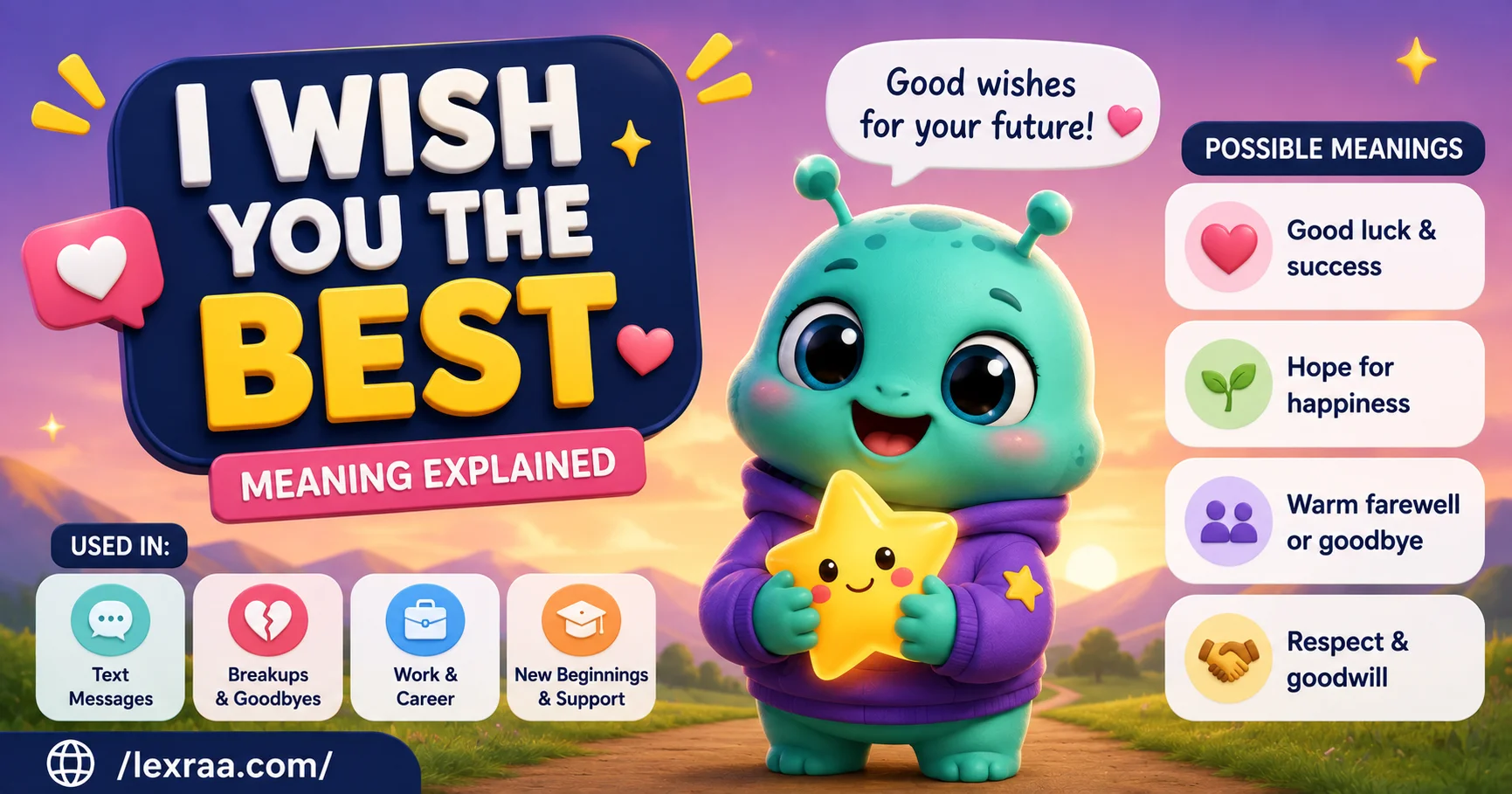
“I wish you the best” means “I hope good things happen for you.” It can express kindness, encouragement, congratulations, or goodwill. However, when said during a farewell or breakup, it can also carry the feeling of “I’m moving on, but I genuinely hope you’re okay.”
What Does “I Wish You the Best” Mean?
At its most straightforward, “I wish you the best” is an expression of goodwill. The speaker is saying that they hope the other person has happiness, success, peace, good fortune, or positive experiences in the future.
It is not an acronym, abbreviation, or internet slang term. It is an ordinary English phrase that can be used in conversation, text messages, emails, cards, workplace communication, and personal relationships.
For example:
“Good luck with your new job. I wish you the best.”
Here, the meaning is simply that the speaker hopes the new opportunity goes well.
The phrase is deliberately broad. “The best” does not refer to one specific thing unless the surrounding conversation tells you what that thing is. It could mean success in a career, happiness after a difficult period, a good future after moving away, or simply positive things in someone’s life.
Oxford’s dictionary definition of wish includes the sense of expressing hope that someone will be happy, lucky, or successful, with examples such as wishing someone well or wishing them every success.
Is “I Wish You the Best” Slang?
No. “I wish you the best” is not slang.
It is also not a texting abbreviation like “LOL,” “IDK,” or “BTW.” Someone may type it casually in a text, but using it in a text does not turn the phrase into slang.
This distinction matters because the phrase can appear in very informal conversations while still being standard English.
For example:
“You’re moving tomorrow? I wish you the best!”
That is a casual message, but the expression itself remains standard English.
You may also see the shorter version:
“Wish you the best!”
This simply drops the subject “I.” The meaning remains essentially the same, although the shorter form feels more conversational and less formal.
The Meaning Can Change With Context
The words stay the same, but the emotional message can change considerably depending on who says them, when they say them, and what happened immediately before.
If a friend says:
“You’ve worked so hard on this project. I wish you the best!”
the phrase sounds supportive.
If a colleague says:
“It was great working with you. I wish you the best.”
it functions more like a professional farewell.
If an ex says:
“I don’t think we should continue this relationship. I wish you the best.”
the phrase may sound much more final.
That does not mean the phrase has secretly acquired a completely different dictionary definition. Rather, the surrounding circumstances add pragmatic meaning—the meaning listeners infer from context.
This is one of the most important things to understand about the phrase: “I wish you the best” does not automatically mean goodbye, but it can be used to close a relationship or conversation.
Does “I Wish You the Best” Mean Goodbye?
Sometimes, but not always.
The phrase is closely associated with farewells because expressions such as “all the best” are established ways of saying goodbye, ending a letter, or sending good wishes. Cambridge specifically lists “all the best” as a phrase used for goodbye, ending a letter, or sending good wishes.
“I wish you the best” can work similarly.
For example:
“It was wonderful having you on the team. I wish you the best in your new position.”
There is clearly a goodbye element because the person’s departure has already been established.
But consider:
“I know your interview is tomorrow. I wish you the best!”
This is not necessarily a goodbye. It is encouragement.
So if someone sends you “I wish you the best,” don’t automatically interpret it as “I never want to speak to you again.” Look at the conversation around it.
What Does It Mean When an Ex Says “I Wish You the Best”?
This is where the phrase creates the most confusion.
After a breakup, “I wish you the best” often communicates goodwill while acknowledging that the relationship is ending or changing.
It can mean something like:
“I hope you’re happy and successful, even though we’re no longer together.”
It may also function as a polite closing statement when the speaker does not want to continue discussing the relationship.
However, the sentence alone cannot tell you whether an ex still has romantic feelings, wants to remain friends, or hopes you will get back together.
Some relationship-focused articles treat the phrase as a strong goodbye, while others emphasize that it can simply express goodwill. That disagreement itself is useful: there is no universal hidden translation for the phrase when an ex says it. Context and the rest of the conversation matter more than the sentence by itself.
For example, compare:
“I wish you the best. I’ll always care about you.”
with:
“I wish you the best. Please don’t contact me anymore.”
The first leaves emotional warmth in the message. The second clearly establishes distance.
The phrase is identical, but the surrounding words completely change how it should be interpreted.
“I Wish You the Best” vs. “Good Luck”
These expressions overlap, but they are not identical.
“Good luck” usually focuses on a particular event or challenge:
“Good luck on your exam.”
“I wish you the best” is broader:
“I wish you the best in your new career.”
Good luck often points toward something specific that is about to happen. “I wish you the best” can refer to someone’s wider future.
That difference becomes especially noticeable during farewells. “Good luck” can sound temporary, while “I wish you the best” can sound more like a broader statement about the person’s life ahead.
“I Wish You the Best” vs. “I Wish You Well”
“I wish you well” is very close in meaning.
Both expressions communicate hope for another person’s welfare or success.
“I wish you well” can sound slightly more formal or literary in some contexts:
“I wish you well in your future endeavors.”
“I wish you the best” is extremely natural in everyday speech and writing.
Oxford specifically documents “wish somebody well” as a construction meaning to hope that someone will be happy, lucky, or successful.
Where Is the Phrase Used?
Because this is standard English rather than platform-specific slang, there is no reliable reason to associate it with one particular social-media app.
It can naturally appear in:
- Text messages
- WhatsApp chats
- Instagram DMs
- Emails
- Workplace messages
- Farewell cards
- Graduation messages
- Conversations between friends
- Relationship conversations
The platform generally does not determine the meaning.
For example, “I wish you the best” in WhatsApp and “I wish you the best” in an email can express the same basic goodwill. The difference usually comes from the relationship and situation rather than the app.
Where Did the Phrase Come From?
There does not appear to be a single documented person, event, website, or social-media community responsible for creating the exact phrase “I wish you the best.”
It is better to avoid invented origin stories.
The expression follows a much older English pattern in which wish is used to express hope for another person’s happiness, success, or well-being. Oxford traces the verb wish to Old English wȳscan, from Germanic roots, and documents its use in constructions such as “wish somebody well” and “wish somebody every success.”
Related farewell expressions also have a long history. Dictionary.com records “all the best” as a best-wishes/farewell expression and dates that idiomatic use to 1937.
So the safest explanation is that “I wish you the best” developed naturally from established English patterns for expressing good wishes. There is no clear single origin story for the exact modern phrase.
Natural Examples of “I Wish You the Best”
1. Funny — Friend
Maya: “I finally quit my terrible job.”
Lena: “Wait, you actually did it?”
Maya: “Yep. Freedom starts Monday.”
Lena: “Honestly, I wish you the best—and may your next boss actually read emails.”
Here, the phrase is sincere but surrounded by humor.
2. Sarcastic — Friends
Alex: “I’m moving to a city where I know nobody.”
Sam: “Bold strategy.”
Alex: “I’m calling it character development.”
Sam: “I wish you the best. Please remember us when you’re famous.”
The phrase is playful rather than emotionally serious.
3. Playful — Dating
Nora: “My interview is tomorrow and I’m already nervous.”
Eli: “You’ve got this.”
Nora: “Easy for you to say.”
Eli: “Fine. I wish you the best—and I’m expecting celebratory coffee afterward.”
Here, it expresses encouragement without sounding like a farewell.
4. Serious — Breakup
Jordan: “I think we’ve reached the point where we need to let this go.”
Taylor: “I didn’t want it to end like this.”
Jordan: “Neither did I.”
Taylor: “I wish you the best, genuinely.”
The phrase acts as a respectful closing statement.
5. Workplace Farewell
Manager: “We’re really going to miss having you on the team.”
Employee: “I’ve loved working here.”
Manager: “Good luck with the new position.”
Employee: “Thank you. I wish you all the best too.”
This is professional goodwill, not romantic or emotionally coded language.
6. Family
Sister: “I’m nervous about moving out.”
Brother: “You’ll figure it out.”
Sister: “You really think so?”
Brother: “Absolutely. I wish you the best, even if you stop answering our family group chat.”
The phrase expresses support with a personal joke attached.
7. Group Chat
Chris: “I’m leaving the gaming group for a while.”
Ava: “Nooo, who is going to carry us now?”
Chris: “You’ll survive.”
Ava: “I wish you the best, legend. We’ll probably lose every match.”
This is affectionate and humorous rather than final in a serious sense.
8. Professional Email
Daniel: “Thank you for everything during the project.”
Priya: “It was a pleasure working with you.”
Daniel: “I’m starting my new role next week.”
Priya: “Congratulations. I wish you the best in your new position.”
This is polite, professional, and clearly positive.
How Should You Reply to “I Wish You the Best”?
Your response depends on what you want the conversation to communicate.
Neutral Reply
“Thank you. I wish you the best too.”
This is safe when you are unsure what tone the other person intended.
Serious Reply
“Thank you. I appreciate that. I genuinely wish you well too.”
This works when the conversation is emotional or important.
Funny Reply
“Thanks! I’ll do my best not to disappoint the universe.”
This keeps the exchange light when the original message was casual.
Flirty Reply
A flirty reply only makes sense if the conversation is clearly romantic and the phrase was not intended as a goodbye.
“Thanks, but I was hoping you’d be part of the best.”
That response changes the tone and can reopen a romantic conversation, so it should not be used if the other person has clearly ended the relationship.
Comparison: Similar Expressions
| Term | Meaning | Tone | Popularity | Confusion Risk |
|---|---|---|---|---|
| I wish you the best | Hope good things happen for you | Warm/neutral | Very common | Low |
| Good luck | Hope a specific situation goes well | Casual/supportive | Very common | Low |
| Best wishes | Express goodwill or good hopes | Polite/formal | Common | Low |
| I wish you well | Hope you are happy, successful, or okay | Formal/warm | Common | Medium |
| All the best | Good wishes; can also be a farewell | Casual/polite | Very common | Medium |
| Take care | Hope you remain well; often used when parting | Casual/warm | Very common | Medium |
| I don’t wish you well | The opposite: expressing lack of goodwill | Negative | Less common | Low |
The important distinction is that “I wish you the best” is broad, while “good luck” tends to focus on a particular challenge. “All the best” can function especially naturally as a farewell or sign-off, while “take care” can be both a caring statement and a simple conversational goodbye. Cambridge explicitly recognizes “all the best” as a goodbye, letter-ending, and good-wishes expression.
Who Uses “I Wish You the Best”?
There is no strong evidence that this phrase belongs specifically to Gen Z, Millennials, a particular gender, or one region.
It is part of general English vocabulary and can be used by people of different ages in personal and professional communication.
The context may change the preferred wording. A younger person might type:
“Wish you the best!”
while a formal workplace message might say:
“I wish you every success in your future endeavors.”
But both communicate a similar basic idea.
It would be misleading to label the phrase as specifically American, British, Gen Z, or Millennial slang.
Is “I Wish You the Best” Rude or Safe?
Generally, it is polite and safe.
It contains no profanity or inherently offensive language. It can be used with friends, family, classmates, teachers, coworkers, managers, clients, and acquaintances.
The one issue is emotional interpretation.
After a breakup, “I wish you the best” can feel cold or final if the recipient expected reconciliation. In a workplace conversation, however, the same words can sound completely normal and respectful.
So the phrase itself is not rude. The circumstances can make it feel distant.
If you want to make a professional message warmer, add a specific sentence:
“I really enjoyed working with you, and I wish you the best in your new role.”
That sounds more personal than simply writing:
“I wish you the best.”
Why Does This Phrase Work So Well?
The strength of “I wish you the best” comes from its deliberate openness. It communicates positive intention without forcing the speaker to specify exactly what the other person’s future should look like. That makes it useful in situations ranging from congratulations to difficult goodbyes. It can also create emotional distance without becoming hostile: someone can sincerely want another person to be happy while accepting that they will no longer be closely involved in that person’s life. This combination of goodwill and flexibility explains why the phrase remains useful across personal and professional communication.
Frequently Asked Questions
Does “I wish you the best” mean goodbye?
It can, especially when it appears at the end of a relationship, job, friendship, or important conversation. However, the phrase itself does not always mean goodbye. Someone can say it before an exam, interview, trip, or new opportunity simply to express encouragement.
Does “I wish you the best” mean they care about you?
It shows at least an expression of goodwill, but it cannot tell you exactly how deeply someone feels. A person can wish you happiness while also wanting emotional or physical distance. The surrounding conversation is much more informative than the phrase alone.
Is “I wish you the best” passive-aggressive?
Not inherently. It is normally a positive expression of goodwill. It can sound passive-aggressive if the surrounding message, punctuation, sarcasm, or relationship history creates that impression, but the phrase itself does not carry a passive-aggressive meaning.
What does “I wish you nothing but the best” mean?
It is a stronger version of the same basic message. “Nothing but the best” emphasizes that the speaker hopes only positive things happen to the other person. Depending on context, it can sound especially sincere, emotional, or final.
What does “I wish you the best for the future” mean?
It means the speaker hopes your future goes well. It is particularly common when someone is leaving a job, school, relationship, location, or another stage of life. Adding “for the future” makes the forward-looking aspect more explicit.
Is “I wish you the best” formal?
It can work in both formal and informal situations. In professional communication, it is polite and acceptable, although a more specific phrase such as “I wish you every success in your new role” can sound more tailored. In casual texting, “Wish you the best!” is perfectly understandable.
Can I say “I wish you the best” after a breakup?
Yes, but understand that it can sound like a closing statement. If you genuinely want to remain friends or continue communicating, saying so directly may prevent confusion. For example, “I wish you the best, and I hope we can still be on good terms” communicates more than the original phrase alone.
Is “I wish you the best” the same as “I wish you well”?
They are very similar. Both express a hope that another person experiences happiness, success, or well-being. “I wish you the best” is often broader and more conversational, while “I wish you well” can sound somewhat more formal depending on the situation.
Final Takeaway
“I wish you the best” means “I hope good things happen for you.” It is a standard English expression, not slang or an abbreviation.
Its meaning can range from simple encouragement to a meaningful farewell. After a new job announcement, it may simply mean “I hope you succeed.” Before an exam, it can mean “Good luck.” At the end of a professional relationship, it can mean “I hope your next chapter goes well.” After a breakup, it may communicate goodwill alongside emotional distance.
The biggest mistake is assuming that the phrase has one hidden meaning in every situation.
Instead, pay attention to what came before it, who said it, the relationship between the people, and whether the conversation is continuing or ending.
If you want to interpret a message accurately, don’t analyze “I wish you the best” in isolation. The surrounding words usually reveal whether it is encouragement, politeness, affection, or a respectful goodbye.