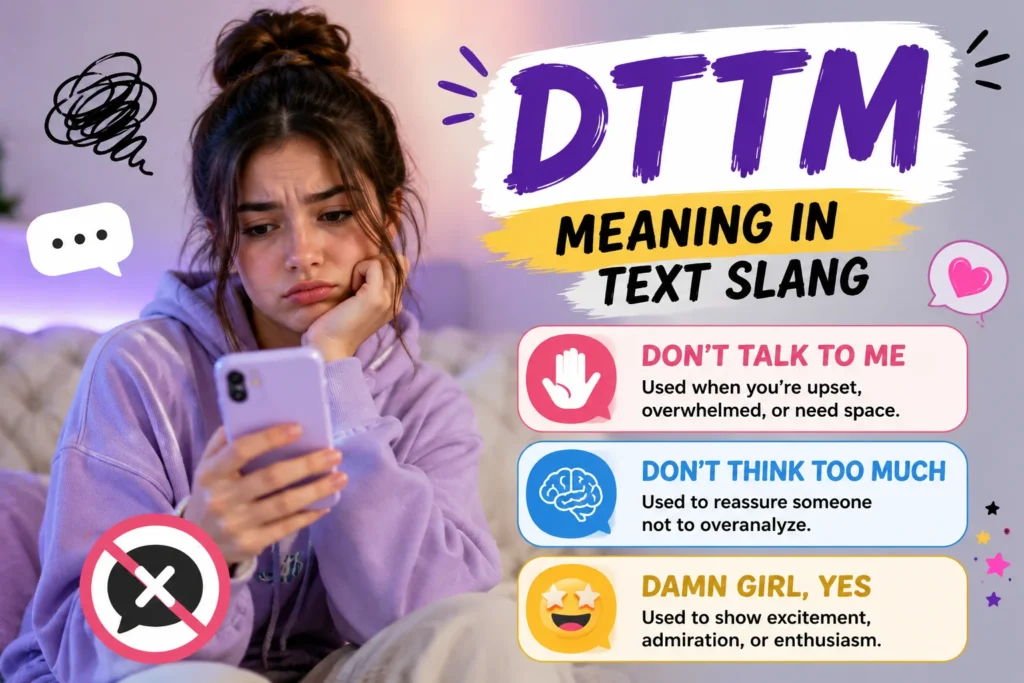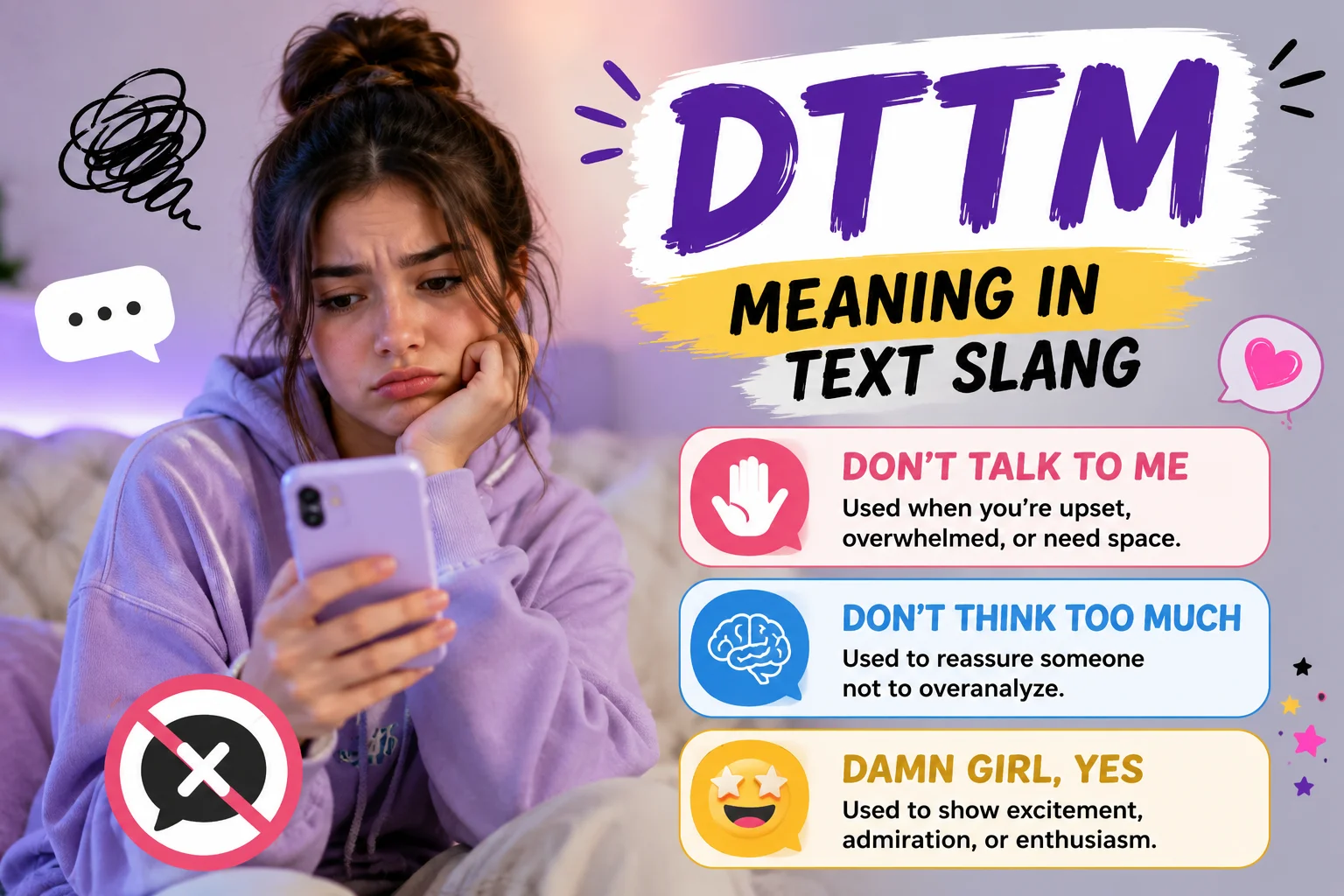
DTTM means “Don’t Talk to Me” in text messages and online conversations. People use this abbreviation when they want someone to stop talking, need personal space, or feel too annoyed or overwhelmed to continue a conversation. It can sound serious or playful depending on the situation.
For example, someone might text “DTTM right now” after an argument because they genuinely want space. Another person might say “DTTM 😭” after making an embarrassing mistake as a dramatic joke.
The surrounding conversation usually reveals which meaning the sender intends.
What Does DTTM Stand For?
DTTM stands for Don’t Talk to Me. It is an informal texting abbreviation formed from the first letters of the phrase.
People use it to communicate that they don’t want to talk at that moment or would rather avoid a particular subject.
Here are its basic characteristics:
| Detail | Meaning |
|---|---|
| Full form | Don’t Talk to Me |
| Type | Texting abbreviation |
| Main purpose | Asking someone to stop talking or give space |
| Tone | Direct, frustrated, dismissive, or playful |
| Formality | Very informal |
| Profanity | No |
DTTM is not usually a polite way to end a conversation. Depending on the relationship and tone, it can come across as blunt or even rude.
How Is DTTM Used in Text Messages?
Although DTTM has one main expansion, people use it in different situations. The tone depends on whether the sender is genuinely setting a boundary or simply reacting dramatically to something.
1. When Someone Wants Space
A person might use DTTM when they are upset, tired, or not ready to discuss something.
Example:
- Alex: Can we talk about what happened yesterday?
- Sam: Not right now. DTTM, please.
Here, Sam wants to pause the conversation and avoid discussing the issue at that moment.
2. When Someone Feels Annoyed
DTTM can express irritation when someone keeps asking questions, repeating something, or bringing up an unwanted subject.
Example:
- Mia: Did you finish the assignment?
- Jake: You have asked me five times already. DTTM.
Jake is frustrated by the repeated questions.
3. As a Playful Reaction
Friends sometimes use DTTM dramatically after an embarrassing mistake or an unfortunate event. In this situation, the sender may not literally want people to stop talking.
Example:
- Emma: I waved at someone who wasn’t waving at me.
- Lily: No way 😭
- Emma: DTTM. I’m never going outside again.
Emma is joking about feeling embarrassed.
4. When Someone Doesn’t Want to Discuss a Topic
DTTM can also be directed at a particular subject rather than the person asking about it.
Example:
- Noah: Remember when you fell during the school performance?
- Chris: DTTM about that. I’m still embarrassed.
Chris wants Noah to stop bringing up the embarrassing memory.
Realistic Examples of DTTM in Conversations
These examples show how the abbreviation can appear in everyday messaging.
Example 1: After an argument
- A: You never listen to what I’m saying.
- B: I’m too upset to discuss this. DTTM for now.
Example 2: After an embarrassing mistake
- A: I accidentally sent the screenshot to the person I was talking about.
- B: Seriously?
- A: DTTM 😭
Example 3: When someone keeps teasing
- A: Remember your terrible singing yesterday?
- B: Bro, DTTM about my singing.
Example 4: When someone needs a break
- A: Want to join the group call?
- B: Not today. I need some quiet time. DTTM.
Example 5: When a topic becomes uncomfortable
- A: So, are you going to explain what happened?
- B: I don’t want to discuss it right now. Please leave it alone.
The last example uses the full phrase instead of the abbreviation. It shows how someone can communicate the same boundary more clearly.
Is DTTM Rude?
DTTM can sound rude because it directly tells someone not to talk to you. However, its tone depends on the situation and the relationship between the people communicating.
For example, a close friend might send:
“DTTM 😂 You know I can’t handle another embarrassing story.”
This is likely playful.
But sending:
“DTTM. I’m done talking to you.”
during a serious disagreement sounds much more dismissive.
If someone sends you DTTM during an argument, don’t automatically assume they are joking. They may genuinely need time away from the conversation.
How to Reply When Someone Says DTTM
The best response depends on whether the sender sounds serious, irritated, or playful. When someone clearly asks for space, respect that request instead of continuing to message them.
| Situation | Possible reply |
|---|---|
| They seem upset | “Okay, I’ll give you some space.” |
| They need time | “No problem. We can talk later.” |
| They are frustrated | “I understand. I won’t push it.” |
| They are joking | “Fine, I’ll stop embarrassing you 😂” |
| They want to avoid a topic | “Got it. I won’t bring it up again.” |
If you’re unsure whether they are joking, a simple response such as “Okay, let me know when you’re ready to talk” is usually a safe choice.
Unlike DTTM, BRB meaning in text signals a temporary break: the sender is stepping away but expects to return to the conversation.
DTTM vs. Similar Text Abbreviations
DTTM can be confused with other abbreviations because several texting expressions involve ending a conversation or asking for space. However, they don’t all communicate the same thing.
| Abbreviation | Full Form | Main Difference |
|---|---|---|
| DTTM | Don’t Talk to Me | Asks someone to stop talking or give space |
| IDC | I Don’t Care | Shows a lack of interest or concern |
| DND | Do Not Disturb | Signals that someone doesn’t want interruptions |
| TTM | Talk to Me | Invites someone to communicate |
| TTYL TTYL is a casual way to end a conversation for now, while DTTM more directly asks someone to stop talking. Learn more about TTYL meaning in text and how it is used as a sign-off. | Talk to You Later | Indicates that the conversation will continue later |
| BRB | Be Right Back | Means someone is temporarily stepping away |
One particularly useful comparison is DTTM versus TTM.
DTTM pushes a conversation away, while TTM invites someone to talk. The extra “D” changes the meaning completely.
DTTM asks someone to stop talking, whereas IDC communicates that something does not matter to the sender. See IDC meaning in text for more examples of how this abbreviation can sound indifferent or dismissive.
Frequently Asked Questions
1. What does DTTM mean from a girl or guy?
DTTM means “Don’t Talk to Me” regardless of who sends it. A person’s gender does not change the abbreviation’s meaning. The surrounding conversation helps you understand whether the message is serious or playful.
2. Does DTTM mean someone is angry?
Not always. Someone may use it when they are irritated, embarrassed, overwhelmed, or simply not interested in talking. Sometimes it is an exaggerated joke between friends rather than a sign of genuine anger.
DTTM can communicate that someone has reached their limit, while FFS meaning in text explains another common way people express frustration or exasperation in digital conversations.
3. Is DTTM the same as leave me alone?
They communicate similar ideas, but they aren’t exactly the same phrase. DTTM literally means “Don’t Talk to Me,” while “leave me alone” can also ask someone to stop approaching, contacting, or bothering you.
4. Is DTTM an offensive abbreviation?
DTTM does not contain profanity, but it can sound harsh or disrespectful when directed at someone. Its impact depends on the relationship, situation, and tone of the message.
5. What is the difference between DTTM and TTM?
DTTM means “Don’t Talk to Me,” while TTM means “Talk to Me.” The first asks someone to stop communicating, whereas the second encourages conversation.
6. Can I use DTTM in professional messages?
It’s better to avoid it in professional communication. Many people may not recognize the abbreviation, and its direct tone can sound dismissive. Use a clearer sentence such as “I’m unavailable right now” or “Can we discuss this later?”
Final Thoughts
DTTM means “Don’t Talk to Me” in texting and casual online conversations. People use it to ask for space, express frustration, or jokingly react to an embarrassing or annoying situation.
If someone sends you DTTM, pay attention to the conversation before deciding how to respond. A playful message between friends is different from a serious request to stop communicating. When in doubt, respect their space and let them decide when they’re ready to talk.