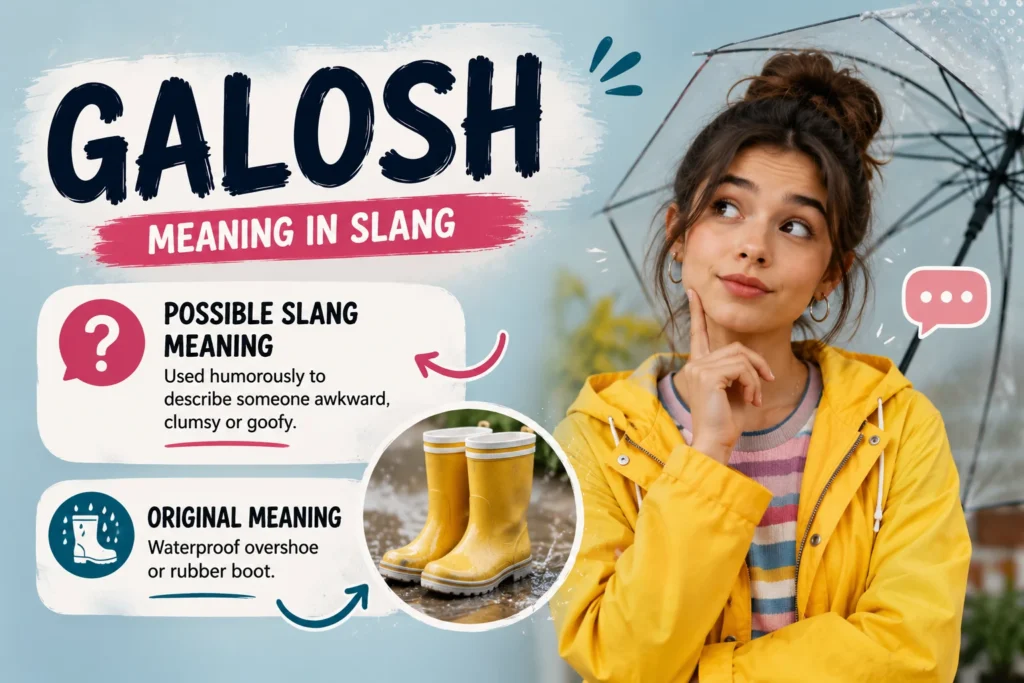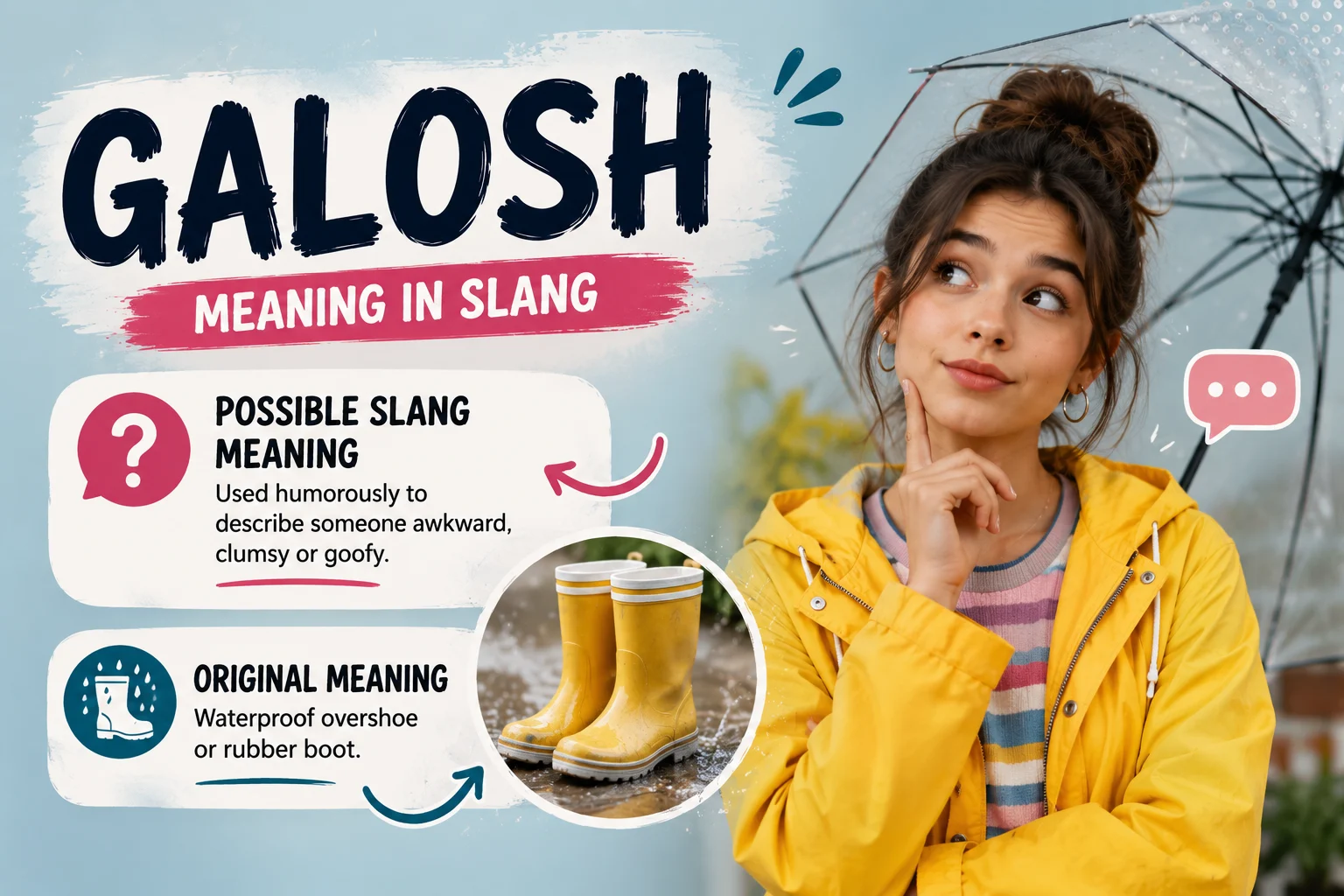
If you’re searching for “galosh meaning slang in English,” the short answer is that galosh is not an established English slang term. It is primarily the standard word for a waterproof overshoe, while alleged slang meanings are inconsistent, poorly documented, and not widely used in real conversations.
People search this phrase because they may have seen galosh in a meme, social media comment, or one of the many recent SEO articles claiming it has a hidden slang meaning. Unfortunately, those sources often contradict each other, making it difficult to know what’s real.
This guide separates verified facts from internet speculation so you can understand exactly what “galosh” means—and what it doesn’t.
What Does “Galosh” Actually Mean?
The word galosh (sometimes spelled golosh) has a long-established meaning in English. It refers to a waterproof overshoe or rubber boot worn over regular shoes to keep feet dry in rain, snow, or muddy conditions.
This is the definition recognized by major English dictionaries and has been in use for well over a century.
Examples:
- Don’t forget your galoshes before walking through the snow.
- She slipped on a pair of galoshes before going outside.
Outside of this literal meaning, there is no officially recognized slang definition in major dictionaries or established English language references.
Is “Galosh” Actually Slang?
The evidence says not in any widely accepted sense.
Unlike internet abbreviations such as LOL, SMH, TBH, or ICYMI, galosh is not a recognized piece of internet slang.
During verification, several newer websites claimed that galosh can describe someone who is:
- awkward
- goofy
- clumsy
- socially awkward
- old-fashioned
However, these explanations present several problems:
- They don’t agree on one consistent definition.
- They rarely provide real examples from authentic conversations.
- Most cite no original source showing how the supposed slang developed.
- The claimed meanings are absent from authoritative dictionaries.
That doesn’t mean nobody has ever used galosh jokingly as a nickname or insult. Individual users can give almost any word a humorous meaning within a conversation.
The important distinction is this:
A one-off joke or nickname is not the same as established internet slang.
At the time of writing, there isn’t enough independent evidence to say that galosh has become a recognized slang word in English.
Why Do So Many People Search “Galosh Meaning Slang”?
This is perhaps the most interesting part of the story.
Search interest doesn’t necessarily mean a slang word actually exists.
Instead, several factors appear to be driving searches for this keyword.
Conflicting SEO Articles
Over the past year, dozens of websites have published articles assigning different slang meanings to galosh.
Some describe it as:
- a clumsy person
- an awkward friend
- someone acting foolish
- a playful insult
Because these articles often disagree with one another, readers naturally search Google hoping to find the “real” answer.
Curiosity After Seeing the Word Online
Sometimes someone encounters galosh in:
- a meme
- a comment section
- a Discord conversation
- a gaming chat
Without context, they assume it’s a hidden piece of Gen Z slang and search for its meaning.
In many cases, however, the writer may simply be using the ordinary English word or inventing a personal joke.
AI and Content Farming
Another reason for the confusion is the rapid growth of AI-generated and SEO-focused content.
Some websites publish articles for virtually every unusual word paired with phrases like:
- “meaning in slang”
- “TikTok meaning”
- “Gen Z meaning”
even when there is little or no documented evidence that the word functions as genuine slang.
This creates a cycle:
- One unsupported article appears.
- Other sites repeat it.
- People search because they’ve seen conflicting definitions.
- More articles are published.
Search volume increases even though the slang itself never becomes established.
Read More: KM Meaning Slang: What It Really Means in Texts and Social Media
Is “Galosh” an Acronym, Abbreviation, or Slang Word?
None of the above.
Galosh is simply a noun.
It is:
- not an acronym
- not an abbreviation
- not an initialized phrase
- not an officially recognized slang expression
Although individual internet users occasionally experiment with words creatively, there is no evidence that galosh has developed into a stable slang term with one accepted meaning.
Where Does “Galosh” Appear Online?
Unlike genuine internet slang, galosh doesn’t have a consistent platform-specific meaning.
Social Media
Occasionally, people may use the word humorously in memes or comments, often comparing someone to old-fashioned rain boots or making a playful joke.
These uses are highly individual and don’t represent a shared internet definition.
Dictionaries
Authoritative dictionaries consistently define galosh only as waterproof footwear.
They do not list any modern slang meaning.
Forums and Discussion Boards
Most forum discussions mentioning galosh are about:
- footwear
- winter clothing
- vintage fashion
- historical language
- spelling (“galosh” vs. “golosh”)
There is very little evidence of people using it as an established slang expression.
What Makes a Word Count as Real Slang?
One reason this keyword causes confusion is that people often assume any unusual word online must be slang.
In reality, linguists generally recognize slang when several things happen:
- Many unrelated people use the word with the same meaning.
- The meaning stays relatively consistent across conversations.
- It spreads naturally across platforms and communities.
- Other speakers understand it without needing an explanation.
Words like LOL, GOAT, NPC, and ghosting meet these criteria because millions of people use them consistently.
Based on currently available evidence, galosh does not.
Possible Contexts Where Someone Might Use “Galosh” Humorously
Although galosh is not an established slang word, language on the internet is creative. People sometimes give ordinary words temporary or humorous meanings within a specific group of friends or community.
These uses are context-specific jokes, not definitions that most English speakers would automatically recognize.
As a Playful Nickname
A friend might jokingly call someone “a galosh” after they trip over their own feet or wear oversized rain boots.
Example
A: You slipped walking into the café again.
B: It was the wet floor!
A: Sure, galosh. 😂
Here, the word works as a lighthearted nickname rather than established slang.
As a Joke About Being Old-Fashioned
Because galoshes are often associated with rainy weather and older generations, someone might jokingly compare a person’s style to a galosh.
Example
A: You actually brought rain boots on vacation?
B: The forecast said storms.
A: You’re such a galosh sometimes.
Again, this isn’t a recognized slang definition—it’s simply playful teasing.
As an Inside Joke
Friend groups frequently invent words that make sense only within their own conversations.
For example, one group might use galosh to describe anyone who forgets an umbrella.
Outside that group, however, nobody would understand the meaning without an explanation.
This illustrates an important point:
A personal nickname or inside joke does not automatically become internet slang.
Real Conversation Examples
The following conversations show possible humorous uses of the word based on context. They are not examples of an established slang definition.
Example 1 – Friends After the Rain
A: You wore sandals in this weather?
B: I thought it wouldn’t rain.
A: Rookie mistake, galosh.
B: Next time I’ll bring boots.
Example 2 – Family Group Chat
A: Dad packed rain boots for a beach trip.
B: Classic Dad.
A: Total galosh move.
B: At least we’ll stay dry.
Example 3 – Gaming Voice Chat
A: You ran straight into the trap.
B: I didn’t even see it.
A: Nice one, galosh.
B: Thanks for the support. 😂
Example 4 – School Friends
A: I brought two jackets today.
B: Why two?
A: Just in case it gets cold.
B: You’re becoming a real galosh.
Example 5 – Office Humor
A: I printed the meeting agenda twice.
B: Better safe than sorry.
A: That’s the most galosh thing I’ve done all week.
B: At least everyone has a copy.
Example 6 – Weather Conversation
A: It finally started snowing.
B: Good thing I wore waterproof boots.
A: Look who’s prepared.
B: Call me a galosh if you want.
These conversations demonstrate how ordinary words can be repurposed as temporary jokes. They should not be interpreted as evidence that “galosh” is widely recognized slang.
Grammar and Language Role
Part of Speech
Galosh is a noun.
Its standard meaning refers to waterproof footwear worn over shoes.
Sentence Position
It most naturally appears as a noun.
Examples:
- I forgot my galoshes.
- Those galoshes kept my feet dry.
In humorous conversations, it may occasionally be used as a nickname.
Example:
- Don’t be such a galosh.
This usage is creative rather than grammatically standard.
Can It Replace a Full Sentence?
No.
Unlike abbreviations such as LOL, OMG, or BRB, the word galosh cannot naturally stand alone as a complete response.
For example:
❌ Galosh.
doesn’t communicate a clear meaning without additional context.
Formal vs. Informal Register
| Context | Appropriate? |
|---|---|
| Dictionaries | ✅ Yes |
| Literature | ✅ Yes |
| Casual conversation | ✅ Yes |
| Humorous nickname | Occasionally |
| Professional writing | ✅ Literal meaning only |
| Internet slang | ❌ Not established |
How to Reply if Someone Calls You “Galosh”
Since there is no fixed slang meaning, your reply depends entirely on the joke being made.
Funny Reply
“I’ll take that as a compliment.”
or
“At least I’m waterproof.”
Serious Reply
“What do you mean by galosh?”
This is perfectly reasonable because many people won’t recognize the intended joke.
Flirty Reply
A flirty response generally doesn’t fit this word naturally.
If someone jokingly calls you galosh, it’s usually better to respond playfully rather than romantically.
Example:
“Only if you promise to be my umbrella.”
Neutral Reply
“Fair enough.”
or
“I’ll survive.”
Comparison Table
| Term | Meaning | Usage Context | Tone | Popularity | Confusion Risk |
|---|---|---|---|---|---|
| Galosh | Waterproof overshoe; occasional personal joke | Literal English word | Neutral | Moderate (literal) | High when mistaken for slang |
| Goofball | Silly or funny person | Casual speech | Playful | High | Low |
| Dork | Socially awkward person | Informal conversation | Light teasing | High | Low |
| Clown | Someone acting foolish | Social media, texting | Humorous or sarcastic | Very High | Low |
| NPC | Someone acting predictable or lacking originality | Internet slang | Sarcastic | Very High | Medium |
| Professional (opposite idea) | Serious or competent person | General English | Neutral | High | Very Low |
Key Takeaway
Words like clown, dork, and NPC have become genuine internet slang because millions of people use them with shared meanings.
Galosh hasn’t reached that stage. When it appears as a humorous nickname, the meaning comes almost entirely from the immediate conversation rather than a widely understood internet definition.
Who Uses the Word “Galosh”?
Age Group Breakdown
Unlike popular internet slang, galosh is not strongly associated with any particular age group.
- Older adults are generally more familiar with the literal meaning because the word has been part of English for generations.
- Younger users are more likely to encounter the word after seeing it in a meme, an AI-generated article, or a Google search rather than through everyday conversation.
Gen Z vs. Millennials
There is no reliable evidence that Gen Z or Millennials use galosh as established slang.
The difference is more about exposure than meaning:
- Gen Z may occasionally see the word in humorous online posts or curiosity-driven content asking, “What does galosh mean?”
- Millennials are slightly more likely to recognize it as the name of waterproof footwear from books, family conversations, or older media.
Neither generation consistently uses galosh as a shared slang expression.
Regional Usage
The literal word galosh is understood in many English-speaking countries, although its popularity has declined over time.
The spelling golosh is also considered correct in some dictionaries.
There is no verified regional slang meaning in the United States, United Kingdom, Canada, Australia, or other English-speaking regions.
Online Platforms
Based on available evidence:
- TikTok: No verified, widespread slang usage.
- Instagram: Occasional humorous references to the literal word or fashion, but no consistent slang meaning.
- Snapchat: No evidence of an established slang definition.
- WhatsApp: No documented slang usage.
- X (formerly Twitter): The word occasionally appears in jokes or discussions about footwear, but not with a stable internet slang meaning.
In other words, galosh behaves like a regular English word—not like internet slang.
Origin and Internet Culture
Where Did the Word “Galosh” Come From?
The English word galosh dates back several centuries.
It ultimately comes from older European languages and entered English through French, where it referred to a type of protective shoe or overshoe.
Over time, the meaning became standardized as waterproof footwear worn over ordinary shoes during wet weather.
Unlike many internet slang terms, galosh did not originate online.
Has It Become Internet Slang?
Current evidence suggests no.
While individual users occasionally use galosh as a humorous nickname, there is no documented point where the word evolved into a widely recognized internet expression.
Instead, the recent increase in searches appears to come from:
- curiosity
- conflicting SEO articles
- AI-generated content
- isolated jokes taken out of context
This is quite different from words like ghosting, GOAT, or NPC, whose meanings spread naturally through millions of real conversations.
Why the Confusion?
Internet culture moves quickly, and unusual words often attract attention.
Once a few websites suggest that an uncommon dictionary word has a hidden slang meaning, others repeat the claim without independent verification.
As a result, search interest grows even though real-world usage remains limited.
This appears to be exactly what has happened with galosh.
Is “Galosh” Rude or Offensive?
No.
The standard English word galosh is completely neutral.
It contains:
- no profanity
- no offensive language
- no sexual meaning
- no hate speech
- no discriminatory language
If someone jokingly calls another person “a galosh,” the tone depends entirely on the relationship and the context.
Among friends, it might be playful.
Between strangers, however, the joke could simply cause confusion because most people won’t recognize any intended slang meaning.
Is It Appropriate for School or Work?
Yes.
Using galosh in its literal sense is perfectly appropriate in:
- schools
- workplaces
- academic writing
- newspapers
- professional communication
If someone uses it as a private joke or nickname, remember that not everyone will understand the intended meaning.
For clear communication, it’s usually better to choose more familiar words.
Real-World Observation
One interesting thing about galosh is that the search trend tells us more about today’s internet than about the word itself.
People increasingly assume that any unusual word must hide a secret Gen Z meaning, especially after seeing articles or social media posts suggesting it does. In reality, many of these searches begin because someone encounters conflicting information rather than genuine slang usage.
That makes galosh a good example of how online curiosity, search engines, and content publishing can create interest around a word without changing its actual meaning.
Frequently Asked Questions
What does galosh mean in English?
A galosh is a waterproof overshoe or rubber boot worn over regular shoes to protect them from rain, snow, or mud. This is the established dictionary definition used throughout the English-speaking world. It is not primarily a slang word.
Is galosh real slang?
No verified evidence shows that galosh is established internet slang. While a few websites assign humorous meanings to the word, those definitions are inconsistent and lack widespread real-world usage. At present, it should be treated as a standard English noun.
Why do people search for “galosh meaning slang”?
Many searches appear to be driven by confusion after seeing conflicting online articles or isolated jokes. Some readers assume the word has a hidden internet meaning, but available evidence does not support that conclusion.
Is galosh used on TikTok?
There is no verified evidence that galosh has a shared slang meaning on TikTok. Most appearances relate to footwear, weather, fashion, or isolated humorous comments rather than a recognized internet expression.
Can I call someone a galosh?
You can, but only as a personal joke. Because there is no widely accepted slang definition, many people may not understand what you mean. If you intend to tease someone playfully, a more familiar term will usually communicate your meaning more clearly.
Is galosh offensive?
No. The literal word is completely neutral. Any humorous use depends on tone and context rather than the word itself.
Does galosh have a hidden Gen Z meaning?
No reliable evidence supports the idea that galosh has a secret Gen Z definition. While isolated jokes exist online, they have not developed into widely understood slang.
What is the difference between galosh and golosh?
Both galosh and golosh refer to the same type of waterproof overshoe. The different spellings reflect historical variations rather than different meanings.
Why do some websites give different slang meanings for galosh?
Many recent SEO-focused articles attempt to assign slang meanings to uncommon words without citing consistent evidence. Because they often disagree with one another, readers are left searching for clarification.
Should I use galosh as slang?
Unless you’re making an inside joke with friends, it’s better not to. Most English speakers will recognize galosh only as waterproof footwear, so using it as slang is more likely to confuse people than communicate a clear message.
Conclusion
The search for “galosh meaning slang in English” reveals an important distinction between real internet slang and internet speculation.
Today, galosh remains an ordinary English noun meaning a waterproof overshoe. Although some websites suggest humorous slang definitions, there is currently no consistent evidence that English speakers widely use the word with a shared slang meaning.
If you encounter galosh online, the safest approach is to read the surrounding context instead of assuming it has a hidden internet definition.
Usage Tips
- Use galosh with its standard dictionary meaning when discussing footwear.
- Read the surrounding conversation before assuming a slang meaning.
- Treat unusual online definitions with healthy skepticism unless they appear across multiple reliable sources.
- When in doubt, ask the speaker what they mean.
Common Mistakes
- Assuming every uncommon English word is Gen Z slang.
- Trusting a single website without checking other reliable sources.
- Using galosh as slang and expecting everyone to understand it.
- Confusing isolated jokes with established internet language.
When to Use It
Use it when:
- Talking about waterproof footwear.
- Reading literature, dictionaries, or historical writing.
- Referring to rain or winter clothing.
Avoid using it when:
- You want a universally understood slang term.
- Clear communication is important.
- You’re relying on unsupported internet definitions.