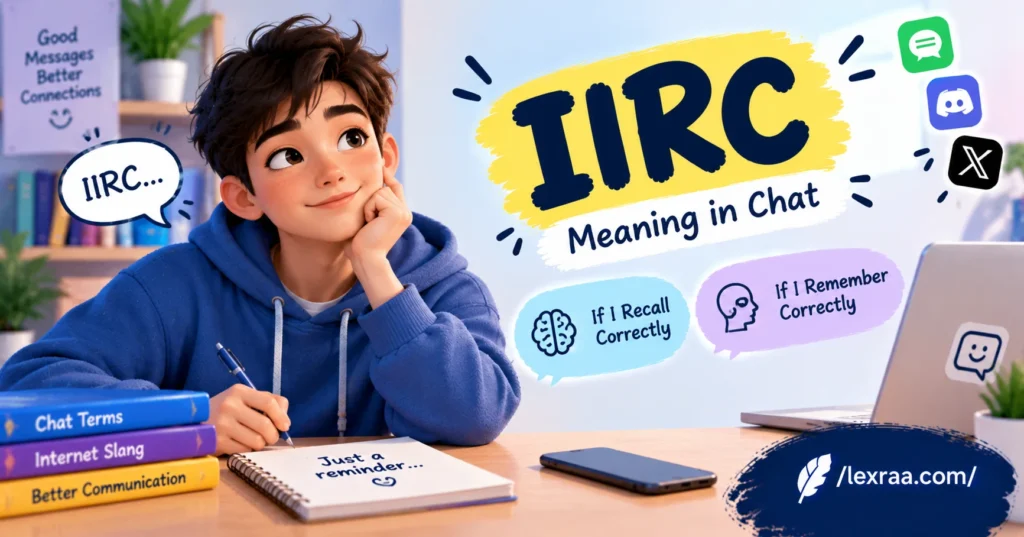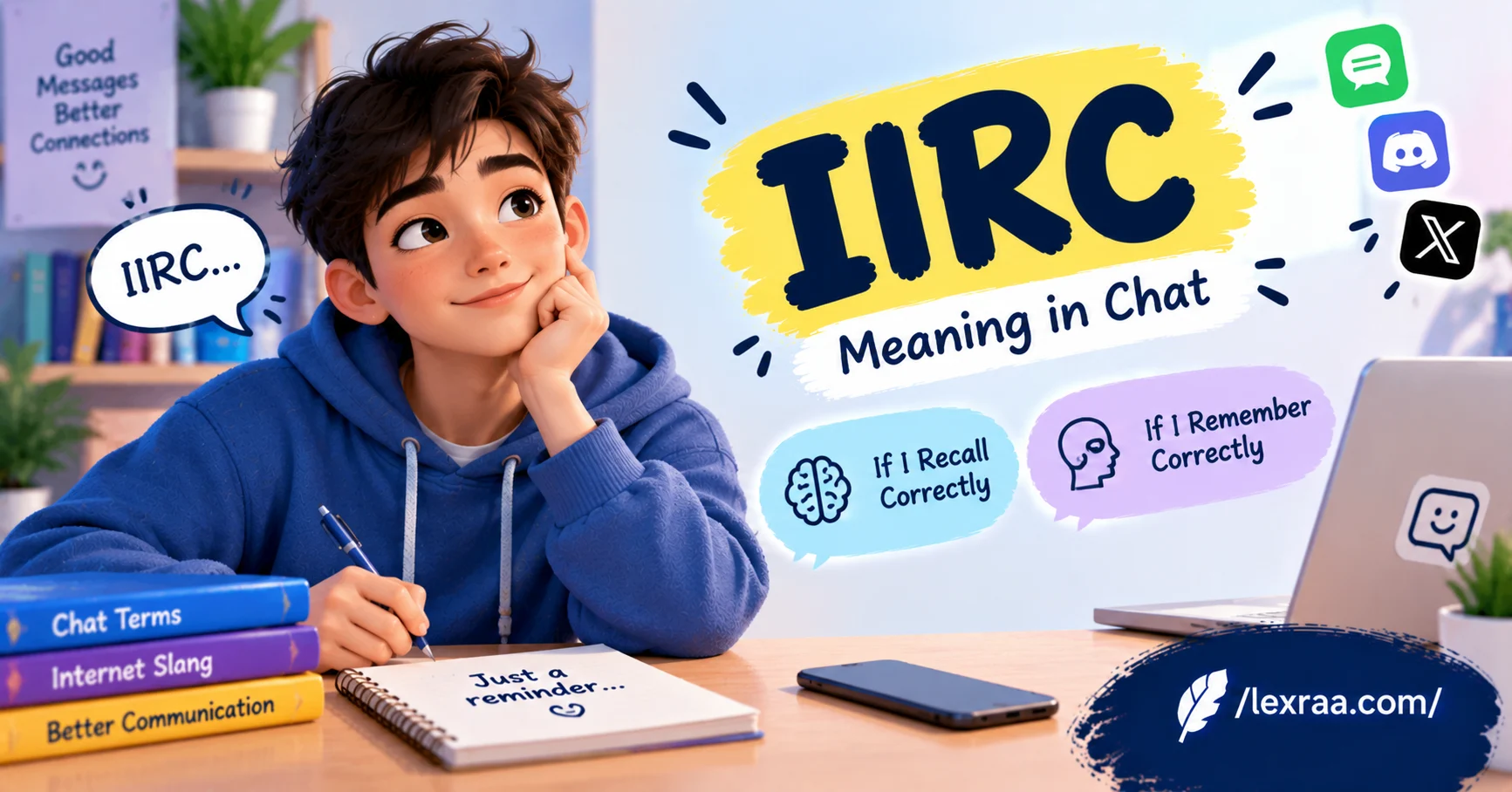
IIRC means “If I Recall Correctly” or “If I Remember Correctly.” People use this internet abbreviation when sharing something they remember but may not have perfectly right. It signals that a statement comes from memory, leaves room for correction, and can make a message sound less absolute.
Someone asks when the movie came out, and you reply, “IIRC, it was 2019.” You’re giving your best recollection—not promising you’ve checked IMDb.
The IIRC meaning in chat is simple, but there’s a useful nuance: it doesn’t always mean the sender is clueless. Sometimes they’re fairly confident and just don’t want to present a memory as a verified fact.
What IIRC means and how people use it
IIRC is an internet abbreviation—more precisely, an initialism—formed from the first letters of “If I Recall Correctly.” “If I Remember Correctly” is also a widely recognized expansion. Both mean roughly, “This is what I remember, but I could be mistaken.”
“if I recall correctly” meaning and notes its use in social media, text messages, and emails.
Common examples include:
- “IIRC, class starts at 9.” — That’s what I remember, but double-check.
- “We met in May, IIRC.” — I think May was the month.
- “IIRC, you already sent the link.” — I remember you sending it, though I could be wrong.
- “That feature was removed last year, iirc.” — That’s my recollection of the change.
Notice that IIRC can appear at the beginning or end of a sentence. It doesn’t change the underlying meaning.
The subtle message behind IIRC
IIRC does more than save typing. It tells the reader how to interpret the information that follows.
It separates memory from verified facts
Compare these two messages:
“The meeting is on Thursday.”
“IIRC, the meeting is on Thursday.”
The first sounds definite. The second signals that the sender is relying on memory, not necessarily a calendar or official notice.
It can soften a correction
Imagine a friend insists that you agreed to meet on Saturday. You remember the conversation differently:
“IIRC, we said Sunday, but I might be mixing it up.”
That wording corrects the detail without immediately accusing the other person of being wrong. It’s especially useful when neither person has checked the original messages.
It can be used with confidence—or sarcasm
Some people use IIRC even when they’re reasonably sure of the facts. In a debate, it can also introduce a pointed reminder:
“IIRC, you said the update was already finished last week.”
That may be a genuine recollection or a sarcastic nudge, depending on the relationship and the conversation. IIRC alone doesn’t prove the sender is uncertain, annoyed, or being passive-aggressive.
Five realistic conversations using IIRC
1. iMessage — Making weekend plans
Alex: Are we meeting at 6 or 7?
Jamie: iirc we said 6:30 lol
Alex: ok I’ll check the group chat
Why it works: Jamie offers a remembered time without pretending it’s confirmed.
2. Discord — Gaming advice
Player 1: where do i unlock the desert map?
Player 2: iirc you need to finish the second mission first
Player 1: got it, trying that now
Tone: Casual and helpful. The answer is a recollection, not a guaranteed walkthrough.
3. WhatsApp — A family reminder
Sara: Did Auntie say lunch was on Friday?
Amir: IIRC it’s Saturday, but let me ask her
Sara: thanks, don’t wanna show up a day early 😭
Tone: Practical. Amir follows the memory-based answer with a plan to confirm it.
4. Reddit comment — Correcting a detail
User 1: wasn’t that game released in 2020?
User 2: iirc it was 2019, though I could be mixing up the announcement date
User 3: just checked, the release was 2019
Tone: Collaborative rather than combative. The reply distinguishes a release date from a possible announcement date.
5. Workplace chat — Recalling a previous decision
Mina: Did we agree to send the draft before noon?
Leo: IIRC, yes, but I’ll check the meeting notes
Mina: Perfect, I’ll hold off until you confirm
Tone: Professional and cautious. For deadlines, a quick check beats relying on memory.
These are illustrative examples, not quotations from real conversations.
Read More: IMS Text Meaning: What Does IMS Mean in Chat?
IIRC vs. AFAIK, IMO, and similar abbreviations
IIRC belongs to a family of short forms that qualify a statement, but each one does a different job.
| Term | Meaning | Tone | Popularity | Confusion Risk |
|---|---|---|---|---|
| IIRC | If I Recall Correctly | Cautious, conversational | — | Medium |
| AFAIK | As Far As I Know | Cautious, matter-of-fact | — | High |
| IMO | In My Opinion | Subjective | — | Low |
| IMHO | In My Humble Opinion | Subjective, sometimes self-deprecating | — | Medium |
| TBH | To Be Honest | Candid or conversational | — | Low |
| FYI | For Your Information | Informative, direct | — | Medium |
Popularity rankings are omitted because comparable usage data wasn’t established for these abbreviations.
The most useful distinction is between IIRC and AFAIK:
- IIRC: “This is what I remember.”
- AFAIK: “This is what I know, as far as I’m aware.”
- IMO/IMHO: “This is my opinion, not necessarily an objective fact.”
For example, “IIRC, the shop closes at 8” refers to remembered information. “AFAIK, the shop closes at 8” means the sender believes that based on their current knowledge, which may include more than memory.
Where IIRC came from—and its other meanings
IIRC belongs to early internet shorthand and appears in online communication alongside abbreviations such as AFAIK and IMHO. The exact point at which it was first coined is not firmly established by the sources reviewed, so claims of a precise invention date should be treated cautiously.
The abbreviation also has meanings outside everyday chat. lists several, including:
- Internet shorthand: If I Remember Correctly or If I Recall Correctly.
- International Integrated Reporting Council: A name associated with corporate reporting.
- Indiana Interstate Railway reporting mark: A railway identification use.
- International Interdisciplinary Research Center: An institution-related use associated with Sigmund Freud University Vienna.
For a message like “IIRC, we discussed this last week,” the internet abbreviation is the natural interpretation. In a corporate report or railway reference, the surrounding subject may point to a different expansion.
Why IIRC sticks around
IIRC solves a small but common problem: how to share a useful memory without sounding more certain than you are. Four letters communicate that qualification quickly, which is handy in fast-moving chats and detailed online discussions.
Frequently asked questions
Is IIRC rude or passive-aggressive?
No, not by itself. It usually qualifies a statement, although it can sound pointed when someone uses it to remind another person of something they said or did.
Should I write IIRC in uppercase or lowercase?
Both IIRC and iirc are understood. Uppercase makes the abbreviation stand out, while lowercase often blends naturally into casual messages; neither changes the meaning.
How do you pronounce IIRC?
People commonly say the letters individually: “eye-eye-ar-see.” In writing, most readers simply recognize the abbreviation without needing to pronounce it.
Is IIRC still used, or is it outdated?
It remains documented in contemporary dictionaries and online discussions. It is established internet shorthand rather than a trend that depends on a particular viral meme.
Can I use IIRC in an email to my boss?
It can fit informal workplace emails or internal team messages. For a formal report, an important deadline, or information that must be exact, write “if I recall correctly” or verify the detail before sending it.
Does IIRC mean the person is guessing?
Not necessarily. It means they’re qualifying a statement based on memory; they may be quite confident, but they’re leaving room for the possibility that their recollection is wrong.
Conclusion
IIRC means “If I Recall Correctly” or “If I Remember Correctly.” Use it when sharing a remembered detail, gently correcting someone, or contributing information without claiming absolute certainty. It works naturally in texts, forums, online discussions, and some informal workplace messages. Avoid relying on it when a fact needs to be verified, such as a deadline or official instruction. The common mistake is treating IIRC as proof that someone is clueless—or assuming the information that follows must be correct.