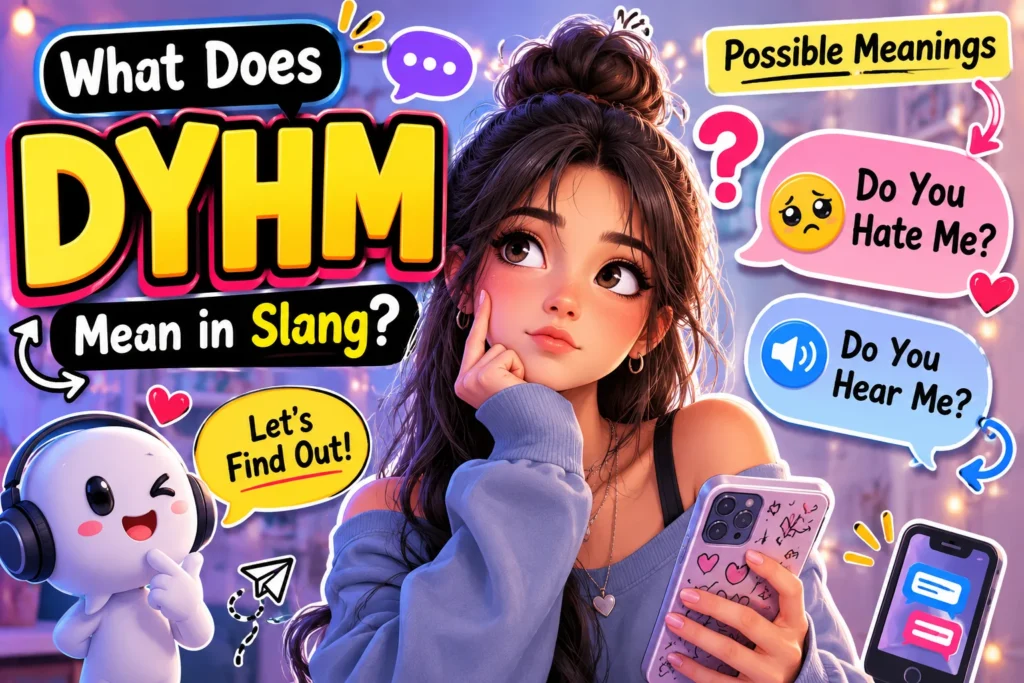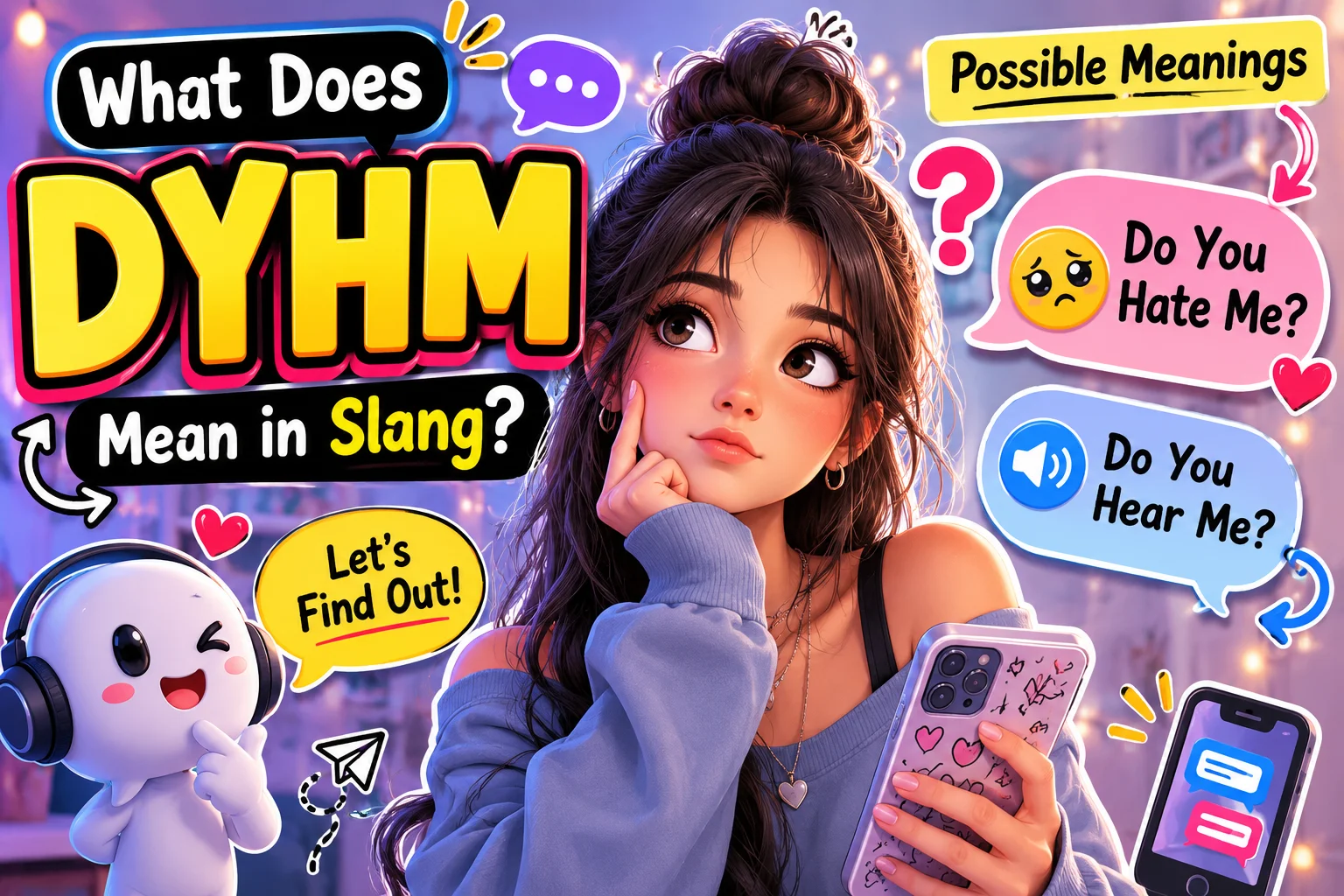
DYHM most commonly means “Do You Hate Me?” in texting and online slang. People use it to ask for reassurance, often after being ignored, misunderstood, or joking around with friends or a romantic partner. Some people also search it because it has a less common alternative meaning.
Many users come across DYHM in a text, Snapchat message, or Instagram DM and aren’t sure whether it’s serious, playful, or sarcastic. The meaning depends almost entirely on the conversation and the relationship between the people chatting.
What Does DYHM Mean in Slang?
The most widely recognized slang meaning of DYHM is:
DYHM = “Do You Hate Me?” (Most Common Meaning)
In modern texting, DYHM stands for:
“Do You Hate Me?”
It’s an acronym people use when they feel someone is acting distant, hasn’t replied, or seems upset. In many cases, the sender isn’t genuinely asking if they’re hated—they’re simply looking for reassurance or making a lighthearted joke.
Examples:
- “You left me on read… DYHM? 😭”
- “You’ve been quiet all day. DYHM?”
- “Be honest… DYHM?”
Depending on the context, it can express:
- Playful teasing
- Mild insecurity
- Curiosity
- Emotional reassurance
Because tone is difficult to judge through text alone, emojis often help clarify that the message is meant jokingly.
Less Common Meaning: “Do You Hear Me?”
A second expansion occasionally appears:
“Do You Hear Me?”
This version is much less common in internet slang and casual texting. It usually appears only when someone wants to confirm that another person has received or understood a message.
Example:
- “DYHM? The call keeps cutting out.”
Although this meaning exists, it is not the definition most people are looking for when they search “DYHM meaning slang.”
Is DYHM an Acronym, Abbreviation, or Slang?
DYHM fits all three descriptions.
| Category | Does DYHM Fit? | Explanation |
|---|---|---|
| Acronym | Yes | Each letter represents the first letter of a word. |
| Abbreviation | Yes | It shortens a full question into four letters. |
| Slang | Yes | It is used informally in texting and online conversations. |
The acronym saves typing while making conversations feel more casual and conversational.
Why Do People Search “DYHM Meaning Slang”?
Most people search the phrase after receiving messages like:
- “DYHM?”
- “Wait… DYHM 😭”
- “You never text first. DYHM?”
Without context, it’s difficult to know whether the sender is:
- Being serious
- Looking for reassurance
- Joking with a friend
- Flirting
- Feeling anxious
Learning the common meanings helps prevent misunderstanding the sender’s intent.
Where Is DYHM Used?
Unlike some internet abbreviations, DYHM appears mainly in private conversations rather than public posts.
Snapchat
Snapchat is one of the most common places to see DYHM.
It often appears after:
- A delayed reply
- A broken Snap streak
- Someone leaving a message unopened
Examples:
- “You ignored my Snap… DYHM? 😂”
- “No reply all day. DYHM?”
The tone is usually playful rather than genuinely confrontational.
Instagram Direct Messages
On Instagram, DYHM commonly appears in casual conversations between:
- Friends
- Dating partners
- Close acquaintances
Examples:
- “You’ve liked everyone’s post except mine… DYHM? 😅”
- “You disappeared today. DYHM?”
Most users pair it with emojis to soften the message.
On WhatsApp, DYHM is typically used in one-on-one chats.
Examples:
- “You’ve been offline all day. DYHM?”
- “I haven’t heard from you… DYHM? ❤️”
Among close friends and family, it often serves as a humorous way to ask for reassurance.
TikTok
DYHM occasionally appears in TikTok captions, comments, and relationship-related memes discussing overthinking or waiting for replies.
For example, creators may jokingly reference the feeling of wondering, “DYHM?” after being left on read or receiving short responses. However, it is far less common than mainstream texting abbreviations like LOL, OMG, or FR.
Does DYHM Appear on X?
There is limited independent evidence that DYHM is widely used as slang on X (formerly Twitter). While isolated posts may exist, it is not a consistently recognized X-specific abbreviation. Most documented usage comes from private messaging platforms rather than public social feeds.
How Is DYHM Written?
You’ll usually see:
- DYHM
- dyhm
- Dyhm
All three spellings mean the same thing.
People sometimes add punctuation or emojis:
- DYHM?
- dyhm 😭
- DYHM lol
- DYHM 😂
These additions help communicate whether the question is serious or playful.
Does Capitalization Matter?
No.
Whether someone writes:
- DYHM
- dyhm
- Dyhm
the meaning remains unchanged.
However:
- DYHM? can feel slightly more direct.
- dyhm 😭 often feels softer and more humorous.
Grammar and Language Role
Understanding how DYHM works grammatically makes it easier to recognize in conversation.
Part of Speech
DYHM functions as an interrogative acronym because it represents an entire question.
Rather than acting as a noun or verb, it replaces the complete sentence:
“Do you hate me?”
Sentence Position
You’ll most often find DYHM:
- As a complete standalone message
- At the end of another sentence
- Occasionally after an explanation
Examples:
- “DYHM?”
- “You’ve barely replied today… DYHM?”
- “I was joking earlier—DYHM?”
Can It Replace a Full Sentence?
Yes.
Many people simply send:
DYHM?
Because the acronym already represents a complete question, no additional words are necessary.
Formal or Informal?
DYHM is entirely informal.
It’s appropriate for:
- Friends
- Siblings
- Partners
- Casual online conversations
- Private messaging
It is generally not appropriate for:
- Workplace communication
- Academic writing
- Professional emails
- Business messaging
Outside casual digital conversations, writing the full sentence is much clearer and more appropriate.
Tone Variations
Because DYHM usually means “Do You Hate Me?”, it naturally appears in conversations that involve reassurance, teasing, or mild emotional uncertainty. It genuinely supports the following tones.
Playful Tone
A: You stole the last slice of pizza. 😭
B: It was worth it.
A: DYHM? 😂
B: Never. I just really wanted pizza.
Funny Tone
A: You beat me again in Mario Kart.
B: Practice more. 😎
A: DYHM??
B: Nope, I just love winning.
Serious Tone
A: You’ve barely replied all week.
B: I’ve been overwhelmed with work.
A: DYHM?
B: Not at all. I’m sorry if it felt that way.
Lightly Sarcastic Tone
A: Thanks for forgetting my birthday.
B: Wait… what?
A: DYHM? 🙄
B: I honestly mixed up the dates. I’m sorry.
Real Chat Examples
These examples reflect realistic conversations where DYHM appears naturally in texts or direct messages.
Example 1 – Best Friends
A: You ignored my last three messages.
B: My phone died.
A: DYHM? 😂
B: Of course not.
Example 2 – Dating
A: You’ve been quiet today.
B: Sorry, work has been crazy.
A: DYHM? ❤️
B: Never. I just needed a break.
Example 3 – Siblings
A: You didn’t save me any dessert.
B: Oops…
A: DYHM? 😭
B: I owe you one.
Example 4 – College Friends
A: Everyone got invited except me.
B: That wasn’t intentional.
A: DYHM?
B: Absolutely not. I’ll explain.
Example 5 – Snapchat Friends
A: My Snap has been unopened for six hours.
B: I forgot to check Snapchat.
A: DYHM? 😂
B: Nope. I just got busy.
Example 6 – Instagram DM
A: You liked everyone’s photos except mine.
B: Wait, really?
A: DYHM? 😅
B: I honestly missed it.
Example 7 – Group Chat
A: Nobody reacted to my meme.
B: We all saw it.
A: DYHM? 😂
B: No, we’re just terrible at replying.
Example 8 – Parent and Teen
A: You haven’t answered my texts today.
B: My classes ran late.
A: DYHM? 😄
B: Never, Mom.
How to Reply When Someone Texts “DYHM”
Most of the time, the sender is looking for reassurance rather than a literal answer.
Funny Reply
- “Only when you steal my fries. 😂”
- “For about five seconds.”
- “You’re too dramatic. 😆”
Serious Reply
- “Not at all.”
- “I’m sorry if I made you feel that way.”
- “No, I’ve just been busy today.”
Flirty Reply
Since DYHM often appears between people who are dating or flirting, a romantic response can feel natural.
- “Quite the opposite ❤️”
- “I like you too much for that.”
- “Never. I was actually thinking about you.”
Neutral Reply
- “No.”
- “Not at all.”
- “You’re overthinking.”
- “Everything’s okay.”
Similar Slang Terms
| Term | Meaning | Usage Context | Tone | Popularity | Confusion Risk |
|---|---|---|---|---|---|
| DYHM | Do You Hate Me? | Texting, DMs | Playful or reassuring | Medium | Medium |
| WYD | What You Doing? | Casual texting | Friendly | Very High | Low |
| HMU | Hit Me Up | Casual messaging | Friendly | Very High | Low |
| IDC | I Don’t Care | Casual texting | Neutral or blunt | High | Medium |
| FR? | For Real? | Casual conversations | Curious | High | Low |
| ILY (opposite idea) | I Love You | Personal texting | Affectionate | Very High | Low |
Who Uses DYHM?
Age Groups
DYHM is most common among:
- Teenagers
- High school and college students
- Young adults
- People who regularly communicate through texting and social media
Older adults are generally more likely to type the full question instead of using the acronym.
Gen Z vs. Millennials
Gen Z
- Uses DYHM more often in playful conversations.
- Frequently pairs it with emojis like 😭, 😂, 🥲, or ❤️.
- Commonly sends it after being left on read or receiving slow replies.
Millennials
- Tend to type the full phrase “Do you hate me?” more often than the acronym.
- When using DYHM, it’s usually with close friends or partners rather than in broader social conversations.
Regional Usage
There is no reliable evidence that DYHM has different meanings in the US, UK, Canada, Australia, or other English-speaking regions.
Its interpretation depends far more on the conversation than on location.
Platforms
The documented slang meaning appears mainly on:
- Snapchat
- Instagram DMs
- SMS and iMessage
- Occasional TikTok relationship content
There is little evidence that DYHM is widely used as a recurring slang abbreviation on X.
Origin and Internet Culture
Texting Origins
DYHM developed as part of internet and SMS shorthand, where people shortened common phrases to make typing faster.
Like abbreviations such as:
- WYD
- IDK
- BRB
- ILY
DYHM compresses an entire question into just four letters.
How It Became Slang
Over time, DYHM became less of a literal question and more of a playful expression.
Instead of genuinely asking whether someone disliked them, people began using it humorously after:
- Being ignored
- Waiting for replies
- Losing a game
- Getting teased by friends
That shift is what makes it recognizable as internet slang today.
AAVE or Cultural Roots
There is no documented evidence that DYHM originated in AAVE or another specific cultural dialect.
Instead, it appears to have grown naturally from general online texting culture.
TikTok and Meme Culture
Relationship memes and short videos have occasionally helped popularize DYHM, especially jokes about:
- Being left on read
- Overthinking delayed replies
- Assuming the worst after short responses
However, there is no evidence of a single viral trend, creator, or sound that established the acronym.
How the Meaning Has Evolved
Unlike many internet abbreviations, DYHM has changed very little over time.
The wording has remained the same, but its tone has shifted from a literal question to one that is often playful, exaggerated, or self-aware among close friends.
Safety and Appropriateness
Is DYHM Rude?
No.
The phrase itself is not offensive and contains no profanity.
Depending on the tone, however, repeatedly asking “DYHM?” may make a conversation feel emotionally heavy if the other person isn’t joking.
Does It Contain Explicit Language?
No.
DYHM contains no profanity or explicit wording.
It is generally considered safe for casual conversations.
School and Workplace
While the acronym isn’t offensive, it is too informal for professional communication.
Avoid using DYHM in:
- Business emails
- Workplace messaging
- Academic assignments
- Formal correspondence
Writing the full sentence—or avoiding the phrase altogether—is more appropriate in professional settings.
Cultural Sensitivity
There are no documented cultural sensitivities associated with DYHM.
The only concern is ensuring the recipient understands that the message is playful if that is your intent.
Real-World Observation
Unlike abbreviations that simply save typing, DYHM often communicates emotion. People usually send it when they want reassurance after a delayed reply, an awkward interaction, or a misunderstanding. In many friendships and relationships, it’s less about literally asking whether someone is disliked and more about expressing vulnerability in a lighthearted way. Emojis, timing, and the existing relationship almost always determine whether it feels funny, affectionate, or genuinely concerned.
Frequently Asked Questions
What does DYHM mean when someone texts it to you?
Most of the time, DYHM means “Do You Hate Me?” It’s usually sent after someone has been quiet, left a message unanswered, or behaved differently than usual. In many conversations, the sender isn’t asking the question literally—they’re looking for reassurance or making a playful joke. Reading the rest of the conversation helps you understand whether the message is serious or lighthearted.
Is DYHM always serious?
No. DYHM is often used humorously between close friends or romantic partners. Emojis such as 😂, 😭, or ❤️ usually indicate that the sender is teasing rather than expressing genuine concern. However, if the conversation has already become tense, the question may reflect real insecurity or confusion.
Does DYHM mean the same thing on Snapchat and WhatsApp?
Yes. On both Snapchat and WhatsApp, DYHM most commonly stands for “Do You Hate Me?” The platform doesn’t change its meaning. Instead, the tone depends on the relationship between the people chatting and the context of the conversation.
Can DYHM mean “Do You Hear Me?”
Yes, but that meaning is much less common in modern internet slang. It usually appears when discussing a phone call, voice chat, or audio issue. If you encounter DYHM in an everyday text conversation, “Do You Hate Me?” is almost always the intended meaning.
Is it rude to send DYHM?
Not necessarily. When used among close friends or partners, it’s generally seen as playful or affectionate. However, repeatedly sending DYHM after someone doesn’t reply immediately can make the other person feel pressured, so it’s best used sparingly.
Who usually uses DYHM?
DYHM is most common among Gen Z, teenagers, college students, and young adults who regularly use texting abbreviations. It’s especially popular in casual conversations and private messaging. Older users are more likely to write the full phrase instead of using the acronym.
Is DYHM appropriate for work or school?
Generally, no. Although the acronym isn’t offensive, it’s very informal and emotionally personal. In professional, academic, or workplace communication, writing complete sentences is usually more appropriate and less likely to cause misunderstandings.
Why do people use DYHM instead of writing the full question?
People use DYHM because it’s quicker to type and fits naturally with other common abbreviations like LOL, IDK, and WYD. It also creates a more relaxed and conversational tone. Among people familiar with internet slang, the acronym is easy to recognize.
What does DYHM stand for in slang?
In modern internet slang, DYHM stands for “Do You Hate Me?” It’s commonly used to seek reassurance after delayed replies, awkward interactions, or misunderstandings. In many cases, it’s meant humorously rather than as a genuine accusation.
What does “DYHM?” mean in a text message?
When someone texts “DYHM?”, they’re usually asking whether you’ve become upset with them or whether something feels different between you. The message often reflects playful overthinking rather than real conflict. Looking at the surrounding conversation helps determine the intended tone.
Is DYHM a slang word or an acronym?
DYHM is an acronym because each letter represents a word in a longer phrase. At the same time, it functions as internet slang because it’s widely used in informal digital conversations. Like LOL, BRB, and ILY, it has become part of modern texting culture.
Why do people text DYHM after being left on read?
Many people jokingly send DYHM after being left on read because it exaggerates a common feeling of uncertainty. Instead of genuinely believing someone dislikes them, they’re making fun of their own tendency to overthink. This playful use has helped keep the acronym relevant in casual messaging.
Conclusion
The most widely accepted answer to “DYHM meaning slang” is “Do You Hate Me?” It’s a casual texting acronym people use to ask for reassurance, tease friends, or react to delayed replies. While “Do You Hear Me?” exists as an alternative expansion, it’s much less common in modern online conversations.
Like many internet abbreviations, DYHM depends on context. The surrounding messages, emojis, and relationship between the people involved usually make its meaning clear.
Usage Tips
- Use DYHM in casual conversations with friends, family, or a partner.
- Pay attention to emojis and context to understand the sender’s tone.
- Use the full phrase instead of the acronym if clarity is important.
- Remember that the acronym usually expresses reassurance or playful teasing.
Common Mistakes
- Assuming DYHM is always meant seriously.
- Confusing “Do You Hate Me?” with the less common “Do You Hear Me?”
- Using the acronym in professional or formal communication.
- Ignoring the context before interpreting the message.
When to Use DYHM
- While chatting with close friends.
- In casual text messages or private DMs.
- To jokingly ask for reassurance.
- During lighthearted conversations where both people understand texting slang.
When to Avoid DYHM
- In workplace or business communication.
- In academic or formal writing.
- When the recipient may not recognize internet abbreviations.
- During serious disagreements where clear communication is more appropriate.