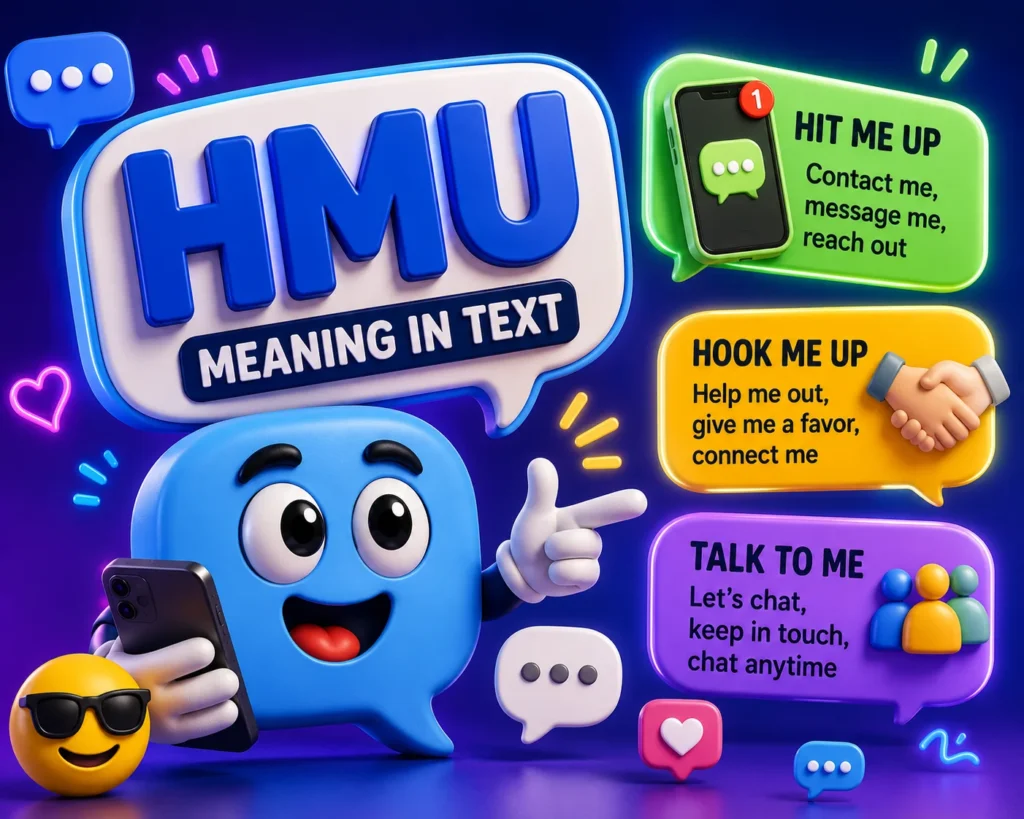
HMU most commonly means “Hit Me Up.” When someone texts it to you, they’re inviting you to contact them later—whether by texting, calling, or sending a DM. It’s one of the most recognizable pieces of internet shorthand and is used across casual messaging platforms.
Unlike some abbreviations that have several equally common meanings, HMU has one dominant texting meaning. A few niche expansions exist, but they’re uncommon and highly context-dependent.
What Does HMU Mean in Text?
In texting, HMU stands for “Hit Me Up.” Despite sounding aggressive when read literally, the phrase doesn’t mean to physically hit someone. Instead, it’s an informal invitation that means:
- Contact me
- Message me
- Text me
- Call me
- Reach out when you’re free
- Let me know if you’re interested
The exact interpretation depends on the conversation.
For example:
- “HMU when you get home.”
- “HMU if you need help.”
- “Bored tonight. HMU.”
In each case, the sender is simply asking someone to get in touch.
Is HMU an Acronym, Abbreviation, or Slang?
HMU is best described as an initialism (a type of abbreviation) because each letter represents the first letter of a word:
- H = Hit
- M = Me
- U = Up
It’s also considered internet slang because its meaning has become more conversational than literal. Few people think about the original phrase anymore—they simply recognize HMU as shorthand for “contact me.”
What Does HMU Mean When Someone Texts It to You?
If someone sends “HMU”, they’re usually leaving the conversation open rather than ending it.
Depending on context, they may be saying:
- “Message me later.”
- “Let me know.”
- “Call me.”
- “Reach out if you’re interested.”
- “Talk to me whenever.”
Sometimes it’s practical.
“HMU after your interview.”
Sometimes it’s friendly.
“HMU next time you’re in town.”
Sometimes it carries a slightly flirty tone.
“HMU if you’re still single 😉”
The abbreviation itself isn’t inherently romantic. The relationship between the people and the rest of the conversation determine the tone.
Are There Other Meanings of HMU?
Yes, but they’re much less common.
1. Hit Me Up (Most Common)
This is by far the meaning you’ll encounter in texting, DMs, group chats, and social media.
2. Hook Me Up
Occasionally, people use HMU to mean “Hook Me Up,” usually when asking someone for a favor, recommendation, discount, or connection.
Example:
“HMU with your playlist.”
or
“Can you HMU with those notes?”
However, many people would simply read this as “hit me up,” so context matters.
3. Joke Expansions
Over the years, internet users have jokingly invented fake meanings like:
- Hold My Unicorn
- Hug My Umbrella
These are memes rather than genuine definitions and should not be treated as standard slang.
A Common Misunderstanding
A lot of people assume HMU is always flirting.
That’s not true.
Someone can say:
“HMU if you need a ride.”
without any romantic meaning whatsoever.
Likewise,
“HMU later.”
might simply mean they want to continue the conversation after work.
Only the surrounding conversation—not the abbreviation itself—determines whether it’s friendly, romantic, professional (rare), or practical.
Where Is HMU Actually Used?
HMU appears anywhere casual text communication happens.
SMS and iMessage
Traditional texting remains one of the most common places to see HMU.
Examples:
- “HMU when you land.”
- “HMU after class.”
Friends commonly use HMU to arrange plans, continue conversations, or ask someone to message later.
Examples:
- “HMU after dinner.”
- “HMU if the movie’s still on.”
Instagram DMs
Instagram users frequently end conversations with HMU.
Examples:
- “HMU whenever.”
- “HMU if you want to collaborate.”
Snapchat
Because Snapchat focuses on casual conversations, HMU naturally fits.
Examples:
- “HMU tonight.”
- “HMU after practice.”
X (formerly Twitter)
HMU occasionally appears in posts inviting replies or direct messages.
Example:
“Anyone selling concert tickets? HMU.”
While it exists on X, it’s more common in direct conversations than public tweets.
How People Actually Type HMU
You’ll commonly see:
- hmu
- HMU
- Hmu
All mean exactly the same thing.
Unlike abbreviations such as LOL, capitalization rarely changes the meaning.
People may also combine it with emojis.
Examples:
- hmu 😊
- HMU later
- hmu whenever
- hmu lol
- hmu if ur free
Lowercase hmu has become especially common among younger texters because most phone keyboards automatically use lowercase in casual chats.
Where HMU Usually Appears in a Sentence
HMU is flexible.
At the beginning:
HMU when you’re free.
In the middle:
Just HMU after work.
At the end:
I’m bored… hmu.
Sometimes it even stands alone:
HMU.
In that case, the meaning is understood as “Contact me.”
Tone Variations With Real Text Conversations
The same abbreviation can sound very different depending on who sends it and why. Here are four common ways HMU is used in everyday messaging.
Funny
A: I’m attempting to cook pasta.
B: How’s it going?
A: If the smoke alarm starts singing, HMU with a pizza recommendation.
B: I’ll start looking now.
Sarcastic
A: I totally enjoyed sitting in traffic for two hours.
B: Sounds like the best day ever.
A: Yeah, HMU if you know a shortcut through another universe.
B: Working on it.
Playful
A: Guess who finally beat your high score?
B: No way!
A: HMU when you’re ready for a rematch.
B: Challenge accepted.
Serious
A: My interview is tomorrow morning.
B: You’ve prepared well.
A: Thanks. HMU afterward—I could use someone to talk to.
B: Absolutely.
Real Text Message Examples
Here are realistic conversations showing how HMU naturally appears across different relationships and messaging situations.
1. Friends Making Plans
A: Are you doing anything Saturday?
B: Not yet.
A: HMU if you want to grab lunch.
B: Sounds good.
2. Dating
A: I had fun tonight.
B: Me too.
A: HMU when you get home.
B: I will 😊
3. Coworkers
A: I finished the presentation.
B: Nice.
A: HMU if you want me to review yours.
B: Thanks, I probably will.
4. Family
Mom: Did you arrive safely?
You: Just checked into the hotel.
Mom: Great. HMU tomorrow morning.
You: Will do.
5. College Classmates
A: Did you understand today’s lecture?
B: Mostly.
A: HMU if you need my notes.
B: Thanks!
6. Gaming Friends
A: Are we playing tonight?
B: Maybe around eight.
A: HMU when everyone’s online.
B: Deal.
7. Group Chat
A: Anyone interested in a movie?
B: I might be.
A: HMU privately if you’re coming.
B: Sending you a message now.
8. Neighbors
A: I’m borrowing a ladder tomorrow.
B: Okay.
A: HMU if you need it afterward.
B: Thanks!
9. Stranger From a Marketplace
Buyer: Is the bike still available?
Seller: Yes.
Buyer: Great. HMU with the pickup address.
Seller: I’ll send it now.
10. Long-Distance Friends
A: I’m visiting your city next month.
B: Seriously?
A: Yep. HMU when you’re free.
B: Can’t wait!
How to Reply to HMU
Your response depends on what the sender is asking.
Funny Reply
“Only if snacks are included.”
Serious Reply
“Sure. I’ll message you after work.”
Flirty Reply
“I was hoping you’d say that 😉”
Neutral Reply
“Sounds good. I’ll reach out later.”
HMU Compared With Similar Texting Terms
| Term | Meaning | Typical Tone | Popularity | Confusion Risk |
|---|---|---|---|---|
| HMU | Hit Me Up | Friendly, casual | Very High | Low |
| DM | Direct Message | Neutral | Very High | Low |
| PM | Private Message | Neutral | Medium | Low |
| TXT | Text me | Casual | Medium | Low |
| LMK | Let Me Know | Helpful | Very High | Medium |
| IDC (opposite tone) | I Don’t Care | Dismissive | High | Low |
Unlike LMK, which asks someone for information, HMU specifically invites future contact.
Who Uses HMU?
Gen Z
Gen Z still uses HMU regularly, although it now competes with newer phrases like “DM me,” “text me,” or simply “message me.” It often appears in lowercase (“hmu”) and is common in casual chats.
Millennials
Millennials helped popularize HMU during the late 2000s and early 2010s. Many still use it naturally in texting, especially with friends.
Older Adults
Older adults recognize HMU less frequently, especially if they don’t regularly use internet slang. In mixed-age conversations, spelling out “message me” is often clearer.
Regional Usage
HMU is most strongly associated with American English, where “hit me up” has long meant “contact me.” Because English-language social media is global, the abbreviation is also widely understood in Canada, the UK, Australia, New Zealand, and many other countries where English is commonly used online.
There’s no reliable evidence that HMU has a different standard meaning in one English-speaking country versus another.
Where Did HMU Come From?
The phrase “hit me up” existed in spoken American English before texting became common. It originally meant “contact me” or “get in touch with me.”
As SMS messaging grew during the late 1990s and early 2000s, people shortened longer phrases to save characters and type faster. HMU emerged as one of many texting abbreviations from that era, alongside terms like BRB, IMO, IDK, and LMK.
Its popularity increased with instant messaging services, Facebook chat, Twitter, and smartphone messaging. Rather than being created by TikTok or another single platform, HMU spread gradually across digital communication as internet slang evolved.
There is no verified evidence that HMU originated specifically in AAVE (African American Vernacular English). While the spoken phrase “hit me up” has appeared in various American communities, including Black communities, the abbreviation itself is best understood as a product of early internet and texting culture rather than having a single documented cultural origin.
Why HMU Has Stayed Popular
Many internet abbreviations disappear after a few years, but HMU has lasted because it serves a practical purpose. It’s shorter than “message me later,” sounds friendly without being overly formal, and works in almost every casual situation.
Another reason it survives is flexibility. You can use HMU to invite conversation, ask someone to call, encourage collaboration, or simply keep the door open for future communication. Unlike trend-driven slang that quickly feels outdated, HMU solves an everyday communication need, which has helped it remain relevant even as texting habits continue to evolve.
Is HMU Rude or Safe to Use?
In most situations, HMU is completely safe and non-offensive. It’s considered casual internet slang rather than rude language.
Here’s how it fits in different settings:
- Contains profanity? No.
- Offensive? No.
- Suitable for friends? Yes.
- Suitable for family? Usually yes.
- Suitable for coworkers? Sometimes, if your workplace communication is informal.
- Suitable for teachers or clients? Generally no—it’s better to write “Please contact me” or “Feel free to reach out.”
The abbreviation itself isn’t disrespectful. However, because it’s informal, it can sound too casual in professional emails or official communication.
A Practical Insight: Why HMU Still Works So Well
HMU has survived for years because it doesn’t pressure the other person into replying immediately. Unlike asking, “Can you call me right now?” it leaves the timing open. That flexibility makes conversations feel more relaxed. It also works equally well whether you’re making plans, offering help, continuing a discussion, or simply letting someone know you’re available. Many internet abbreviations come and go, but HMU remains useful because it solves a common communication need with just three letters.
Frequently Asked Questions
What does HMU mean in text from a girl?
It usually means exactly the same thing it does from anyone else: “Hit me up” or “contact me.” Whether it’s friendly, romantic, or simply practical depends on the rest of the conversation and your relationship with the sender. The abbreviation itself doesn’t automatically imply flirting.
What does HMU mean in Snapchat?
On Snapchat, HMU almost always means “Hit Me Up.” Someone may be asking you to send them a Snap, start a chat, or continue talking later. Because Snapchat is built around casual conversations, HMU fits naturally there.
Is HMU flirting?
Not necessarily. Friends, classmates, coworkers, and family members all use HMU in everyday conversations. It can become flirty when the surrounding conversation has a romantic tone, but the abbreviation alone isn’t flirtatious.
Is it rude to reply with just “HMU”?
It depends on the context. If someone asks when you’re available, replying with “HMU later” is perfectly normal. However, using only “HMU” without any context may sound abrupt if the conversation requires a fuller response.
What’s the difference between saying “HMU” and “Hit me up”?
There isn’t any difference in meaning. HMU is simply the abbreviated version of the full phrase. Some people prefer writing the abbreviation because it’s faster, while others spell out “hit me up” for clarity.
Does HMU mean the same thing in a group chat?
Yes. In a group chat, HMU still means “contact me.” The only difference is that the invitation may be directed at everyone in the group instead of one specific person.
Can HMU mean “Hook Me Up”?
Occasionally, yes. In some conversations, especially when asking for help, recommendations, or favors, people use HMU to mean “Hook Me Up.” However, “Hit Me Up” is far more common, so context should always guide your interpretation.
Is HMU outdated?
No. HMU isn’t as trendy as some newer Gen Z expressions, but it’s still widely recognized and frequently used across texting apps and direct messages. Because it’s practical rather than trendy, it continues to remain part of everyday internet slang.
Conclusion
If you’ve received HMU in a text, the sender is almost always saying “Hit Me Up,” meaning contact me, message me, or reach out later. Although a few alternative meanings exist, they’re much less common and usually obvious from the context.
What has kept HMU relevant is its simplicity. It’s quick to type, easy to understand, and flexible enough to work in everything from friendly conversations to planning events or keeping in touch.
Usage Tips
- Use HMU in casual conversations with friends, classmates, or family.
- Read the surrounding message to understand whether it’s friendly, practical, or slightly flirty.
- Feel free to use lowercase hmu—it means the same thing.
- If you’re writing professionally, replace it with “contact me” or “reach out.”
Common Mistakes
- Assuming HMU always has a romantic meaning.
- Thinking it literally means “hit” someone.
- Using it in formal business emails.
- Ignoring context when interpreting the abbreviation.
When to Use HMU
Use HMU when:
- You want someone to message or call you later.
- You’re making casual plans.
- You’re inviting someone to continue a conversation.
- You’re chatting with friends on messaging apps.
Avoid HMU when:
- Writing to clients, teachers, or supervisors.
- The person may not understand texting abbreviations.
- Clear, formal communication is more appropriate.