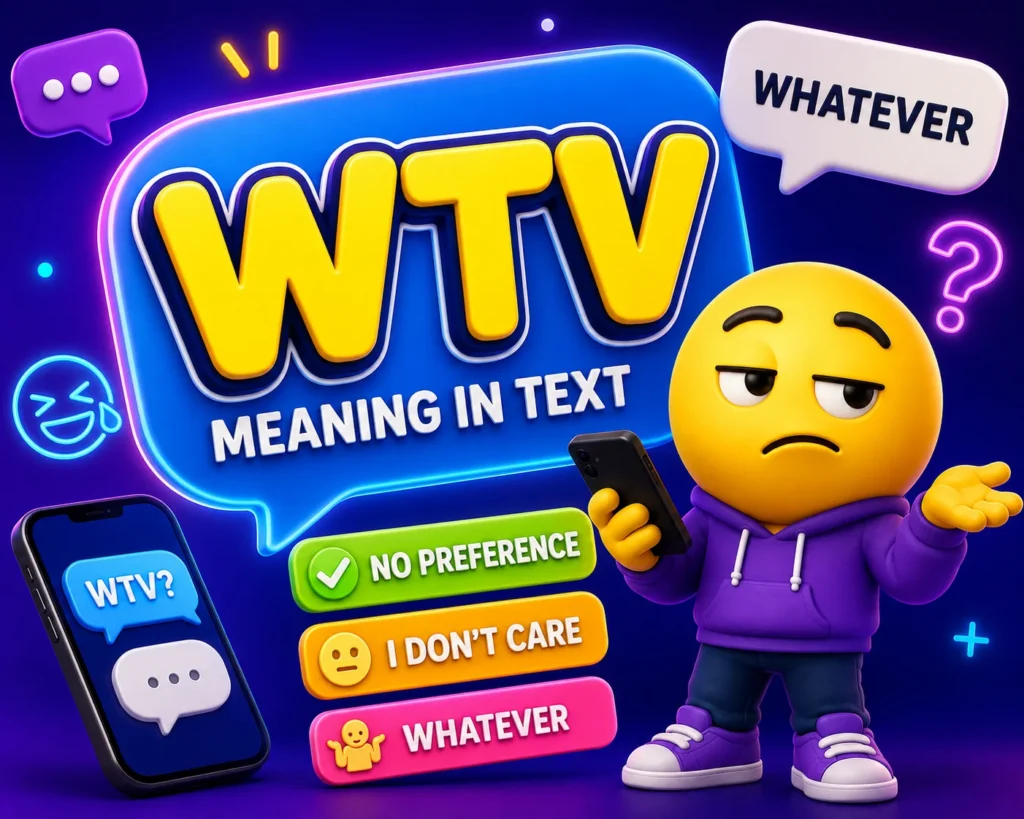
WTV usually means “whatever” in text messages and online chat. Depending on context, it can express indifference, flexibility, resignation, or mild dismissal, so the tone matters as much as the abbreviation itself.
What Does WTV Mean in Text?
WTV is an abbreviation of “whatever.” It is used as a shortened form when someone wants to type quickly or keep a conversation informal. Established slang references consistently define WTV this way, particularly in texting and online communication.
The tricky part is that “whatever” itself can communicate several attitudes. If someone asks, “Where should we eat?” and you answer “wtv,” you may simply mean that you are happy with any choice. But if someone sends “wtv” after an argument, it can sound like “I don’t care” or “I’m done discussing this.”
So WTV does not automatically mean the sender is annoyed. The surrounding conversation, punctuation, previous messages, and relationship between the people involved all help determine its tone.
WTV Can Mean “I Don’t Mind”
One of the friendliest uses is to show that you have no preference.
“Pizza or burgers?”
“Wtv, you pick.”
Here, WTV is close to “either is fine” rather than “I don’t care about you or this conversation.”
WTV Can Mean “Whatever”
Sometimes it simply substitutes for the full word.
“You can watch wtv you want.”
In this construction, the abbreviation is functioning almost exactly like the ordinary word “whatever.” Slang references describe this use as shorthand that can indicate openness to anything, carelessness, or indifference depending on context.
WTV Can Sound Dismissive
A standalone “wtv.” can have a noticeably different effect.
“You never listen to me.”
“Wtv.”
The short response can sound like the person is refusing to engage with the complaint. Dictionary.com specifically describes WTV as being used in texting and chat to suggest not caring, boredom, or lack of enthusiasm.
This is why interpreting WTV requires more than expanding the letters. “Whatever” can be neutral in one sentence and dismissive in another.
Is WTV an Acronym or an Abbreviation?
WTV is best described as an abbreviation or texting shorthand for “whatever,” rather than a traditional acronym.
An acronym normally forms a pronounceable word from the initial letters of several words, such as “NASA.” WTV is different: it is a shortened written form of a single word.
Wiktionary identifies wtv as an internet-slang and text-messaging abbreviation of “whatever,” while CyberDefinitions also categorizes it as an abbreviation.
You may see it written as WTV, wtv, or Wtv. Capitalization usually does not change the meaning.
What Does WTV Mean Depending on Context?
The same three letters can carry different social meanings.
| Context | Likely meaning | Possible tone |
|---|---|---|
| “Pick wtv you want” | Whatever you want | Flexible |
| “Wtv, I’m good” | I don’t mind | Casual |
| “Wtv.” after an argument | Whatever / drop it | Dismissive |
| “Do wtv works for you” | Whatever works | Easygoing |
| “He can say wtv” | Whatever he wants/says | Indifferent |
The most useful clue is what comes immediately before and after WTV. A longer sentence often makes the intended attitude clearer than the abbreviation itself.
Is There a Common Misunderstanding About WTV?
Yes. A common mistake is assuming that every “wtv” means the sender is angry or doesn’t care.
That interpretation is too strong. WTV can simply mean the person has no preference. For example, “Wtv movie you want is fine” is not necessarily hostile; it may simply mean the sender is letting the other person choose.
At the same time, a one-word “wtv” can sound cold, particularly after disagreement. The abbreviation inherits the emotional flexibility of the full word “whatever.”
Another possible source of confusion is that abbreviation databases list other meanings for WTV in specialized contexts, including business and technical uses. Those are separate from the ordinary texting meaning and should not be assumed when WTV appears in a casual message.
Where Is WTV Used?
The strongest evidence supports WTV as informal internet and text-message shorthand rather than a term belonging to one particular social-media platform.
Text Messages and Online Chats
Texting is one of the clearest contexts for WTV. It is used as a quick replacement for “whatever,” especially in casual conversations.
Snapchat
WTV has been documented in Snapchat-related slang references, where it carries the same basic meaning of “whatever.” There is no separate Snapchat-specific definition that needs to be learned.
Instagram and TikTok
Several slang references report WTV in casual social-media communication, including Instagram and TikTok. However, the meaning remains “whatever”; the platform does not create a different standard definition.
Because platform-specific usage claims are often repeated without strong measurement, it is safer to say that WTV can appear in these informal spaces rather than claiming that it is uniquely popular on one particular app.
X and Other Online Posts
WTV also appears in public online writing. For example, Wiktionary documents a 2024 X post using “wtv” as an abbreviation of “whatever,” providing a real-world example beyond slang-definition websites.
Where Did WTV Come From?
The exact origin of WTV as a texting abbreviation is unclear.
The full word “whatever” is much older than internet slang, but that does not establish when people first shortened it to WTV. YourDictionary describes WTV as a relatively new abbreviation for “whatever,” while modern slang references consistently identify the abbreviation’s function without providing a verified inventor, first message, or precise creation date.
That distinction matters. It is reasonable to connect WTV with the broader history of internet and text-message shorthand, where shortening words saves typing effort, but there is not enough reliable evidence to name a particular person, website, region, or community as the definitive origin of WTV.
There is also no strong evidence from the sources reviewed that WTV originated specifically in AAVE or another particular cultural variety. It is better to describe it as general internet/texting shorthand unless stronger historical evidence emerges.
Real Examples of WTV in Conversations
1. Funny: Choosing Dinner
Maya: What are we eating tonight?
Jordan: You choose.
Maya: Pizza?
Jordan: Wtv 😂 I skipped lunch, I’m eating anything.
Here WTV is relaxed and humorous. Jordan is not dismissing Maya; they are saying they are flexible.
2. Sarcastic: Ending an Argument
Alex: You said you were going to help me yesterday.
Sam: I was busy.
Alex: You were playing games all night.
Sam: Wtv 🙄
The standalone WTV feels dismissive because it appears during an argument and is paired with an eye-roll emoji.
3. Playful: Making Plans
Nina: Movie tonight?
Chris: Sure. What do you wanna watch?
Nina: Wtv you pick 😌
Chris: Dangerous choice. I’m picking a three-hour documentary.
Here WTV means “whatever you choose” and has a playful tone.
4. Serious: Moving Past a Disagreement
Taylor: Are you still upset about yesterday?
Morgan: A little, honestly.
Taylor: Do you want to talk about it?
Morgan: Wtv. I don’t want to argue again.
In this context, WTV signals emotional withdrawal or reluctance to continue the discussion.
5. Friends: Weekend Plans
Liam: Beach or bowling Saturday?
Noah: Wtv works for me.
Liam: That’s not a vote 😂
Noah: Fine. Bowling.
Here the abbreviation communicates genuine flexibility.
6. Dating: Letting Someone Choose
Ella: Dinner at 7?
Ryan: Yeah. Where?
Ella: Wtv you like.
Ryan: Italian it is.
The phrase is neutral and cooperative because the rest of the conversation shows willingness to make plans.
7. Family: Mild Frustration
Mom: Please remember to bring your jacket.
Teen: I know.
Mom: I’m serious. It’s cold outside.
Teen: Wtv 😭
The abbreviation can make the reply sound dismissive even if the person is simply being impatient.
8. Group Chat: No Preference
Ava: Should we meet at 6 or 7?
Ben: 7 for me.
Chris: Wtv.
Ava: Let’s do 7 then.
Chris is simply indicating that either time works.
9. Social Media: Casual Comment
Friend: I’m posting the blue version.
You: Wtv, both look good.
Friend: Blue wins then 😂
You: Fair.
Here WTV expresses mild indifference rather than rejection.
10. Coworkers: Use With Caution
Coworker: Should we send the report today or tomorrow?
You: Wtv, either works.
Coworker: Let’s send it today.
You: Sounds good.
The meaning is understandable, but WTV is informal. A professional workplace message would normally be clearer as “Either works for me.”
How Should You Reply to WTV?
Your response should depend on the apparent tone.
Funny Reply
If the sender is clearly joking:
“WTV? That’s the most decisive answer I’ve ever heard 😂”
Serious Reply
If the person sounds dismissive:
“If something is bothering you, you can tell me. I’d rather understand than guess.”
Flirty Reply
If the conversation is already romantic or playful:
“Wtv? So basically you just want me to choose for you? 😏”
This works only when the existing conversation supports that kind of tone.
Neutral Reply
When you simply want to move forward:
“Okay, I’ll choose.”
There is no need to overanalyze every WTV. If the surrounding conversation is normal and friendly, a simple response is usually enough.
WTV vs Similar Texting Terms
| Term | Meaning | Tone | Popularity | Confusion Risk |
|---|---|---|---|---|
| WTV | Whatever | Casual, flexible, sometimes dismissive | Common in informal chat | Low |
| W/E | Whatever | Casual, sometimes dismissive | Recognized but less consistent | Medium |
| WTFR | What the f***, really? | Strongly informal/shocked | Less common | High |
| IDC | I don’t care | Direct, potentially blunt | Common | Medium |
| IDK | I don’t know | Uncertain or neutral | Very common | Low |
| Anything | Any option is acceptable | Neutral | Very common | Low |
| No matter | Regardless | Neutral/formal | Common in ordinary English | Low |
The closest comparison is “whatever.” WTV is simply the shortened written form.
IDC can sound stronger because “I don’t care” directly states a lack of concern. WTV can be softer when used to mean “any choice is fine.”
IDK is different because it expresses uncertainty or lack of knowledge. Someone who says “IDK” may want an answer; someone who says “WTV” may be saying that the answer does not matter to them.
There is no perfect opposite abbreviation for WTV. In a practical sense, a phrase such as “I definitely prefer X” conveys the opposite attitude by showing a strong preference.
Who Uses WTV?
WTV is associated with informal digital communication and is documented among both teenagers and adults. CyberDefinitions lists typical users as adults and teenagers, while other slang references describe it broadly as texting and online-chat shorthand rather than restricting it to one generation.
It would be misleading to claim that only Gen Z uses WTV. Younger internet users may encounter and use it frequently, but the abbreviation is not exclusive to them.
There is also no reliable evidence from the sources reviewed establishing a meaningful US-versus-UK or other regional difference in the basic meaning. The safest interpretation is that the abbreviation has a broadly understandable English-language texting use.
Is WTV Rude or Safe?
WTV is not profanity or an inherently offensive expression. Its potential problem is tone.
In a friendly conversation, “Wtv, you choose” can be completely harmless. In an argument, “Wtv.” can feel dismissive, impatient, or passive-aggressive.
For school or work, the full word or a clearer phrase is usually safer. Instead of writing “WTV,” you could say “Either option works for me” or “I don’t have a preference.”
The relationship also matters. A close friend may understand a blunt “wtv” as playful, while a teacher, manager, client, or unfamiliar person may interpret the same message as disrespectful.
Why Does WTV Work So Well in Conversation?
WTV survives because it compresses a surprisingly flexible English word into three letters without losing much of its conversational function. The sender can use it to surrender a decision, signal indifference, brush aside an argument, or casually say that something does not matter. That flexibility is useful in fast-moving chats, where punctuation, emojis, and surrounding messages provide much of the emotional information that would otherwise be expressed through voice. In other words, WTV works not because it has one precise emotional meaning, but because readers can interpret its attitude from context.
Frequently Asked Questions About WTV
What does WTV mean in text?
WTV usually means “whatever.” It is an informal abbreviation used in texting, chats, and social-media communication. Depending on context, it can mean “I don’t mind,” “anything is fine,” or “I don’t care.”
Does WTV mean “whatever” on Snapchat?
Yes. WTV is documented as a Snapchat and texting abbreviation for “whatever.” Its basic meaning does not change simply because it appears on Snapchat.
Is WTV rude?
Not necessarily. “WTV” can be neutral when someone is saying they have no preference, but a standalone “wtv” during an argument can sound dismissive. Look at the conversation around it before deciding whether the sender is being rude.
What does WTV mean from a girl or guy?
There is no gender-specific meaning supported by reliable evidence. Whether a girl or guy sends WTV, the ordinary texting meaning remains “whatever.” The tone depends on the individual conversation rather than the sender’s gender.
What is the difference between WTV and IDC?
Both can communicate indifference, but IDC directly means “I don’t care,” while WTV means “whatever.” IDC can therefore sound more explicit or blunt, whereas WTV can also mean that the sender is simply flexible about a choice.
What is the difference between WTV and IDK?
WTV means “whatever,” while IDK means “I don’t know.” If someone says IDK, they may be uncertain about the answer; if they say WTV, they may be saying that the answer or choice is not important to them.
Can WTV mean something other than “whatever”?
In specialized contexts, WTV can have other expansions. Acronym databases list several unrelated meanings, including “What’s the Value?” and business or technical names. In ordinary texting, however, “whatever” is the established interpretation.
Should I use WTV at work?
It is better to avoid it in formal workplace communication. Although most people can understand it, “Either works for me” or “I don’t have a preference” sounds clearer and more professional.
Conclusion
The simplest answer to “WTV meaning in text” is “whatever.” It is an informal abbreviation that can express flexibility, indifference, resignation, or dismissal depending on the conversation.
The biggest mistake is treating every WTV as automatically rude. “Wtv, you choose” may simply mean “I don’t mind,” while “Wtv.” after an argument can signal that the person wants to end the discussion.
Use WTV naturally in casual conversations with people who understand texting shorthand. For school assignments, professional emails, customer communication, or serious conversations, spell out the meaning instead. When you receive WTV, read the surrounding messages before deciding what emotional tone the sender intended.