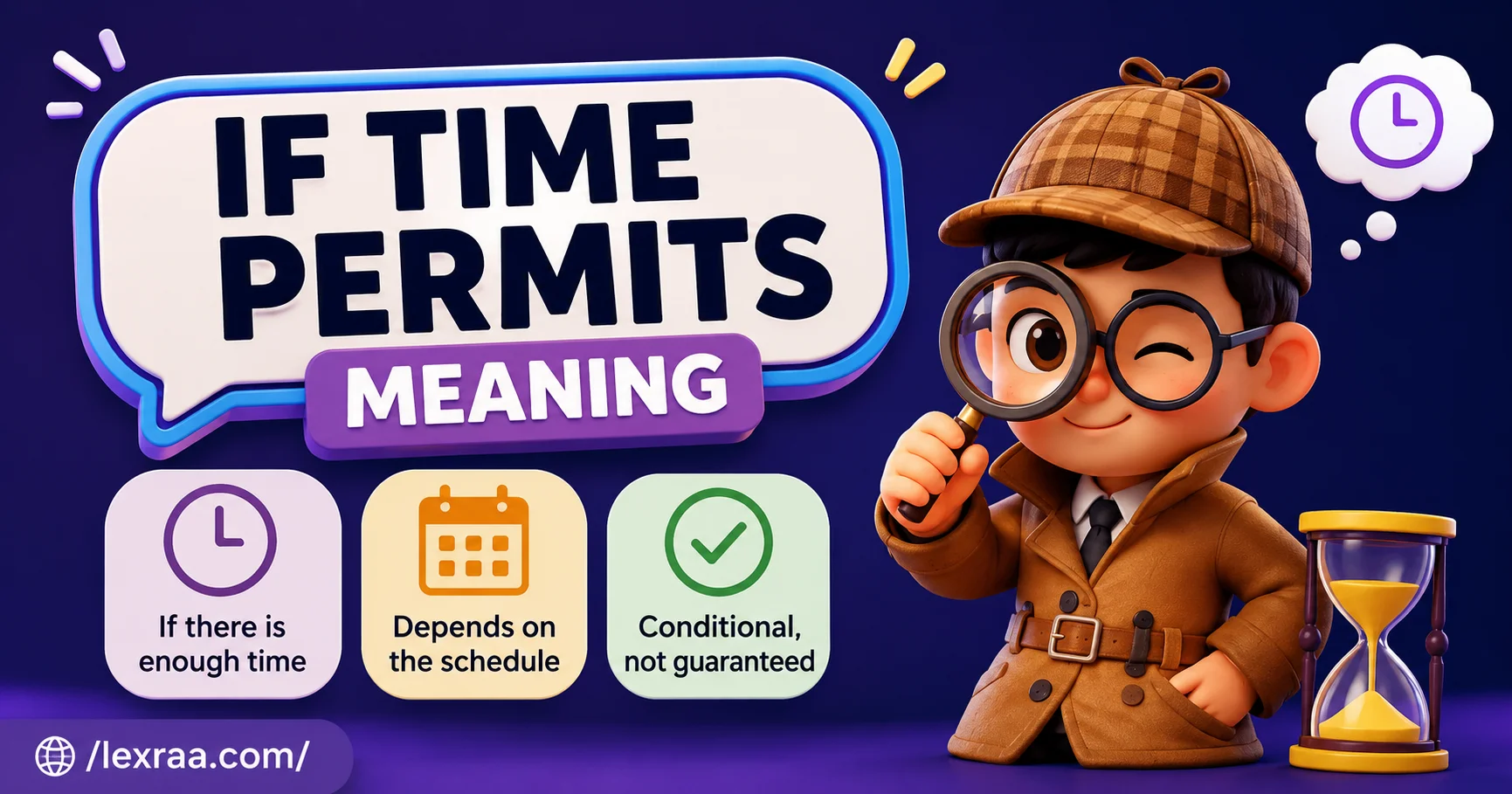
“If time permits” means “if there is enough time available.” It tells someone that an activity, task, discussion, or plan will happen only if the available time allows it. The phrase is polite and somewhat formal, so it appears often in professional, academic, and organized settings.
For example:
“We will discuss the final topic if time permits.”
This means the topic will be discussed only if enough time remains after the other planned activities.
It does not guarantee that something will happen. Instead, it makes the action conditional on the amount of time available.
What Does “If Time Permits” Mean?
The phrase “if time permits” expresses a condition based on available time.
In simpler English, you can understand it as:
- If there is enough time
- If we have enough time
- If the schedule allows
- If there is time available
- If we can fit it in
Consider this sentence:
“I’ll answer your questions if time permits.”
The speaker is willing to answer the questions, but only if there is enough time to do so.
The phrase therefore combines willingness with uncertainty. The speaker isn’t necessarily refusing the activity. They simply aren’t promising that there will be enough time for it.
What Does “Permits” Mean Here?
The word “permits” can mean “allows” or “makes possible.” Merriam-Webster defines the verb permit with meanings including “to consent to,” “give permission,” and “make possible,” and specifically includes the expression “if time permits.”
So, literally:
If time permits = If time allows it.
Time isn’t literally giving permission. The phrase uses personification: available time is treated as something that can allow an activity to happen.
For example:
“We can stop for coffee if time permits.”
means:
“We can stop for coffee if our schedule gives us enough time.”
Is “If Time Permits” Formal or Casual?
“If time permits” is correct in both speech and writing, but it tends to sound more formal than everyday alternatives.
It fits naturally in:
- Business meetings
- Presentations
- Academic discussions
- Formal emails
- Event schedules
- Official announcements
- Project planning
For casual conversation, many people would simply say:
“If we have time.”
Compare:
“We can grab coffee if time permits.”
with:
“We can grab coffee if we have time.”
Both are correct, but the second sounds more natural in an everyday conversation with a friend.
The difference is primarily one of style and tone, not correctness. Current usage guides similarly describe “if time permits” as somewhat formal compared with “if time allows” or “if we have time.”
Does “If Time Permits” Mean It Will Definitely Happen?
No.
This is one of the most important parts of the phrase.
When someone says:
“I’ll review the document if time permits.”
they are not promising that the review will happen.
They are saying that they intend or are willing to do it provided that enough time becomes available.
This makes the phrase useful when someone wants to avoid making a firm commitment.
Compare:
“I’ll review the document tomorrow.”
This sounds like a commitment.
“I’ll review the document tomorrow if time permits.”
This is conditional and leaves open the possibility that the review won’t happen.
Why Do People Say “If Time Permits”?
The phrase is useful because it acknowledges that schedules have limits.
Imagine a manager has a meeting with six items on the agenda. The manager might say:
“We’ll discuss the new proposal if time permits.”
That tells everyone that the proposal is worth discussing, but the primary agenda items come first.
In this sense, “if time permits” can subtly communicate priority. An activity mentioned with this phrase is often secondary to whatever must be completed first.
That doesn’t necessarily mean the activity is unimportant. It simply means there isn’t enough certainty about the available time to promise it.
“If Time Permits” vs. “If Time Allows”
These two phrases are extremely close.
If time permits
“We’ll review the final section if time permits.”
If time allows
“We’ll review the final section if time allows.”
Both mean:
“We’ll review it if there is enough time.”
The main difference is tone.
“If time permits” can sound slightly more formal or traditional.
“If time allows” often feels a little more natural in modern everyday and workplace communication.
Neither is grammatically wrong.
Current grammar references consistently treat the two expressions as interchangeable in their basic meaning.
“If Time Permits” vs. “If We Have Time”
These phrases communicate almost the same condition, but their style is different.
If time permits:
“We’ll take questions if time permits.”
If we have time:
“We’ll take questions if we have time.”
The first sounds more formal and polished.
The second sounds more conversational and direct.
For a presentation or meeting:
“We’ll take additional questions if time permits.”
works naturally.
For a conversation with a friend:
“We can get dessert if we have time.”
sounds more natural.
“If Time Permits” vs. “If I Have Time”
These phrases are similar but aren’t always identical.
“If I have time” focuses specifically on the speaker’s own availability.
“I’ll call you later if I have time.”
This suggests the person’s schedule is the deciding factor.
“If time permits” is broader.
“We’ll discuss the issue if time permits.”
The limitation could come from the entire schedule, meeting length, other activities, or circumstances.
So “if I have time” is often more personal and conversational, while “if time permits” is more formal and schedule-oriented.
“If Time Permits” vs. “Time Permitting”
“Time permitting” is a shorter version of the same basic idea.
Compare:
“We’ll answer additional questions if time permits.”
and:
“We’ll answer additional questions, time permitting.”
Both indicate that the questions will be answered if enough time remains.
“Time permitting” is particularly concise and works well in formal or professional writing.
For someone learning English, however, “if time permits” may be easier to understand because the condition is stated explicitly.
Grammar of “If Time Permits”
The structure is simple:
If + time + permits
Here:
- If introduces the condition.
- Time is the subject.
- Permits is the verb.
Because time is a singular noun, the verb takes the singular form permits.
Correct
“If time permits, we’ll continue.”
Incorrect
“If time permit, we’ll continue.”
The same pattern appears in:
“If time allows, we’ll continue.”
Because time is singular, we use allows, not allow.
The phrase is a conditional clause, meaning it establishes the condition under which the main action will occur.
Where Can You Use “If Time Permits”?
The phrase is flexible, but it is especially useful when discussing schedules or optional activities.
At Work
“I’ll review the remaining files if time permits.”
This tells a coworker that the task is possible but not guaranteed.
In a Meeting
“We’ll discuss the budget changes if time permits.”
This makes the discussion dependent on how much time remains.
In a Presentation
“I’ll answer questions at the end if time permits.”
This is a common way to manage a limited presentation schedule.
In Education
“We’ll cover the final chapter if time permits.”
The teacher is signaling that the chapter may be covered if enough class time remains.
When Making Plans
“We can visit the old town if time permits.”
The visit is an optional possibility rather than a guaranteed part of the itinerary.
Example Conversations Using “If Time Permits”
1. Professional
Manager: Can you review the second report today?
Employee: I’ll try to get to it if time permits.
Manager: That’s fine. The first report is the priority.
Employee: I’ll finish that one first.
Here, the phrase clearly establishes a priority.
2. Academic
Teacher: We have ten minutes left in class.
Student: Will we discuss the final example?
Teacher: Yes, if time permits.
Student: Okay, we’ll see how much we can cover.
The phrase indicates that the remaining time determines whether the discussion happens.
3. Travel
Friend 1: Are we going to the museum today?
Friend 2: We can go if time permits.
Friend 1: Let’s finish lunch first.
Friend 2: Sounds good.
The museum visit is possible but depends on the schedule.
4. Funny
Friend 1: Are you finally going to clean your room?
Friend 2: Yes, if time permits.
Friend 1: You’ve had three weeks.
Friend 2: Clearly, time has been against me.
The formal phrase becomes humorous because it is being used for an ordinary personal task.
5. Sarcastic
Coworker: Will you take another meeting today?
Alex: If time permits.
Coworker: Your calendar has no empty spaces.
Alex: Exactly. A true mystery.
Here, the formal wording is used sarcastically to highlight an obviously packed schedule.
6. Family
Parent: Can we stop for ice cream?
Child: Yes!
Parent: If time permits. We still have errands.
Child: Then we need to become very fast.
The phrase tells the child that the extra stop depends on finishing the main tasks first.
7. Workplace Email Conversation
Colleague: Could we review the presentation today?
Jordan: Yes, if time permits after the client call.
Colleague: That works for me.
Jordan: I’ll message you afterward.
This use sounds professional without making a firm promise.
8. Casual Conversation
Friend 1: Want to grab coffee later?
Friend 2: Sure, if time permits.
Friend 1: That’s a very formal way to say you’re busy.
Friend 2: My calendar has become my boss.
Here, the slightly formal wording itself becomes part of the joke.
Is “If Time Permits” Polite?
Yes, it can sound polite because it avoids making an overly strong promise.
For example:
“If time permits, I’d like to discuss another issue.”
This doesn’t demand that the other person make time. It acknowledges that there may be limits.
It can therefore be useful when you want to express interest while respecting an existing schedule.
However, the phrase can sometimes sound vague.
If someone says:
“I’ll get back to you if time permits.”
you may not know whether they genuinely intend to respond or are simply leaving the possibility open.
So while the phrase is polite, it doesn’t necessarily provide a firm commitment.
Can “If Time Permits” Sound Dismissive?
Sometimes, yes.
The phrase itself isn’t dismissive, but its meaning can imply that something is secondary to other priorities.
For example:
“We’ll discuss your suggestion if time permits.”
could be interpreted as:
“Your suggestion isn’t guaranteed to receive attention.”
Whether that sounds reasonable or dismissive depends on the situation.
If the schedule genuinely is limited, the phrase is simply realistic.
If someone repeatedly uses it to avoid committing to something, it may start to sound evasive.
Common Mistakes With “If Time Permits”
Using “Permit” Instead of “Permits”
Because time is singular, the correct form is:
“If time permits.”
Not:
“If time permit.”
Assuming It Means “Whenever I Want”
It doesn’t.
The phrase specifically introduces a time-based condition.
“I’ll call you if time permits.”
means the call depends on having enough available time.
Using It When Time Isn’t the Real Problem
Suppose you need to wait for your manager’s approval.
Saying:
“I’ll send it if time permits.”
may be inaccurate if the real issue is approval.
A clearer sentence would be:
“I’ll send it once I have approval.”
Good communication identifies the actual condition instead of using “if time permits” as a vague catch-all.
Using It Too Often in Casual Speech
The phrase is perfectly correct, but it can sound unnecessarily formal in everyday conversation.
Instead of:
“We can get pizza if time permits.”
a friend might naturally say:
“We can get pizza if we have time.”
The shorter alternative often feels warmer and more conversational.
Is “If Time Permits” Correct English?
Yes.
“If time permits” is grammatically correct and widely understood.
It is a conditional expression meaning that something depends on having enough available time. Reference sources consistently recognize the construction as valid English.
You can place it at the beginning or end of a sentence.
At the Beginning
“If time permits, we’ll discuss the final question.”
At the End
“We’ll discuss the final question if time permits.”
Both are correct.
When the conditional phrase comes first, a comma normally separates it from the main clause.
Who Typically Uses “If Time Permits”?
There isn’t a specific age group, gender, or region associated with the phrase.
It is part of standard English rather than youth slang or internet-specific language.
Its frequency is more closely related to context and formality.
You are more likely to encounter it in:
- Professional communication
- Academic settings
- Presentations
- Meetings
- Formal planning
- Written announcements
You can also hear it in ordinary conversation, but people often choose simpler alternatives such as “if we have time.”
Is “If Time Permits” Rude or Safe?
The phrase is not rude, offensive, or profane.
It is generally safe for:
- School
- Work
- Emails
- Meetings
- Presentations
- Everyday conversations
Its only potential issue is tone.
In very casual settings, it can sound a little formal:
“We can get lunch if time permits.”
A friend might find that amusing or overly serious, but that doesn’t make the phrase inappropriate.
Alternatives to “If Time Permits”
The best alternative depends on how formal you want to sound.
| Phrase | Meaning | Tone | Best Context | Confusion Risk |
|---|---|---|---|---|
| If time permits | If enough time is available | Formal | Meetings, writing | Low |
| If time allows | If enough time is available | Neutral-formal | Work, planning | Low |
| If we have time | If enough time remains | Casual | Everyday speech | Low |
| If there’s time | If time is available | Casual-neutral | Plans, conversation | Low |
| Time permitting | If enough time is available | Formal | Writing, schedules | Low |
| If I have time | If my schedule allows | Personal / casual | Everyday speech | Medium |
These aren’t always perfect substitutes.
For example, “if I have time” focuses on one person’s availability, while “if time permits” can refer more broadly to the circumstances or schedule.
FAQ
What is the simple meaning of “if time permits”?
It simply means “if there is enough time.” Something will happen only if the available time makes it possible. It does not guarantee that the activity will happen.
Is “if time permits” formal?
Yes, it generally has a somewhat formal or polished tone. It is especially common in professional, academic, and organized settings. In casual conversation, “if we have time” often sounds more natural.
Is “if time permits” the same as “if time allows”?
Yes, the two phrases have essentially the same meaning. Both indicate that something depends on having enough time. “If time permits” can sound slightly more formal, while “if time allows” often feels more conversational.
What is the opposite of “if time permits”?
There isn’t one fixed opposite phrase. Depending on the situation, an opposite idea could be “regardless of the time available,” “even if we’re short on time,” or simply a firm statement that the activity will happen. The best wording depends on what you want to communicate.
Can I use “if time permits” in an email?
Yes. It is appropriate in professional emails when you want to make an activity conditional on available time. For example, “If time permits, I’d also like to review the final section” sounds polite and professional.
Does “if time permits” mean “maybe”?
It can imply possibility rather than certainty, but the uncertainty specifically comes from available time. If enough time becomes available, the speaker intends or expects the activity to happen. It is therefore more precise than simply saying “maybe.”
What is a casual way to say “if time permits”?
The most natural casual alternatives are “if we have time,” “if there’s time,” and “if we can fit it in.” These expressions communicate the same basic idea without the formal tone of “if time permits.”
Is “if time permit” grammatically correct?
No. The standard expression is “if time permits” because “time” is singular and therefore takes the singular verb “permits.” “If time permit” is a grammatical error in this construction.
Final Takeaway
“If time permits” means “if there is enough time available.”
It is a standard English conditional phrase, not slang, and it is commonly used when an activity depends on whether enough time remains.
The phrase can communicate three useful ideas at once: intention, flexibility, and uncertainty. Someone using it is often willing to do something but does not want to promise that the schedule will allow it.
Use “if time permits” when you want a polished or professional tone. Choose “if we have time” or “if there’s time” for more natural everyday conversation.
The key distinction is simple:
If time permits = If there is enough time for it to happen.
And when you need to communicate a firm commitment, leave the condition out and say exactly what you intend to do.