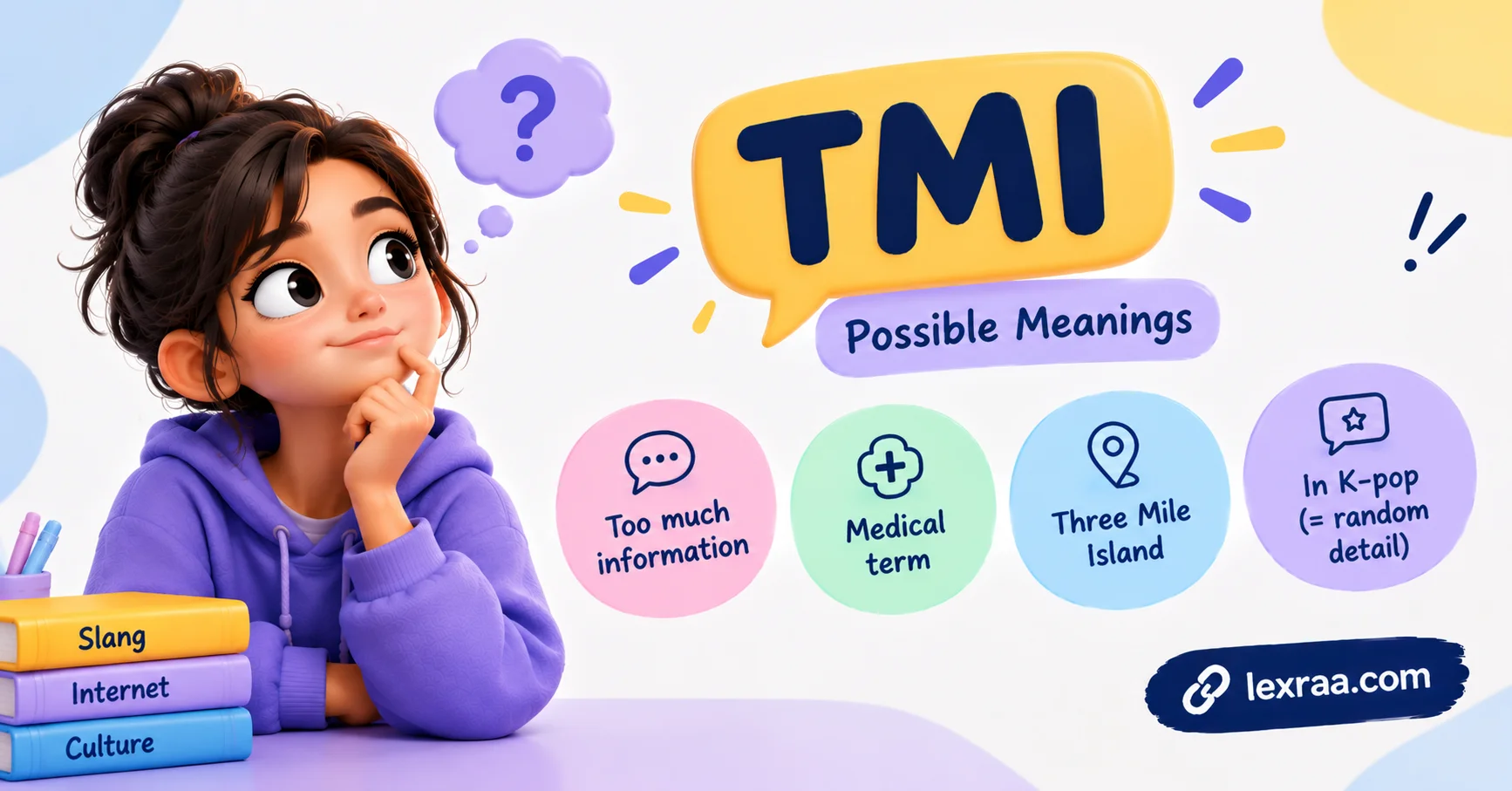
TMI in text means “too much information.” It is an informal abbreviation used when someone shares something overly personal, embarrassing, graphic, unnecessary, or simply more detailed than the listener wanted to know.
What Does TMI Mean in Text?
TMI = “too much information.”
In texting and online conversation, TMI is usually a reaction to oversharing. Someone may tell you an intimate story, describe a gross experience in detail, or continue explaining something when the basic information was already enough. You can respond with “TMI!” to signal, often humorously, that you did not need all those details.
For example:
Friend: “I was late because I had the worst stomach problem this morning, and then—”
You: “TMI 😭”
The abbreviation is formally described by dictionaries as an abbreviation or initialism of “too much information,” rather than a separate slang word with an unrelated meaning. Cambridge specifically defines it as an informal abbreviation used when someone gives too many details, especially embarrassing or personal ones.
TMI does not necessarily mean there was literally a large amount of information. One short sentence can be TMI if it is extremely personal, while a long explanation about an ordinary subject may not be TMI at all.
That distinction is important: TMI is mainly about social appropriateness and personal boundaries, not word count.
The Main Ways People Use “TMI”
TMI can perform several closely related functions in a conversation.
1. Reacting to someone else’s oversharing
This is the classic use:
“You told your boss that? TMI!”
The speaker is saying that the information was unnecessarily personal or inappropriate for the situation.
2. Joking about an ordinary detail
Friends sometimes use TMI even when the information isn’t genuinely offensive:
“I color-code my socks according to the day of the week.”
“Okay, TMI 😂.”
Here, TMI is playful exaggeration rather than an actual complaint.
3. Warning that you’re about to overshare
Someone may write:
“TMI, but I haven’t slept properly in three days.”
In this construction, TMI functions almost like a disclaimer. The writer recognizes that the next detail may be more personal than necessary.
4. Signaling information overload
The expression can also react to too many unnecessary details, even when those details aren’t particularly private. Wiktionary records senses involving both excessively personal information and information that is excessive or unnecessary in context.
Is TMI the Same as “Oversharing”?
They’re closely connected, but they are not exactly the same thing.
Oversharing describes the act of revealing more personal information than is appropriate or comfortable for the situation.
TMI is often the reaction to that behavior.
For example:
“I told my new coworker all about my breakup.”
That is potentially oversharing.
“My coworker said, ‘TMI!’”
That is the listener’s reaction to the oversharing.
This distinction makes TMI useful in conversation: it can acknowledge a boundary without requiring a long explanation about why the information was uncomfortable.
Is TMI Always Negative?
No. TMI can be serious, teasing, sarcastic, or completely playful.
Cambridge and Merriam-Webster emphasize its association with embarrassing or private information, but everyday conversational use can be lighter.
Compare:
“My doctor had to examine a very private area.”
“TMI.”
That may be a genuine request for fewer details.
Now compare:
“I alphabetize my spice rack.”
“TMI 😂.”
That is probably a joke.
So the tone depends heavily on the relationship between the people, the subject being discussed, and punctuation or emojis.
TMI on Instagram, Snapchat, TikTok, WhatsApp, and X
TMI is not a platform-specific abbreviation. Its basic meaning remains “too much information” across digital communication.
It is documented as internet and texting language, and sources associate it broadly with chats, social media, forums, and text messaging.
On Instagram, TMI can appear in comments, DMs, captions, or replies when someone shares an unnecessarily personal detail.
“Girl… TMI 😭”
There is no special Instagram-only definition.
Snapchat
The same meaning applies on Snapchat:
“Bro, TMI 💀”
The emoji can make the response sound more amused than genuinely offended.
TikTok
Someone might comment:
“Okay, TMI 😂”
after a creator gives an unusually personal story.
Again, TikTok does not create a separate meaning for the abbreviation.
TMI works naturally in one-to-one messages and group chats:
“TMI guys 😭 can we talk about literally anything else?”
X
TMI has also appeared in social-media posts and reactions on X. Merriam-Webster even gives a Twitter example involving followers reacting to personal disclosures with “TMI.”
The important takeaway: don’t interpret “TMI on Instagram” or “TMI on Snapchat” as a special slang definition. The platform changes, but the basic meaning does not.
What Does TMI Mean in K-Pop?
This is one of the genuinely useful exceptions to know.
In English, TMI normally means “too much information,” particularly information that is excessively personal, embarrassing, or unwanted.
In Korean popular culture, however, TMI can be used somewhat differently. It may refer to a random, mundane, or unnecessary detail about someone’s day rather than an uncomfortable confession. Korean media sources describe the borrowed expression as “Too Much Information,” while K-pop coverage has specifically noted this difference between English-language and Korean usage.
So if a K-pop idol is asked to share a TMI and answers:
“I ate bread for breakfast.”
an international English speaker might wonder why that counts as “too much information.”
The Korean usage is often closer to “a random little fact about myself” or “an unnecessary detail” than the English-language reaction of “please stop telling me this.”
That cultural distinction is especially useful when reading K-pop interviews, fan posts, Weverse content, or translated Korean entertainment material.
Other Real Meanings of TMI
In a normal text conversation, “too much information” is overwhelmingly the meaning you should consider first.
However, TMI has other established meanings outside internet slang.
For example, Three Mile Island can be abbreviated as TMI, particularly in historical, geographical, energy, or nuclear-related discussions. Dictionary.com lists this as another American English meaning.
In medical and scientific contexts, TMI can also represent specialized technical terms, including Total Marrow Irradiation, a radiotherapy technique used in hematopoietic stem-cell transplantation.
Those meanings generally have nothing to do with texting slang.
So if someone texts:
“Your story was TMI 😂”
the intended meaning is almost certainly “too much information.”
If a medical research paper says TMI, you need the surrounding context before interpreting it.
Where Did TMI Come From?
The history of TMI deserves some caution because the commonly repeated origin story is not strongly documented.
Wiktionary attributes an early shortening of “too much information” to former Wall Street Journal reporter Joseph Checkler around 1988. However, Know Your Meme explicitly notes that the source supporting this attribution is uncited.
That means it would be too confident to write, “Joseph Checkler definitely invented TMI in 1988.”
What is better supported is the broader timeline.
TMI was established in American informal usage by the 1990s, and it became increasingly recognizable as internet slang during the late 1990s and 2000s. Know Your Meme documents an early Urban Dictionary definition from 2002 and notes that the abbreviation became popular as internet slang during the 2000s.
The rise of forums, chatrooms, email, blogs, instant messaging, and later social media provided ideal environments for short expressions such as TMI.
There is no reliable evidence from the sources reviewed that TMI originated specifically in AAVE, so it would be misleading to assign it an AAVE origin.
10 Natural TMI Conversations
1. Funny
A: I ate six slices of pizza before noon.
B: Six?!
A: And I’m thinking about ordering more.
B: TMI, but honestly, I’m impressed.
2. Sarcastic
A: I need to tell you exactly what happened on my date.
B: Okay, go ahead.
A: Then he spent twenty minutes describing his bathroom routine.
B: Wow. TMI. I suddenly feel like I was there.
3. Playful
A: Guess what? I still sleep with my childhood teddy bear.
B: Aww, that’s actually cute.
A: His name is Mr. Pickles.
B: Okay, TMI, Mr. Pickles can stay out of this conversation 😂.
4. Serious
A: I probably shouldn’t tell you all the details about my medical appointment.
B: You can tell me if you’re comfortable.
A: It’s honestly pretty personal.
B: Then don’t worry about it. You don’t owe me the details.
This example also shows why TMI can be about boundaries, not merely humor.
5. With a Friend
A: I haven’t showered since Monday.
B: Dude.
A: What? You asked why I wasn’t going out.
B: I asked where you were, not for the entire hygiene report. TMI.
6. Family
Mom: Your brother told me about his first date.
Daughter: Oh no.
Mom: He told me absolutely everything.
Daughter: Mom, TMI. Please stop.
7. Coworkers
Coworker A: I’m late because my stomach has been acting weird all morning.
Coworker B: I hope you’re feeling better.
Coworker A: Let me explain exactly what happened—
Coworker B: TMI. Coffee first, explanation never.
8. Dating
A: I want to tell you something embarrassing.
B: Go for it.
A: I practiced what I was going to say before calling you.
B: That’s not TMI. That’s actually adorable.
This illustrates an important point: TMI is subjective. What one person considers oversharing may feel completely comfortable to someone else.
9. Group Chat
A: Guys, I need advice.
B: What’s wrong?
A: My roommate has been using my toothbrush.
C: TMI 🤢
B: That’s not TMI. That’s a crime against humanity.
10. Instagram DM
A: I saw your story about your breakup. Are you okay?
B: Yeah, but I probably shouldn’t get into every detail.
A: You can tell me if you want.
B: Thanks, but I’ll spare you the TMI.
Here TMI is used by the speaker about their own information, rather than as criticism from the listener.
How to Reply When Someone Says “TMI”
Your best response depends on whether they are joking or genuinely uncomfortable.
Funny reply
“You asked! 😂”
Serious reply
“Sorry, I didn’t mean to make you uncomfortable.”
Playful reply
“Okay, okay. I’ll keep the rest classified. 😭”
Flirty reply
If you’re already flirting:
“You sure? I haven’t even gotten to the interesting part yet. 😉”
That response only fits a relationship where that kind of teasing is welcome.
Neutral reply
“Haha, fair. I’ll leave out the details.”
If the other person appears genuinely uncomfortable, the neutral or serious response is better than continuing the joke.
TMI vs. Similar Terms
| Term | Meaning | Tone | Popularity | Confusion Risk |
|---|---|---|---|---|
| TMI | Too much information | Playful, awkward, or critical | High | Low |
| Oversharing | Giving more personal information than appropriate | Neutral/critical | High | Low |
| FYI | For your information | Neutral/informative | High | Medium |
| TL;DR | Too long; didn’t read / summary wanted | Casual | High | Medium |
| Info dump | Giving a large amount of information at once | Casual | Medium | Medium |
| NSFW | Not safe for work; warns about potentially inappropriate content | Warning | High | Medium |
One particularly important distinction is TMI vs. NSFW.
TMI means the information may be too personal or unnecessary for the listener.
NSFW is a warning that content may be inappropriate to view in a workplace or other public setting.
Something can be TMI without being NSFW, and NSFW content does not automatically mean TMI.
There is also no standard opposite abbreviation for TMI. It would be misleading to invent one simply to fill a comparison table.
What Does TMI Mean From a Girl or Guy?
The meaning does not change based on the sender’s gender.
If a girl texts:
“TMI 😂”
and a guy texts:
“TMI bro 💀”
both are generally saying that the information was too personal, unnecessary, awkward, or excessive for the situation.
Context can make TMI part of flirting, friendship, teasing, or an actual boundary, but the abbreviation itself does not have a separate “from a girl” or “from a guy” definition.
So if someone searches “TMI meaning from a girl,” the safest interpretation is still “too much information.” Look at what was said immediately before TMI to determine the tone.
Who Uses TMI?
TMI is not exclusive to Gen Z.
It has been used in internet and texting culture for decades, with documented usage extending back well before today’s social-media platforms. Know Your Meme traces its online popularity to the 2000s, while dictionary sources now treat it as an established informal abbreviation.
Gen Z and Millennials can both use it, but there is no reliable basis for claiming that one generation “owns” the expression.
There also isn’t a strong regional rule separating American and British texting usage. Dictionary.com notes both American and British dictionary treatment, with the British definition likewise centered on “too much information.”
Is TMI Rude or Safe?
TMI is not profanity and is generally safe in casual conversation.
However, it can become rude depending on how you use it.
If a close friend tells an embarrassing story and you say:
“TMI 😂”
they may laugh.
If someone is seriously discussing a medical, emotional, or traumatic experience and you respond:
“TMI.”
it can sound dismissive or insensitive.
The safest rule is to consider why the person shared the information. Someone joking about an awkward date is different from someone opening up about a serious personal problem.
For school or workplace writing, it is usually better to avoid TMI unless you are discussing the abbreviation itself. In professional communication, write “too much information,” “unnecessary detail,” or simply address the relevant point directly.
Why TMI Has Stayed Useful
TMI works because it compresses a surprisingly complicated social reaction into three letters. Saying “too much information” can sound blunt, but “TMI 😂” can communicate embarrassment, amusement, surprise, and a request to stop at the same time. It also leaves room for ambiguity: friends can use it as affectionate teasing, while someone uncomfortable can use it as a genuine boundary signal. That flexibility helps explain why an abbreviation that became popular online decades ago still feels natural in modern chats.
FAQ
What does TMI mean in texting?
TMI means “too much information.” It is commonly used when someone shares more personal, embarrassing, graphic, or unnecessary information than the listener wanted. It can be serious or completely playful depending on the conversation.
What does TMI mean on Instagram?
On Instagram, TMI still means “too much information.” It can appear in comments, captions, replies, or DMs when someone thinks another person has overshared. Instagram does not give TMI a separate platform-specific definition.
What does TMI mean on Snapchat?
TMI on Snapchat normally means “too much information.” A person may use it after hearing an awkward story or receiving an overly personal message. Emojis such as 😂 or 💀 can make the response sound more humorous.
What does TMI mean in K-pop?
TMI can have a somewhat different everyday meaning in Korean popular culture. Instead of necessarily referring to embarrassing oversharing, it can mean a random, mundane, or unnecessary personal detail, such as what someone ate that day. This is a borrowed English abbreviation whose Korean usage developed somewhat differently.
Is TMI a bad word?
No. TMI is not a swear word or profanity. It is an informal expression that can be mildly critical when someone overshares, but friends often use it jokingly. Its effect depends on the subject and relationship.
Is TMI rude?
It can be if used at the wrong moment. Saying “TMI” to a friend who is joking about an awkward experience is usually harmless, while saying it to someone discussing a serious personal problem can come across as insensitive. Tone and context matter more than the three letters themselves.
What is the difference between TMI and oversharing?
Oversharing is the behavior of revealing more personal information than appropriate. TMI is often the reaction to that behavior. In other words, someone overshares, and another person may respond, “TMI!”
Does TMI mean something different when a girl says it?
No standard gender-specific meaning exists. Whether a girl, guy, friend, coworker, or partner says TMI, the basic meaning remains “too much information.” The surrounding conversation determines whether the person is joking, uncomfortable, or simply teasing.
Conclusion
TMI means “too much information,” and in texting it usually signals that someone has shared more personal, embarrassing, graphic, or unnecessary information than the listener wanted.
It is an informal abbreviation/initialism, not a platform-specific slang term. You’ll see it in texts, DMs, group chats, social media, and everyday conversation, while specialized contexts can give TMI unrelated meanings such as Three Mile Island or Total Marrow Irradiation.
The historical origin of the abbreviation is less certain than many websites suggest. The frequently repeated 1988 Joseph Checkler attribution is not strongly documented, while its establishment in informal and internet communication by the 1990s and 2000s is much clearer.
Use “TMI” casually when the context supports it, especially with friends or in lighthearted online conversation. If someone is sharing something genuinely sensitive, however, don’t treat TMI as a joke simply because the information is personal.