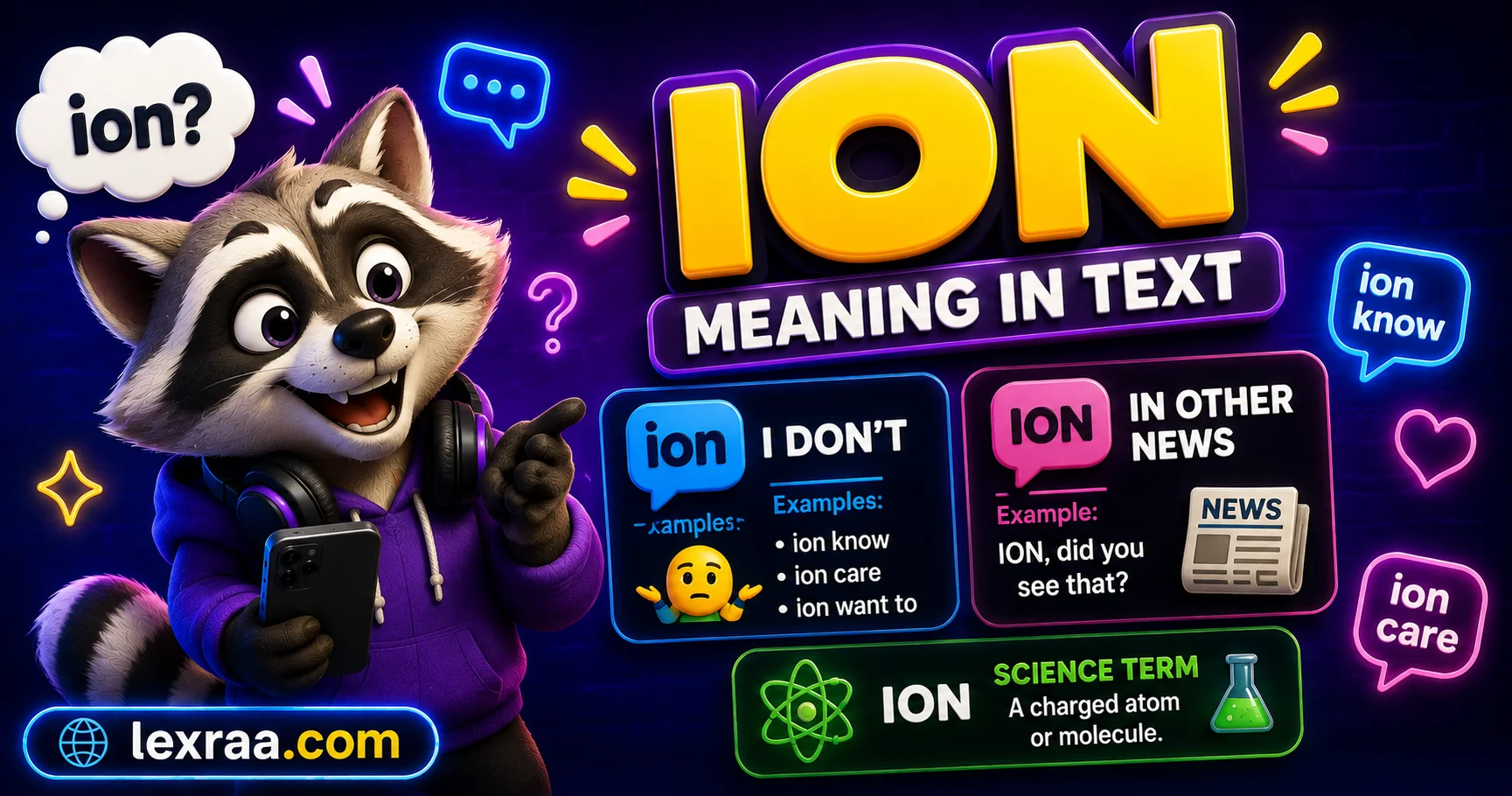
In a text, “ion” usually means “I don’t.” It is a phonetic slang spelling used in casual conversation, so “ion know” means “I don’t know” and “ion care” means “I don’t care.” The meaning depends heavily on context.
What does ION mean in text?
The most common texting meaning of ion is “I don’t.” It is not a traditional initialism where each letter stands for a separate word. Instead, it is a phonetic spelling: a written version of how “I don’t” can sound when compressed in fast, informal speech.
That is why ion usually needs words after it:
- ion know = I don’t know
- ion care = I don’t care
- ion want to = I don’t want to
- ion like that = I don’t like that
- ion think so = I don’t think so
The spelling can look confusing because ion is also an ordinary English science term for an electrically charged atom or molecule. In a sentence such as “The solution contains ions,” it has nothing to do with texting slang.
The other genuine meaning: ION = “In Other News”
Written in capitals, ION can also mean “In Other News.” This is an actual internet abbreviation used to introduce a different topic or make an abrupt subject change.
For example:
ION, did you see what happened at the concert?
Here, the writer is essentially saying, “Anyway, changing the subject…” Dictionary.com notes this use as an occasional internet abbreviation, so it is real, but it is much less likely to be the intended meaning when you see lowercase ion inside a phrase such as “ion know.”
The easiest way to tell which meaning someone intended
You usually do not need to guess.
If ion is followed by a verb or phrase that can complete “I don’t…”, the slang meaning is almost certainly intended:
- ion believe you
- ion wanna go
- ion remember that
If ION appears before a completely new subject, “In Other News” is more plausible:
- ION, my sister finally got the job.
And if the conversation is about chemistry, physics, batteries, or atoms, it probably means the scientific word.
This context test is more useful than simply memorizing a list of meanings because it works even when capitalization is inconsistent.
A common misunderstanding: ION does not always mean “I don’t know”
One of the most frequent mistakes is translating ion directly as “I don’t know.” That only works in the specific phrase “ion know.”
Think of ion as replacing “I don’t,” not as a complete replacement for IDK.
So:
- ion know → I don’t know
- ion care → I don’t care
- ion get it → I don’t get it
If someone sends only “ion” with no context, the intended meaning may be harder to establish. They could be using slang, referring to “In Other News,” or simply discussing the scientific word.
Where did “ion” come from?
The texting use of ion is connected to the way “I don’t” is pronounced and represented in informal speech, including speech patterns associated with African American English/AAVE. It is better understood as speech influencing writing than as a phrase invented by a particular app or a single viral post.
Dictionary.com documents the slang use of ion and includes examples from 2018, while other contemporary explanations consistently describe it as a phonetic rendering of “I don’t.” An exact first person, first post, or precise invention date is not clearly established, so claiming that one individual “created” the term would go beyond the available evidence.
The cultural context matters here. Many expressions that spread widely through internet culture have roots in Black speech and online communities. Once these expressions reach broader platforms, people outside those communities may adopt them without knowing where some of the linguistic influence came from.
That does not mean every person who types “ion” is consciously using AAVE, nor does it mean the expression belongs to one age group. It does mean that its history should not be reduced to “Gen Z invented a random shortcut.”
Where is ION actually used?
The strongest evidence supports ion = “I don’t” as a form used in casual texting and online conversation. It appears in social-media posts, comments, group chats, memes, and direct messages. Dictionary.com specifically discusses its presence in social media and text messaging, while contemporary support resources also document it as a texting expression.
It can appear on platforms such as TikTok, Instagram, Snapchat, X, and private messaging apps, but it is important not to interpret that as proof that every platform has its own special definition. The meaning generally travels with the users rather than changing from app to app.
A message saying:
ion even know why I’m here 😭
means the same thing whether it appears in a TikTok comment, Instagram DM, Snapchat conversation, or ordinary text message.
How ION changes the tone of a message
Replacing “I don’t” with “ion” does more than save a few characters. It can make a sentence sound more conversational, dismissive, humorous, dramatic, or deliberately casual.
Compare these:
I don’t want to go.
This is neutral and grammatically standard.
ion wanna go.
This sounds informal and closer to casual online speech.
ION WANNA GO 😭
Now the capitalization and emoji make the refusal sound more dramatic.
The slang itself does not automatically make a message rude. The rest of the sentence and the relationship between the people involved usually determine the tone.
10 natural examples of ION in conversation
1. Funny
Maya: Did you eat the leftovers?
Noah: ion know what leftovers you’re talking about.
Maya: The empty container is literally next to you.
Noah: ion recall anything without my lawyer 😭
2. Sarcastic
Jay: So you’re saying you’re innocent?
Chris: ion know, the evidence looks suspicious.
Jay: You posted the photo yourself.
Chris: Exactly. Somebody hacked my personality.
3. Playful
Ava: Be honest, did you miss me?
Leo: ion know… maybe a little.
Ava: “Maybe” is not an answer.
Leo: ion wanna sound too obvious 😂
4. Serious
Sam: Are you coming to the meeting tomorrow?
Taylor: ion think I can. I have an appointment that morning.
Sam: Okay, thanks for telling me.
Taylor: I’ll send my notes afterward.
5. Friends making plans
Nina: Movie tonight?
Omar: ion feel like going out.
Nina: Rough day?
Omar: Yeah, I just need food and sleep.
6. Family group chat
Dad: Who left the kitchen light on?
Daughter: ion know but everybody suddenly disappeared 😭
Dad: Very helpful.
Son: ion think the lamp is going to confess either.
7. Dating conversation
Alex: You really thought I wouldn’t notice you liked my story?
Riley: ion know what you’re talking about 👀
Alex: You liked it in six seconds.
Riley: Okay, ion have a defense.
8. Coworkers chatting casually
Morgan: Are you ordering lunch?
Casey: ion think so. I brought something today.
Morgan: Smart. I’m spending too much on takeout.
Casey: ion blame you though. That place is good.
9. Group chat disagreement
Ben: That was the best episode of the season.
Priya: ion agree, but the ending was wild.
Ben: Finally, something we can agree on.
Priya: Don’t get used to it.
10. Social-media comment
Commenter: Why is everyone doing this trend?
Reply: ion know but the algorithm got all of us 😭
Commenter: Fair enough.
Reply: ion even remember how I got here.
How to reply when someone says “ion”
The best reply depends on what they are refusing, denying, or expressing.
Funny reply
Them: ion know what happened.
You: Conveniently, your memory disappeared at the exact right moment 😭
Serious reply
Them: ion think I can make it today.
You: No problem. Thanks for letting me know—hope everything is okay.
Flirty reply
Them: ion think you miss me.
You: Then you might need better evidence 😏
Neutral reply
Them: ion want to go.
You: Okay, no worries. We can do something else.
One useful rule: reply to the full sentence, not just the slang. If someone says “ion care,” they are communicating a stance. Explaining what ion means back to them is usually less useful than responding to what they actually said.
ION compared with similar texting terms
| Term | Meaning | Tone | Popularity | Confusion Risk |
|---|---|---|---|---|
| ion | I don’t | Casual, expressive | Common in online slang | High for new users |
| idk | I don’t know | Casual, neutral | Very widespread | Low |
| idc | I don’t care | Often blunt or dismissive | Very widespread | Low |
| ion know | I don’t know | Casual, phonetic | Common in slang-heavy chats | Medium |
| nah | No / not really | Casual | Very widespread | Low |
| I do | An affirmative response | Neutral to emphatic | Universal | Low |
The key distinction is simple: ion is broader than IDK and IDC because it can introduce many different phrases. It supplies the “I don’t” part, while the next word tells you what the person does not know, want, believe, like, or understand.
Who uses ION?
There is good evidence that ion is associated with younger internet users and informal online culture, but assigning it exclusively to Gen Z would be inaccurate. Internet slang regularly crosses age groups, especially once expressions become widely visible through social media and messaging.
You may encounter it more often in communities where casual, slang-heavy writing is normal. Some people use it constantly; others understand it but would never type it themselves.
There is also no reliable basis for saying that one gender uses ion more than another, and broad claims that it belongs to a particular country or region should be treated cautiously. Its linguistic roots and online spread are more complicated than a simple regional label.
Is “ion” rude, offensive, or safe to use?
The word itself is not profanity or an insult. However, the sentence containing it can certainly sound rude.
Compare:
- ion think that’s right — casual disagreement
- ion care — potentially dismissive
- ion got time for this — can sound frustrated
- ion know, ask someone else — potentially rude depending on tone
It is generally fine in casual chats with people who understand the slang. It is a poor choice for formal emails, academic writing, job applications, or professional communication where clarity matters.
A useful test is this: Would the reader understand “ion” without having to decode it? If the answer is no, use “I don’t” instead.
Why does this tiny word stick around?
Ion works because it carries pronunciation, identity, and tone in only three letters. It is not merely a shorter spelling of “I don’t”; writing a phrase the way it sounds can make a message feel closer to spoken conversation. That is one reason phonetic slang survives even when the “correct” version is only a few extra characters. Internet language often rewards expressions that are fast to type while also signaling a particular conversational style.
Frequently asked questions
Does ion mean “I don’t”?
Yes. In most casual texting contexts, ion means “I don’t.” For example, “ion understand” means “I don’t understand.” Context is important because ion can have other meanings outside slang.
What does “ion know” mean?
Ion know means “I don’t know.” It is one of the clearest and most common ways to recognize the slang meaning. It is not the same as saying that ion itself means “I don’t know.”
Is ion an abbreviation or acronym?
For the “I don’t” meaning, it is better described as a phonetic slang spelling rather than a conventional acronym. The letters do not each represent a separate word. ION, however, can function as the abbreviation “In Other News.”
Does ION mean “In Other News”?
It can. ION = “In Other News” is an established internet abbreviation used when changing topics. Still, in a phrase like “ion care” or “ion know,” the intended meaning is almost certainly “I don’t.”
Is ion proper English?
The scientific word ion is standard English. The texting version meaning “I don’t” is informal slang and is not appropriate for standard formal writing. That does not make it meaningless or random; it serves a specific purpose in casual communication.
Is ion the same as IDK?
No. IDK means “I don’t know,” while ion means “I don’t.” “Ion know” and “IDK” can communicate the same basic idea, but ion can also be used in many other phrases, such as “ion care” or “ion want that.”
Can I use ion at work or school?
Usually, standard wording is safer in formal settings. A teacher, manager, client, or colleague may not recognize the slang, and “I don’t” is clearer. In a relaxed private conversation with classmates or friends, the context is different.
Why do people spell “I don’t” as ion?
The spelling reflects a compressed, informal pronunciation of the phrase. The slang has connections to speech patterns associated with African American English/AAVE and later spread through digital communication and broader internet culture. An exact single origin date or inventor is not clearly documented.
Final thoughts
If someone texts you “ion,” the safest first interpretation is “I don’t”—especially when the next words create a phrase such as “ion know,” “ion care,” or “ion want to.” It is a phonetic piece of internet slang, not a mysterious acronym and not automatically a typo.
The biggest mistake is assuming it always means “I don’t know.” Read the words around it instead. Also remember that ION can occasionally mean “In Other News,” while ion can simply be the scientific word in the right context.
Use it in casual conversations where the other person is likely to understand it. For school, work, or any situation where clarity matters more than slang, “I don’t” is still the better choice.