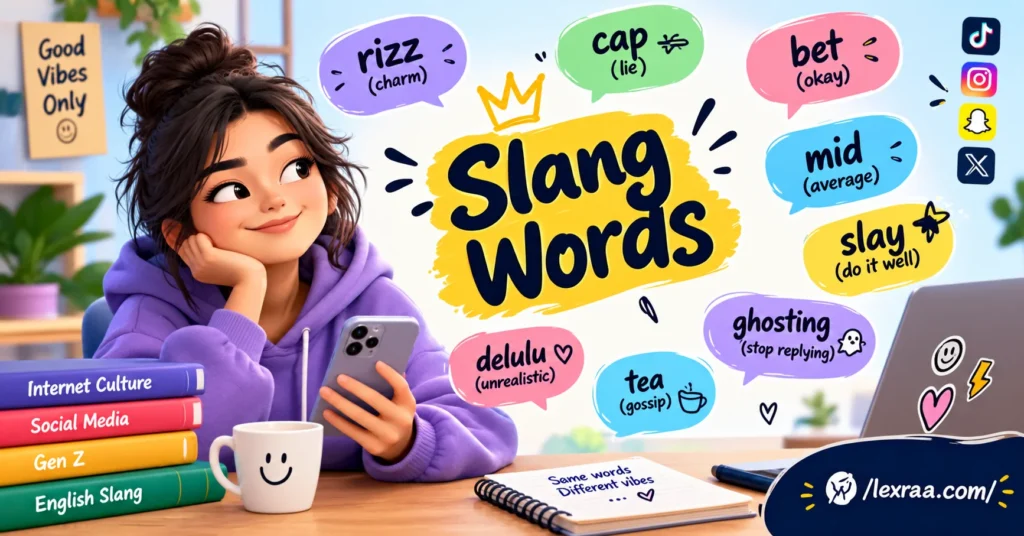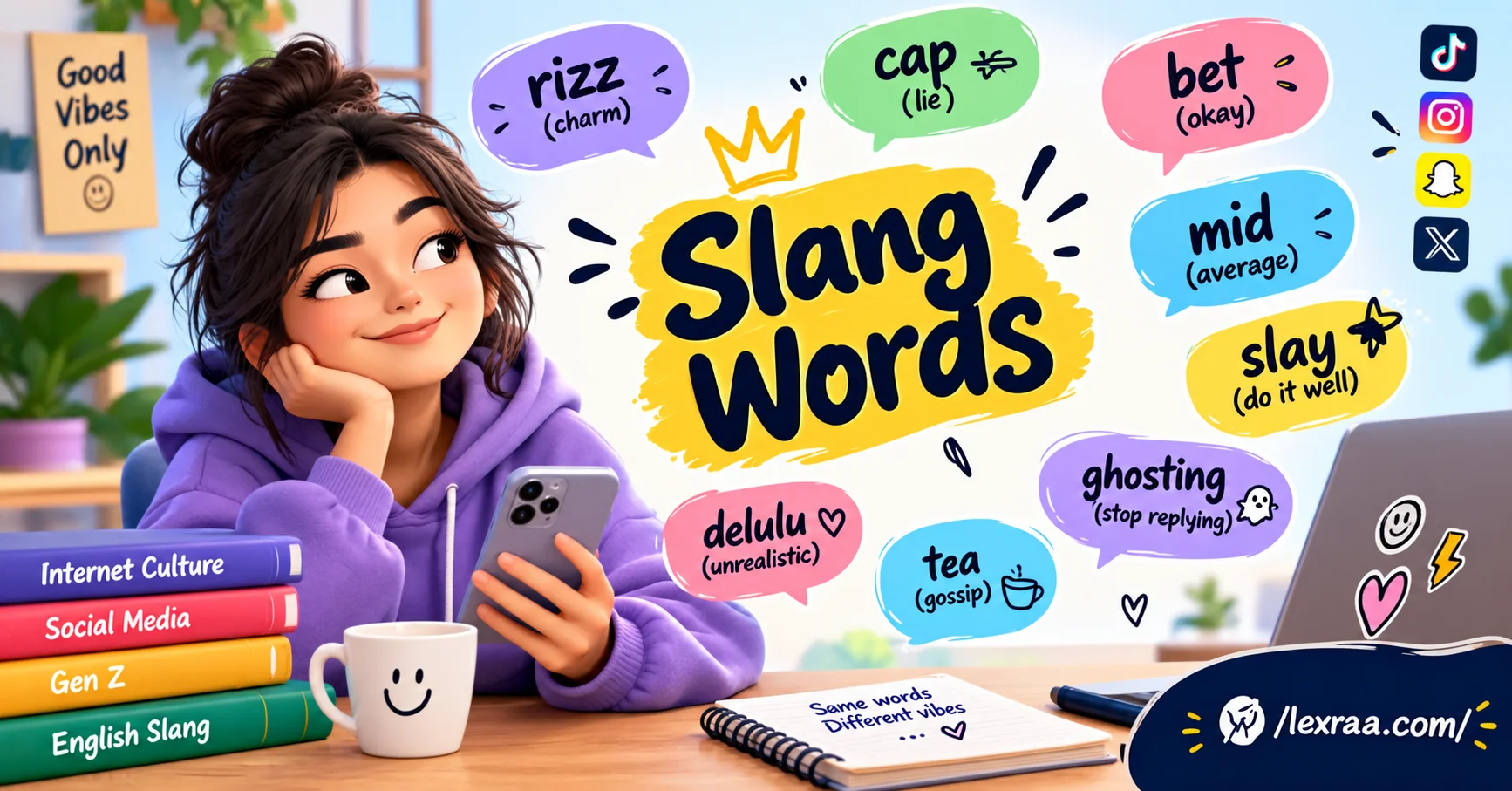
Slang words are informal expressions used by particular groups or communities. They can make conversations shorter, funnier, more expressive, or more relatable—but their meanings can change quickly depending on context, culture, and platform.
What Are Slang Words?
Slang words are very informal vocabulary associated with particular social groups, communities, generations, or situations. Unlike standard vocabulary, slang often carries an extra sense of attitude, humor, familiarity, or identity.
For example:
- Rizz → charm or ability to attract someone
- Cap → a lie or something untrue
- Bet → okay, agreed
- Mid → average or disappointing
- Ghosting → suddenly stopping communication
- Delulu → jokingly describing someone as unrealistic or delusional
Slang isn’t limited to Gen Z. Every generation develops and adopts slang, and some expressions eventually become ordinary English. Cambridge notes that slang can include individual words as well as longer expressions and idioms.
Slang Words vs. Regular Words
The biggest difference is usually formality and social context.
| Type | What it means | Example |
|---|---|---|
| Standard word | Generally accepted in formal and informal English | “Excellent” |
| Slang | Informal expression associated with a group or context | “Fire” = excellent |
| Abbreviation | Shortened form of a word or phrase | “ML” |
| Acronym/initialism | Letters representing multiple words | “GOAT” |
| Jargon | Specialized language used by a profession or field | “API” in technology |
| Idiom | Expression whose meaning isn’t fully literal | “Break a leg” |
A single term can overlap categories. ML, for example, can be slang in a personal text but an ordinary technical abbreviation when it means machine learning.
Common Slang Words and What They Mean
There isn’t one permanent list of “the” slang words because slang changes constantly. Current 2026 slang guides commonly include expressions such as rizz, delulu, no cap, mid, slay, ate, sus, aura, cooked, tea, ghosting, and IYKYK.
Here are some useful examples:
| Slang word | Common meaning | Example |
|---|---|---|
| Rizz | Charm or flirting ability | “He has serious rizz.” |
| No cap | Honestly; no lie | “That was amazing, no cap.” |
| Cap | A lie or false claim | “That’s cap.” |
| Bet | Okay; agreed | “Meet at 8?” — “Bet.” |
| Mid | Average or unimpressive | “The movie was mid.” |
| Slay | Do something extremely well | “You slayed that presentation.” |
| Ate | Did something exceptionally well | “She ate that performance.” |
| Sus | Suspicious | “That explanation sounds sus.” |
| Delulu | Delusional, usually jokingly | “I’m being delulu about my celebrity crush.” |
| Ghosting | Suddenly ending communication | “He ghosted me after two dates.” |
| Tea | Gossip or interesting information | “What’s the tea?” |
| IYKYK | If you know, you know | “That restaurant after midnight… IYKYK.” |
| Cooked | In trouble, exhausted, or finished depending on context | “I didn’t study. I’m cooked.” |
| Aura | Perceived coolness, presence, or social appeal | “That entrance gave him aura.” |
| Touch grass | Spend less time online | “You’ve been gaming for 12 hours. Touch grass.” |
These meanings are context-dependent, so even a familiar slang word can change meaning from one community to another.
Slang Words You See in Texts
Texting has created a huge amount of shorthand, but not every abbreviation is technically slang.
For example:
- LOL → laughing out loud
- OMG → oh my God
- BTW → by the way
- IDK → I don’t know
- BRB → be right back
- ILY → I love you
- ML → can mean My Love or Much Love in personal texting
The distinction matters because an abbreviation simply shortens language, while slang usually carries a social or informal meaning.
For example, “BRB” is primarily an abbreviation. “No cap” is a slang expression. “Rizz” is a slang word that developed a meaning beyond its original form.
What Does ML Mean in Slang?
One of the most useful examples of why context matters is ML.
In personal texting, ML can mean “My Love” or “Much Love.” Current slang references document both uses, although sources differ on which one is more common.
💕 ML = My Love
When someone writes:
“Goodnight, ML ❤️”
“My Love” is a natural interpretation, especially when the conversation is affectionate or romantic.
❤️ ML = Much Love
In another message:
“Thanks for helping me today, ML!”
“Much Love” may fit better because it works as a warm sign-off without necessarily being romantic. Slang.net specifically distinguishes much love as a friendly or platonic use while noting that my love can sound more romantic.
🎂 ML in a Birthday Message
“ML” can also appear in birthday posts where it may mean “More Life.” That phrase has a separate cultural history and is associated with Jamaican slang and dancehall culture; Drake’s 2017 project More Life helped expose the phrase to a much wider audience.
So:
“Happy birthday bro, ML 🙏”
could mean “More Life” rather than “My Love” or “Much Love.”
🤖 ML in AI
In technology, ML usually means “Machine Learning.”
“I’m studying ML this semester.”
Here, there is nothing romantic about it. The academic or technology context makes machine learning the obvious interpretation.
🎮 ML in Gaming
In gaming conversations, ML can refer to Mobile Legends, particularly Mobile Legends: Bang Bang.
“You playing ML tonight?”
If the conversation contains words such as rank, hero, match, lane, squad, or jungle, the gaming interpretation becomes much more likely.
📏 ML as a Measurement
Lowercase ml is also the standard abbreviation for milliliter/millilitre, a unit equal to one-thousandth of a liter. This is not slang at all.
Does “ML” Mean Something Different From a Girl or Guy?
Not necessarily.
Searches such as “ML meaning from a girl” or “ML meaning from a guy” can make it seem as though the sender’s gender determines the meaning. There isn’t good evidence for that.
Instead, look at the relationship and the surrounding message.
For example:
“Goodnight ML ❤️”
may sound affectionate regardless of whether the sender is a man or woman.
But:
“I’m working on an ML project.”
almost certainly refers to machine learning, regardless of who sent it.
The conversation gives you more information than the sender’s gender.
ML Meaning in a Relationship
In a relationship or flirtatious conversation, “My Love” is one plausible interpretation of ML.
For example:
“Miss you already, ML ❤️”
Here, the affectionate context strongly supports My Love.
But don’t automatically interpret every ML as romantic. “Much Love” can be friendly, and technical or gaming conversations can give the same two letters completely different meanings.
The safest approach is to read the entire sentence rather than decoding the abbreviation by itself.
Where Did Slang Words Come From?
Slang itself has a much older history than TikTok or texting.
The word “slang” is documented in English from 1756, originally referring to specialized vocabulary associated with groups such as tramps or thieves. By the early 1800s, it had developed broader associations with professional jargon, and by 1818 it referred to very informal language characterized by novelty and vividness.
The deeper etymology is not completely certain. One influential explanation connects the word to Northern English slang and related Scandinavian words associated with movement, territory, or wandering. Because the historical path is complicated, it is better to describe this as a documented etymological theory rather than a simple proven origin.
Modern slang has many sources. It can develop within regional communities, professions, youth cultures, music scenes, gaming communities, online communities, and marginalized groups before spreading more widely.
Does All Slang Come From Gen Z?
No.
Gen Z has popularized many expressions through social media, but slang existed centuries before this generation.
Modern platforms simply make slang travel much faster. TikTok, Instagram, gaming communities, group chats, memes, and short-form video can move an expression from a relatively small community into international online culture. The European Youth Portal similarly notes the role of platforms such as TikTok and Instagram in spreading contemporary slang.
Some expressions also come from Black American English/AAVE, LGBTQ+ communities, drag and ballroom culture, regional dialects, and other communities before becoming widely visible online. That history matters because popularization on TikTok does not necessarily mean TikTok invented the term.
How Slang Spreads Online
Modern slang often follows a recognizable path:
Community → creator/music/meme → social media → wider internet → everyday speech
But not every word follows this exact route.
A phrase might start in a local community, appear in music, become a meme, and eventually be used by people who have never encountered its original context.
That creates an interesting problem: the word can become mainstream while its original cultural meaning becomes less visible.
This is why researching a slang word’s origin matters. A popular internet explanation may describe how people use it today without explaining where it actually came from.
Which Apps Use Slang Words?
Slang appears across practically every major social platform, but different communities favor different expressions.
TikTok
TikTok is particularly important for the rapid spread of slang, memes, catchphrases, and repurposed expressions. Current slang guides frequently connect words such as rizz, delulu, aura, cooked, and brainrot with TikTok and short-form internet culture.
Instagram comments, captions, Reels, and DMs frequently use informal expressions and abbreviations. However, a word appearing on Instagram does not automatically give it an Instagram-specific meaning.
Snapchat
Snapchat’s conversational format makes abbreviations and short slang expressions particularly practical, but the meaning still depends on the individual term and context.
WhatsApp conversations commonly mix ordinary English, regional expressions, abbreviations, emojis, and internet slang. There is no universal “WhatsApp slang dictionary”; meanings depend on the people using them.
X
X has historically been an important environment for short expressions, memes, political language, fandom terminology, and rapidly changing internet vocabulary.
The key point: a platform can help spread slang without being the place where the slang originated.
Why Do People Use Slang?
Slang does more than save typing time.
It creates familiarity
Using the same expression as your friends can signal “we understand each other.”
It adds emotion
Compare:
“That was very funny.”
with:
“I’m dead 😂”
The second feels more exaggerated and conversational.
It can signal identity
Certain words can connect people to a generation, profession, fandom, region, music scene, or online community.
It keeps communication efficient
Expressions such as “bet,” “no cap,” “say less,” and “IYKYK” can communicate an entire attitude with only a few characters.
That efficiency helps explain why slang works so well in fast-moving online conversations.
Slang Isn’t Always Literal
One of the biggest mistakes when learning slang is translating every word literally.
Consider:
“That movie ate.”
The speaker isn’t saying that the movie consumed food.
They mean the movie performed exceptionally well or was impressive.
Likewise:
“I’m cooked.”
doesn’t necessarily refer to food. Depending on context, it can mean “I’m in trouble,” “I’m exhausted,” or “I’m finished.”
Slang often depends on pragmatics—the meaning created by the situation, speaker, tone, and surrounding words.
How to Tell What a Slang Word Means
When you encounter unfamiliar slang, use this quick checklist:
1. Read the whole sentence.
Don’t interpret the word in isolation.
2. Check the topic.
Is the conversation about dating, gaming, school, work, music, or memes?
3. Look at nearby words.
They often reveal the intended meaning.
4. Consider the relationship.
A message from a close friend can sound very different from one from a coworker.
5. Check the date.
Some slang becomes outdated quickly.
6. Look for the original community.
A dictionary definition may not explain the cultural context behind a term.
7. Ask if you’re still unsure.
“Wait, what does that mean here?” is better than confidently misunderstanding someone.
Four Short Slang Conversations
😂 Funny
Sam: Bro, that video was actually fire.
Leo: You watched it three times.
Sam: Research.
Leo: Sure, professor. 😂
😏 Sarcastic
Mia: You said you’d be here at 7.
Josh: I was technically on time.
Mia: It’s 8:42.
Josh: Time is a social construct.
❤️ Playful
Ava: You really liked my outfit?
Noah: You ate.
Ava: Finally, someone understands.
Noah: I understood the assignment. 😌
💬 Serious
Ella: What does “ghosting” mean exactly?
Ryan: Usually when someone suddenly stops communicating without explanation.
Ella: So that’s what happened.
Ryan: Yeah, unfortunately.
More Real-Life Examples
Friends
“Bet, I’ll meet you there.”
Bet means okay or agreed.
Coworkers
“The presentation was solid, no cap.”
No cap means honestly or without exaggeration.
Dating
“He’s got rizz.”
Rizz refers to romantic charm or flirting ability.
Family
“Mom said the restaurant was bussin.”
Depending on the family and community, bussin can mean excellent, especially delicious.
Group Chat
“IYKYK 😂”
IYKYK means “if you know, you know,” often referring to an inside joke or shared experience.
Gaming
“We’re cooked.”
In a gaming conversation, cooked can suggest that the team is in serious trouble or unlikely to recover.
How to Reply to Slang
There’s no single correct response. Match the tone.
Funny:
“Bro, you have your own dictionary.”
Serious:
“What does that mean in this context?”
Flirty:
“Oh, so we’re using that kind of language now? 👀”
Neutral:
“Got it.”
If you don’t understand a term, asking is completely normal. Pretending to understand can create a much stranger conversation than simply asking for clarification.
Slang Words vs. Similar Language Types
| Term | Meaning | Tone | Popularity | Confusion Risk |
|---|---|---|---|---|
| Slang | Informal language associated with groups or contexts | Very informal | Common | — |
| Jargon | Specialized language used by a profession or field | Technical | Common | Medium |
| Colloquialism | Informal everyday expression | Casual | Common | Medium |
| Abbreviation | Shortened form of a word or phrase | Varies | Very common | High |
| Idiom | Expression whose meaning isn’t fully literal | Informal or neutral | Very common | Medium |
| Dialect | Language variety associated with a region or community | Varies | Common | High |
| Formal language | Language suited to professional or official situations | Formal | Common | Low |
Slang and jargon are especially easy to confuse. “API” is technical jargon in software development, while “rizz” is slang. An expression can also move between categories as its usage changes.
Who Uses Slang Words?
Almost everyone uses some form of slang. The difference is which expressions they know and how frequently they use them.
Younger internet users may encounter rapidly changing slang through TikTok, gaming, memes, and group chats. Older generations also have their own slang, and some expressions associated with Millennials, Gen X, or earlier generations remain in everyday speech.
It is therefore misleading to say “Gen Z invented slang.” Gen Z has popularized many recent expressions, but slang is a much older linguistic phenomenon. Cambridge describes slang as language used especially among particular social groups, not as something belonging to one age group.
Regional differences also matter. A slang expression can be common in one country or community and unfamiliar somewhere else. Don’t assume that a viral TikTok term is automatically universal English.
Is Slang Rude or Safe?
Slang isn’t automatically rude.
Words such as bet, chill, awesome, bro, or lowkey can be harmless in casual conversation.
But some slang can be:
- Offensive
- Sexual
- Profane
- Racially sensitive
- Insulting
- Closely tied to a particular culture or community
The same word can also change tone depending on who says it and who hears it.
For school, work, applications, formal emails, and professional communication, standard vocabulary is usually safer unless the setting clearly allows informal language.
Cambridge specifically warns that slang can offend people when used outside the group or context where it is understood.
A Real Insight: Slang Is About More Than Meaning
The most interesting thing about slang is that a definition alone doesn’t tell you how a word feels.
“Bet” doesn’t simply mean “yes.” It can sound relaxed and confident.
“Rizz” isn’t merely “charisma.” It carries a playful internet-culture tone.
“ML” demonstrates the opposite problem: the same two letters can express affection, describe a technology field, identify a game, or represent a unit of measurement.
That’s why understanding slang requires more than memorizing a list. You need the meaning, context, tone, and community behind the word.
FAQ
What are slang words?
Slang words are informal expressions associated with particular groups, communities, or situations. They are often more casual and expressive than standard vocabulary. Slang can change quickly and may eventually become widely accepted language.
Why do people use slang?
People use slang to sound casual, express emotion, build familiarity, and signal connection with a particular community. Online, slang can also make communication faster. A short expression can communicate an attitude that would otherwise require a full sentence.
Is slang the same as an abbreviation?
No. An abbreviation is simply a shortened form, while slang is informal language associated with social usage and context. Some abbreviations can become slang, but the two categories are not identical.
Are slang words only used by Gen Z?
No. Every generation develops slang. Gen Z has helped spread many expressions through TikTok, gaming, memes, and social media, but slang existed long before the internet. Some older slang has even survived into modern everyday English.
Where does slang come from?
Slang can come from regional speech, social groups, music, professions, marginalized communities, youth culture, gaming, and online communities. Its origins vary from word to word, so there is no single source of all slang.
Why does slang change so quickly?
Modern communication makes language spread extremely fast. A phrase can move from a small community to TikTok, memes, music, and everyday conversations within a short period. Some expressions disappear just as quickly when people stop using them.
What does ML mean in slang?
In personal texts, ML can mean “My Love” or “Much Love.” In other contexts, it can mean More Life, Machine Learning, Mobile Legends, or milliliter, among other documented uses. The surrounding conversation is the best clue.
How can I understand slang I don’t know?
Start with the sentence, topic, speaker, and platform rather than the word alone. Search for the term using the exact context in which you saw it, and check whether reliable dictionaries or established references support the definition. If two meanings remain possible, asking the speaker is usually the simplest solution.
Conclusion
Slang words are informal language shaped by people, communities, culture, and context. They can make communication faster and more expressive, but their meanings aren’t always fixed.
The biggest mistake is treating slang like a normal dictionary word with one permanent definition. Words such as ML, cooked, tea, rizz, and bet can mean something different depending on the conversation.
When learning a new slang word, ask three things:
What does it mean? Where did it come from? How are people actually using it?
That approach gives you much more than a basic definition—and helps you avoid using a word incorrectly or in a context where it may sound awkward or offensive.