
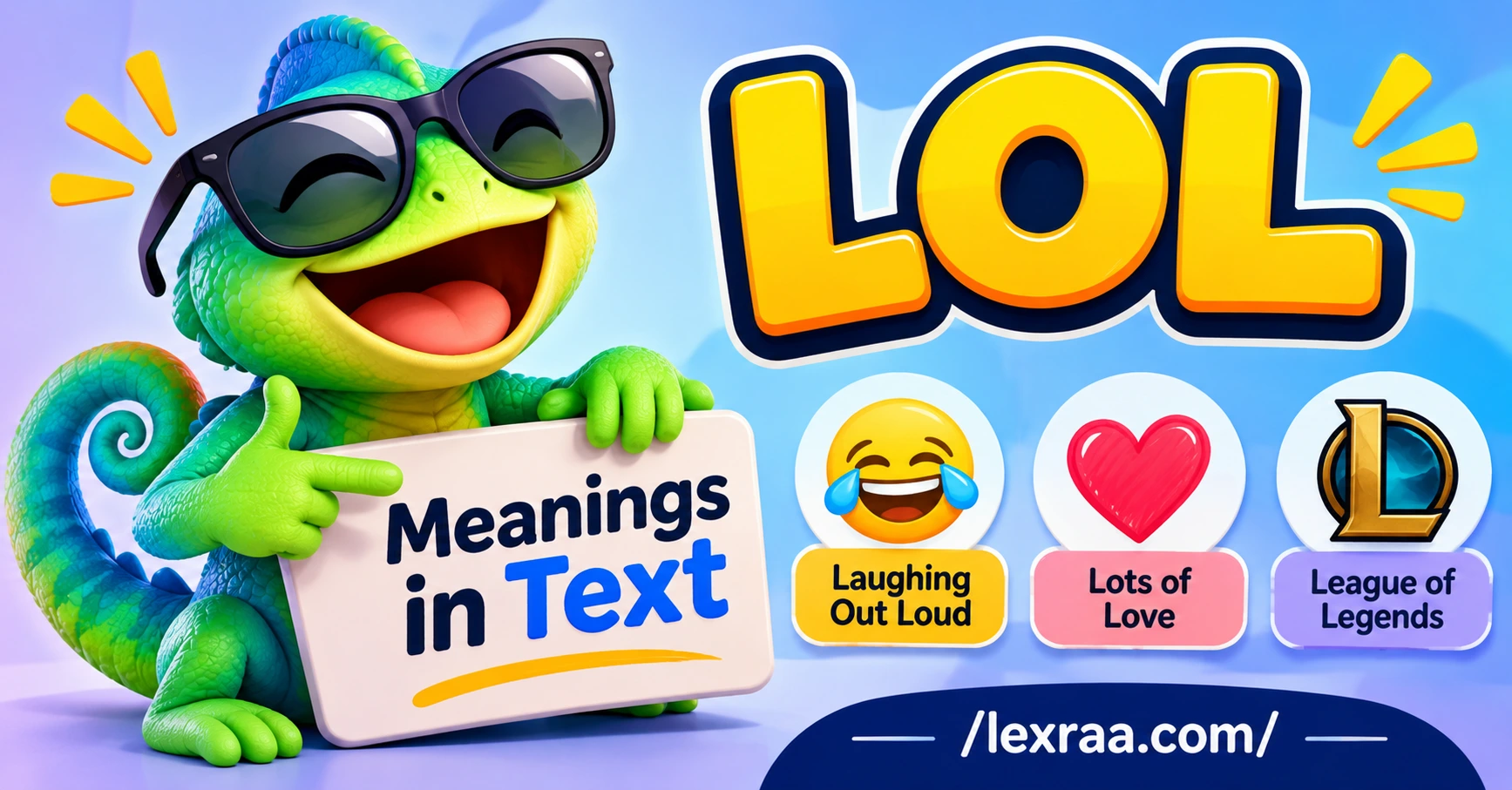
LOL means “laughing out loud.” It’s a widely recognized internet abbreviation used in texts, chats, and social media to express amusement or show that a message is meant as a joke. Depending on the conversation, it can also soften a reply or add a playful tone.
What Does LOL Mean in Texting?
LOL stands for “laughing out loud.” It’s an informal abbreviation people use when something makes them laugh, smile, or feel amused.
For example:
- Friend: “I walked into the wrong classroom and sat there for five minutes.”
- You: “LOL how did you not notice?”
You’re reacting to your friend’s embarrassing but funny experience.
However, LOL doesn’t always mean someone is literally laughing out loud. People also use it as a lighthearted reaction, even when something is only mildly amusing.
You might see it:
- After a funny comment or joke.
- As a quick response to an amusing story.
- At the end of a message to make it sound less serious.
- When someone wants to show they’re joking.
- As a casual reaction to an awkward or surprising situation.
Like other familiar texting abbreviations such as IDK, LOL helps people communicate quickly without typing a full phrase.
Both LOL and lol have the same basic meaning. Capitalization can affect how a message feels, but it doesn’t have a universal meaning.
How People Actually Use LOL
One reason LOL has lasted so long is its flexibility. It can communicate laughter, make a statement feel less serious, or add a little friendliness to an otherwise plain message.
1. To React to Something Funny
This is the most direct use. Someone shares a joke, funny mistake, or amusing situation, and the other person responds with LOL.
Example:
- Mia: “My dog just stole my sandwich and ran upstairs.”
- Noah: “LOL he’s getting away with everything.”
Here, LOL expresses genuine amusement.
2. To Make a Message Sound Less Serious
Sometimes a message could sound blunt or overly direct without a little context. Adding LOL can make it feel more relaxed.
Example:
- Alex: “You still owe me that coffee lol.”
- Jordan: “I haven’t forgotten. I’ll get it tomorrow.”
Alex is reminding Jordan about the coffee in a casual way rather than making a formal demand.
3. To Show Awkwardness or Mild Embarrassment
People sometimes use LOL when describing an uncomfortable or embarrassing moment.
Example:
- Riley: “I waved at someone who wasn’t waving at me.”
- Casey: “LOL I’ve done that too.”
The abbreviation makes the exchange feel lighthearted and helps show that Riley isn’t treating the mistake too seriously.
4. To Add a Playful or Sarcastic Tone
LOL can accompany a sarcastic comment, but it doesn’t automatically make a message sarcastic. The words and the surrounding conversation matter.
Example:
- Sam: “You said you’d be ready in five minutes.”
- Taylor: “That was an hour ago lol.”
Taylor is teasing Sam about being late. The LOL helps signal a playful tone.
Real Chat Examples of LOL
Here are a few more examples showing how the abbreviation works in different conversations.
Example 1 — Friends
- Emma: “I studied the wrong chapter for the entire quiz.”
- Olivia: “LOL that’s actually unlucky.”
- Emma: “I know. I only realized afterward.”
Meaning: Olivia is reacting with amusement and sympathy.
Example 2 — Family Chat
- Dad: “I finally figured out how to send a photo.”
- Alex: “LOL proud of you.”
- Dad: “I’ll have you know I’m learning.”
Meaning: Alex is teasing their dad affectionately.
Example 3 — Group Conversation
- Chris: “Who finished the last slice of pizza?”
- Morgan: “Not me lol.”
- Jamie: “Your name is literally on the empty plate.”
Meaning: LOL makes Morgan’s denial sound playful, especially given the obvious joke.
Example 4 — Casual Conversation
- Taylor: “I thought today was Friday.”
- Jordan: “LOL I wish.”
- Taylor: “Monday is taking forever.”
Meaning: Jordan is expressing amusement while agreeing with Taylor’s frustration.
Does LOL Always Mean Someone Is Laughing?
No. Although LOL originally represents laughter, its conversational use is broader.
Someone might write LOL without actually laughing. It can simply show that a message is lighthearted, friendly, or not intended to sound too serious.
Compare these examples:
| Message | Possible tone |
|---|---|
| “That’s hilarious LOL” | Genuine amusement |
| “I forgot my keys again lol” | Self-deprecating humor |
| “You’re late again lol” | Playful teasing or mild annoyance |
| “Well, that went perfectly lol” | Possible sarcasm |
The last example could be sarcastic if something went wrong. But you shouldn’t assume sarcasm from LOL alone.
A useful tip: Read the entire message before interpreting the abbreviation. The same LOL can feel friendly in one conversation and slightly sarcastic in another.
LOL vs. LMAO vs. ROFL vs. Haha
These expressions all relate to laughter, but they aren’t interchangeable in every situation.
| Term | Meaning | Tone | Popularity | Confusion Risk |
|---|---|---|---|---|
| LOL | Laughing out loud | Casual, playful | Widely recognized | Low |
| LMAO | Laughing my ass off | Very informal, emphatic | Widely recognized | Low |
| ROFL | Rolling on the floor laughing | Exaggerated, playful | Established but less commonly encountered in some conversations | Medium |
| Haha | Written representation of laughter | Friendly, conversational | Widely recognized | Low |
| JK | Just kidding | Playful or clarifying | Widely recognized | Medium |
These are qualitative descriptions, not measured popularity rankings.
The main distinction is that LOL is a flexible reaction, while LMAO and ROFL often present laughter more emphatically. Haha represents laughter directly through repeated letters, and JK clarifies that something was meant as a joke.
Not every short texting abbreviation expresses laughter; IMO, for example, is used when sharing a personal opinion.
Does LOL Have Other Meanings?
Although “laughing out loud” is the standard meaning in internet slang, LOL has a few other established uses.
1. Lots of Love
LOL can also stand for “lots of love” in some personal messages or sign-offs.
For example:
“Hope you have a wonderful birthday. LOL, Aunt Sarah.”
In this context, the sender may intend to express affection rather than laughter. However, this usage can create confusion because most readers encountering LOL in casual online conversation will interpret it as “laughing out loud.”
If you mean lots of love, writing the full phrase is clearer.
2. League of Legends
In gaming conversations, LoL can refer to League of Legends, the multiplayer online game.
For example:
- Player 1: “Are you playing LoL tonight?”
- Player 2: “Maybe after dinner.”
Here, the conversation is about the game, not laughter.
Capitalization may help distinguish the meanings, but context is the more reliable clue.
Is LOL Rude or Appropriate to Use?
LOL is generally informal and isn’t inherently rude. It’s suitable for casual conversations with friends, family, and people who understand the shorthand.
However, adding LOL to a serious message can sometimes make it sound dismissive.
For example:
- “I’m sorry you’re having a difficult day.” — Supportive.
- “Sorry you’re having a difficult day lol.” — Could sound insensitive.
The second message may seem as though the sender isn’t taking the situation seriously.
Sometimes, a quick reaction is all a conversation needs. Expressions such as IKR, a shorthand for agreeing with someone, serve a similar purpose in casual chats.
For professional communication, it’s usually better to write clearly rather than rely on texting abbreviations. A friendly workplace chat may be different, but formal emails and serious discussions call for more careful wording.
Frequently Asked Questions
What does LOL mean from a girl or a guy?
LOL has the same basic meaning regardless of who sends it: “laughing out loud.” It doesn’t automatically indicate romantic interest, annoyance, or any particular feeling. Read the rest of the conversation to understand the intended tone.
Does LOL mean laughing out loud or lots of love?
“Laughing out loud” is the standard meaning in modern internet slang. “Lots of love” is another documented expansion, particularly in personal-message contexts, but it can be ambiguous.
What does LOL mean when someone replies with just LOL?
A standalone LOL usually expresses amusement or acknowledges something funny. Depending on the conversation, it can also be a brief, lighthearted reaction without much additional meaning.
Is lowercase lol different from uppercase LOL?
Both forms generally mean “laughing out loud.” Some people use uppercase LOL for emphasis and lowercase lol for a more relaxed tone, but there is no fixed capitalization rule.
Can LOL be sarcastic?
Yes. People sometimes add LOL to sarcastic comments or situations that aren’t genuinely funny. However, the abbreviation alone doesn’t prove sarcasm; the wording and context provide the important clues.
What is the difference between LOL and LMAO?
LOL means “laughing out loud,” while LMAO means “laughing my ass off.” LMAO is more emphatic and very informal, whereas LOL can express anything from mild amusement to genuine laughter.
When did LOL first become popular online?
A documented early appearance of LOL meaning “laughing out loud” is in the May 1989 issue of the electronic newsletter FidoNews. The abbreviation may have circulated earlier, but the exact moment it originated is uncertain.
Final Thoughts
LOL means “laughing out loud” and remains a familiar abbreviation in online conversations. People use it to react to jokes, express amusement, and make messages feel more relaxed or playful. Just remember that it doesn’t always mean someone is literally laughing, and it isn’t automatically sarcastic or romantic. Use it in casual conversations, and consider the context before interpreting someone else’s message.



1 thought on “LOL Meaning in Slang: What Does LOL Mean in Text?”