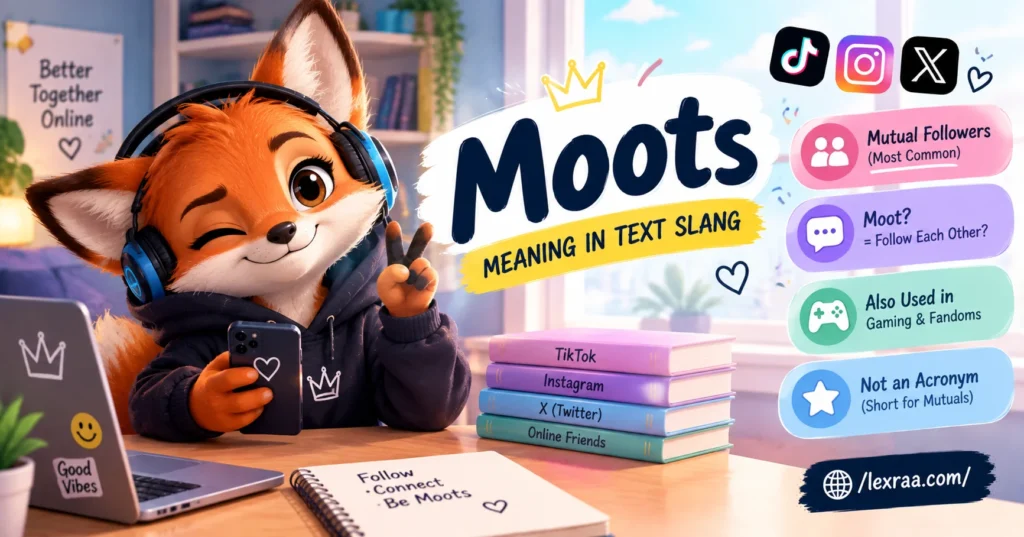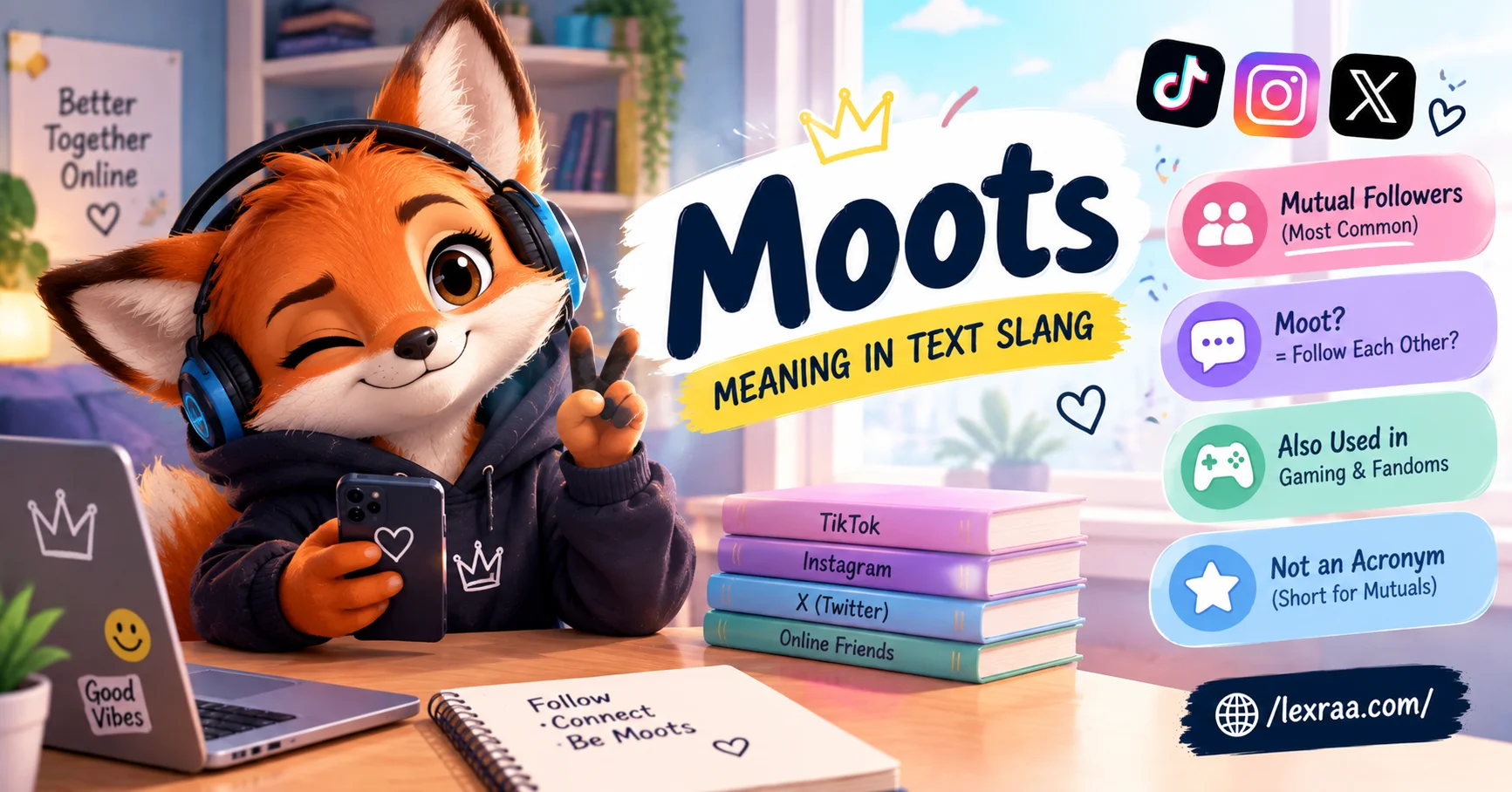
If someone says “moots” in a text, comment, or social-media post, they usually mean mutual followers—people who follow each other online. It is casual internet slang, especially common around TikTok, Instagram, X, and fandom communities.
You might see messages such as “anyone wanna be moots?”, “my moots are the best,” or “looking for new moots.” In each case, the word points to a two-way social-media connection rather than ordinary offline friendship.
What Does Moots Mean?
Moots is internet slang for mutuals or mutual followers.
If you follow someone and they follow you back, you can be described as moots. The singular form is moot, although the plural moots is particularly common when someone is talking about their online circle.
For example:
“She’s one of my moots on Instagram.”
This means the two accounts follow each other.
The word can also carry a little more social meaning than simply “follower.” In many online communities, especially fandom spaces, a moot may be someone whose posts you regularly see, like, comment on, repost, or discuss. However, following each other is the basic idea; regular interaction is common but not a requirement.
Is “Moots” an Acronym?
No. Moots is not an acronym.
It is a shortened slang form connected to mutuals/mutual followers. Wiktionary describes the internet-slang moot as a clipping of “mutual” with a humorously altered pronunciation.
So:
moot = one mutual follower
moots = multiple mutual followers
mutuals = the more conventional social-media term
What Does “Moots?” Mean?
When someone simply sends:
“Moots?”
they are usually asking whether you want to become mutual followers.
Depending on the platform, it can effectively mean:
“Want to follow each other?”
or:
“Do you want to be mutuals?”
For example, if someone discovers your TikTok account because you both like the same type of content, they might comment “moots?” If you agree, you would normally follow their account and they would follow yours.
This is why “moots?” should not automatically be interpreted as “Do you want to be my friend?” It can lead to an online friendship, but the immediate request is generally about the mutual social-media connection.
Moots vs. Regular Followers: The Important Difference
This is one distinction that makes the slang much easier to understand.
A follower can be a one-way relationship. You might follow a creator who does not follow you.
A moot is a reciprocal relationship: you follow them and they follow you back.
That difference is the whole reason the term exists. Social platforms make one-way following possible, so internet users developed vocabulary for relationships that go in both directions. Dictionary.com traces the slang to the idea of a “mutual follower.”
There is also an important nuance: being moots does not automatically mean the two people are close friends. Two accounts can follow each other without ever exchanging a DM.
What Does Moots Mean on TikTok?
On TikTok, moots means mutual followers.
You may encounter phrases such as:
- “Looking for new moots”
- “My moots know the struggle”
- “Any anime moots?”
- “Tag your moots”
- “Moots, what should I watch next?”
TikTok-focused sources describe the term as referring to people who follow each other. It can also be used to build a small community around a shared interest, such as music, gaming, anime, books, or fandoms.
If someone comments “moots?” on TikTok, they are generally suggesting a mutual follow rather than making a romantic proposal.
What Does Moots Mean on Instagram?
On Instagram, moots has essentially the same meaning: people who follow each other.
For example:
“These are my art moots.”
This means the person is talking about mutual followers connected through an art-related social circle.
Instagram is particularly suited to this slang because following can be one-sided. Two accounts can therefore move from being ordinary followers to mutuals, or “moots,” once the follow is returned.
You may also see “moots” in comments, captions, Stories, and DMs.
What Does Moots Mean on X?
Moots has a particularly strong connection with X, formerly Twitter.
The concept of a “mutual follower” was already documented on Twitter in 2007, according to Dictionary.com. The slang form became especially associated with fandom communities, and Dictionary.com notes that K-pop fans helped popularize moot around 2017.
This explains why you may encounter phrases such as:
“Goodnight moots.”
or:
“My moots are going to love this.”
In fandom culture, a moot can be someone you have never met offline but recognize as part of the same online community.
Read More: Snow Bunny Meaning Slang: What Does It Really Mean?
What About Snapchat and WhatsApp?
The evidence for moots is much stronger on follower-based social platforms such as TikTok, Instagram, and X than it is on Snapchat or WhatsApp.
That difference makes sense structurally. TikTok, Instagram, and X have prominent follower relationships where one person can follow another without receiving a follow back. “Moots” describes the reciprocal version of that relationship.
WhatsApp is primarily organized around contacts, chats, and groups rather than public follower relationships, so moots is not a defining WhatsApp term.
Likewise, there is not enough strong evidence to present Snapchat as a major or distinctive home for the slang. Someone can certainly use the word in a Snapchat conversation, but that does not mean Snapchat is where the term is especially established.
Some newer slang sites also mention the term on Wizz, where people use it when talking about making mutual connections. That usage is plausible and documented by current secondary sources, but the evidence is considerably thinner than for TikTok, Instagram, or X.
Where Did “Moots” Come From?
The modern slang moot is connected to mutual follower, not to the older English meaning of the word “moot.”
Dictionary.com explains that the social-media term developed as a shortening and phonetic respelling of mutual follower. It also notes that the phrase “mutual follower” appeared on Twitter in 2007.
The slang became particularly visible in online fandom communities. Dictionary.com specifically identifies K-pop fandom as an important force in popularizing moot around 2017. Wiktionary’s citations also show the term being used by Twitter users in 2020 and 2021, including in K-pop-related and other online communities.
That gives us a useful timeline:
Mutual follower → mutuals → moot/moots
The exact moment someone first invented the slang is not established, so it would be misleading to claim that a particular person or platform definitively invented it.
Don’t Confuse It With the Older Word “Moot”
There is another completely legitimate English word moot.
In traditional English, a moot point can refer to a question that is debatable or, in some contexts, no longer practically relevant. A moot can also refer to a hypothetical legal debate or discussion.
That meaning has nothing to do with social-media followers.
So:
“My moot replied to my post.” → mutual follower
“That point is moot.” → a different English meaning
The spelling is identical, but the context tells you which word is intended.
“Let’s Be Moots” and “Moot Me” — What Do They Mean?
These expressions are simply variations of the same idea.
“Let’s be moots”
This usually means:
“Let’s follow each other.”
For example:
“You like K-pop too? Let’s be moots!”
The speaker is proposing a mutual online connection.
“Moot me”
This is an informal way of asking someone to become a mutual.
For example:
“Your edits are so good. Moot me!”
The person is essentially saying, “Follow me and I’ll follow you back,” although the exact action can depend on the platform.
8 Realistic Conversations Using “Moots”
1. Funny — New TikTok Account
Mia: I made a new TikTok and have three followers.
Jay: Three? Celebrity status already.
Mia: I need more moots 😭
Jay: Fine, I accept your application.
2. Sarcastic — Group Chat
Alex: My moots are ignoring my posts again.
Sam: Maybe they’re recovering from your 47-slide story.
Alex: It was important.
Sam: Apparently not important enough for a like.
3. Playful — Instagram
Lena: Wait, you like anime too?
Noah: Obviously.
Lena: Okay, we should be moots.
Noah: Followed. Your move.
4. Serious — New Online Community
Ava: I just joined this fandom and don’t know anyone here.
Maya: Same, honestly.
Ava: Want to be moots?
Maya: Sure. I’ll follow you now.
5. Friends
Chris: Who keeps sending you these memes?
Jordan: My moots.
Chris: I thought they were your real friends.
Jordan: Some of them are. Some are internet friends.
6. Family
Sister: Why did you say “good morning, moots”?
Brother: They’re people who follow me and I follow back.
Sister: So… internet friends?
Brother: Basically, but “moots” is shorter.
7. Dating Context
Ella: How do you know him?
Ryan: We were moots first.
Ella: And then?
Ryan: We started DMing and eventually met.
Being moots does not inherently mean two people are dating. It can simply be the starting point for an online connection.
8. Fandom
Kai: Any music moots here?
Nora: Me! What artists do you listen to?
Kai: Mostly K-pop and R&B.
Nora: Followed. We definitely need to be moots.
9. X Post
Sam: My moots are going to understand this immediately.
Lee: I already reposted it.
Sam: See? I knew my moots wouldn’t disappoint.
Lee: That’s what we’re here for.
10. New Account
Tara: “Moots?”
Nina: Sure! Just followed you.
Tara: Followed back 🙂
Nina: Officially moots now.
How Do You Reply to “Moots?”
Your reply depends on whether you actually want the mutual connection.
Funny reply
“Only if you promise to tolerate my reposts 😂”
Neutral reply
“Sure! Just followed you back.”
Friendly reply
“Yes! I’d love to be moots.”
Serious/simple reply
“Sure, I’m happy to connect. I’ll follow you.”
Flirty reply — only when the conversation already has that tone
“Moots first, let’s see where this goes 😉”
Being moots itself is not romantic, so a flirty response makes sense only when the surrounding conversation already suggests mutual interest.
Moots vs. Similar Social-Media Terms
| Term | Meaning | Tone | Popularity | Confusion Risk |
|---|---|---|---|---|
| Moots | People who follow each other | Casual, friendly | Common in online communities | Low once learned |
| Mutuals | Reciprocal followers | Casual, neutral | Very common | Low |
| Followers | People who follow an account | Neutral | Extremely common | Medium |
| Friends | People connected socially; platform meaning varies | Casual/general | Very common | Medium |
| OOMF | “One of my followers” / one of my mutuals, depending on context | Informal, indirect | Niche | High |
| IRL friends | Friends known in real life | Casual | Common | Low |
| Strangers | People without an established personal relationship | Neutral | Common | Low |
One useful distinction is between moots and friends. A person can be your moot without being your friend, and a person can become an IRL friend after first meeting as a moot. The slang describes the online connection, not necessarily the depth of the relationship.
Who Uses “Moots”?
The strongest evidence connects moots with younger social-media users and online fandom communities, particularly K-pop fandoms on X. Dictionary.com specifically identifies younger K-pop fans as a prominent group using the term.
That does not mean every Gen Z user says “moots,” or that older users never use it. Internet slang spreads between communities, so age alone is not enough to determine whether someone will understand or use the term.
There is also no reliable basis for claiming that moots is specifically American, British, Canadian, or tied to one particular region. Its documented use is primarily connected to online communities that cross national boundaries.
Is “Moots” Rude or Safe?
In its ordinary social-media meaning, moots is not offensive or profane.
It is generally safe in casual online conversation, including comments, DMs, fandom communities, and conversations with friends.
However, it is informal slang. Writing “I need more moots” in a school essay, formal email, job application, or professional report would usually be inappropriate simply because the audience may not understand it and the register is casual.
There is another reason context matters: moot has unrelated meanings in English, and user-generated slang dictionaries contain occasional nonstandard definitions. Those should not be mistaken for the established social-media meaning. The reliable social-media definition is the mutual-follower sense.
Does Being Moots Mean You Are Friends?
Not necessarily.
This is one of the easiest mistakes to make when learning the term. Moots describes a reciprocal online following relationship; it does not guarantee a close friendship.
Two people can become moots after following each other and never interact again. In other cases, mutual followers may regularly comment, message, share interests, and eventually become genuine online or offline friends.
The word therefore tells you how the accounts are connected, not exactly how close the people are.
Why Does “Moots” Work So Well?
The usefulness of moots comes from the fact that “follower” is too broad to describe modern online relationships accurately. Social platforms created several levels of connection: someone can follow you, you can follow them back, you can interact regularly, and you can eventually become friends. Moots gives the reciprocal-following stage its own compact label.
It also works particularly well in fandom communities because it turns a potentially anonymous follower relationship into a recognizable social category. Instead of saying “the people who follow me and whom I follow back,” one short word—moots—does the job.
FAQ About Moots
What does moots mean in text?
Moots usually means mutual followers or mutuals. It describes people who follow each other on social media. The term is informal internet slang rather than an acronym.
What does “moots?” mean on TikTok?
“Moots?” is generally an invitation to become mutual followers. If someone comments or messages “moots?” they may be asking you to follow them so they can follow you back. The exact wording can vary, but the basic idea is a reciprocal social-media connection.
Does moots mean friends?
Not necessarily. Moots are people who follow each other, while friends usually implies a closer personal relationship. Some moots become friends, but the word itself does not guarantee friendship.
What does “let’s be moots” mean?
“Let’s be moots” normally means “let’s become mutual followers.” It is an informal way of suggesting that two people follow each other. It can lead to friendship, but it is not automatically romantic.
What does “moot me” mean?
“Moot me” is a casual request to become mutual followers. In practical terms, it often means “follow me and I’ll follow you back.” The phrase is most natural in social-media communities where reciprocal following is common.
Is moots short for mutuals?
Yes. The social-media slang moot/moots developed from the idea of mutual followers and is commonly treated as a shortened form of “mutuals.” Dictionary.com describes it as a shortening and phonetic respelling connected to “mutual follower.”
Is “moot” the same as “moot point”?
No. The social-media moot means a mutual follower, while moot point belongs to the older English vocabulary and has a different meaning. You have to use the surrounding context to tell which sense is intended.
What does moots mean on Instagram?
On Instagram, moots refers to people who follow each other. For example, if you follow an account and that account follows you back, you can call each other moots. The term is informal and is often used in comments, captions, and DMs.
Final Takeaway
The simplest way to remember moots is:
Moots = mutual followers.
If you follow someone and they follow you back, you are moots. The word is especially associated with social-media communities such as TikTok, Instagram, and X, with a notable history in online fandom spaces.
Don’t assume that being moots automatically means being close friends or dating. It describes the reciprocal online connection first; the actual relationship depends on what happens after the follow.
And if someone messages “moots?”, they are usually not asking you to solve a complicated mystery—they are simply asking whether you want to become mutuals.