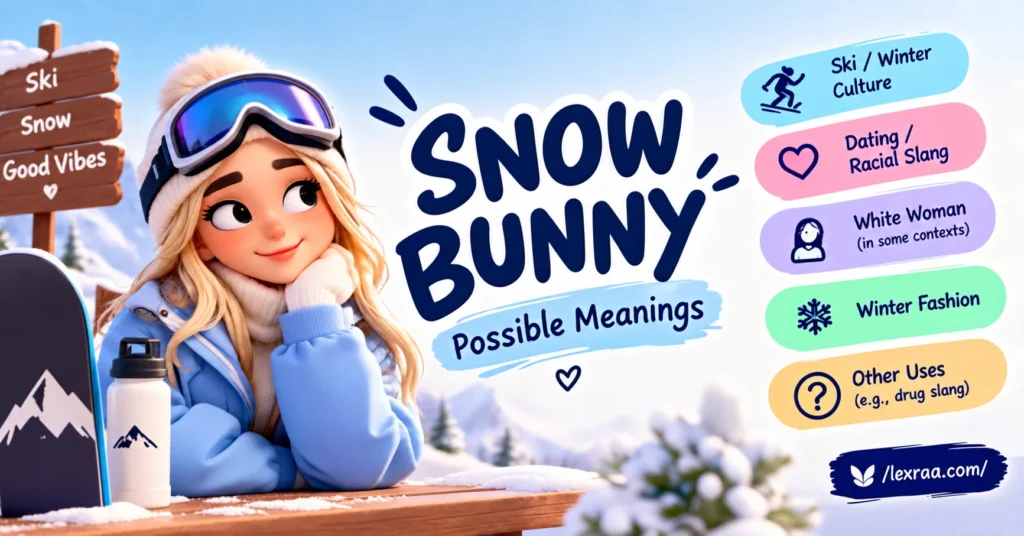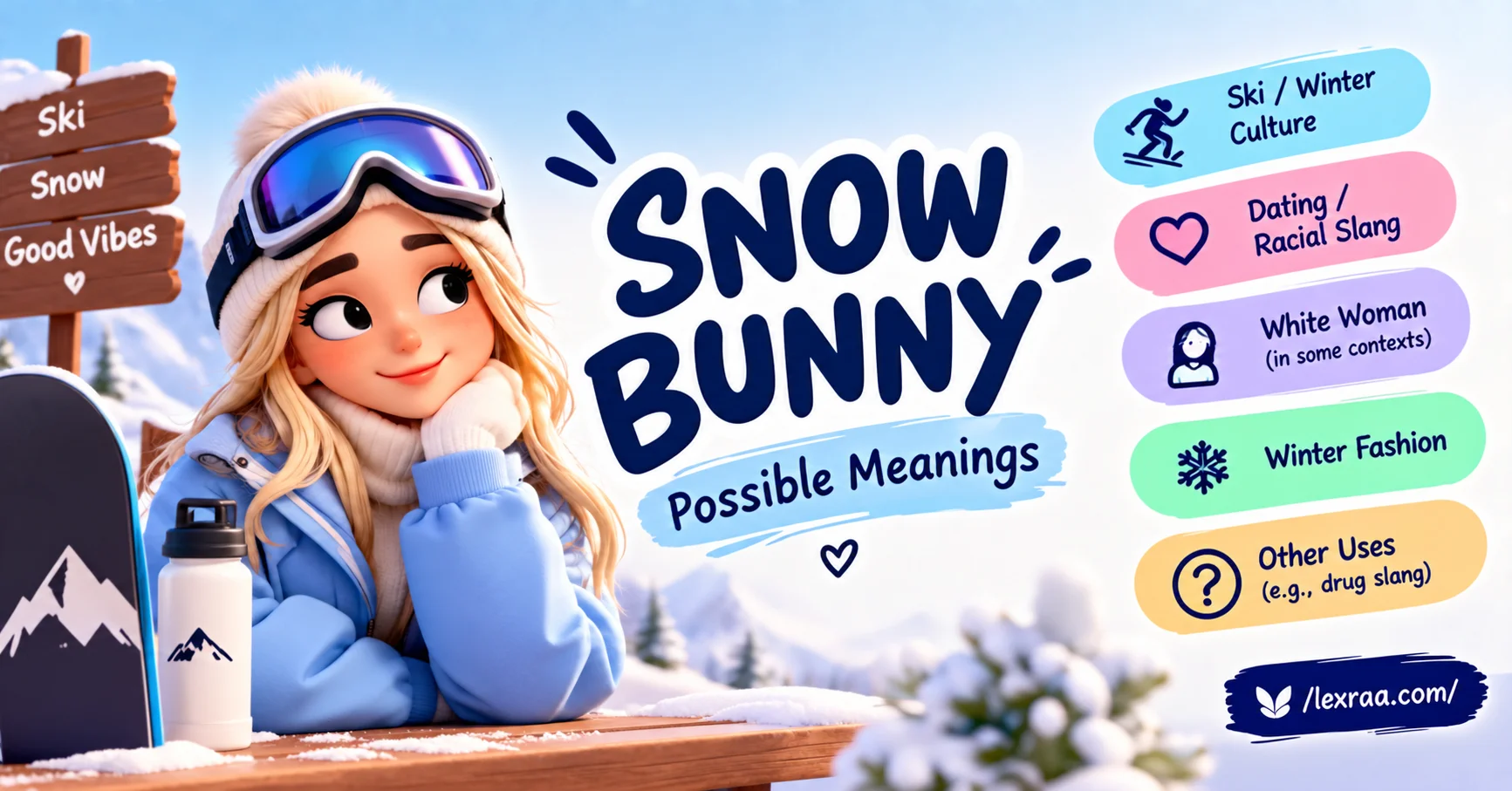
“Snow bunny” has two major slang meanings: it can describe a woman associated with skiing or ski-resort culture, or, in a more sensitive racial/dating context, a white woman associated with attraction to or relationships with Black men. Context determines which meaning is intended.
What Does “Snow Bunny” Mean in Slang?
“Snow bunny” is not an acronym or abbreviation. It is a slang phrase with more than one meaning, depending on the context.
1. Skiing and Winter Culture
The older meaning comes from ski and winter-sports culture.
A “snow bunny” can describe a woman who is inexperienced at skiing or someone who enjoys spending time at ski resorts and the social side of winter activities.
It can also refer to a woman associated with ski fashion, snowy resorts, or après-ski culture.
2. Dating and Racial Slang
“Snow bunny” also has a racialized dating meaning in American slang.
In this context, it can refer to a white woman, particularly one who dates or is attracted to Black men. This usage is documented in slang references, including Wiktionary and Dictionary.com.
The exact origin of this later meaning is not clearly established, so claims about a specific person or song creating it should be treated cautiously.
Which Meaning Is Intended?
Context usually tells you which meaning is meant.
A post about skiing, snowboarding, winter outfits, or ski resorts is likely using the winter-related meaning.
A conversation about dating, attraction, or interracial relationships may be using the racialized slang meaning.
The Two Main Meanings at a Glance
| Context | What “snow bunny” can mean |
|---|---|
| Skiing / snowboarding | A woman associated with skiing, especially a beginner or casual skier |
| Ski-resort culture | A stylish or attractive woman who enjoys the slopes, lodge, or après-ski scene |
| Dating / relationship slang | A white woman, particularly in discussions of attraction to or relationships with Black men |
| General appearance slang | In some usage, an attractive white woman |
| Drug-related slang | A much less common slang use for a woman who uses cocaine |
The drug-related meaning is real but far less reliable as a default interpretation. Wiktionary records it, and some slang sources document the connection because “snow” can itself be cocaine slang. However, you should not assume this meaning unless the surrounding conversation clearly concerns drugs or nightlife.
A Common Misunderstanding: It Does Not Always Mean a White Woman
One of the biggest misunderstandings surrounding “snow bunny” is assuming that the phrase always refers to a white woman.
That interpretation is common in contemporary online slang, but it is not the original dictionary meaning. Cambridge defines a snow bunny in connection with inexperienced skiing or someone who goes to a skiing holiday primarily for the après-ski activities. Dictionary.com likewise traces the older slang sense to skiing.
The reverse mistake also happens. Someone may see “snow bunny” under a dating-related TikTok and assume it is about skiing simply because of the word “snow.” In that setting, the racialized dating meaning may be intended instead.
The surrounding words are usually more informative than the phrase itself.
How to Tell Which Meaning Someone Means
The easiest way to understand “snow bunny” is to look at the context. The same phrase can mean something completely different in another conversation.
❄️ Winter or Skiing Context
If you see words like:
- Skiing, snowboarding, slopes
- Ski resort, mountain, lodge
- Goggles, boots, powder
- Winter outfits or après-ski
👉 It probably refers to ski or winter culture.
Example:
“I finally learned to ski. I’m officially a snow bunny 😂”
Here, the meaning is clearly related to skiing, not dating.
❤️ Dating Context
If the conversation includes:
- Dating or relationships
- Attraction or romantic preferences
- Interracial dating
- Black men and white women
👉 It may refer to the racialized dating meaning.
Example:
“He only dates snow bunnies.”
In this context, “snow bunny” is likely being used as racial dating slang.
❄️ Fashion & Aesthetic Context
Sometimes the phrase is simply connected to a winter look or ski-resort aesthetic.
A post featuring snow outfits, goggles, boots, or ski clothing may use “snow bunny” playfully without referring to dating.
Quick tip: If the meaning still isn’t clear, check the surrounding caption or conversation before assuming what the person means.n contain very little context.
Why TikTok Can Make “Snow Bunny” Confusing
TikTok is one of the places where the two meanings can collide most visibly. Current TikTok results for “snow bunny” include videos about winter fashion and ski-related content as well as discussions of the racialized slang meaning and people debating the stereotype itself.
That means a caption such as “snow bunny season” cannot automatically be decoded from the words alone. A ski outfit video may be using it as winter-fashion slang, while a relationship discussion may be using it in its racialized sense.
TikTok also makes older slang available to audiences who may never have encountered its original context. A phrase that was once associated with ski culture can therefore acquire a very different interpretation when it appears in a dating meme or commentary video.
What About Instagram, Snapchat, WhatsApp, and X?
There is no separate official “Snow Bunny meaning” for each app. The phrase carries the same broad meanings across platforms; the content surrounding it determines the interpretation.
Current online examples and discussions show the term appearing in TikTok and Instagram-style social content, while older examples documented by Dictionary.com include X/Twitter posts using the dating-related sense. WhatsApp and Snapchat can also carry the phrase in private chats, but evidence for a unique platform-specific meaning is weak.
So it is better to say “snow bunny on TikTok” or “snow bunny in a text” than to invent a special Snapchat or WhatsApp definition.
Where Did “Snow Bunny” Come From?
The best-documented origin of “snow bunny” is ski culture.
- 1950s: Traces the term to the 1950s, when it referred to a novice skier, usually a woman.
- The word “snow” connects it to skiing and winter resorts, while “bunny” had already been used informally for an attractive woman.
- Cambridge still defines it in connection with inexperienced skiers and ski-resort social culture.
The later racialized dating meaning is harder to trace. Dictionaries document its use for a white woman, particularly in discussions involving attraction to Black men, but there is no well-established single inventor or exact origin for this meaning.
In short: the ski-related origin is well documented, while the origin of the later racialized meaning remains unclear.
10 Natural Examples of “Snow Bunny”
The following conversations are illustrative examples showing how context changes the meaning.
1. Funny — Beginner Skier
Maya: How was skiing?
Lena: I spent most of the day falling.
Maya: So… professional snow bunny? 😂
Lena: Exactly. The bunny hill owns me.
Here, “snow bunny” refers to a beginner or inexperienced skier.
2. Sarcastic — Winter Fashion
Chris: Did you actually ski today?
Nina: Absolutely not.
Chris: So the ski outfit was just for decoration?
Nina: I’m a snow bunny, not an Olympian. 😭
The phrase is being used jokingly around the ski-resort stereotype.
3. Playful — Instagram
Ava: Posted my first ski-trip pictures.
Zoe: Okayyy snow bunny! ❄️
Ava: I knew someone was going to say that.
Zoe: The boots gave you away.
This is a winter-fashion/ski-resort usage.
4. Serious — Dating Context
Marcus: Someone called me a snow bunny because I’m dating a Black guy.
Jade: Did they explain what they meant?
Marcus: Yeah, they were talking about my dating preferences.
Jade: Then they were probably using the racialized slang meaning.
Here, the phrase has nothing to do with skiing.
5. Friends Planning a Ski Trip
Sam: Are you bringing your snowboard?
Ella: Obviously.
Sam: I thought you only went for the lodge hot chocolate.
Ella: I’m still a snow bunny, but I’m improving! 😂
The meaning is clearly connected to winter sports.
6. Family Conversation
Mom: Why do you keep calling yourself a snow bunny?
Daughter: I love skiing and winter trips.
Mom: Oh, I thought you meant something else.
Daughter: Yeah, apparently the phrase has another meaning online.
This shows why someone unfamiliar with current slang might misunderstand it.
7. Group Chat
Alex: Ski weekend is booked!
Jordan: I’m ready.
Tara: I’m bringing six outfits and zero skiing skills.
Alex: Our resident snow bunny has arrived 😂
Again, the ski-resort meaning is obvious.
8. Dating Discussion
Ryan: He said he only dates snow bunnies.
Eli: In what sense?
Ryan: He was talking about white women.
Eli: Then he’s using the racial dating meaning.
9. TikTok Comment
User 1: Her ski outfit is actually perfect.
User 2: Total snow bunny look ❄️
User 1: Right? The goggles complete it.
User 2: The whole winter aesthetic works.
The visual context makes the winter meaning likely.
10. When the Meaning Is Unclear
Alex: Someone just called me a snow bunny.
Mia: What were you talking about?
Alex: Nothing about skiing.
Mia: Then I’d ask what they meant before assuming.
This is often the safest response when there is not enough context.
How to Reply If Someone Calls You a “Snow Bunny”
Your reply can depend on what they appear to mean.
Funny reply:
“Only if surviving the bunny hill counts. 😂”
Serious reply:
“What do you mean by snow bunny?”
Flirty reply:
“Depends… are you talking about my ski outfit? 😉”
A flirty response only makes sense if the conversation is already clearly playful and the person is comfortable with the term.
Neutral reply:
“Which meaning do you mean?”
That last option is particularly useful because it avoids accidentally accepting a racialized or sexualized interpretation you did not intend.
Snow Bunny vs. Similar Terms
| Term | Meaning | Tone | Popularity | Confusion Risk |
|---|---|---|---|---|
| Snow bunny | Ski-related woman, or a racialized dating term for a white woman depending on context | Casual; can be sensitive | Common in slang | — |
| Ski bunny | A woman associated with skiing or ski culture | Casual, recreational | Common in ski contexts | Medium |
| Snowbird | Someone who travels to a warmer place during winter, often seasonally | Neutral | Common | High |
| Bunny | Older slang that can refer to an attractive woman | Informal | Moderate | Medium |
| Snowflake | A sensitive or easily offended person in a modern political/cultural insult | Often insulting | Common | Medium |
| Snowboarder | A person who rides a snowboard | Neutral | Very common | Low |
| Ski expert | A highly skilled skier; a useful contrast to the “beginner” sense of snow bunny | Neutral | Common | Low |
There is no true opposite of “snow bunny.” “Ski expert” works as a contrast only when you are talking about the old beginner-skier meaning; it is not an antonym in the normal linguistic sense.
“Snowbird” is particularly easy to confuse with “snow bunny,” but they describe very different things. A snowbird is generally someone who moves or travels to a warmer climate during winter, while a snow bunny is associated with snow, skiing, or one of the slang meanings above.
Who Uses “Snow Bunny”?
The ski-related meaning has been established in North American English for decades and is also recognized in British dictionary usage. Cambridge currently defines it in connection with inexperienced skiing and ski holidays, showing that the term is not restricted to American internet slang.
The racialized meaning is more specifically associated with American slang and is documented as African-American Vernacular usage by Wiktionary. It appears in discussions of interracial dating, popular music, social media, and informal conversations.
There is not enough reliable demographic evidence to say that Gen Z uses it more than Millennials, or that one particular gender uses it more frequently. Online discussions can make a phrase look heavily associated with a particular age group without providing representative usage data.
Regional differences also matter, but the evidence does not justify a simple claim such as “Americans mean X while British people mean Y.” The safer distinction is between context and community: ski culture tends to preserve the winter-sports meaning, while certain American slang and dating contexts use the racialized meaning.
Is “Snow Bunny” Offensive?
It can be.
The skiing meaning is not inherently offensive, although it can sound dated, overly focused on appearance, or dismissive if someone uses it to suggest that a woman is only there for fashion or socializing. Dictionary.com labels some of its ski-related uses as potentially disparaging.
The racialized meaning deserves considerably more caution. Dictionary.com labels those uses as potentially disparaging and offensive, particularly when the term reduces a woman to her race, appearance, or sexual preferences.
It is therefore not a good choice for school, work, professional writing, or formal communication when referring to another person. If you mean “woman who skis,” say skier, beginner skier, or snowboarder. If you are discussing an interracial relationship, simply describing the relationship is usually clearer than applying a slang label.
The term itself is not profanity, but some of its uses can be sexualized or objectifying.
What About “Snow Bunny Mind Control”?
This is an internet-culture phrase connected to the newer racialized meaning. Know Your Meme documents “Snowbunny Mind Control” as a meme phrase that appeared online in 2024 and was connected to commentary about white women and influence in underground hip-hop culture.
That meme should not be treated as evidence that “snow bunny” originally meant “mind control.” It is a later internet expression built around an existing slang term.
This distinction matters because viral phrases often make people believe that a new meme is the original definition of an older word.
Why Does “Snow Bunny” Stick Around?
“Snow bunny” survives because it is unusually context-rich. The first half instantly suggests snow, skiing, and winter, while “bunny” has long carried associations with youthfulness, attractiveness, or playfulness. That makes the phrase memorable even before someone knows its slang history.
Its later racialized meaning also demonstrates how slang can be repurposed by different communities. The same sounds remain unchanged while the social context changes from ski resorts to dating conversations, music, memes, and social media. Current TikTok discussions show people actively negotiating those competing meanings rather than using one universally accepted definition.
That is why context is not just a helpful clue with this phrase—it is part of the meaning itself.
FAQ
1. What does snow bunny mean in slang?
“Snow bunny” has two major slang meanings. It can describe a woman associated with skiing, snowboarding, or ski-resort culture, particularly a beginner or casual skier. In another American slang usage, it can refer to a white woman, especially in discussions of attraction to or relationships with Black men.
2. Does snow bunny mean a white girl?
Sometimes, yes. In racialized slang, “snow bunny” can refer to a white woman and may specifically imply attraction to or dating Black men. But this is not the only meaning, because the older ski-related definition is well established.
3. What does snow bunny mean on TikTok?
TikTok uses “snow bunny” in more than one way. It can appear in skiing and winter-fashion content, while other videos use it in discussions of interracial dating or racial stereotypes. The video, caption, and surrounding comments are usually needed to determine the intended meaning.
4. Is snow bunny a bad word?
Not automatically. The skiing meaning can be playful, although it may sound dated or focused on appearance. The racialized meaning can be offensive or objectifying, so using the phrase for someone without knowing how they interpret it can create an unnecessary problem.
5. Where did the term snow bunny originate?
The clearest documented origin is mid-20th-century ski culture, with Dictionary.com tracing the slang term to the 1950s. The later racialized meaning is documented in American and AAVE slang, but its exact origin is unclear. It is better not to claim that one person or song invented that later meaning.
6. Does snow bunny mean someone who likes skiing?
It can. The traditional meaning refers to someone, usually a woman, who is inexperienced at skiing or who enjoys the social side of a ski holiday. It can also be used more broadly for a stylish woman associated with ski resorts and winter sports.
7. Is snow bunny an AAVE word?
The racialized meaning is labeled as African-American Vernacular slang by Wiktionary. However, that does not mean the entire phrase originated in AAVE: the older ski-related meaning clearly predates the documented racialized usage. The exact path by which the newer meaning developed is not firmly established.
8. What should I say instead of snow bunny?
Use a more precise term when there is any chance of misunderstanding. For skiing, say skier, beginner skier, or snowboarder; for winter fashion, describe the outfit or style directly. In dating discussions, describe the relationship or preference rather than assigning someone a potentially racialized label.
Conclusion
“Snow bunny” is one of those slang phrases where the setting changes the meaning dramatically.
In its older, well-documented sense, it is connected to skiing, ski resorts, beginner skiers, and the social side of winter recreation. In contemporary American slang, it can also describe an attractive white woman, particularly in discussions involving attraction to or relationships with Black men. A much less common drug-related meaning is also documented, but it should never be assumed without clear context.
The biggest mistake is treating one definition as universal. If you see “snow bunny” on TikTok, Instagram, X, or in a text, look at the surrounding content before deciding what it means. And if you’re speaking to someone directly, asking “What do you mean by snow bunny?” is often better than guessing.
For formal, professional, or unfamiliar settings, clearer alternatives are usually preferable. “Skier,” “snowboarder,” “winter-fashion enthusiast,” or a straightforward description of someone’s relationship communicates the intended idea without carrying the extra baggage that “snow bunny” can bring.