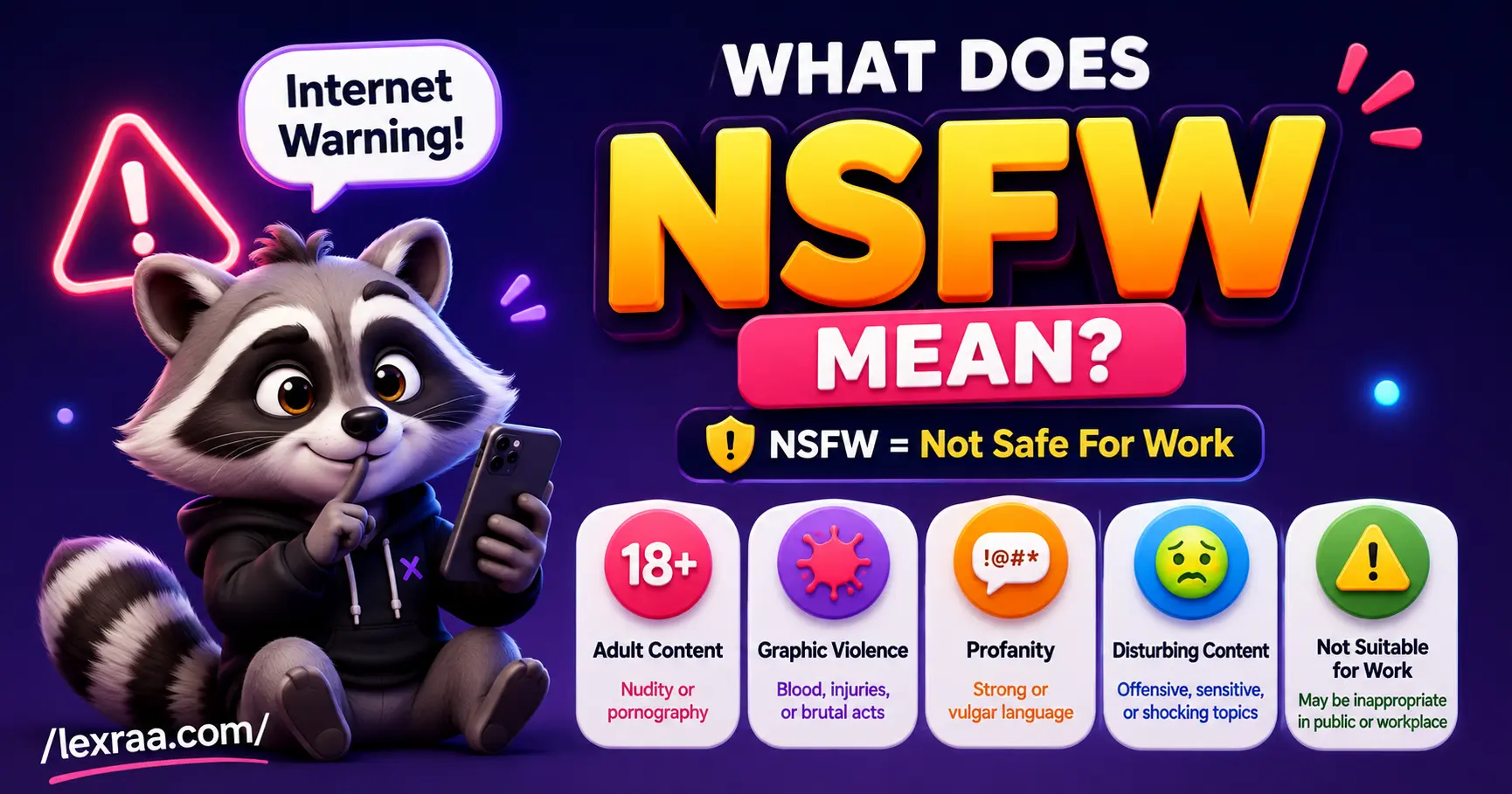
NSFW means “Not Safe For Work.” It is an internet abbreviation used as a warning that a photo, video, link, message, or other content may be inappropriate to view at work, school, in public, or around other people.
The label does not automatically mean pornography. NSFW can warn about sexual or nude material, strong profanity, graphic violence, disturbing imagery, or other content that could create an awkward or inappropriate situation if someone nearby sees your screen.
What Does NSFW Mean?
NSFW is an initialism formed from the first letters of Not Safe For Work. It is also commonly described as an internet abbreviation or piece of internet slang.
You might see it written in several ways:
- NSFW
- nsfw
- NSFW content
- NSFW warning
- NSFW link
- NSFW image
The capitalization usually does not change the meaning.
For example, if a friend messages, “NSFW—don’t open this at work,” they are warning you that the material could be unsuitable for a professional or public environment.
Dictionaries give essentially the same core definition. Merriam-Webster defines NSFW as “not safe for work” or “not suitable for work,” while Oxford describes it as a warning used with internet material that people may find offensive.
What Can Make Something NSFW?
The label can cover more than one kind of mature or unsuitable material. Depending on the context, it may refer to:
- Nudity or sexual material
- Pornographic content
- Strong or explicit language
- Graphic violence
- Disturbing images
- Offensive material
- Extremely crude humor
- Content that would be inappropriate in a workplace or public setting
That means NSFW describes the viewing situation, not one specific category of content.
A sexually suggestive joke might be called NSFW, but so could an extremely graphic injury photograph. The important idea is that the sender thinks you should check your surroundings before opening it.
Is NSFW the Same as Porn?
No. Pornographic material is one common reason something receives an NSFW warning, but the two terms are not interchangeable.
“Porn” describes a particular type of sexual material. NSFW is a warning label that says the material may not be appropriate to view in certain environments.
For example:
“This article contains graphic accident photos. NSFW.”
There may be nothing sexual about the article at all.
Likewise, someone might label a meme NSFW because it contains extremely offensive language or a crude joke. The warning simply tells you to exercise caution before opening or viewing it.
This distinction is useful because people sometimes see NSFW and immediately assume that the content must be sexually explicit. In actual internet usage, the label can be broader.
A Common Misunderstanding About NSFW
One common misunderstanding is that NSFW means “you are not allowed to see this.”
That is not what the abbreviation literally communicates.
It means the content is not considered suitable for viewing in a work or similar public environment. Whether you can view it at all depends on the website, platform rules, your age, local laws, workplace policies, and the nature of the material.
There is another important distinction: NSFW is not a guarantee that content is actually safe or unsafe. It is a human-applied warning and can sometimes be used too broadly, too narrowly, or jokingly.
So if someone sends you an NSFW warning, the sensible response is to treat it as a caution rather than assuming exactly what the content contains.
Where Is NSFW Used?
NSFW is an established internet term rather than a feature belonging to one particular app. Its basic meaning stays the same when people move between websites, forums, messaging services, and social networks.
Reddit and Online Forums
Reddit and older internet forums are particularly important to the history of NSFW-style labeling. On community-based websites, users can use content labels or warnings to signal that a post may contain material unsuitable for everyone.
In these environments, NSFW can function almost like a category label rather than something casually typed into a private conversation.
X
X has an especially clear modern connection to the concept because its rules explicitly address adult content and sensitive media. X allows certain consensually produced adult material when it is properly labeled, and the platform provides settings and warnings for sensitive media.
So if someone uses NSFW in an X post, it can be part of a broader warning that the attached material may contain adult or otherwise sensitive content.
Read More: GRWM Meaning: GRWM MEANING on TikTok and Instagram?
Instagram, TikTok, Snapchat, and WhatsApp
People also use NSFW informally on Instagram, TikTok, Snapchat, and WhatsApp, particularly in captions, comments, direct messages, group chats, or before sharing a link or piece of media. Current slang references document this kind of usage, although they do not establish that NSFW has a different meaning on any of these apps.
That distinction matters. Seeing “NSFW” on Instagram does not mean Instagram has given the abbreviation a special Instagram-only definition. It still means essentially the same warning: be careful before viewing the content in your current surroundings.
On WhatsApp, for example, someone might manually type “NSFW” before forwarding a questionable meme. That is a conversational warning, not necessarily a built-in WhatsApp classification.
Where Did NSFW Come From?
The exact origin of NSFW is not completely certain, so it would be misleading to claim that one particular person definitely invented it.
Dictionary.com gives the first recorded period for NSFW as 2000–2005.
A commonly repeated history connects the abbreviation to early internet forums and a precursor known as NFBSK, meaning “Not For British School Kids.” The story concerns a 1998 discussion associated with the Snopes forums, where users were reportedly concerned about children encountering inappropriate material. Later, the phrase “not safe for work” appeared in internet culture, including a notable Fark post from August 22, 2000.
There is stronger evidence for the general timeline than for every detail of that origin story. The claim that NFBSK directly and definitively evolved into NSFW is widely repeated, but the historical evidence is not strong enough to present every step as proven fact.
What can be said with reasonable confidence is that NSFW emerged from early internet communities in the late 1990s and early 2000s, when people needed short labels for content that others might not want to open in a workplace or public setting.
It was later adopted more broadly as internet communication moved from forums into social media, messaging, blogs, and content-sharing platforms.
There is no good evidence that NSFW originated specifically as an AAVE term, nor is there evidence that Gen Z invented it. Its history is closely tied to early internet culture and online content warnings.
Read More: Opp Meaning: What Does “Opp” or “Opps” Mean in Slang?
10 Natural NSFW Conversation Examples
1. Funny — Friends
Alex: Bro, I found the weirdest meme.
Sam: Send it.
Alex: NSFW 😂
Sam: Okay, now I definitely need to know what this is.
Here, NSFW creates suspense while warning Sam that the meme may not be appropriate to open around other people.
2. Sarcastic — Group Chat
Mia: Who sent this video to the family group?
Noah: Technically, it was educational.
Mia: Educational?!
Noah: NSFW educational. Very important distinction.
The humor comes from deliberately stretching the warning label.
3. Playful — Dating
Ella: I found something that reminded me of you.
Ryan: Should I be worried?
Ella: Maybe. NSFW 😏
Ryan: Well, now you’ve made me curious.
Here, NSFW adds a suggestive tone, although the abbreviation itself does not necessarily mean the sender is flirting.
4. Serious — Coworkers
Jordan: Can you check the link I sent?
Taylor: I’m at the office right now.
Jordan: Don’t open it yet—NSFW.
Taylor: Got it. I’ll check it when I’m home.
In this situation, NSFW is being used literally as a workplace warning.
5. Family Chat
Mom: Is that the video you mentioned?
Chris: Yes, but don’t play it in the living room.
Mom: Why?
Chris: NSFW. I’ll explain later.
The label tells the recipient that privacy matters before opening the media.
6. Social Media
Ava: This post has a warning in the caption.
Liam: What does it say?
Ava: “NSFW.”
Liam: I’ll save it for later, then.
The abbreviation works as a quick content warning without requiring a long explanation.
7. Gaming Community
Ben: Check out this mod I found.
Kai: Is it safe to open at school?
Ben: Definitely not. NSFW.
Kai: Good warning. I’ll wait until I’m home.
NSFW can refer to mature gaming-related material rather than only sexual content.
8. Coworker-to-Coworker
Nina: I forwarded you the article.
Omar: Anything I should know before opening it?
Nina: Yes—NSFW because of the images.
Omar: Thanks for the warning.
The sender is using NSFW as practical digital etiquette.
9. Sarcastic Meme
Leo: NSFW meme incoming.
Chris: How bad is it?
Leo: My grandmother would disown me.
Chris: Opening it later. 😂
The label is serious enough to communicate caution but can also be used jokingly.
10. Private Message
Sara: Can I send you something?
Maya: Sure.
Sara: Just warning you, it’s NSFW.
Maya: Thanks for asking first.
This example shows an important part of responsible online communication: a warning gives the recipient an opportunity to decide whether they want to view the material.
How Should You Reply to “NSFW”?
Your response depends on why the person used the abbreviation.
Funny reply:
“Now you’ve made me way too curious. 😂”
Serious reply:
“Thanks for the warning. I’ll check it somewhere private.”
Flirty reply:
“NSFW? You really know how to get my attention. 😏”
Only use a flirty response when that kind of relationship and conversation already makes sense.
Neutral reply:
“Got it. I’ll open it later.”
If you are unsure what the sender means, the safest response is simply:
“What kind of content is it?”
That lets them clarify without forcing you to open something unexpectedly.
Read More: GC Meaning: What Does “GC” Mean in Text and Slang?
NSFW vs. Similar Internet Terms
| Term | Meaning | Tone | Popularity | Confusion Risk |
|---|---|---|---|---|
| NSFW | Not Safe For Work | Warning/cautionary | Very high | Low |
| SFW | Safe For Work | Reassuring/neutral | High | Medium |
| NSFL | Not Safe For Life; a much stronger warning for disturbing material | Serious/extreme | Moderate | Medium |
| 18+ | Intended for adults | Formal/direct | Very high | Low |
| Mature | Content intended for mature audiences | Neutral/formal | Very high | Medium |
| Explicit | Contains direct or unrestricted mature content | Direct | Very high | Low |
| Work-safe | Suitable for a workplace environment | Reassuring | Moderate | Low |
The closest opposite of NSFW is SFW, meaning Safe For Work.
NSFL is different from NSFW because it generally signals material considered extremely disturbing or graphic rather than simply inappropriate for viewing at work.
Who Uses NSFW?
NSFW is not restricted to one age group. Its history reaches back to early internet communities, meaning it predates Gen Z by many years.
Millennials and older internet users may have encountered it through forums, blogs, email, message boards, and early social websites. Younger users encounter the same abbreviation through social media, group chats, online communities, and content-sharing platforms.
There is also no strong evidence that NSFW belongs specifically to American, British, or another regional variety of slang. The abbreviation became part of international internet vocabulary, and its basic meaning is widely recognizable in English-language online communication.
The spelling and capitalization can vary, but the underlying warning remains remarkably stable.
Is NSFW Rude or Offensive?
NSFW itself is not a profanity or insult. It is a content-warning abbreviation.
However, the material being labeled NSFW may be sexual, profane, violent, disturbing, or otherwise offensive. That is why context matters.
Using NSFW before sending potentially inappropriate material can actually be considerate because it gives someone a chance to avoid opening it around coworkers, classmates, children, family members, or strangers.
At the same time, an NSFW label does not make inappropriate material automatically acceptable. Consent, privacy, age restrictions, workplace rules, and platform policies still matter.
For example, sharing someone’s intimate images without consent is not made acceptable simply because the sender labels them “NSFW.” X explicitly prohibits non-consensual intimate media, for example.
For school or professional communication, it is generally best to avoid sending genuinely NSFW material altogether unless there is a legitimate reason and the relevant rules permit it.
Why Does NSFW Work So Well as Internet Language?
NSFW survives because it solves a very specific communication problem in only four letters. A sender can warn someone about potentially inappropriate content without describing the material itself, which is especially useful when the recipient might be viewing the message in a public or professional environment.
Linguistically, it also works as a pragmatic label: the letters tell you how to interpret what comes next and what action to take. Instead of merely describing content, NSFW changes the reader’s behavior—pause, check your surroundings, and decide whether now is an appropriate time to open it. That usefulness helps explain why the abbreviation remained recognizable as internet communication moved from forums to social media and private messaging.
FAQ About NSFW
Does NSFW always mean something sexual?
No. Sexual or pornographic material is a common reason for an NSFW warning, but NSFW can also refer to graphic violence, disturbing imagery, strong profanity, or other inappropriate material. The abbreviation means that the content may be unsuitable for viewing at work or in similar public settings. Context tells you what kind of material the sender is warning about.
What does NSFW mean on Instagram?
On Instagram, NSFW generally has the same meaning as elsewhere: Not Safe For Work. People may use it informally in captions, comments, or DMs as a warning about potentially mature or inappropriate material. It should not be interpreted as a special Instagram-only definition.
What does NSFW mean on TikTok?
NSFW on TikTok generally functions as an informal warning that something may be unsuitable for certain audiences or surroundings. The abbreviation itself still means Not Safe For Work. Because platforms have their own content rules and moderation systems, seeing NSFW does not necessarily tell you exactly what kind of material is involved.
What is the opposite of NSFW?
The common opposite is SFW, meaning Safe For Work. SFW indicates that content is generally considered suitable to view in a workplace or other public environment. Neither label is an absolute guarantee about how every person or organization will judge the content.
Is NSFW a bad word?
No. NSFW is not itself a swear word. It is an abbreviation used as a warning, although the content behind the warning may contain profanity, sexual material, violence, or other mature subjects.
Is NSFW appropriate for school?
The abbreviation itself is harmless to write or understand, but NSFW-labeled content may not be appropriate for school. If someone sends you an NSFW link while you’re in class, it is better not to open it until you know what it contains and whether viewing it would violate school rules.
Does NSFW mean 18+?
Not necessarily. NSFW means the content may be inappropriate to view in a workplace or public setting; it does not itself establish a specific legal age requirement. Some NSFW material may also be age-restricted, but the two labels should not be treated as exact synonyms.
Who invented the term NSFW?
There is no reliably established single inventor. The term appears to have developed within early internet culture around the late 1990s and early 2000s, and the frequently repeated story connecting it to the older “NFBSK” abbreviation should be treated as part of the documented-but-not-completely-settled history rather than an indisputable invention story.
Final Takeaway
NSFW means “Not Safe For Work.” It is an internet abbreviation used to warn that content may be unsuitable to view at work, school, in public, or around other people.
The most important mistake to avoid is assuming that NSFW automatically means pornography. It can refer to sexual material, but it can also warn about graphic violence, disturbing imagery, profanity, offensive humor, or other mature content.
When you see NSFW before a link, image, video, or message, treat it as a simple instruction to pause and consider where you are before opening it. And when you use the label yourself, use it accurately—an effective warning should help people make an informed choice rather than simply create unnecessary suspense.