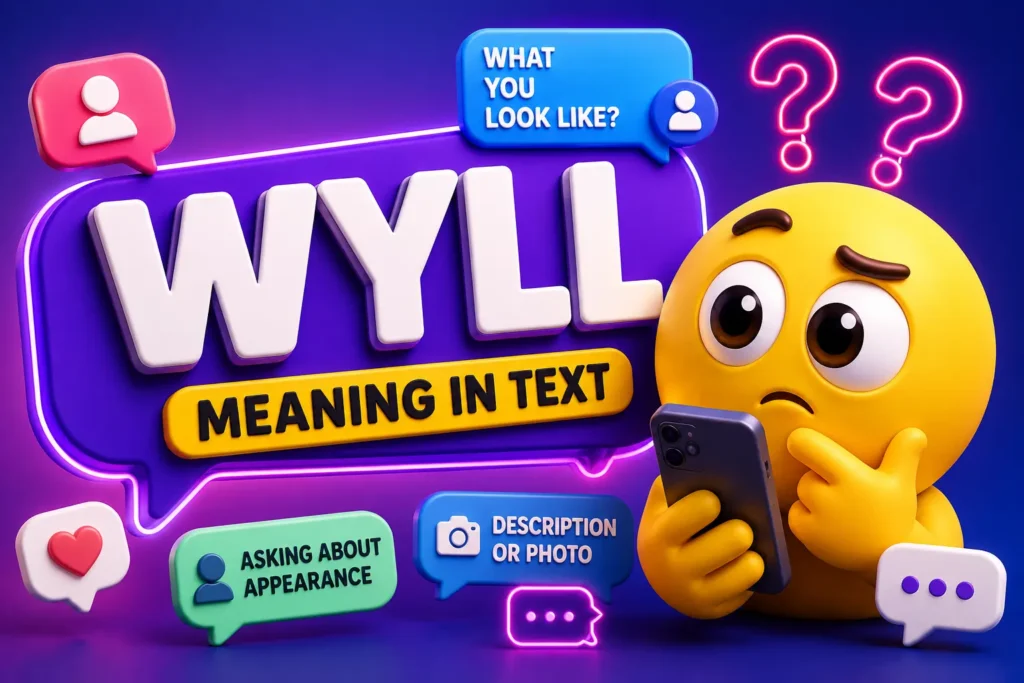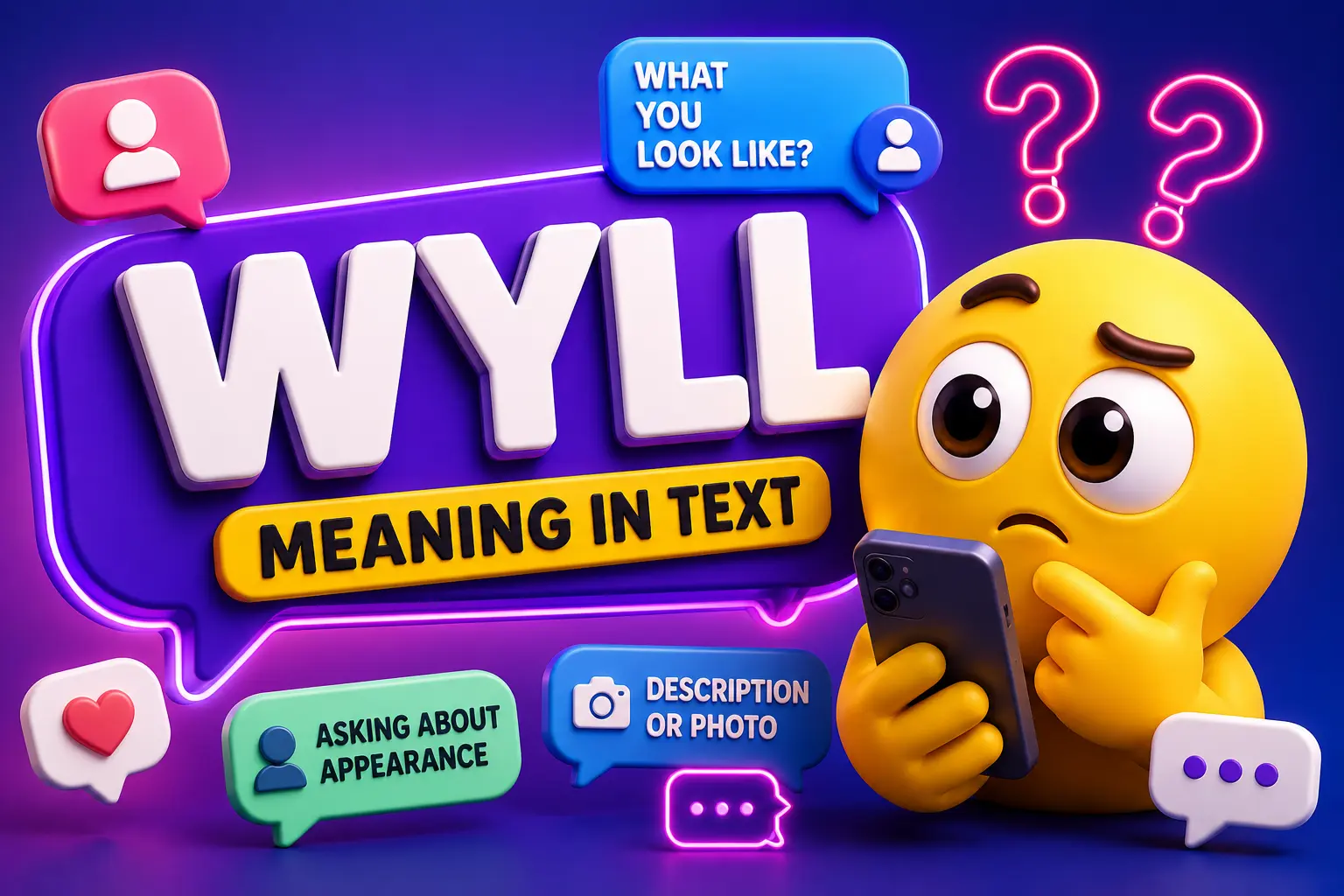
WYLL most commonly means “What You Look Like.” When someone texts you WYLL, they’re asking what you look like, often as a shortcut for requesting a description or a photo. People search for “WYLL meaning in text” because they receive it unexpectedly and aren’t sure whether it’s friendly, flirty, or something they should answer.
What Does WYLL Mean in Text?
In modern texting, WYLL almost always stands for:
What You Look Like
It is an initialism (a type of abbreviation) used in casual online conversations. Instead of typing the full question, people shorten it to WYLL to save time.
For example:
A: WYLL?
B: Brown hair, glasses, and about 5’10”.
Or:
A: We’ve been chatting for a while. WYLL?
B: I’ll send you a selfie.
Unlike abbreviations such as LOL or BRB, WYLL isn’t a reaction. It’s a question asking someone to describe their appearance or share a picture if they’re comfortable doing so.
Is WYLL an Acronym, Abbreviation, or Slang?
WYLL is technically an initialism, meaning each letter represents the first letter of a word.
It expands to:
- W = What
- Y = You
- L = Look
- L = Like
Because it’s widely used in informal online conversations, it’s also considered internet slang.
The Main Meaning of WYLL
What You Look Like
This is by far the most common meaning in texting.
People usually send WYLL when:
- They’re getting to know someone.
- They haven’t exchanged photos yet.
- They’re curious about the other person’s appearance.
- They want a physical description before continuing the conversation.
Examples:
WYLL?
Hey, WYLL?
We’ve been talking all day. WYLL?
The question itself is neutral, but the tone depends on the relationship and context.
Can WYLL Have Other Meanings?
In everyday texting, “What You Look Like” is overwhelmingly the accepted meaning.
Occasionally, the same letters may represent different phrases inside specific workplaces, games, or organizations. However, those are specialized abbreviations rather than internet slang.
If someone sends WYLL through:
- SMS
- iMessage
- Instagram DM
- Snapchat
- Discord
they almost certainly mean “What You Look Like.”
Why Do People Use WYLL Instead of Typing the Full Question?
Messaging apps encourage short, fast conversations.
Instead of writing:
What do you look like?
people simply type:
WYLL?
The abbreviation is quicker and fits naturally into casual chats.
It’s especially common when two people have met online but haven’t seen each other’s faces.
Read More: WYD Meaning in Text: The Real Meaning Behind the Message
When Is WYLL Usually Used?
Getting to Know Someone
The most common situation is early conversations.
Example:
A: Where are you from?
B: Chicago.
A: Nice. WYLL?
Asking for a Description
Sometimes the sender wants a written description instead of a picture.
Example:
A: WYLL?
B: Curly hair, glasses, and pretty tall.
Before Exchanging Photos
Many people ask WYLL before deciding whether to share their own picture.
Example:
A: WYLL?
B: I’ll send a photo if you’re comfortable sending one too.
Casual Curiosity
Friends who haven’t met in person may also use it.
Example:
A: We’ve only talked online.
B: True.
A: WYLL?
Is WYLL Always Asking for a Photo?
No.
Although many people use WYLL when hoping to see a picture, the abbreviation literally asks what someone looks like, not necessarily “send me a selfie.”
You can answer by:
- Describing yourself
- Sending a photo (if you want)
- Politely declining
- Changing the subject
You are never obligated to share personal photos simply because someone texts WYLL.
Platform Breakdown
SMS and iMessage
WYLL appears in regular texting, especially between people who recently met online or received each other’s numbers.
Examples:
A: We’ve been talking for a week.
B: Yeah.
A: WYLL?
Or:
WYLL? I realized I’ve never seen you.
Because texting is informal, the abbreviation fits naturally.
WhatsApp users often send WYLL during casual conversations.
It appears in:
- One-on-one chats
- Dating conversations
- New friendships
- International messaging
Example:
A: WYLL?
B: Dark hair and glasses.
Sometimes it’s followed by:
I’ll send mine too.
Instagram Direct Messages
Instagram DMs are one of the most common places to encounter WYLL, especially after someone follows a new account or starts a conversation.
Example:
A: We’ve been chatting all afternoon.
B: Yeah.
A: WYLL?
Since Instagram already centers around photos, some people ask this before visiting the other person’s profile or requesting a picture.
Snapchat
On Snapchat, WYLL frequently appears before people exchange snaps.
Example:
WYLL?
Wanna trade selfies?
The abbreviation often serves as the beginning of a conversation rather than a complete discussion.
Discord
Although less common than on Instagram or Snapchat, WYLL still appears in private Discord conversations between users who only know each other through gaming or shared communities.
Example:
A: We’ve played together for months.
B: True.
A: WYLL?
TikTok
WYLL occasionally appears in TikTok comments or replies when users ask creators or other commenters about their appearance. However, its primary use remains in direct messaging rather than public comments.
X (Formerly Twitter)
You’ll sometimes see WYLL in private messages or casual replies on X, but it is significantly less common there than on messaging-first platforms.
Is WYLL Typed the Same Way Everywhere?
Yes.
The abbreviation keeps the same meaning regardless of capitalization.
Common forms include:
- WYLL
- wyll
- Wyll
People may also add punctuation or emojis:
- WYLL?
- wyll 👀
- WYLL 😂
- wyll??
The capitalization doesn’t change the meaning, although lowercase often feels more casual.
Grammar and Language Role
Part of Speech
WYLL functions as an interrogative abbreviation. It represents a complete question rather than a noun or verb.
Example:
WYLL?
Sentence Position
Most people send it as a standalone message.
Examples:
WYLL?
So… WYLL?
It can also appear inside a longer sentence.
Example:
Before we meet, WYLL?
Can WYLL Replace a Full Sentence?
Yes.
Unlike abbreviations that introduce another statement, WYLL can stand alone because it already represents a complete question.
For example:
A: WYLL?
B: Brown hair, blue eyes, and about 6 feet tall.
No additional words are needed for the abbreviation to make sense.
Capitalization Conventions
All of these are commonly understood:
- WYLL
- wyll
- Wyll
Lowercase is especially common among Gen Z, while uppercase may appear more often when someone wants the abbreviation to stand out.
Is WYLL Usually Typed Alone or Inside a Sentence?
Most often, WYLL is sent as its own message.
However, you’ll also see it embedded naturally:
Hey, WYLL?
Just curious—WYLL?
Formal or Informal?
WYLL is highly informal.
It’s appropriate in:
- Text messages
- Snapchat
- Instagram DMs
- WhatsApp chats
- Discord messages
- Casual online conversations
It is not appropriate in:
- Professional emails
- Workplace communication
- School assignments
- Business correspondence
- Formal introductions
In professional situations, writing “What do you look like?” in full is clearer and more appropriate.
WYLL in Different Tones
Although WYLL always means “What You Look Like,” the intention behind the question can vary depending on who sends it and the conversation you’re having.
Friendly
Sometimes it’s simply a way to get to know someone better.
A: We’ve been chatting for a few days.
B: Yeah, it’s been fun.
A: WYLL?
B: Brown hair, glasses, and always wearing hoodies.
Playful
Friends or someone you’re getting to know may ask in a lighthearted way.
A: I bet you look exactly like your profile picture. 😂
B: Maybe.
A: WYLL?
B: You’ll have to guess first.
Flirty
In dating conversations, WYLL is often a subtle way to ask about someone’s appearance.
A: You’re really easy to talk to.
B: Thanks 😊
A: WYLL?
B: I’ll send a selfie if you send one too.
Serious
Occasionally, someone asks before meeting in person.
A: We’re meeting this weekend.
B: Yep.
A: WYLL? I don’t want to walk past you.
B: I’ll wear a blue jacket and white sneakers.
Real Chat Examples
1. New Friends (WhatsApp)
A: We’ve talked all week.
B: I know.
A: WYLL?
B: Curly hair, glasses, and pretty tall.
2. Instagram DM
A: Your profile is private.
B: Yeah, I keep it that way.
A: WYLL?
B: I’ll send a picture later.
3. Dating App
A: Before we meet… WYLL?
B: Brown hair and green eyes.
A: Sounds nice.
B: You’ll find out soon enough.
4. Snapchat
A: WYLL? 👀
B: Why don’t I just send a snap?
A: Works for me.
B: One second.
5. Gaming Friend (Discord)
A: We’ve played together for months.
B: True.
A: WYLL?
B: Honestly, just an average guy with messy hair.
6. College Friends
A: I think I’ve seen you around campus.
B: Maybe.
A: WYLL?
B: Black backpack, glasses, and usually a baseball cap.
7. Long-Distance Friends
A: It’s funny we’ve never exchanged pictures.
B: I know!
A: WYLL?
B: I’ll send one after work.
8. Family Introduction
A: Your cousin said we’d get along.
B: Nice!
A: WYLL?
B: Tall, short beard, always wearing sneakers.
9. Group Chat
A: Wait… who’s Alex?
B: That’s me.
A: WYLL?
B: I’m the one with the red hoodie in my profile photo.
10. Stranger After Adding Your Number
A: Hey!
B: Hi.
A: WYLL?
B: Before I answer, can I ask how you got my number?
11. Friend Setting Up a Meetup
A: I’ll be at the café in ten minutes.
B: Great.
A: WYLL?
B: Blue jacket and black backpack.
12. Online Community
A: We’ve chatted for months.
B: Yeah.
A: WYLL?
B: I’d rather describe myself than share pictures.
How to Reply to WYLL
There’s no single “correct” response. Reply based on your comfort level and relationship with the sender.
Funny Reply
If you want to keep things light:
Like someone who needs more coffee. ☕
or
Imagine a movie star… then lower your expectations. 😂
Serious Reply
If you’re comfortable describing yourself:
Brown hair, glasses, and about 5’8″.
or
I’m wearing a green hoodie today if that helps.
Flirty Reply
Only if the conversation is already mutual and comfortable:
You’ll have to earn that selfie. 😉
or
Maybe I’ll show you after we talk a little more.
Neutral / Unbothered Reply
If you don’t want to make a big deal of it:
Just an ordinary person.
or
I don’t usually share pictures online.
or
I’d rather get to know each other first.
Comparison Table
| Term | Meaning | Usage Context | Tone | Popularity | Confusion Risk |
|---|---|---|---|---|---|
| WYLL | What You Look Like | Asking about appearance | Curious | High | Low |
| WYA | Where You At | Asking someone’s location | Casual | Very High | Low |
| WYD | What You Doing | Starting a conversation | Casual | Very High | Low |
| WTW | What’s the Word / What’s Up | Greeting or making plans | Friendly | High | Medium |
| HMU | Hit Me Up | Invite someone to message | Casual | High | Low |
| IDC | I Don’t Care | Showing indifference | Neutral | High | Low |
Among these, IDC works as the closest practical opposite. While WYLL shows curiosity and invites conversation, IDC signals disinterest.
Who Uses WYLL?
Teenagers (13–18)
Teenagers are among the most frequent users of WYLL, especially on Snapchat, Instagram, and WhatsApp. It commonly appears when making new friends or chatting with classmates online.
Young Adults (18–30)
College students and young adults often use WYLL in dating conversations, social apps, and online communities. It’s especially common before meeting someone in person for the first time.
Adults Over 30
Older adults generally recognize the phrase less often than younger users. Many prefer asking “What do you look like?” in full instead of using the abbreviation.
Gen Z vs. Millennials
Gen Z
Gen Z typically writes wyll in lowercase and often combines it with abbreviations like:
- wyd
- wya
- hmu
- fr
- ngl
Lowercase spelling and emojis such as 👀 or 😊 are especially common.
Millennials
Millennials are more likely to type the full question instead of the abbreviation, though many still recognize WYLL from messaging apps and social media.
Regional Usage
There is no reliable evidence that WYLL belongs to a specific English-speaking country.
It appears across:
- United States
- Canada
- United Kingdom
- Australia
- Other English-speaking online communities
Its spread is driven more by internet culture and messaging apps than by regional dialect.
Origin and Internet Culture
Where Did WYLL Come From?
WYLL emerged from online messaging culture as users shortened common questions to save time. Unlike early SMS abbreviations created mainly to fit character limits, WYLL became more common with smartphones and social media messaging, where quick typing remained popular.
Texting and Direct Messaging
The abbreviation gained traction as more conversations shifted to:
- Instagram DMs
- Snapchat
- Discord
- Dating apps
- SMS
Because people often wanted to know what an online friend or match looked like, shortening “What You Look Like” to WYLL became a natural convenience.
Role in Modern Internet Culture
Unlike timeless abbreviations such as LOL or BRB, WYLL is more closely associated with today’s messaging culture and online introductions. It appears most often in one-on-one chats rather than public posts or comment sections.
A Note on Privacy
Because WYLL asks about someone’s appearance, it’s important to remember that responding is always optional. Many users choose to describe themselves instead of sending a photo, while others prefer to wait until they know the other person better. Respecting those boundaries is considered normal online etiquette.
In Part 3, we’ll cover safety and appropriateness, real-world observations, FAQs, People Also Ask questions, usage tips, common mistakes, the conclusion, and a high-CTR meta title and meta description optimized for Google search.
part 3
Is WYLL Rude or Offensive?
WYLL is not inherently rude or offensive. It simply means “What You Look Like.” However, whether it feels appropriate depends on who is asking, how they ask, and the stage of the conversation.
For example:
WYLL? We’ve been chatting for a few days.
This usually comes across as friendly curiosity.
On the other hand:
Send a pic. WYLL?
This can feel pushy or intrusive, especially if the two people don’t know each other well.
The abbreviation itself isn’t the problem—it’s the context and tone that matter.
Does WYLL Contain Profanity?
No.
WYLL contains no profanity, explicit language, or offensive wording. It is simply an internet abbreviation used in casual conversations.
Is WYLL Appropriate for School or Work?
Generally, no.
Because WYLL asks about someone’s physical appearance, it isn’t suitable for most professional or academic settings.
Appropriate for:
- Friends
- Casual texting
- Dating conversations
- Online communities
- Social messaging apps
Usually avoid in:
- Work chats
- Emails
- Teacher or professor conversations
- Business communication
- Professional networking
If you genuinely need to identify someone in a professional setting, asking politely with more context is much more appropriate.
Privacy and Safety Considerations
Unlike many texting abbreviations, WYLL involves personal information.
If someone you don’t know asks WYLL, remember:
- You don’t have to send a photo.
- A written description is enough if you’re comfortable.
- It’s perfectly acceptable to decline.
- Never feel pressured to share personal images.
Protecting your privacy online is always more important than satisfying someone’s curiosity.
Real-World Observation
One interesting thing about WYLL is that it reflects how online relationships often begin before people ever meet face-to-face. Unlike traditional conversations where appearance is immediately visible, texting allows friendships and relationships to develop without that information. As a result, WYLL naturally appears once people become curious about the person behind the messages. At the same time, many users have become more privacy-conscious, so it’s increasingly common to answer with a description, a profile picture, or even a polite refusal rather than immediately sending a selfie.
Frequently Asked Questions
What does WYLL mean when someone texts you?
When someone texts WYLL, they almost always mean “What You Look Like.” They’re asking about your appearance, either through a description or, sometimes, a photo. The question is usually casual, but you can choose how much information you’re comfortable sharing.
Is WYLL asking for a picture?
Not necessarily.
The literal meaning is “What You Look Like,” which could be answered with a physical description. Some people hope you’ll send a selfie, but there’s no obligation to do so.
Can I refuse to answer WYLL?
Absolutely.
You’re never required to share photos or personal details online. If you don’t feel comfortable, you can politely decline or suggest continuing the conversation without exchanging pictures.
Does WYLL mean the same thing on every platform?
Yes.
Whether you receive WYLL through SMS, WhatsApp, Instagram DMs, Snapchat, or Discord, it almost always means “What You Look Like.” The meaning stays consistent across messaging platforms.
Is WYLL used in dating conversations?
Very often.
People frequently use WYLL when they’ve been chatting with someone on a dating app or social platform and want to know what the other person looks like before meeting or exchanging photos.
Is WYLL still popular?
Yes.
Although it’s newer than abbreviations like LOL or BRB, WYLL remains common among younger users on messaging apps and social media, particularly in one-on-one conversations.
Can WYLL be answered without sending a selfie?
Definitely.
Many people simply describe themselves by mentioning features such as hair color, height, clothing, or style. Others direct the sender to an existing profile picture instead of taking a new photo.
Is it rude to reply with just “WYLL” in a text?
It can be.
Sending only “WYLL?” without any greeting or context may feel abrupt, especially if you’re talking to someone new. A friendlier message usually leads to a better conversation.
What’s the difference between texting WYLL and saying “What do you look like?” out loud?
The meaning is identical, but the abbreviation feels much more casual and internet-focused. Saying the full question aloud often sounds more natural in face-to-face conversations, while WYLL fits the fast pace of texting.
Does WYLL mean the same thing in a group chat vs a 1-on-1 text?
Yes, the definition stays the same. However, it’s much more common in private conversations because asking about one person’s appearance in a group chat can feel awkward or out of place.
Why do people ask WYLL after chatting for a while?
Many online friendships begin without sharing photos. After building some trust, people naturally become curious about who they’re talking to. WYLL is simply a shorthand way of asking that question.
Should I send a selfie if someone texts WYLL?
Only if you’re comfortable doing so.
There’s no rule that says you must send a picture. If you prefer not to, you can describe yourself, point them to a public profile photo, or politely say you’d rather wait.
Is WYLL safe to use?
Yes, the abbreviation itself is harmless.
The important thing is to think carefully before sharing personal photos or identifying information with someone you don’t know well. Good online safety habits always matter more than responding quickly.
Conclusion
If someone texts WYLL, they’re almost always asking “What You Look Like.” It’s a common internet abbreviation used in casual conversations, especially when two people have been chatting but haven’t seen each other’s appearance.
While WYLL is friendly in many situations, you should never feel obligated to share personal photos or information. The best response is the one that matches your comfort level and the relationship you have with the other person.
Understanding WYLL helps you recognize the intent behind the message, reply naturally, and protect your privacy when needed.
Usage Tips
- Use WYLL only in casual conversations with people you know or trust.
- Respect the other person’s privacy if they choose not to answer.
- Offer context instead of sending only “WYLL?” when possible.
- Remember that a written description is just as valid as a photo.
Common Mistakes
- Assuming WYLL always means “send me a selfie.”
- Feeling pressured to share personal photos.
- Using WYLL in professional or formal conversations.
- Confusing WYLL with similar abbreviations like WYD or WYA.
When to Use WYLL
Use WYLL when:
- Chatting casually with friends.
- Getting to know someone online.
- Planning to meet someone you’ve only texted.
- Both people are comfortable with the conversation.
Avoid WYLL when:
- Messaging strangers without context.
- Communicating in professional settings.
- Talking to teachers, clients, or supervisors.
- The other person has already indicated they don’t want to share personal information.