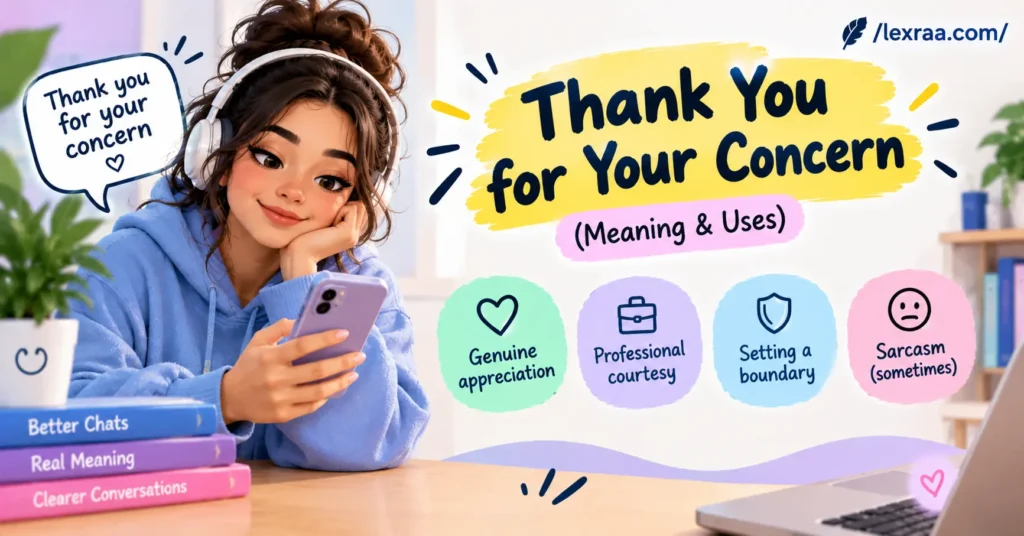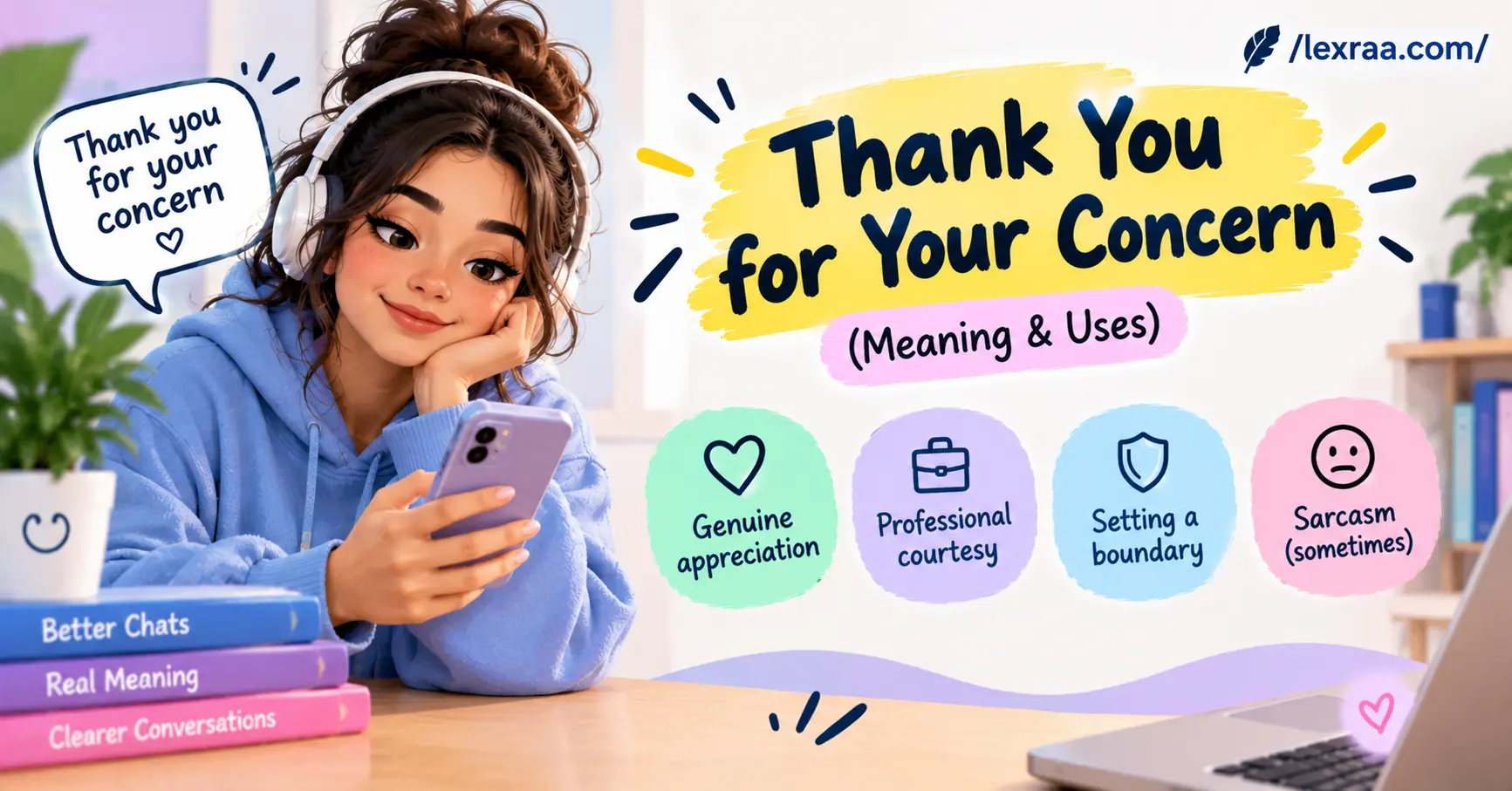
“Thank you for your concern” is a polite way to say, “I appreciate that you care about me or my situation.” Someone might use it after you check on their well-being, offer help, or express worry. Depending on the context, it can sound genuinely grateful, professionally courteous, or quietly dismissive.
The Meaning Behind the Phrase
The phrase is an ordinary English expression, not an acronym or a special slang term. It combines gratitude (“thank you”) with acknowledgment of another person’s care or worry (“your concern”).
The word concern can refer to care, interest, or worry about someone or something. That is why the phrase works in several situations, from a friend checking in to a colleague asking about a problem. See Dictionary.com’s definition of concern.
Common meanings include:
- Genuine gratitude: “I appreciate you checking on me.”
- Acknowledgment: “I understand that you’re worried.”
- Reassurance: “Thank you for asking; I’m okay.”
- Polite boundary-setting: “I appreciate your concern, but I can handle this.”
- Formal courtesy: “Thank you for taking an interest in this matter.”
One important distinction: thanking someone for their concern doesn’t mean you agree with their advice or intend to follow it.
You can appreciate someone’s intentions and still make your own decision.
Four Ways “Thank You for Your Concern” Can Sound
1. Sincere and appreciative
“Thank you for your concern. It means a lot that you checked on me.”
The speaker genuinely appreciates someone checking in.
2. Formal and professional
“Thank you for your concern regarding the project. The issue is being addressed.”
A courteous response that keeps the conversation professional.
3. Polite but firm
“Thank you for your concern, but I’ve already made my decision.”
The speaker acknowledges the concern without inviting further advice.
4. Potentially sarcastic
“Oh, thank you for your concern 🙄”
The phrase may sound sarcastic if the other person has been intrusive or judgmental.
A clue people often overlook
A boundary is not the same as sarcasm. Someone may sincerely appreciate your concern but still prefer privacy.
For example, “Thank you for your concern, but I’d rather keep this private” is a clear boundary. It doesn’t necessarily mean the speaker is angry with you.
“Thank You for Your Concern” in Real Conversations
These examples show how the phrase can fit different relationships and situations.
1. iMessage — A friend checks on you
Mia: Hey, you seemed upset earlier. Everything okay?
You: Yeah, just dealing with a few things.
Mia: I’m here if you need me.
You: Thank you for your concern ❤️ I really appreciate it.
What it means: The speaker is grateful and recognizes the friend’s support.
2. WhatsApp — A family member gives advice
Aunt: You should really change your plans. I’m worried about you.
You: I understand, and I appreciate you checking in.
Aunt: I just don’t want you to regret it.
You: Thank you for your concern. I’ve thought it through.
What it means: The reply acknowledges the worry without promising to follow the advice.
3. Workplace email — A colleague follows up
Colleague: I heard there was an issue with the client presentation. Are you okay?
You: Thank you for your concern.
You: I’ve resolved the issue and updated the presentation.
Colleague: Glad to hear it. Let me know if you need anything.
What it means: The phrase is professional and courteous. The next sentence provides a practical update.
4. Instagram DM — Someone offers unwanted criticism
Person: Maybe you should stop making such a big deal out of everything.
You: Thanks for your concern, but I’m good.
Person: I was only trying to help.
You: I understand. I’ve got it handled.
What it means: The reply is guarded and sets a boundary. Depending on the relationship, it could sound mildly irritated rather than grateful.
5. Group chat — Friends worry after you disappear
Friend 1: You vanished all weekend 😭
Friend 2: We thought something happened.
You: I’m okay, promise! Thank you for your concern.
Friend 1: Okay good, don’t scare us like that again 😂
What it means: The phrase is sincere, and the surrounding conversation makes the concern feel affectionate rather than intrusive.
How It Compares With Similar Phrases
These expressions overlap, but they don’t communicate exactly the same thing.
| Term | Meaning | Tone | Popularity | Confusion Risk |
|---|---|---|---|---|
| Thank you for your concern | Appreciate someone’s care or worry | Polite, sometimes formal | — | Medium |
| Thanks for checking in | Appreciate someone asking how you’re doing | Friendly, natural | — | Low |
| I appreciate your concern | Acknowledge someone’s care or worry | Formal or measured | — | Low |
| Thank you for your consideration | Appreciate someone taking something into account | Professional | — | Medium |
| Thanks for the advice | Acknowledge someone’s suggestion | Casual or formal | — | Medium |
| It’s none of your business | Reject someone’s involvement or questions | Direct, potentially rude | — | Low |
Popularity ratings are omitted because comparable search-volume evidence wasn’t established for these phrases.
The biggest difference is what you’re thanking the person for. Concern focuses on care or worry, checking in focuses on asking about you, and consideration focuses on taking something into account.
“It’s none of your business” is a possible opposite in conversational intent, but it is much more confrontational. You don’t need to be that blunt to protect your privacy.
How to Reply Without Making Things Awkward
If someone tells you “thank you for your concern,” your response can be short. Choose one that matches the situation rather than treating the phrase as a hidden message.
- If they’re genuinely grateful: “Of course. I’m glad you’re okay.”
- If they’re setting a boundary: “No problem. I respect that.”
- If the conversation feels tense: “Understood. I just wanted to check in.”
You don’t have to keep asking questions to prove that you care. If the person has indicated that they don’t want to discuss the issue, respect their choice and let the conversation move on.
Why This Phrase Sticks Around
“Thank you for your concern” does two jobs at once: it acknowledges someone’s care and gives the speaker room to decide how much to share. That combination makes it useful in personal and professional conversations, especially when a longer explanation would be uncomfortable or unnecessary.
Its flexibility is also why people sometimes misread it. The phrase can express genuine appreciation or politely end a conversation without changing its basic wording.
Frequently Asked Questions
Is “thank you for your concern” grammatically correct?
Yes. It is a complete and natural English expression. You can also say “thanks for your concern” for a slightly more casual version.
Is “thank you for your concern” better than “thanks for your concern”?
Neither is universally better. “Thank you for your concern” often sounds more formal, while “thanks for your concern” can feel more conversational. Both are appropriate when they match the situation.
Can I say “thank you for your concern” when someone is worried about my family?
Yes. You can use it when someone expresses worry about you, a family member, or a situation affecting you. Adding a brief update, such as “We’re doing better now,” can make your reply more reassuring.
Does thanking someone for their concern mean I accept their help?
No. You can appreciate someone’s care without accepting their offer or advice. If necessary, add a polite clarification: “I appreciate it, but I have things under control.”
Can the phrase sound rude in a text message?
It can sound distant or dismissive in a tense conversation, especially if it follows unwanted advice or criticism. However, the phrase itself is polite, and a short message isn’t enough to establish the sender’s intention.
What is a warmer alternative when someone genuinely cares?
Try “Thanks for checking on me,” “It means a lot that you asked,” or “I really appreciate you being there.” These options sound personal and make it clear that you value the other person’s effort.
Final Takeaway
“Thank you for your concern” usually means that you appreciate someone caring about you or your situation. Use it when you want to acknowledge their kindness, respond professionally, or set a respectful boundary. If you want to sound warmer, add a personal sentence or choose a more conversational alternative. The most common mistake is assuming the phrase is sarcastic just because it sounds formal. Read the situation before reading between the lines.