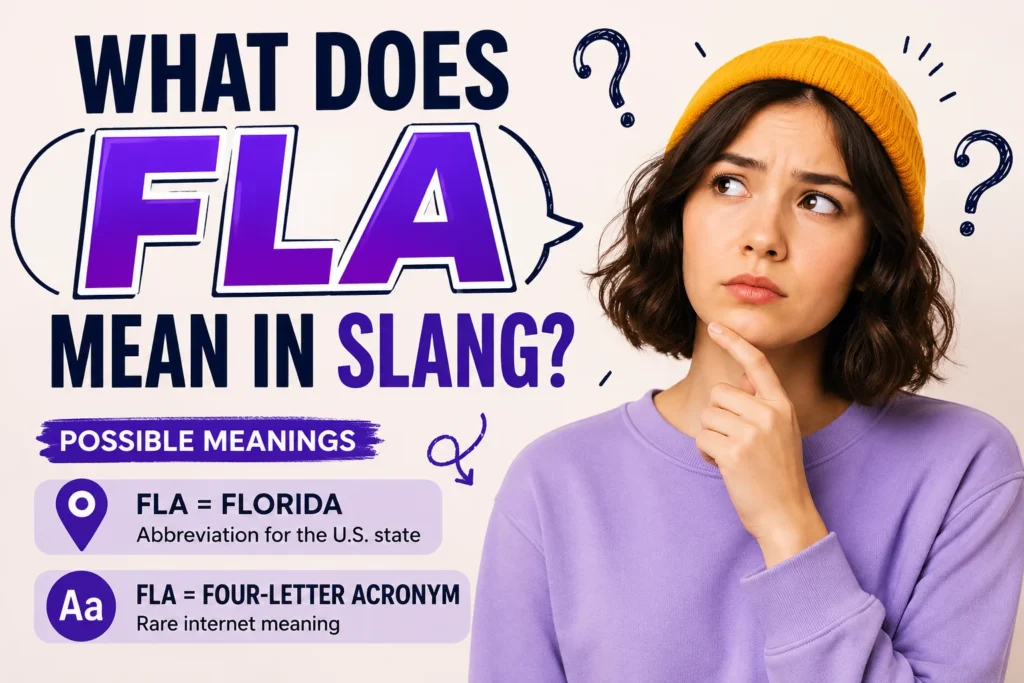
If you’re wondering what does FLA mean in slang, the short answer is that FLA is usually not a true slang word. In most online conversations, FLA is simply the abbreviation for Florida. A much rarer internet meaning is “Four-Letter Acronym,” but that usage appears only in niche online communities rather than mainstream texting.
Many people search this phrase because they see “FLA” in a message, social media post, or username and assume it’s modern Gen Z slang. In reality, most examples point to an abbreviation instead of a widely recognized slang term. Understanding that difference helps avoid misreading conversations.
What Does FLA Mean?
Unlike internet abbreviations such as “LOL,” “SMH,” or “IMO,” FLA doesn’t have one universally accepted slang definition. Most reliable references identify two genuine meanings.
1. FLA = Florida (Most Common Meaning)
By far the most common use of FLA is as a shortened form of Florida. You’ll see it in:
- Social media bios
- Travel posts
- Event listings
- Sports discussions
- Weather updates
- Business names
- Mailing addresses
Examples include:
- “Heading back to FLA tomorrow.”
- “Best beaches in FLA?”
- “Born in FLA, living in Texas now.”
In these situations, FLA functions exactly like “CA” for California or “NY” for New York. It isn’t slang—it’s simply an abbreviation.
Although people occasionally encounter it in text messages, its meaning usually depends on geographic context rather than internet culture.
2. FLA = Four-Letter Acronym (Rare)
A much less common meaning is “Four-Letter Acronym.”
This appears mainly in discussions about language, abbreviations, online forums, or technical communities. It is not a popular texting expression and isn’t something most people use in everyday conversations.
For example:
“That’s another FLA people keep using.”
Even here, readers often need additional context because the meaning isn’t widely recognized.
For that reason, if someone sends “FLA” without explanation, you should not automatically assume they mean “Four-Letter Acronym.” In most cases, they are referring to Florida.
Is FLA an Acronym, an Abbreviation, or Slang?
This is where much of the confusion comes from.
| Term | Does FLA Fit? | Explanation |
|---|---|---|
| Slang | Rarely | There is no widely accepted slang meaning used across major social platforms. |
| Abbreviation | Yes | Most commonly used as the abbreviation for Florida. |
| Acronym | Sometimes | “Four-Letter Acronym” is itself an acronym, but this meaning is uncommon. |
In other words, FLA is primarily an abbreviation rather than internet slang.
Many websites label every short form as “slang,” but that isn’t always accurate. Google users often search “what does FLA mean in slang” because they expect a hidden texting meaning. The available evidence suggests that expectation usually comes from misunderstanding rather than actual slang usage.
Why Do People Search “What Does FLA Mean in Slang”?
There are several reasons this question appears in search results.
People See It Without Context
Someone might receive a message like:
“Flying back to FLA next week.”
Without knowing the sender lives in Florida, it’s easy to assume FLA is secret internet slang.
Social Media Encourages Guessing
Short abbreviations are everywhere online. Users regularly encounter combinations of three or four letters and assume they’re new Gen Z expressions.
Since terms like “FR,” “TS,” “ATP,” and “SMH” really are internet slang, many people naturally expect FLA to work the same way.
Search Engines Suggest the Query
Autocomplete and related searches encourage users to investigate unfamiliar abbreviations, even when those abbreviations turn out to have ordinary meanings rather than slang definitions.
Where Is FLA Actually Used Online?
Unlike many genuine slang terms, FLA doesn’t have strong, documented usage across multiple social media platforms as a slang expression.
Instead, verified examples overwhelmingly use it simply as Florida, regardless of platform.
You may occasionally see posts like:
- “Vacation in FLA was amazing.”
- “Moving to FLA this summer.”
- “FLA weather is unreal.”
These are geographic abbreviations, not examples of evolving internet slang.
There is no reliable evidence that FLA has become a mainstream Gen Z expression on TikTok, Snapchat, Instagram, WhatsApp, or X with a consistent slang meaning. If someone uses it differently, the meaning usually depends on a specific community, group chat, workplace, or inside joke rather than internet culture as a whole.
How FLA Functions in English
Understanding its grammatical role makes the term easier to interpret.
Part of Speech
When referring to Florida, FLA acts as a proper noun abbreviation.
Example:
- “I’m visiting FLA next month.”
Sentence Position
It most naturally appears:
- After verbs
- At the end of sentences
- In lists
- In hashtags
- In usernames
- In location fields
Examples:
- “Driving to FLA tomorrow.”
- “Love living in FLA.”
- “#FLA”
Can It Replace a Full Sentence?
No.
Unlike expressions such as:
- LOL
- BRB
- IDC
FLA cannot normally stand alone as a complete response.
For example:
Person A:
“Where are you moving?”
Person B:
“FLA.”
This works only because the question already provides enough context. On its own, “FLA” doesn’t communicate a complete idea.
Formal or Informal?
The abbreviation is generally neutral.
It appears in:
- Informal text messages
- Social media captions
- Travel blogs
- Business names
- News headlines
- Maps and directories
However, in formal writing, it’s usually better to write Florida in full unless you’re following a style guide or space is limited.
Tone Variations
Because FLA is primarily an abbreviation for Florida rather than a true slang word, it doesn’t naturally carry emotional tones like “LOL,” “SMH,” or “bet.” Instead, the tone comes from the rest of the sentence. Below are realistic examples showing how people use it in different contexts.
Playful Tone
A: You’re really leaving us for FLA?
B: Sunshine wins every time. 😎
A: Don’t forget us when you’re at the beach.
B: I’ll send plenty of pictures.
Excited Tone
A: Vacation plans finalized?
B: Yep! FLA next weekend.
A: Nice! Which city?
B: Orlando first, then Miami.
Casual Tone
A: Where’s your cousin living now?
B: Down in FLA.
A: Must be enjoying the warm weather.
B: Definitely more than the snow here.
Since FLA isn’t an emotional slang expression, it doesn’t have genuine sarcastic, flirty, or humorous meanings by itself. Any humor or sarcasm comes from the surrounding conversation rather than the abbreviation.
Real Chat Examples
These examples reflect how FLA is actually used online—as a location abbreviation rather than internet slang.
Example 1 – Friends Planning a Trip
A: Where should we go this winter?
B: I’m thinking FLA.
A: Beach or theme parks?
B: Maybe both.
Example 2 – Family Group Chat
A: When does Grandma come back?
B: She’s still in FLA for another week.
A: Tell her we miss her.
B: I will.
Example 3 – Social Media Comments
A: Those sunset pictures are beautiful.
B: Thanks! Taken in FLA last night.
A: Now I’m jealous.
B: You should visit sometime.
Example 4 – Sports Discussion
A: Which team are you supporting this season?
B: One of the FLA teams.
A: Panthers or Lightning?
B: Panthers.
Example 5 – Travel Conversation
A: Your flight leaves tomorrow?
B: Yep, heading to FLA early.
A: Safe travels!
B: Thanks!
Example 6 – Workplace Chat
A: Is the conference virtual?
B: No, it’s in FLA this year.
A: Are you attending?
B: Hopefully.
Example 7 – Neighborhood Chat
A: I heard your neighbors moved away.
B: Yeah, they relocated to FLA.
A: That’s a big change.
B: They wanted warmer weather.
Example 8 – College Friends
A: Where are you spending spring break?
B: FLA with my roommates.
A: Sounds like fun.
B: Can’t wait.
How to Reply When Someone Says “FLA”
Your reply depends on the conversation—not on the abbreviation itself.
Funny Reply
- “Don’t forget the sunscreen!”
- “Bring me back some sunshine.”
- “Living the beach life already?”
Serious Reply
- “Hope you have a safe trip.”
- “When do you get back?”
- “Have a great time.”
Neutral Reply
- “Nice.”
- “Sounds good.”
- “Enjoy your stay.”
- “Which part of Florida?”
Flirty Reply?
Generally not applicable.
Since FLA simply refers to Florida, it has no built-in romantic meaning. Any flirtatious response depends entirely on the surrounding conversation rather than the abbreviation itself.
Similar Terms People Confuse with FLA
| Term | Meaning | Usage Context | Tone | Popularity | Confusion Risk |
|---|---|---|---|---|---|
| FLA | Florida (primarily); rarely Four-Letter Acronym | Travel, locations, sports | Neutral | Moderate | High |
| FL | Official postal abbreviation for Florida | Addresses, maps | Neutral | Very High | Medium |
| LA | Los Angeles or Louisiana (depending on context) | Geography | Neutral | Very High | Medium |
| LOL | Laugh Out Loud | Texting and social media | Playful | Extremely High | Low |
| SMH | Shaking My Head | Texting and social media | Frustrated, sarcastic | Very High | Low |
Is There an Opposite Meaning?
No.
FLA doesn’t express an opinion, emotion, or action, so it doesn’t have a true opposite in the way words like “win” and “lose” or “yes” and “no” do.
Who Uses the Term?
Age Groups
Since FLA is mostly a geographic abbreviation, it isn’t tied to one generation.
- Teenagers may use it in casual texts or captions.
- College students often use it when discussing travel or school.
- Adults commonly use it in emails, event announcements, and social media posts.
Its usage depends more on convenience than age.
Gen Z vs. Millennials
There is no reliable evidence that Gen Z has adopted FLA as a unique slang term.
- Gen Z is more likely to use newer internet slang such as “FR,” “bet,” or “lowkey.”
- Millennials and older users may write FLA simply as a shorthand for Florida.
In practice, both generations use it similarly when referring to the state.
Regional Usage
The abbreviation appears most often in discussions involving:
- Florida residents
- U.S. travel
- American sports
- Weather updates
- Tourism
There is no verified evidence that FLA has a distinct slang meaning in the UK or other English-speaking regions.
Origin and Internet Culture
Where Did FLA Come From?
The abbreviation FLA predates modern social media by many decades.
Historically, it has been used as a shortened written form of Florida in:
- Newspapers
- Maps
- Directories
- Business names
- Sports reporting
- Travel publications
It became common because abbreviations saved space in print long before texting existed.
Did It Start as Internet Slang?
No.
Unlike terms such as YOLO, FOMO, or SMH, FLA did not originate from online communities.
Instead, the internet simply continued using an abbreviation that already existed.
Role in TikTok and Meme Culture
There is no documented evidence that FLA has become a recognizable TikTok catchphrase, meme trend, viral sound, or creator-specific expression.
While people certainly post about Florida on TikTok, Instagram, Snapchat, and X, those posts use FLA only as a location abbreviation rather than as a piece of evolving internet slang.
Has Its Meaning Changed?
Not significantly.
Unlike many internet expressions that develop new meanings over time, FLA has remained remarkably stable. It still primarily refers to Florida, with the rare secondary meaning of Four-Letter Acronym appearing only in specialized discussions.
Is FLA Offensive?
No.
The abbreviation itself is not rude, offensive, or profane.
School and Workplace
Using FLA to mean Florida is appropriate in:
- Schools
- Colleges
- Business emails
- Travel planning
- Workplace chats
- Public social media posts
For formal reports or official documents, however, writing Florida in full is usually clearer.
Real-World Observation
One interesting thing about FLA is that it highlights how easily internet users can mistake ordinary abbreviations for modern slang. Because today’s online culture is full of short forms like FR, ATP, TS, and SMH, people naturally assume every three-letter abbreviation has a hidden meaning. In reality, FLA remains a practical shorthand for Florida, not a viral Gen Z expression. That distinction matters because understanding the context often prevents unnecessary confusion when reading messages or social media posts.
Frequently Asked Questions
Does FLA mean Florida in text messages?
Yes, in the vast majority of text messages, FLA simply means Florida. People use it as a convenient abbreviation when talking about travel, where they live, sports teams, or the state’s weather. Although a few niche meanings exist, they are much less common, so “Florida” is usually the safest interpretation.
Is FLA a real slang word?
Not in the way people think of internet slang. Unlike terms such as “LOL,” “SMH,” “FR,” or “bet,” FLA is primarily an abbreviation rather than a slang expression. Many people search for its slang meaning because they assume every short abbreviation has a hidden online definition, but there is little evidence to support that.
What does FLA mean on Snapchat?
There is no verified Snapchat-specific slang meaning for FLA. If someone sends “FLA” in a Snapchat message, it most likely refers to Florida. As with any abbreviation, it’s always worth considering the rest of the conversation before deciding what it means.
What does FLA mean on TikTok?
There is no documented evidence that FLA has become a popular TikTok slang term. Most TikTok posts that include “FLA” are simply referring to Florida as a location. If you see it used differently, the meaning is probably specific to that creator or community rather than a widely recognized trend.
Does FLA stand for anything besides Florida?
Yes. A less common meaning is “Four-Letter Acronym.” This usage appears in some discussions about abbreviations and internet language but is relatively rare. Outside those niche contexts, most people understand FLA as Florida.
Is FLA an acronym or an abbreviation?
It depends on how it’s being used. When it refers to Florida, FLA is an abbreviation. When it stands for Four-Letter Acronym, it functions as an acronym because each letter represents a word.
Why do people search “what does FLA mean in slang”?
Most searches come from curiosity after seeing “FLA” in a text, social media post, or username. Since many online abbreviations are genuine slang, people naturally assume FLA is another Gen Z expression. In reality, the search often ends with the realization that it’s simply a common abbreviation for Florida.
Should I use FLA or write Florida in full?
That depends on your audience. In casual texts, social media captions, or quick notes, FLA is perfectly acceptable if the context is clear. In school assignments, professional documents, or formal writing, spelling out Florida is usually the better choice because it avoids any possible confusion.
Conclusion
If you searched “what does FLA mean in slang,” the biggest takeaway is that FLA is generally not an established internet slang term. In everyday online communication, it almost always refers to Florida, making it a practical abbreviation rather than a trendy Gen Z expression. While the rare meaning “Four-Letter Acronym” does exist, it’s limited to specialized discussions and is unlikely to appear in ordinary text conversations.
The confusion comes from the modern internet’s love of short abbreviations. Because many three-letter combinations have become popular slang, it’s easy to assume FLA follows the same pattern. Looking at the surrounding conversation will usually make the intended meaning obvious.
Usage Tips
- Use FLA when the context clearly refers to Florida.
- Consider your audience before using abbreviations in professional or academic writing.
- Read the surrounding message instead of assuming it’s internet slang.
- If the meaning isn’t clear, ask the sender for clarification rather than guessing.
Common Mistakes
- Assuming FLA is a viral Gen Z slang word.
- Confusing it with unrelated internet abbreviations like LOL or SMH.
- Using FLA in formal writing where Florida would be clearer.
- Believing every online abbreviation has a hidden slang meaning.
When to Use FLA
Use FLA when:
- You’re casually referring to Florida in texts or social media.
- Space is limited, such as in captions or usernames.
- Your audience will easily understand the abbreviation.
Avoid FLA when:
- Writing formal reports, essays, or business documents.
- The context could confuse readers unfamiliar with the abbreviation.
- You expect an international audience that may not recognize it.