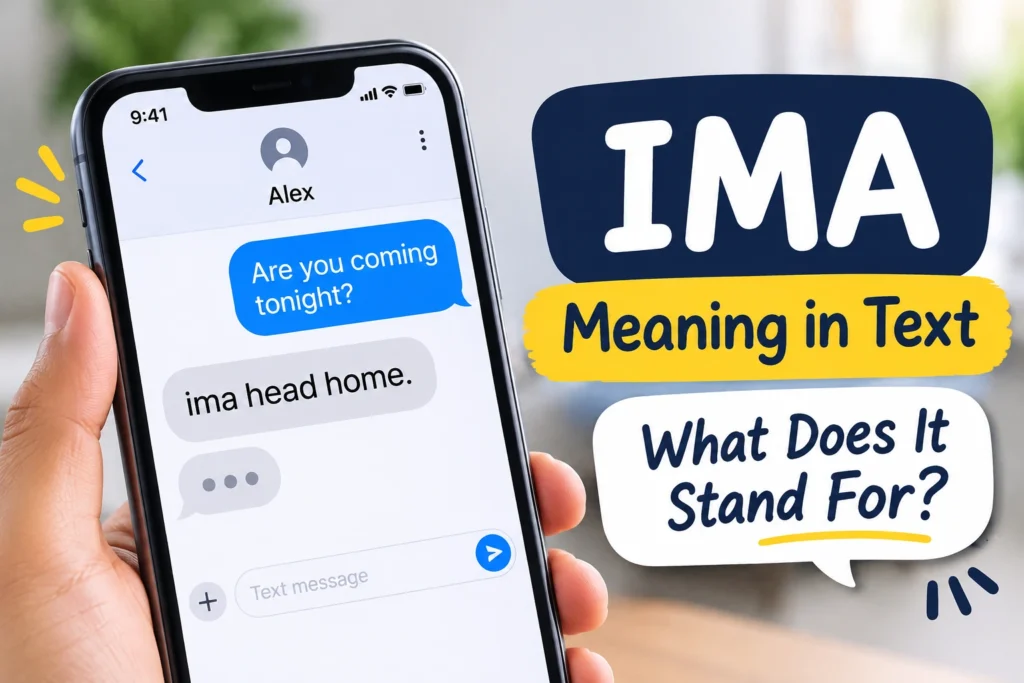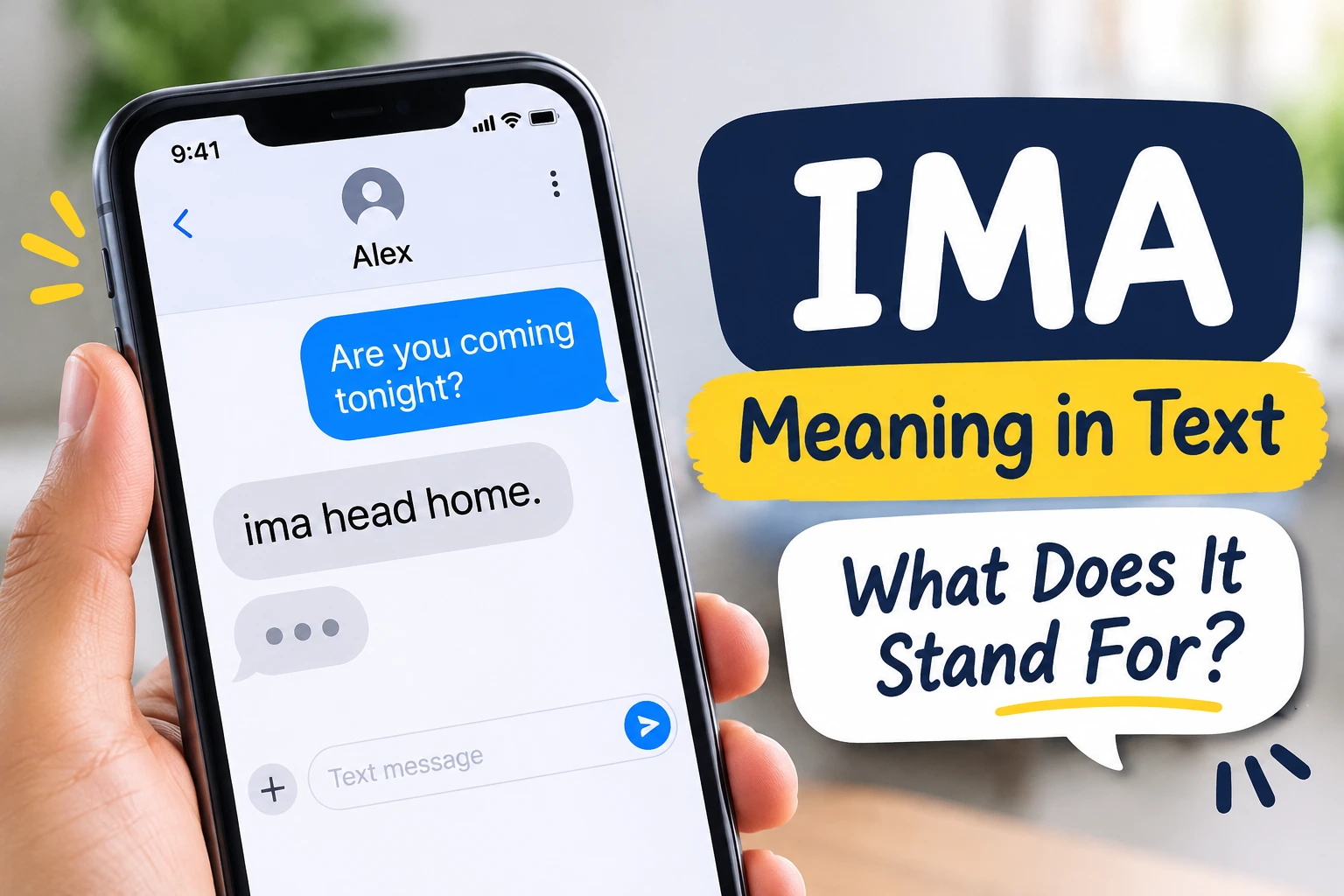
IMA in text usually means “I’m going to.” It is a casual spelling of I’ma or imma, used to tell someone what you intend to do. For example, “ima call you later” means “I’m going to call you later.”
Unlike a typical acronym, ima comes from the way people pronounce a spoken phrase. Its exact meaning can depend on context, especially when it appears in uppercase.
What Does IMA Stand For?
The most common texting meaning of IMA is “I’m going to.” It is a shortened form of I’m gonna, which itself means I am going to.
People use it to announce an intention, describe their next action, or tell someone what they plan to do.
For example:
- “ima head home” means “I’m going to head home.”
- “ima finish this tonight” means “I’m going to finish this tonight.”
- “ima text you tomorrow” means “I’m going to text you tomorrow.”
Cambridge Dictionary recognizes Ima, I’mma, and I’ma as informal spellings of this expression.
Can IMA Have Another Meaning?
Yes, but the alternatives are less common and should be interpreted carefully.
One online shorthand reference lists IMA as “I Might Add.” In that usage, someone adds a point or opinion to something already being discussed.
For example:
The movie was entertaining, IMA, but the ending could have been better.
Here, the sender is adding another thought rather than announcing an action. Although it is not the primary meaning most readers should assume in an ordinary text.
Some slang references also list “I must admit,” but this is not as firmly established as the main contraction. Don’t automatically assign that meaning whenever you see IMA.
In everyday casual messages, “I’m going to” remains the safest interpretation unless the surrounding sentence clearly suggests otherwise.
How Is IMA Used in Text Messages?
People generally use ima before describing something they intend to do. It can introduce an immediate action, a future plan, or a decision.
Here are some common situations:
- Announcing a decision: “ima tell him the truth.”
- Sharing a plan: “ima visit my cousin this weekend.”
- Leaving somewhere: “ima head out now.”
- Making a promise: “ima send you the pictures tonight.”
- Reacting confidently: “ima win this game, just watch.”
The expression is informal and conversational. It is more suitable for casual messages than professional emails, formal documents, or academic writing.
IMA Meaning in Real Text Conversations
These examples show how the expression works in different situations.
1. Making plans
Alex: Are you coming to the party tonight?
Sam: Yeah, ima get ready in a few minutes.
Meaning: Sam intends to get ready shortly.
While IMA tells someone what you intend to do, BRB meaning in text explains how to let someone know you’re stepping away and will be back shortly.
2. Ending a conversation
Mia: It’s getting pretty late.
Jordan: I know, ima go to sleep now.
Meaning: Jordan is saying they are going to bed.
3. Making a promise
Taylor: Don’t forget to send me the notes.
Chris: Don’t worry, ima send them after class.
Meaning: Chris intends to send the notes later.
4. Expressing determination
Ryan: That level looks impossible.
Alex: ima beat it eventually.
Meaning: Alex is confidently saying they intend to complete the level.
IMA vs. Similar Words and Abbreviations
These expressions can appear in similar conversations, but they do not all communicate the same thing.
| Term | Meaning | Tone | Popularity | Confusion Risk |
|---|---|---|---|---|
| IMA | I’m going to | Casual | Established informal use | Can be mistaken for an initialism |
| IMMA | I’m going to | Casual | Established spelling variant | Low |
| I’MA | I’m going to | Casual | Established spelling variant | Low |
| GONNA | Going to | Informal | Common everyday form | Low |
| OMW | On my way | Casual | Established texting abbreviation | Medium |
| BRB | Be right back | Casual | Established texting abbreviation | Medium |
These are descriptive usage labels, not measured popularity rankings.
The important distinction is that IMA announces an intention, while OMW tells someone you are already on your way. BRB, meanwhile, tells someone you will return shortly.
IMA expresses an intention, whereas TTYL is used to end a conversation with the expectation of talking again later. Learn more about TTYL meaning in text and when to use it.
Is IMA the Same as IMMA or I’MA?
In ordinary texting, these spellings usually communicate the same thing: “I’m going to.”
- ima: A short, lowercase spelling.
- imma: Another common spelling of the same expression.
- I’ma: A spelling that uses an apostrophe to represent the contraction.
The differences are mainly in how people choose to write the expression. They do not normally indicate three separate meanings.
Frequently Asked Questions
Does IMA mean “I am”?
Not usually. In casual texting, IMA generally represents I’ma, meaning “I’m going to.” It is not simply a shortened form of “I am.”
Is IMA slang or an acronym?
In its common texting use, IMA is an informal contraction rather than a traditional acronym. It represents the spoken phrase “I’m gonna,” meaning “I’m going to.”
What does “ima go” mean?
“Ima go” means “I’m going to go.” It is a casual way to announce that you intend to leave or go somewhere.
Is IMA rude?
No. The expression is not inherently rude or offensive. Its tone depends on the sentence and situation, although it may sound too casual in formal communication.
Should I write IMA or IMMA?
Either spelling can communicate “I’m going to.” Both are informal, so choose the version that feels natural in your conversation.
What does IMA mean when someone says “I might add”?
In that context, IMA can be an initialism for “I might add.” It introduces an additional thought or opinion, but this is a less common interpretation than “I’m going to.”
Final Takeaway
In most text messages, IMA means “I’m going to.” It is an informal contraction used to announce plans, intentions, or the next thing someone expects to do. You may also see it written as imma or I’ma. Although other expansions exist, context will help you identify the intended meaning. Use it in casual conversations and choose the full phrase when writing formally.