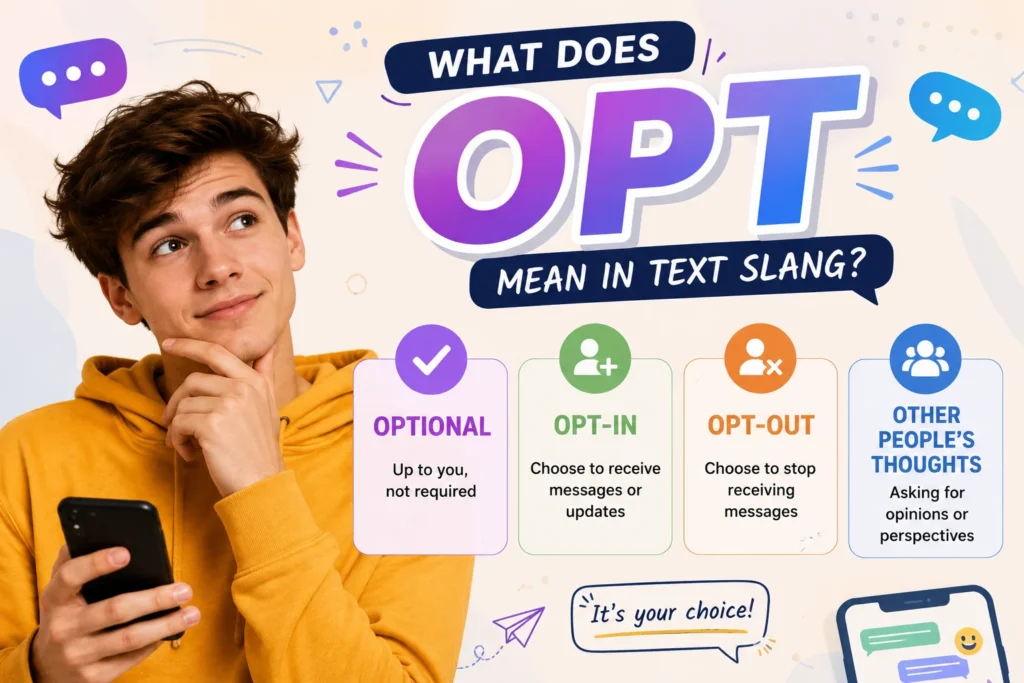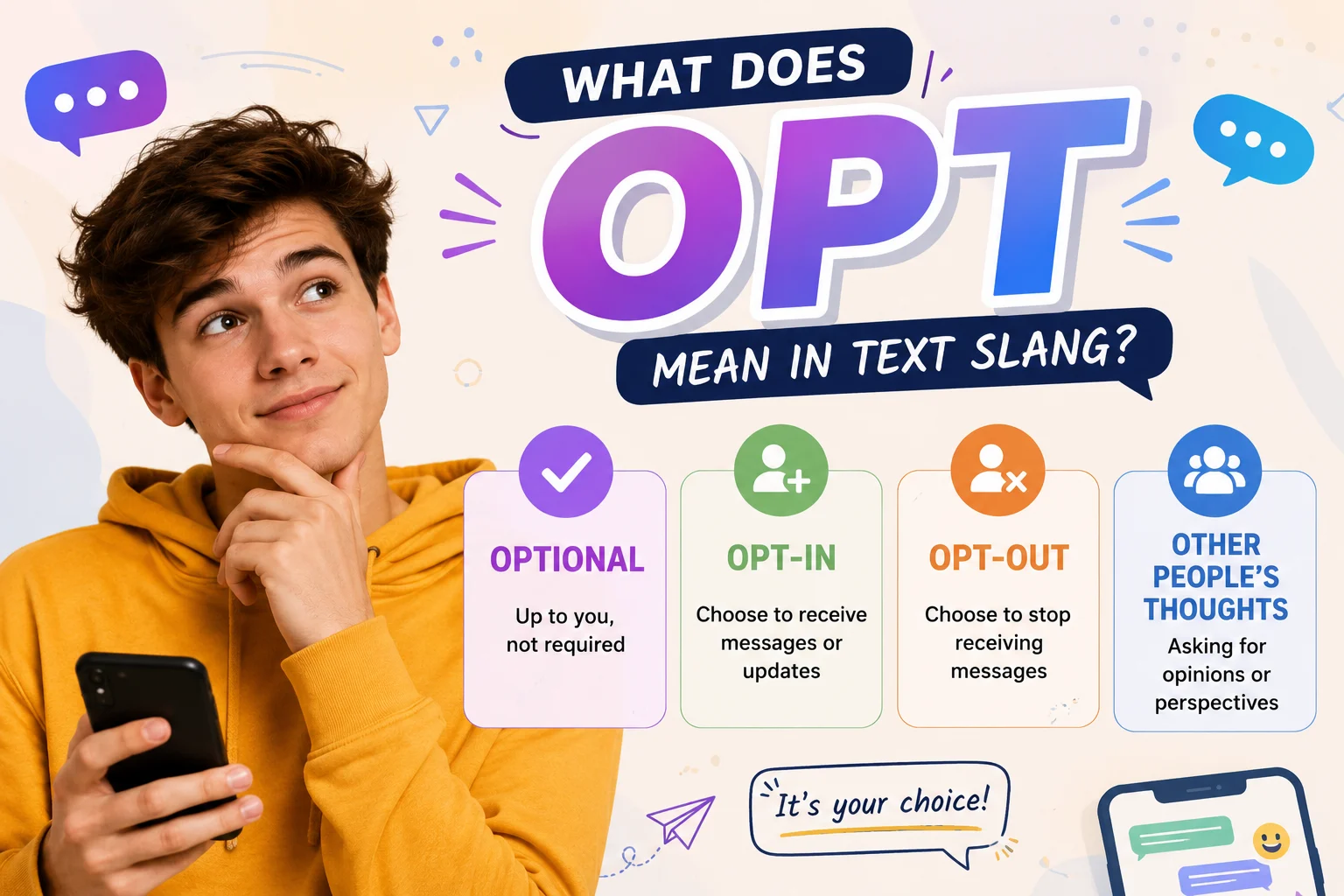
In text slang, OPT most commonly means “optional,” indicating that something is your choice rather than a requirement. Depending on the conversation, it can also refer to opting in or opting out of text messages, and less commonly, “Other People’s Thoughts” when discussing opinions online.
Because OPT has several meanings, the surrounding conversation usually makes it clear which one is intended.
Example:
Friend: Movie night is opt if you’re busy.
You: Thanks! I’ll let you know later.
What Does OPT Mean in Text?
The slang use of OPT usually comes from the word optional.
Instead of typing the full word, people shorten it to OPT in casual chats, gaming groups, school discussions, and social media messages. It’s a quick way to let someone know there’s no obligation to do something.
For example, if someone says an event is “opt,” they’re simply saying attendance is your choice.
Example 1
A: We’re playing after work, but it’s opt.
B: Cool. If I finish early, I’ll join.
Example 2
A: Cameras are opt during today’s meeting.
B: Nice, thanks for letting everyone know.
Example 3
A: Homework review is opt tonight.
B: I might still attend.
Sometimes OPT appears in conversations about subscriptions.
For example:
- Opt in = choose to receive updates.
- Opt out = choose to stop receiving updates.
These aren’t exactly slang, but they’re very common in texting and digital communication.
Finally, some internet users use OPT to mean “Other People’s Thoughts.” You’ll occasionally see it when someone asks for opinions.
Example:
“Just sharing my OPT—not trying to start an argument.”
Although this meaning exists, it’s much less common than optional.
Real Chat Examples
Friend: The study session is opt today.
You: Perfect. I’ll join if I finish work.
Snapchat
Friend: Face cam is opt tonight.
You: Good, I wasn’t ready anyway.
Instagram DM
Friend: Want to post together?
You: Sure! Filters are opt though.
Gaming Discord
Friend: Voice chat is opt.
You: I’ll probably just type today.
Emotional Meaning & Tone
Unlike abbreviations such as LOL, OMG, or SMH, OPT doesn’t express an emotion by itself. Instead, it signals choice, flexibility, or permission. The tone depends on how it’s used in the conversation.
Friendly Tone
When someone says something is opt, they’re usually trying to remove pressure.
Example:
“You can join us if you want—it’s totally opt.”
This sounds welcoming and considerate.
Neutral Tone
Most of the time, OPT is simply informational.
Example:
“Attendance is opt this week.”
There’s no hidden meaning—it’s just letting people know participation isn’t required.
Supportive Tone
People often use OPT to make others feel comfortable about saying no.
Example:
“Bringing snacks is opt, so don’t worry if you can’t.”
Here, the speaker is being thoughtful rather than demanding.
What Does OPT Mean From a Girl?
When a girl uses OPT in a text, it almost always keeps its regular meaning: optional.
She may be letting you know there’s no pressure to make a decision or join an activity.
Example:
Girl: Dinner is opt if you’re tired after work.
Meaning:
She’s giving you the freedom to decide without making you feel guilty.
If she uses OPT to mean “Other People’s Thoughts,” she’s usually inviting opinions.
Girl: I’d love everyone’s OPT before I decide.
What Does OPT Mean From a Guy?
The meaning is generally the same.
A guy might use OPT when organizing plans, gaming sessions, or group chats to show that something isn’t mandatory.
Example:
Guy: Mic is opt tonight.
Meaning:
Using voice chat is optional.
If referring to Other People’s Thoughts, he’s likely asking for feedback.
Guy: What’s everyone’s OPT on the new update?
How to Reply to OPT
Your reply depends on the context.
Casual Replies
- “Sounds good.”
- “I’ll decide later.”
- “Thanks for letting me know.”
- “I might join.”
Friendly Replies
- “I appreciate the flexibility!”
- “I’ll see how my day goes.”
- “Thanks for making it optional.”
Funny Replies
- “Good, because my couch already made plans for me.”
- “Optional? My favorite word.”
- “Now that’s the kind of invitation I like.”
Short Responses
- “Okay!”
- “Maybe.”
- “Cool.”
- “Got it.”
- “Thanks!”
Is OPT Rude or Safe to Use?
OPT is completely safe to use.
It isn’t offensive, rude, or considered inappropriate.
In fact, it often makes conversations sound more polite, since it gives people the freedom to choose rather than making something feel mandatory.
The only downside is that some people may not recognize the abbreviation if they’re unfamiliar with texting slang. In formal situations, writing optional instead of OPT is usually clearer.
Read More: What Does OTS Mean in Slang? Gaming & Texting Explained
Where You’ll See OPT
Texting
Used to tell friends that something isn’t required.
Snapchat
Appears in casual conversations about plans, photos, or group activities.
TikTok
Sometimes found in comments discussing challenges, trends, or participation where joining is optional.
Occasionally appears in group chats or captions to indicate that participation or responses are optional.
Similar Slang Comparison
| Slang | Meaning | Typical Use |
|---|---|---|
| OPT | Optional | Choice, flexibility |
| IDC | I Don’t Care | Showing no preference |
| TBH | To Be Honest | Giving an honest opinion |
| IMO | In My Opinion | Sharing a personal view |
| FYI | For Your Information | Providing information |
| MUST (Opposite) | Required or mandatory | No choice |
👉 Key Insight
Unlike abbreviations that express emotions or reactions, OPT helps communicate freedom of choice. It’s especially useful in group chats because it reduces pressure and makes invitations sound more relaxed and considerate.
Variations and Related Terms
These are genuine terms related to OPT, not invented slang variations.
| Term | Meaning |
|---|---|
| OPT | Optional. |
| Opt In | Choose to receive messages or updates. |
| Opt Out | Choose to stop receiving messages. |
| Optional | The full version of OPT. |
| Choice | Freedom to decide. |
| Voluntary | Participation is not required. |
| Mandatory | The opposite of optional. |
| Required | Something that must be done. |
| IMO | In My Opinion; often appears when asking for feedback. |
| Other People’s Thoughts (OPT) | A less common meaning used when requesting opinions. |
Common Mistakes & Misunderstandings
Because OPT has more than one meaning, it’s easy to misunderstand if you ignore the context.
Assuming It Always Means “Optional”
While optional is by far the most common texting meaning, OPT doesn’t always refer to choice. In discussions about messaging services, it may refer to opt in or opt out, and in some online communities, it can mean “Other People’s Thoughts.”
Confusing “Opt In” and “Opt Out”
These two phrases are opposites.
- Opt in means you agree to receive messages, newsletters, or alerts.
- Opt out means you stop receiving them.
Mixing them up can lead to confusion, especially when dealing with marketing texts or subscriptions.
Using OPT in Formal Writing
Although OPT is common in casual texting, it isn’t suitable for every situation.
For example, in a business email or school assignment, writing “optional” is usually clearer and more professional than using the abbreviation.
Assuming Everyone Knows the Abbreviation
Not everyone is familiar with texting shorthand. If you’re talking to someone who doesn’t use internet slang often, spelling out optional avoids unnecessary confusion.
Other Meanings of OPT
Outside of slang, OPT appears in several different contexts. These meanings are common but are not considered internet slang.
- Optional – The most common texting meaning, indicating that participation is a choice.
- Opt In – Giving permission to receive promotional texts, emails, or notifications.
- Opt Out – Choosing to unsubscribe from marketing messages or alerts.
- Other People’s Thoughts – A less common internet abbreviation used when asking for opinions or feedback.
- Optional Practical Training (OPT) – A U.S. immigration and education term for eligible international students. This is unrelated to slang.
- Optimization (OPT) – A shortened form used in technology and programming contexts. Again, this isn’t a slang meaning.
Frequently Asked Questions
What does OPT mean in Snapchat?
On Snapchat, OPT usually means optional. Someone may use it to say that replying, joining an activity, or participating is completely your choice.
What does OPT mean from a girl?
When a girl uses OPT, she almost always means optional. She’s typically letting you know there’s no pressure to do something. In less common situations, she could be asking for Other People’s Thoughts when looking for opinions.
Is OPT rude?
No. OPT is a polite and neutral abbreviation. In many conversations, it actually makes messages sound friendlier because it gives the other person the freedom to choose.
What does OPT mean in texting?
In texting, OPT most commonly means optional. It lets someone know that an invitation, task, or decision is voluntary rather than required.
What does “opt in” mean?
Opt in means you choose to receive updates, newsletters, or promotional messages from a business or service. It’s commonly used when signing up for email or SMS notifications.
What does “opt out” mean?
Opt out means you choose to stop receiving messages or marketing communications. Many businesses allow users to opt out by replying with words like STOP or UNSUBSCRIBE.
What does OPT mean on social media?
On platforms like Instagram, Snapchat, and TikTok, OPT usually means optional. In some niche communities, it may also stand for Other People’s Thoughts, especially when asking followers for opinions.
What does OPT stand for in texting?
In texting, OPT most commonly stands for “optional.” It tells someone that joining an activity, completing a task, or making a decision is entirely their choice. In some conversations, it may also refer to opting in, opting out, or, less commonly, “Other People’s Thoughts.”
What does OPT mean on Snapchat?
On Snapchat, OPT usually means optional. Friends often use it to let others know there’s no pressure to reply, join a plan, or participate in a conversation or challenge.
What does OPT mean on TikTok?
On TikTok, OPT generally means optional, especially in comments or captions where participation is voluntary. While some niche communities may use other meanings, optional is the interpretation most users recognize.
What does OPT mean from a girl in a text?
When a girl texts OPT, she usually means optional. For example, if she says, “It’s opt if you want to come,” she’s letting you know there’s no obligation and the decision is completely up to you.
Is OPT a rude slang term?
No. OPT is a neutral and polite abbreviation. It doesn’t contain offensive language and is commonly used to make invitations or requests sound more flexible and considerate.
What is the difference between OPT and opt in?
OPT by itself usually means optional in casual texting. Opt in, however, means choosing to receive messages, emails, or notifications from a business or service. Although they share the same root word, they’re used in different contexts.
Conclusion
In most text messages and online conversations, OPT simply means optional. It’s a quick way to tell someone that something is their choice rather than a requirement, making conversations feel more relaxed and considerate.
You’ll also see OPT used in phrases like opt in and opt out, especially when talking about subscriptions or marketing messages. Although Other People’s Thoughts is another recognized meaning, it’s much less common and usually understood from the context.
Once you know which situation you’re in, understanding OPT becomes easy—and you’ll be able to use it naturally in everyday conversations.