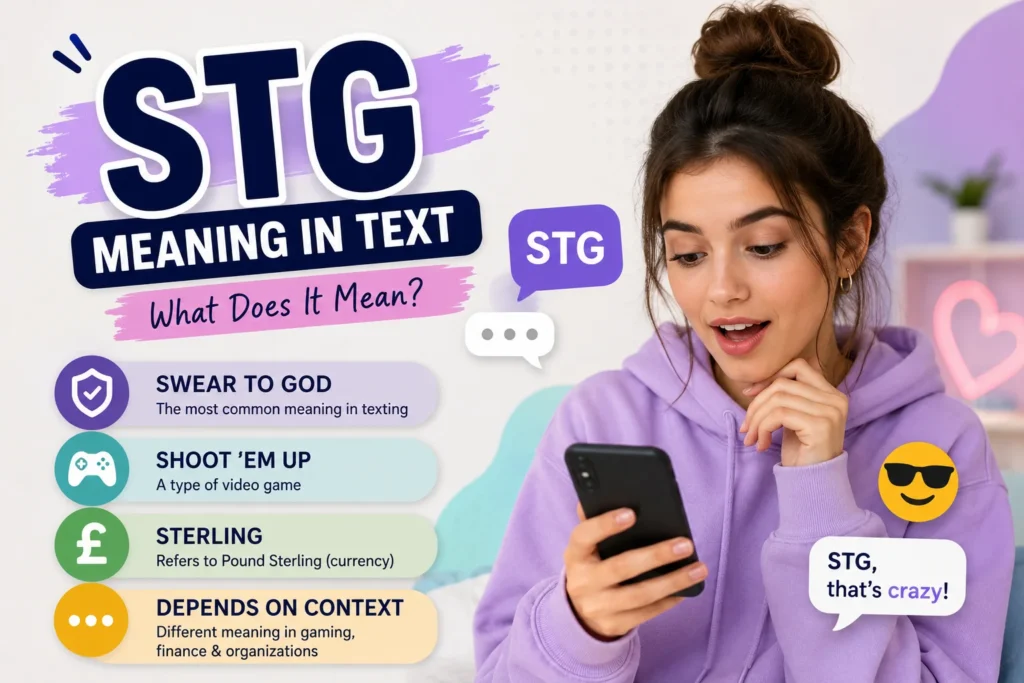
STG most commonly means “Swear to God” in text messages and online conversations. It’s a widely used internet slang abbreviation that emphasizes honesty, surprise, frustration, or sincerity. Many people search this term after seeing “STG” on TikTok, Snapchat, Instagram, WhatsApp, or X.
What Does STG Mean in Text?
The primary and overwhelmingly most common meaning of STG in texting is:
STG = Swear to God
People use it to stress that they’re telling the truth, expressing strong emotions, or emphasizing how serious they are about something.
For example:
- “STG I didn’t touch your charger.”
- “If it rains again tomorrow, STG I’m staying home.”
- “STG that movie made me cry.”
In all of these examples, STG functions as a way of adding emphasis, much like saying:
- “Honestly…”
- “I promise…”
- “Seriously…”
- “I’m not joking…”
Although it contains a religious phrase, many people use it casually in everyday online conversations without intending it as a literal oath.
The Most Common Meaning
When someone texts “STG,” they’re almost always saying:
- Swear to God
- I swear
- I’m being completely serious
- I’m telling the truth
This is the meaning you’ll encounter across text messages, group chats, social media comments, and online discussions.
Why Do People Use STG?
People often choose STG because it’s short, familiar, and adds emotional emphasis without typing an entire sentence.
It can communicate:
- Honesty
- Frustration
- Excitement
- Disbelief
- Surprise
- Determination
For instance:
A: “Did you really finish the project already?”
B: “STG, I stayed up all night.”
Here, STG reinforces that the speaker genuinely means what they’re saying.
Other Meanings of STG
Although Swear to God is by far the most common meaning in texting, STG can have different definitions depending on the context.
These meanings are much less common in everyday messaging but may appear in specialized communities.
1. Swear to God (Most Common)
This is the internet slang meaning recognized across nearly every major social platform.
Example:
“STG I’m deleting this app if it crashes again.”
2. Sterling (Finance)
In financial discussions, STG may refer to Pound Sterling, the official currency of the United Kingdom.
Example:
“The invoice is listed in STG.”
Because this appears mainly in banking or international business, it’s rarely confused with texting slang.
3. Gaming and Technical Meanings
Some gaming communities or organizations use STG as an abbreviation for titles, groups, or technical terms.
Examples include:
- Team names
- Game-specific abbreviations
- Company or project initials
These meanings depend entirely on context and are far less common than Swear to God.
How to Tell Which Meaning Someone Means
In almost every casual conversation, assume:
STG = Swear to God
Only consider another meaning if you’re reading:
- Financial documents
- Business correspondence
- Technical manuals
- Gaming communities with their own abbreviations
For everyday texting, the slang meaning is overwhelmingly the correct interpretation.
Is STG an Acronym, Abbreviation, or Slang Word?
STG fits into more than one category.
Acronym
Yes.
STG is an initialism (often grouped with acronyms) because it represents the first letters of the phrase:
Swear To God
Unlike spoken acronyms such as “NASA,” most people simply say the full phrase rather than pronouncing “STG” as a word.
Texting Abbreviation
STG is also a text abbreviation.
Instead of typing three words, users shorten the phrase into just three letters.
This makes conversations faster while preserving the intended meaning.
Internet Slang
Most importantly, STG is established internet slang.
It’s widely understood among social media users and appears naturally in online conversations, comments, memes, and private chats.
Unlike newly invented abbreviations that appear briefly and disappear, STG has remained common for many years.
How STG Is Used on Different Platforms
Although the meaning stays consistent, the way people use STG varies slightly across social media platforms.
TikTok
On TikTok, STG often appears in:
- Video captions
- Comment sections
- Replies
- Storytime videos
Users typically employ it to emphasize dramatic or funny situations.
Examples:
- “STG this happened to me yesterday.”
- “STG I watched this five times.”
It’s frequently paired with humor, exaggeration, or relatable content.
On Instagram, STG is commonly found in:
- Comments
- Direct Messages
- Story replies
- Meme pages
People use it to react to posts, reassure friends, or emphasize genuine opinions.
Example:
“STG that’s the best outfit you’ve posted.”
Snapchat
Snapchat conversations are fast and informal, making STG especially popular.
Typical uses include:
- Reacting to gossip
- Promising something is true
- Expressing excitement
- Showing frustration
Example:
A: “Did he actually say that?”
B: “STG.”
Here, STG can stand alone as a complete response because the context already explains the meaning.
In WhatsApp chats, STG appears mainly among friends and family members who are familiar with internet slang.
People use it while:
- Making promises
- Emphasizing stories
- Reacting emotionally
- Clarifying misunderstandings
Example:
“STG I forgot your birthday by accident.”
X (formerly Twitter)
On X, character limits encourage shorter expressions, making abbreviations like STG especially practical.
You’ll often see it in:
- Personal opinions
- Live reactions
- Sports commentary
- Entertainment discussions
Example:
“STG this season finale was unbelievable.”
Why STG Became So Popular
Several factors explain why STG has remained one of the internet’s most recognizable abbreviations.
It’s Short and Easy to Type
Instead of writing “I swear to God,” users only need three letters.
This makes conversations faster, particularly on mobile devices.
It Adds Emotion
STG quickly communicates sincerity, disbelief, excitement, or frustration.
Without writing long explanations, users can make their emotions immediately clear.
It’s Widely Recognized
Because STG has been used across texting and social media for years, most frequent internet users immediately understand its meaning.
That shared understanding keeps the abbreviation relevant even as new slang terms appear.
It Fits Casual Conversations
STG sounds natural in:
- Text messages
- Group chats
- Social media comments
- Meme culture
- Online gaming chats
Its flexibility makes it useful in many everyday situations without requiring formal language.
A Note on Religious Sensitivity
Although many people use STG casually, it’s worth remembering that the phrase expands to “Swear to God.” Some individuals avoid using it because of personal or religious beliefs about making oaths or invoking God’s name casually. If you’re unsure how your audience may interpret it—especially in formal, professional, or faith-based settings—it’s often better to use alternatives such as “Honestly,” “Seriously,” “I promise,” or “I’m telling the truth.”
Tone Variations of STG
Although STG (Swear to God) always expresses emphasis or sincerity, its tone changes depending on the conversation. The same abbreviation can sound funny, frustrated, playful, or completely serious based on the surrounding message.
Below are the most common and genuinely documented tone variations.
Funny Tone
Friends often use STG while exaggerating everyday situations for comedic effect.
Conversation Example
A: I ate the whole pizza by myself.
B: STG?
A: Not even proud of it.
B: That’s honestly impressive.
Playful Tone
In lighthearted chats, STG is often used to tease someone without sounding harsh.
Conversation Example
A: STG you’re always late.
B: I was only five minutes late!
A: That’s what you said yesterday too.
B: Fair point.
Serious Tone
People also use STG when they genuinely want someone to believe them.
Conversation Example
A: Did you really report the bug?
B: STG I submitted it this morning.
A: Okay, I believe you.
B: You can check the ticket if you want.
Frustrated Tone
Another common use is expressing annoyance or reaching the end of one’s patience.
Conversation Example
A: The Wi-Fi disconnected again.
B: STG this internet hates me.
A: Same thing happened yesterday.
B: I’m calling the provider tomorrow.
Real Chat Examples
These examples reflect how STG naturally appears in text messages and online conversations.
Example 1 – Friends Planning the Weekend
A: Are you actually coming this time?
B: STG I’ll be there.
A: You said that last week.
B: I know, but this time I’m serious.
Example 2 – Gaming Chat
A: Did you really beat that level already?
B: STG it took me three hours.
A: That’s dedication.
B: Worth every minute.
Example 3 – Family Group Chat
A: Did you remember to buy milk?
B: STG I forgot again.
A: Looks like someone is making another trip.
B: I’ll go after work.
Example 4 – Snapchat Conversation
A: He actually texted you?
B: STG.
A: No way!
B: I’ll send you the screenshot.
Example 5 – TikTok Comments
A: STG this recipe actually works.
B: I tried it yesterday.
A: Same!
B: Definitely making it again.
Example 6 – College Friends
A: Did you finish the assignment?
B: STG I started five minutes before the deadline.
A: That’s stressful.
B: Somehow I still submitted it.
Example 7 – Workplace Chat (Informal)
A: You fixed the spreadsheet already?
B: STG it was just one missing formula.
A: That explains everything.
B: Glad it wasn’t anything worse.
Example 8 – Entertainment Discussion on X
A: STG that’s the best season finale this year.
B: Completely agree.
A: I wasn’t expecting that ending.
B: Neither was anyone else.
Grammar and Language Role
Understanding how STG functions grammatically helps you recognize it in different types of conversations.
Part of Speech
STG isn’t a traditional part of speech like a noun or verb.
Instead, it functions as a discourse marker or emphatic expression, adding emphasis to what follows or reinforcing what has just been said.
Sentence Position
STG most commonly appears:
At the beginning
- STG I’m exhausted.
In the middle
- I’m STG never eating there again.
(This version is less common.)
At the end
- I didn’t touch it, STG.
The beginning of a sentence remains the most natural position.
Can STG Replace a Full Sentence?
Yes.
When the context is already clear, STG can stand alone.
Example:
A: Did that really happen?
B: STG.
In this case, the abbreviation effectively means:
- “I swear to God.”
- “I’m telling the truth.”
Formal vs. Informal Register
| Setting | Appropriate? |
|---|---|
| Text messages | ✅ Yes |
| Snapchat | ✅ Yes |
| TikTok comments | ✅ Yes |
| Instagram DMs | ✅ Yes |
| WhatsApp friends | ✅ Yes |
| Workplace emails | ❌ No |
| School essays | ❌ No |
| Business communication | ❌ No |
Because STG is internet slang, it belongs in casual conversations rather than professional writing.
How to Reply When Someone Says STG
Your response depends on the context and tone of the conversation.
Funny Reply
If someone is exaggerating for humor:
Them: STG I could sleep for two days.
You: Only two? Rookie numbers.
Serious Reply
If they’re trying to convince you:
Them: STG I’m telling the truth.
You: Okay, I believe you.
or
You: Thanks for explaining.
Flirty Reply
Only use this tone if the conversation is already playful or romantic.
Them: STG you’re the cutest person I know.
You: Careful, you’re making me smile.
or
You: I’ll gladly accept that compliment.
Neutral Reply
For everyday conversations:
- Got it.
- Fair enough.
- Makes sense.
- I hear you.
- Okay.
- That’s understandable.
Comparison Table
| Term | Meaning | Usage Context | Tone | Popularity | Confusion Risk |
|---|---|---|---|---|---|
| STG | Swear to God | Texting, social media, chats | Serious, emphatic, casual | Very High | Low |
| ISTG | I Swear to God | Texting, TikTok, messaging | Strong emphasis | High | Low |
| ONG | On God | Internet slang, gaming, social media | Casual, confident | High | Medium |
| FR | For Real | Text messages, comments | Agreement, sincerity | Very High | Low |
| NGL | Not Gonna Lie | Conversations, social media | Honest opinion | Very High | Low |
| JK (related opposite) | Just Kidding | Casual chats | Playful | Very High | Low |
STG vs. ISTG
These abbreviations are extremely similar.
- STG = Swear to God
- ISTG = I Swear to God
ISTG is simply the longer version that explicitly includes “I.”
STG vs. ONG
Both emphasize honesty.
However:
- STG means “Swear to God.”
- ONG means “On God.”
The choice usually comes down to personal preference rather than a major difference in meaning.
Who Uses STG?
Age Groups
STG is most common among:
- Teenagers
- College students
- Young adults
Older adults who regularly use texting and social media also recognize the abbreviation, although they’re generally less likely to use it in everyday conversation.
Gen Z vs. Millennials
Gen Z
- Uses STG frequently in texting.
- Often combines it with newer slang.
- Common in TikTok, Snapchat, and gaming chats.
Millennials
- More likely to use STG in text messages, WhatsApp, Facebook Messenger, and group chats.
- Tend to use it for emphasis rather than as part of fast-changing internet slang trends.
Both generations generally understand its meaning, even if their preferred platforms differ.
Regional Usage
There is no reliable evidence that STG belongs to one English-speaking country.
It is widely recognized across:
- United States
- Canada
- United Kingdom
- Australia
- Other English-speaking online communities
Because it spread through internet culture rather than local dialects, its meaning remains consistent internationally.
Platforms Where STG Appears
Real-world evidence shows STG is commonly used on:
- TikTok: Captions, comments, and replies.
- Instagram: DMs, comments, and Stories.
- Snapchat: Casual one-on-one conversations.
- WhatsApp: Friends’ and family group chats.
- X (formerly Twitter): Reactions, opinions, and live commentary.
- Reddit: Informal discussions and conversational posts.
Unlike some slang that stays confined to one platform, STG has become part of general internet vocabulary across multiple social networks.
Origin and Internet Culture
Where Did STG Come From?
The abbreviation STG comes directly from the phrase “Swear to God.” Long before texting existed, English speakers used “I swear to God” as a way to emphasize that they were telling the truth or expressing a strong feeling.
As texting, instant messaging, and online chat became more popular in the late 1990s and early 2000s, people began shortening common phrases to save time. Just as LOL, BRB, and OMG became widely recognized, STG emerged as a quick way to write “Swear to God.”
There is no evidence that a single person, website, or social media platform invented STG. Instead, it developed naturally as part of internet shorthand.
Is STG Connected to AAVE?
There is no well-documented evidence that STG itself originated in African American Vernacular English (AAVE).
While phrases like “on God” (ONG) have been discussed in relation to AAVE and broader internet culture, STG is generally recognized as a mainstream English texting abbreviation used across many online communities.
For that reason, it would be inaccurate to attribute the origin of STG specifically to AAVE.
STG in TikTok and Meme Culture
STG regularly appears in:
- TikTok captions
- TikTok comments
- Instagram meme pages
- Snapchat conversations
- X (formerly Twitter) reactions
- Reddit discussions
Rather than being tied to one viral trend, creator, or meme, STG has become part of everyday internet language.
You’ll often see comments such as:
- “STG this is the funniest video today.”
- “STG I thought the same thing.”
- “STG I can’t stop watching this.”
Its widespread use across different communities has helped it remain relevant even as newer slang terms emerge.
How STG Has Evolved
Originally, the full phrase “I swear to God” was mostly spoken in face-to-face conversations.
Today, the abbreviation STG allows users to express the same sincerity with just three letters.
Although its format changed, its meaning has stayed remarkably consistent:
- Then: A spoken expression emphasizing honesty.
- Now: A digital abbreviation expressing honesty, surprise, frustration, or emphasis.
Unlike many internet slang terms whose meanings shift over time, STG has remained stable.
Is STG Rude or Offensive?
Generally, no.
STG is not considered profanity or an insult. Most people use it casually among friends without intending to offend anyone.
However, because it expands to “Swear to God,” some people may find it inappropriate due to religious or personal beliefs.
Does STG Contain Profanity?
No.
The abbreviation itself contains no profanity or explicit language.
Its wording is far milder than many other internet expressions.
Is STG Appropriate for School or Work?
It depends on the situation.
Appropriate
- Text messages
- Group chats
- Social media
- Casual conversations
- Friends and family
Better to Avoid
- Business emails
- Academic essays
- Professional presentations
- Formal workplace communication
In professional settings, writing the full sentence—or choosing phrases like “Honestly” or “I assure you”—is usually more appropriate.
Cultural Sensitivity
Some religious communities discourage casually saying “I swear to God.”
If you’re speaking with someone whose beliefs you don’t know, consider using alternatives like:
- Honestly
- Seriously
- I promise
- I’m telling the truth
These expressions communicate the same idea without referencing God.
Real-World Observation
One reason STG has remained popular is that it fills a simple communication need: adding emphasis quickly. In fast-moving digital conversations, people often want to reassure someone, express disbelief, or strengthen a statement without typing a full explanation. STG accomplishes this in just three letters. Unlike many trendy slang words that disappear after a few months, STG has stayed relevant because its meaning is clear, practical, and understood across multiple generations of internet users.
Frequently Asked Questions
What does STG stand for in text?
In texting, STG almost always stands for “Swear to God.” People use it to emphasize that they’re being truthful or to express strong emotions such as surprise, frustration, or excitement. While STG has other meanings in specialized fields, the texting definition is by far the most common.
What does STG mean on Snapchat?
On Snapchat, STG means “Swear to God.” Friends often use it when reacting to surprising news, making promises, or insisting that something really happened. Because Snapchat conversations are casual and fast-paced, abbreviations like STG fit naturally into everyday chats.
What does STG mean on TikTok?
On TikTok, STG usually appears in captions and comments to add emphasis. Users might write “STG this is hilarious” or “STG I needed this today.” The meaning remains the same as in texting—it simply adds sincerity or strong emotion to the message.
Is STG the same as ISTG?
Not exactly, but they’re very close.
- STG means “Swear to God.”
- ISTG means “I Swear to God.”
The extra “I” makes ISTG slightly more explicit, but both abbreviations communicate essentially the same idea and are often used interchangeably.
Is STG considered rude?
Usually, no.
Most people view STG as casual internet slang rather than offensive language. However, because it references God, some individuals may prefer not to use it or may find it inappropriate depending on their religious beliefs or personal values.
Can STG be used in professional communication?
It’s generally best not to.
Although STG isn’t offensive, it is still internet slang. In emails, workplace messages, academic writing, or professional settings, clearer alternatives such as “Honestly,” “I assure you,” or “I can confirm” are more appropriate.
What does STG mean in gaming?
In most gaming chats, STG still means “Swear to God.” However, some games, clans, or communities may use the letters as abbreviations for team names, weapons, or organizations. The surrounding context usually makes the intended meaning clear.
Why do people type STG instead of “I swear to God”?
Typing STG is simply faster. Like LOL, OMG, and BRB, it saves time while keeping the meaning intact. Its short length also fits naturally into text messages, social media comments, and real-time conversations.
Conclusion
If you’ve been wondering what does STG mean in text, the answer is straightforward: STG almost always means “Swear to God.” It’s a well-established internet slang abbreviation used to emphasize honesty, surprise, frustration, or sincerity in casual conversations.
While STG can occasionally represent other phrases in finance, gaming, or technical contexts, those meanings are uncommon compared with its widespread use in texting and social media. Understanding the context makes it easy to recognize which meaning is intended.
Because STG is informal, it’s best reserved for conversations with friends, family, and online communities rather than professional or academic communication.
Usage Tips
- Use STG in casual texts, chats, and social media conversations.
- Remember that it usually means “Swear to God.”
- Consider your audience, especially if they may have religious sensitivities.
- Use professional alternatives in formal communication.
Common Mistakes
- Assuming STG has multiple equally common meanings. In texting, it overwhelmingly means “Swear to God.”
- Using STG in formal emails or work documents. It is internet slang and may appear unprofessional.
- Confusing STG with ISTG or ONG. While related, these abbreviations are not identical.
- Ignoring context. In finance or specialized communities, STG may represent a different abbreviation.
When to Use STG
Use STG when:
- Chatting with friends.
- Sending text messages.
- Commenting on TikTok, Instagram, Snapchat, X, or Reddit.
- Emphasizing that you’re serious or telling the truth.
Avoid STG when:
- Writing business emails.
- Completing school assignments.
- Speaking in formal professional settings.
- Communicating with people who may be uncomfortable with religious expressions.