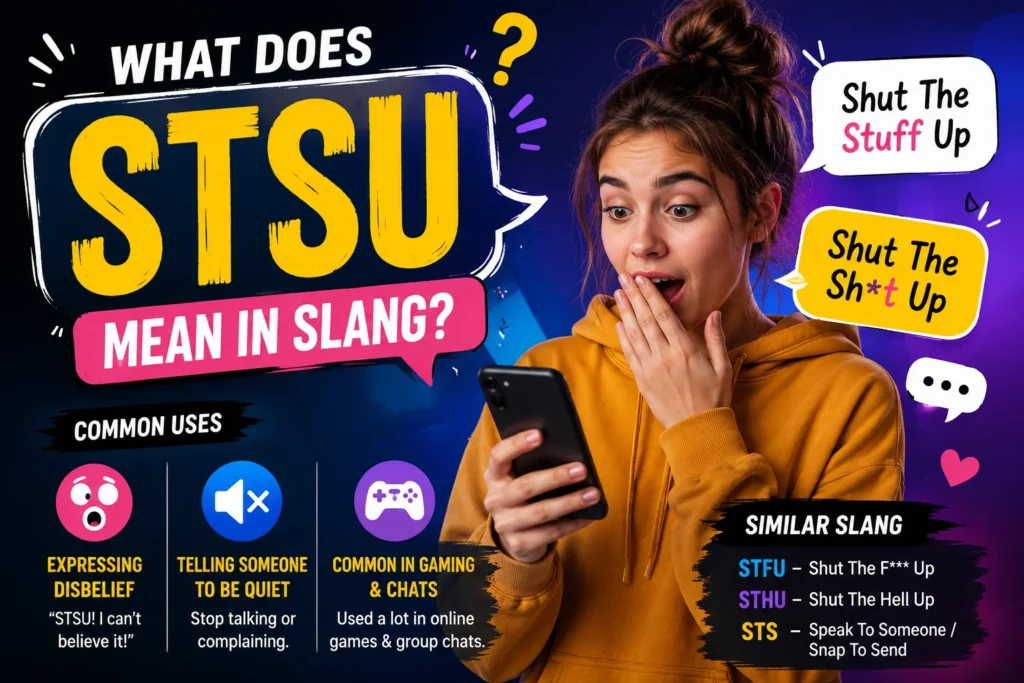
STSU most commonly means “Shut The Stuff Up” in texting and social media. It’s a toned-down, family-friendly version of STFU (“Shut The F* Up”)** and is used to tell someone to stop talking, stop complaining, or react to something unbelievable. In uncensored conversations, STSU may also mean “Shut The Sh*t Up.”
While the phrase can sound rude, it’s often used jokingly between close friends. The tone depends entirely on the relationship and the context.
Example:
Friend: I just won front-row concert tickets!
You: STSU! No way! 😲
Here, STSU expresses surprise and disbelief rather than telling someone to be quiet.
STSU Meaning in Text
In text messages, gaming chats, and social media, STSU usually appears when someone wants to react strongly or tell another person to stop talking.
Unlike its harsher cousin STFU, many people use STSU because it feels less offensive while still getting the point across.
Depending on the conversation, it can mean:
- “Stop talking for a second.”
- “I can’t believe what you just said!”
- “Quit complaining.”
- “You’re joking, right?”
- “That’s unbelievable.”
Because internet slang changes quickly, you’ll often see STSU used humorously rather than aggressively.
When People Use STSU
People commonly type STSU when:
- A friend shares shocking news.
- Someone keeps teasing them.
- A gamer complains repeatedly during a match.
- Friends joke around in group chats.
- Someone exaggerates a story.
The tone usually comes from emojis, punctuation, and your relationship with the other person.
Examples
- “STSU 😂 That’s the funniest thing I’ve heard today.”
- “Bro, STSU. You’re making that up.”
- “STSU and let me finish the story.”
Real Chat Examples
Friend: I met my favorite singer today!
You: STSU! Seriously?
Friend: I even got a selfie!
Snapchat
Friend: I accidentally sent the message to my boss.
You: STSU 😭
Friend: I’m panicking!
Gaming Chat
Friend: This game is so unfair.
You: STSU and focus—we can still win.
Friend: Fair enough.
Group Chat
Friend: I passed every exam without studying.
You: STSU 😂 Nobody believes that.
Friend: I swear it’s true!
Emotional Meaning & Tone
The meaning of STSU changes depending on who you’re talking to.
Playful
Among friends, it’s often a joking reaction to surprising news.
Example:
“STSU! You actually bought the car?”
Disbelief
People use STSU when something sounds unbelievable.
Example:
“STSU. You met your celebrity crush?”
Annoyed
If someone keeps complaining or interrupting, STSU can express frustration.
Example:
“STSU for one minute and listen.”
Slightly Rude
With strangers or people you don’t know well, STSU can easily come across as disrespectful.
Always think about your audience before using it.
STSU Meaning From a Girl
When a girl sends STSU, she’s usually expressing surprise, excitement, or playful disbelief.
For example:
Girl: I got Taylor Swift tickets!
You: STSU!! No way!!
In close friendships, it often means “You’re kidding!” rather than “Be quiet.”
However, if she’s upset during an argument, the phrase may genuinely mean “Stop talking.”
Context is everything.
STSU Meaning From a Guy
Guys commonly use STSU while joking with friends, especially in gaming chats, sports discussions, and group conversations.
Examples include:
- Reacting to unbelievable stories.
- Telling a friend to stop joking around.
- Shutting down playful trash talk.
Among close friends, it’s rarely taken seriously.
With someone you don’t know well, though, it may sound much harsher.
How to Reply to STSU
Casual Replies
- “😂 I’m serious!”
- “Hear me out.”
- “I’m not joking.”
- “Wait until you see the proof.”
Friendly Replies
- “Haha, I knew you’d say that.”
- “Believe it or not, it’s true.”
- “I couldn’t believe it either.”
Funny Replies
- “I’ll be quiet… eventually. 😆”
- “Too late, I’m already talking.”
- “Sorry, no mute button here.”
Short Responses
- “LOL”
- “Seriously.”
- “Facts.”
- “Trust me.”
Is STSU Rude or Safe to Use?
The answer depends on the situation.
Between close friends, STSU is usually harmless and playful.
Between coworkers, acquaintances, or strangers, it can sound rude because it’s still telling someone to “shut up,” even if the wording is softened.
If you’re unsure how someone will take it, it’s safer to use alternatives like:
- “No way!”
- “You’re kidding!”
- “Seriously?”
- “Stop 😂”
These express surprise without sounding disrespectful.
Where You’ll See STSU
Texting
Friends use STSU in casual conversations to react to shocking stories or tease each other.
Snapchat
You’ll often see it in private chats and Snap replies when someone shares unexpected news.
TikTok
People use STSU in comments to react dramatically to surprising videos, unbelievable stories, or funny content.
STSU appears in comments, reels, and direct messages, usually as a humorous reaction to exciting announcements or unbelievable posts.
Similar Slang Comparison
If you’ve come across STSU, you may also see other abbreviations with similar meanings. Some are playful, while others are much stronger or more direct.
| Slang | Meaning | Tone |
|---|---|---|
| STSU | Shut The Stuff Up / Shut The Sh*t Up | Playful to mildly rude |
| STFU | Shut The F*** Up | Very rude |
| STHU | Shut The Hell Up | Rude |
| IDC | I Don’t Care | Dismissive |
| NGL | Not Gonna Lie | Honest opinion |
| FR | For Real | Agreement or emphasis |
| SMH | Shaking My Head | Disappointment |
| BRUH | Expression of disbelief or frustration | Casual |
| CAP | A lie or exaggeration | Informal |
| NO CAP | Seriously; no lie | Honest |
Key Insight
Unlike STFU, which almost always sounds aggressive, STSU often appears between close friends as a playful reaction to surprising news or exaggerated stories. However, because it still means “shut up,” you should be careful using it with people who might misunderstand your tone.
Variations and Types of STSU
STSU (Shut The Stuff Up)
The most common family-friendly version.
Example: “STSU 😂 You’re kidding!”
STSU (Shut The Sh*t Up)
The uncensored version, commonly used among close friends or in gaming chats.
Example: “STSU! Did that really happen?”
STSU 😂
Adding a laughing emoji makes the phrase sound humorous instead of insulting.
Example: “STSU 😂 I can’t believe you actually did that.”
STSU 💀
Often used after hearing something shocking or ridiculously funny.
Example: “STSU 💀 That’s insane!”
STSU 😭
Expresses dramatic disbelief or emotional surprise.
Example: “STSU 😭 You won the giveaway?”
STSU Bro
A casual way to react to a friend.
Example: “STSU bro, that’s impossible.”
STSU Please
A softer, more playful variation.
Example: “STSU please 😂 You’re making me laugh too hard.”
STSU Fr
Combines STSU with FR (For Real) to add emphasis.
Example: “STSU fr, I thought you were joking.”
STSU No Way
Used when reacting to unbelievable news.
Example: “STSU! No way that happened!”
STSU Stop
A dramatic expression often seen in TikTok comments.
Example: “STSU stop 😭 That’s the funniest thing I’ve seen today.”
Common Mistakes & Misunderstandings
Assuming STSU Is Always Rude
Many people immediately think STSU is offensive.
In reality, among friends, it’s often used jokingly as another way of saying:
- “You’re kidding!”
- “No way!”
- “Stop, that’s hilarious!”
The relationship between the people chatting matters much more than the words themselves.
Using It in Professional Conversations
Avoid using STSU in emails, work chats, or conversations with teachers or clients.
Even the censored version can sound disrespectful.
Instead, say:
- “Really?”
- “That’s unbelievable!”
- “I can’t believe it.”
Confusing STSU With STFU
Although they’re related, they aren’t identical.
Many people purposely type STSU instead of STFU to avoid profanity or make the message feel less harsh.
Ignoring Context
The same message can have completely different meanings.
Playful:
“STSU 😂 You’re so lucky!”
Argument:
“STSU and leave me alone.”
The emojis, punctuation, and relationship completely change the tone.
Overusing STSU
Using STSU in every conversation can make you sound unnecessarily aggressive.
Reserve it for moments of genuine surprise, playful teasing, or close friendships.
Other Meanings of STSU
Although “Shut The Stuff Up” and “Shut The Sh*t Up” are the most common internet slang meanings, STSU can occasionally have other interpretations.
Shut The Stuff Up
This is the most family-friendly version and the one many users prefer in public posts or advertiser-friendly content.
Shut The Sh*t Up
The uncensored expansion is common in private chats, gaming communities, and among close friends.
Community-Specific Meanings
Some gaming groups, Discord servers, or private communities may use STSU as a custom abbreviation with a unique meaning.
These uses aren’t standardized and usually only make sense within that specific group.
Mistyped Acronym
Sometimes STSU is simply a typo for another abbreviation, such as:
- STFU
- STS
- STHU
If the message doesn’t make sense, ask the sender what they meant.
Family-Friendly Alternative to STFU
Many people intentionally write STSU instead of STFU because it’s less offensive while conveying a similar idea.
This is especially common on platforms where users prefer to avoid profanity.
FAQ
What does STSU mean in Snapchat?
On Snapchat, STSU usually means “Shut The Stuff Up” or “Shut The Sh*t Up.” It’s commonly used as a playful reaction to surprising news, funny stories, or unbelievable snaps. Friends often use it jokingly rather than as an insult.
What does STSU mean from a girl?
When a girl texts STSU, she is often expressing surprise, excitement, or playful disbelief.
For example:
Girl: I met my favorite actor today!
You: STSU!! Seriously?
In a friendly conversation, it usually means “No way!” or “You’re kidding!” During an argument, however, it may literally mean she wants someone to stop talking.
What does STSU mean from a guy?
Guys frequently use STSU while joking with friends, especially in gaming chats, sports discussions, or group conversations.
It often means:
- “You’re joking!”
- “I don’t believe you!”
- “Stop messing with me.”
The tone is usually casual unless it’s part of an argument.
Is STSU rude?
It depends on the context.
Among close friends, STSU is usually playful and isn’t intended to offend.
However, if you send it to someone you don’t know well, a coworker, or during an argument, it can easily come across as rude because it still tells someone to “shut up.”
When in doubt, choose a friendlier response like “No way!” or “Seriously?”
Is STSU the same as STFU?
Not exactly.
Both abbreviations tell someone to stop talking, but STFU (“Shut The F* Up”)** is much stronger and more offensive.
STSU is generally considered a softer, cleaner alternative that’s more acceptable in casual online conversations.
Where is STSU most commonly used?
You’ll most often see STSU on:
- Text messages
- Snapchat chats
- TikTok comments
- Instagram DMs
- Discord servers
- Gaming chats
- Group conversations
It’s especially common among younger internet users who enjoy using short, expressive abbreviations.
Should I use STSU in professional conversations?
No.
Even though STSU can be playful, it isn’t appropriate for work emails, business messaging apps, or conversations with teachers, clients, or people you don’t know well.
Stick with professional expressions like:
- “Really?”
- “That’s surprising.”
- “I can’t believe it.”
Conclusion
If you’ve been wondering what does STSU mean in slang, the answer is straightforward. In most text messages and social media conversations, STSU stands for “Shut The Stuff Up,” a family-friendly alternative to “Shut The Sh*t Up.” It’s commonly used to react to shocking news, tease friends, express disbelief, or tell someone to stop talking in a playful way.
Although the phrase can sound rude in certain situations, it’s often harmless when shared between close friends who understand each other’s sense of humor. As with many internet slang terms, the meaning depends on context, tone, emojis, and your relationship with the other person.
If you’re ever unsure whether STSU is appropriate, it’s usually safer to respond with friendlier expressions like “No way!”, “Seriously?”, or “You’re kidding!” Those reactions convey the same surprise without risking misunderstandings.
Knowing when and how to use STSU will help you understand online conversations more confidently across texting, Snapchat, TikTok, Instagram, and gaming communities.