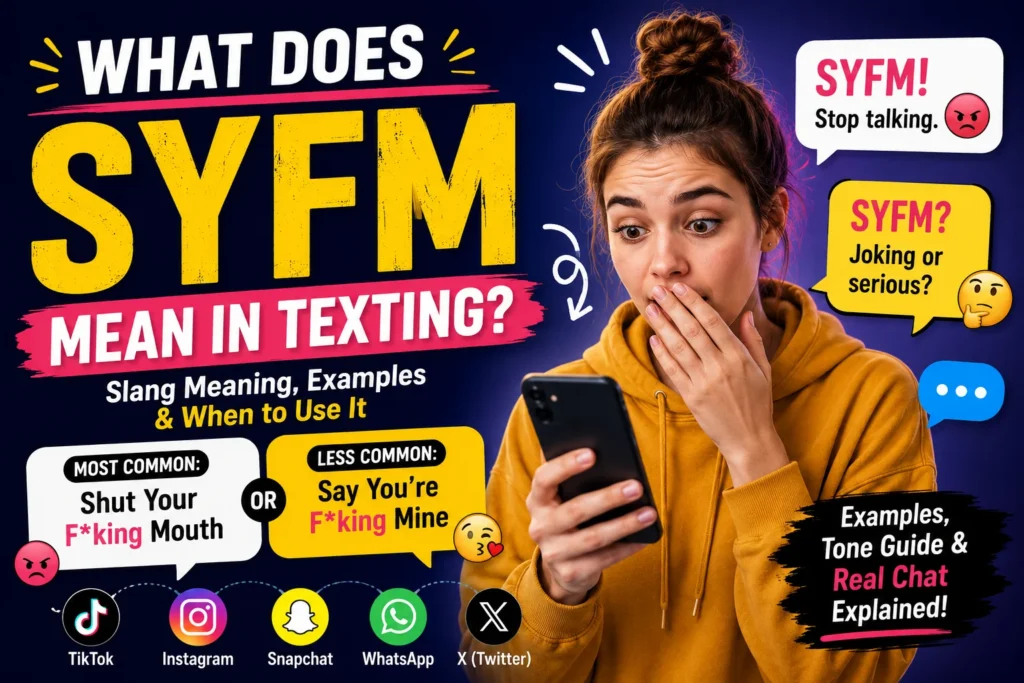
SYFM stands for “Shut Your F**king Mouth.” It’s a blunt texting acronym used to tell someone to stop talking, and depending on tone, it can land as a joke between close friends or a genuine insult during an argument.
People search this term because it shows up unexpectedly in a group chat, a TikTok comment, or a gaming lobby, and without any tone of voice attached, it’s genuinely hard to tell if the sender is joking or furious. That confusion — “is this playful or is this an attack?” — is exactly what this guide solves.
Meaning & Explanation
The Primary Meaning (Most Common)
In the overwhelming majority of cases, SYFM = “Shut Your F**king Mouth.” It’s an abbreviation (not a standalone slang word, since every letter maps directly to a word in the phrase), built the same way STFU or GTFO are built: take a short, aggressive sentence and compress it into a fast-to-type acronym. It’s used to shut down someone who’s talking too much, oversharing an opinion, or annoying the sender in the moment.
A Secondary, Less Common Meaning
In some corners of the internet, particularly in flirty or joking exchanges, SYFM has also been used to mean “Say You’re F**king Mine,” a possessive, half-joking way of telling someone to claim you. This usage is far less established and far less frequently searched than the primary meaning — most people who type or receive SYFM are using the “shut your mouth” version. If you see SYFM outside of an obviously flirtatious, teasing context, assume the primary meaning.
A third, rarer joke variant — “Stop Yapping For a Minute” — occasionally circulates as a softer, family-friendly backronym people invent after the fact, but it isn’t the term’s actual origin or common usage.
Is It an Acronym, Abbreviation, or Slang Word?
SYFM is best classified as an initialism/abbreviation — each letter stands for one word in a fixed phrase — that has crossed over into general internet slang. It’s not pronounced as a new word (like “yolo”); people either say the letters or simply type them.
Platform Breakdown
TikTok
SYFM appears most often in comment sections, usually as a quick, snarky, or funny reply to a video, or as a joking response in the replies under a friend’s post.
On Instagram, SYFM shows up mainly in DMs and comment replies, often paired with a laughing emoji to make sure the recipient reads it as a joke rather than a genuine insult.
Snapchat
Snapchat’s fast, disappearing, and highly casual message culture makes SYFM common as a quick reaction to a snap or chat, and it tends to read as more playful here than on other platforms.
On WhatsApp, SYFM appears mostly in personal and friend-group chats. Because WhatsApp is also used for family and work conversations, people are more careful with it there — it’s common between close friends but avoided in mixed or family threads.
X (Twitter)
On X, SYFM turns up in reply threads and quote posts, often during arguments or debates, where it’s used to dismiss someone else’s point rather than continue the conversation.
Tone & Context Variations
Funny
A: bro just told me pineapple belongs on pizza B: SYFM 😂 that’s a crime A: it’s genuinely good tho B: SYFM, I said what I said
Sarcastic
A: actually I think I’M the funniest person in this chat B: oh really A: yeah, objectively B: SYFM 🙄 sit down
Playful
A: I could beat you in Mario Kart any day B: you literally lost 5 times last night A: those were warm-ups B: SYFM lmaooo just admit it
Serious
A: I don’t think you handled that situation well at all B: SYFM. You weren’t even there. A: I’m just saying what people told me B: Then don’t repeat things you don’t understand.
Real Chat Examples
A: did you seriously tell my mom about last night
B: I panicked okay
A: SYFM I trusted you
B: I’m sorry, I’ll fix it
(TikTok comment):
A: This dance is so bad lol
B: SYFM you can’t even do a cartwheel
A: neither can you
B: true but I’m not judging people 😭
A: hey can we talk about the project timeline
B: sure, what’s up
A: I think we’re behind schedule
B: noted, let’s discuss it on the call
(gaming lobby)
A: Why’d you push without me
B: you were AFK for 3 minutes
A: SYFM I was getting water
B: and I was getting eliminated lol
A: I still think you were wrong for that
B: SYFM, we already talked about this
A: I’m allowed to bring it up again
B: not every night though
(sibling text)
A: mom said you have to do the dishes
B: SYFM she said YOU do them
A: she literally said your name
B: prove it
A: your outfit today is actually fire
B: SYFM stop 😳 you’re just saying that
A: no I’m serious, where’d you get it
B: thrifted it lol, thank you though
(X reply)
A: This take is genuinely embarrassing
B: SYFM, you clearly didn’t read the whole thread
A: I read enough
B: clearly not
A: I heard you’re moving out of state
B: yeah, got a job offer I couldn’t turn down
A: that’s huge, congrats
B: thanks, still processing it honestly
A: you snore SO loud, I heard you through the wall
B: SYFM I do not
A: I have proof, I recorded it
B: delete that immediately 😭
A: can we be serious for a second
B: of course, what’s going on
A: I’m actually really stressed about finals
B: okay, let’s talk it through, I’m here
Group Chat
A: Who ate the last slice of pizza
B: SYFM it’s not that deep, I’ll buy more
A: it’s the principle of it
B: I’ll Venmo you $3 lol
Grammar & Language Role
Part of speech:
Functions as an
imperative interjection
— it acts like a command (“Stop talking”) rather than a noun, verb, or adjective on its own.
Sentence position:
Usually stands alone as its own message, or opens/closes a sentence for emphasis (e.g., “SYFM, I’m not doing that” or “I’m not doing that, SYFM”).
Can it replace a full sentence?
Yes. It’s typically sent as a complete reply by itself, functioning the same way a full sentence like “Stop talking” would. Strictly informal. It contains implied profanity, so it should never appear in formal writing, professional messaging, or any context that requires a polished tone.
How to Reply to SYFM
Funny reply:
“SYFM back at you, I learned from the best 😂”
Serious reply:
“I hear that you’re frustrated, but let’s actually talk about what’s bothering you.”
Flirty reply
(only fits if the secondary “say you’re mine” meaning is clearly being used): “Make me 😏”
Neutral/unbothered reply:
“Okay 👍” or simply not responding to the jab at all.
Comparison Table
| Term | Meaning | Usage Context | Tone | Popularity | Confusion Risk |
|---|---|---|---|---|---|
| SYFM | Shut Your F**king Mouth | Arguments, joking banter, comments | Aggressive or playful | Moderate | High (tone unclear) |
| STFU | Shut The F**k Up | Same as SYFM, more widely known | Aggressive or playful | Very High | Medium |
| GTFO | Get The F**k Out | Telling someone to leave a chat/space | Aggressive | High | Low |
| SYBAU | Shut Your B*tch Ass Up | Harsher version, mainly TikTok/gaming | Very aggressive | Moderate | High |
| ZIP IT | Be quiet | Softer, non-vulgar alternative | Mild | High | Low |
| IJS | I’m Just Saying | Opposite intent — inviting more talk, not silencing it | Neutral | High | Medium |
Who Uses This Term
Age Group Breakdown
SYFM is used mostly by teens and young adults, roughly ages 14–27, who are active in group texts, gaming chats, and short-form video comment sections.
Gen Z vs. Millennials
Gen Z tends to use SYFM casually and jokingly, often stacking it with laughing emojis so the tone reads as banter rather than an insult. Millennials are more likely to reach for the older, more established STFU instead, and generally use SYFM less often or not at all.
Regional Usage
The term is used across English-speaking regions, including the US and UK, with the same core meaning in both. Usage beyond English-speaking internet spaces is limited, since the term relies on an English phrase compressed into letters.
Platforms
The “shut your mouth” meaning dominates on TikTok, Instagram, Snapchat, WhatsApp, and X. The rarer “say you’re mine” meaning is confined almost entirely to flirtatious DM or comment exchanges and is not common on any single platform.
Origin & Internet Culture
SYFM developed as a shorter, more intense sibling of older acronyms like STFU, which trace back to early 2000s internet forums and instant messaging. As competitive online gaming grew, blunt acronyms like this became part of everyday “trash talk” in voice and text chat, since typing a full sentence mid-match wasn’t practical. From there, the term moved into general social media use through comment sections and group chats, where speed and impact matter more than politeness. Its spread on TikTok and Instagram in the past few years has softened its edge somewhat — among younger users it now shows up as often in jokes as it does in genuine frustration, which is the main reason the meaning feels so tone-dependent today.
Safety & Appropriateness
SYFM is rude and contains implied profanity, since the “F” stands for a swear word. It is not appropriate for school, classroom, or workplace communication under any circumstance, and it can come across as genuinely disrespectful to anyone unfamiliar with the sender’s sense of humor. Even in casual settings, it carries real risk of being misread as hostile rather than playful, so it’s worth using only with people who clearly understand your tone.
Real-World Observation
What makes SYFM interesting isn’t the phrase itself — it’s how much weight four letters can carry without any of the vocal cues that would normally tell you whether someone’s joking. In a voice call, “shut your mouth” said with a laugh sounds nothing like the same words said with an edge. In text, both versions look identical unless the sender adds an emoji, a “lol,” or relies on the recipient already knowing their humor. That’s why the term keeps showing up in searches: it’s not that people don’t understand English, it’s that text strips away the one thing that would normally make the meaning obvious. SYFM has stuck around specifically because it sits right at that line — aggressive enough to register, common enough to be recognized, and ambiguous enough that almost everyone who receives it pauses for a second before deciding how to feel about it.
FAQ
What does SYFM mean in a text message?
SYFM means “Shut Your F**king Mouth.” It’s sent when someone wants another person to stop talking, whether that’s out of genuine annoyance or as a joking jab between friends. The actual intent depends entirely on the relationship and the tone of the conversation around it.
Is SYFM always rude?
Not always, but it always contains implied profanity, so it reads as at least mildly rude regardless of intent. Between close friends who joke this way regularly, it can feel more like banter than an insult. Sent to a stranger, coworker, or in a serious conversation, it will almost always come across as disrespectful.
Is SYFM the same as STFU?
They mean essentially the same thing, but SYFM is generally considered slightly more personal and pointed, while STFU is the older, more widely recognized version. Many people use them interchangeably in casual chats.
Can SYFM be used at school or work?
No. Because it contains implied profanity and functions as a command to be quiet, it’s inappropriate for classroom, school, and workplace communication in essentially every situation.
Does SYFM ever mean something other than “shut your mouth”?
Occasionally, yes — a much less common flirty variant means “Say You’re F**king Mine,” used in joking, possessive exchanges. This usage is far rarer than the primary meaning, so context should make it obvious which one is intended.
Where did SYFM come from?
It evolved out of early internet and gaming-forum acronym culture, following the same pattern as older terms like STFU, and later spread through gaming chats, group texts, and short-form video comment sections.
How do I know if someone is joking when they send SYFM?
Look for accompanying emojis, laughing text (“lol,” “😂”), and the overall tone of the conversation leading up to it. If the exchange has been friendly and the message is a quick reply rather than a standalone attack, it’s very likely playful.
Is SYFM common in 2026?
It’s still in active use, particularly on TikTok, Instagram, and Snapchat, though it’s not as universally recognized as classic acronyms like LOL or BRB. It remains most familiar to teens and young adults who spend time in comment sections and gaming chats.
Conclusion
SYFM most commonly means “Shut Your F**king Mouth,” an aggressive-sounding but often joking way to tell someone to stop talking, with tone and relationship deciding whether it lands as banter or an insult.
Usage tips:
- Only use it with people who clearly know your sense of humor.
- Pair it with an emoji or “lol” if you mean it playfully, since text alone won’t convey that.
- Avoid it in any conversation that’s already serious or tense.
- Never use it in school, work, or formal communication.
Common mistakes:
- Assuming it’s always meant as an insult when it’s often a joke among friends.
- Sending it to someone who doesn’t know the term and taking their confusion as rudeness.
- Using it in professional or mixed-company chats where it will read as disrespectful.
- Mixing it up with the much rarer flirty meaning without clear context.
When to use it:
In casual, joking exchanges with close friends who share your tone. When to avoid it: In serious conversations, professional settings, school communication, or with anyone unfamiliar with your texting style.