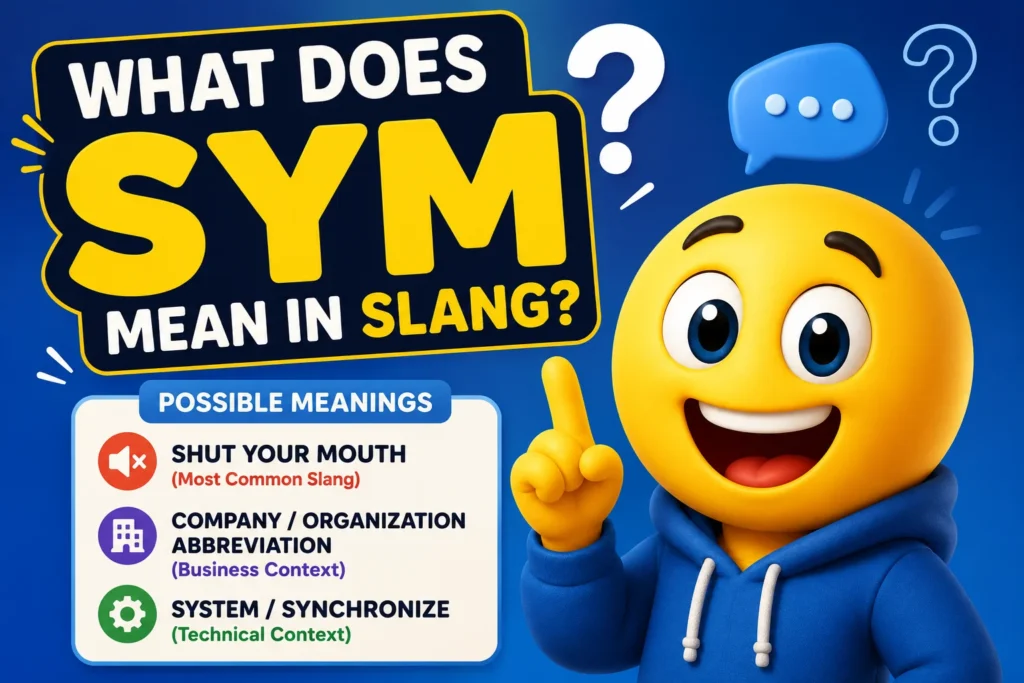
SYM most commonly means “Shut Your Mouth” in internet slang. It is used in casual texting, gaming, and social media to tell someone to stop talking—sometimes jokingly, sometimes seriously. Because SYM also has non-slang meanings, many people search for it to understand what it means in context.
While “Shut Your Mouth” is the primary slang meaning, SYM can also stand for unrelated technical or business terms outside casual conversation. In online chats, however, the slang meaning is by far the most common.
What Does SYM Mean in Slang?
The most widely recognized slang meaning of SYM is:
SYM = Shut Your Mouth
It’s a shorthand expression people type instead of writing the full phrase.
Unlike abbreviations such as LOL (“Laugh Out Loud”), SYM is typically used as a reaction during conversations rather than to describe an emotion.
Examples:
- “Bro, SYM 😂”
- “No way… SYM!”
- “You actually won? SYM.”
Depending on tone, it can mean:
- “You’re joking!”
- “Stop talking!”
- “I don’t believe you!”
- “Be quiet for a second.”
The context determines whether it’s playful or rude.
Is SYM an Acronym, Abbreviation, or Slang?
SYM is an acronym used as internet slang.
Each letter represents a word:
- S = Shut
- Y = Your
- M = Mouth
People use it to type faster during casual conversations.
It should not be confused with professional abbreviations that also use the letters SYM.
Other Meanings of SYM
Outside social media and texting, SYM may have completely different meanings depending on the industry.
Examples include:
- Company abbreviations
- Technical project names
- Educational abbreviations
These meanings are not related to internet slang.
If you see SYM in a message between friends, it almost always means “Shut Your Mouth.”
How SYM Is Used on Different Platforms
TikTok
TikTok users often write SYM in comment sections after seeing surprising or unbelievable videos.
Examples:
- “SYM 😂 that’s insane.”
- “Bro really did that… SYM.”
It usually expresses disbelief rather than genuine anger.
Snapchat
Snapchat conversations are casual and fast-paced, making SYM fairly common among younger users.
Examples:
- “You met them?? SYM.”
- “Stop lying 😂 SYM.”
On Instagram, you’ll mostly see SYM in:
- Comments
- DMs
- Story replies
Example:
“SYM, you’re actually famous now.”
Friends may use SYM while joking in group chats.
Example:
“SYM 😂 I know you’re making that up.”
X (formerly Twitter)
Although less frequent than on TikTok or Snapchat, SYM appears in replies reacting to shocking news, sports highlights, or viral posts.
Example:
“SYM. No one expected that ending.”
Real Chat Examples
Example 1 – Friends
A: I won free concert tickets.
B: SYM. Seriously?
A: I’m not kidding.
B: That’s incredible.
Example 2 – Gaming
A: I beat the boss without taking damage.
B: SYM 😂
A: Check the replay.
B: Okay, now I’m impressed.
Example 3 – Snapchat
A: Guess who texted me today.
B: Who?
A: My old teacher.
B: SYM.
Example 4 – Instagram DM
A: My video hit one million views.
B: SYM!
A: I’m serious.
B: Congrats!
Example 5 – Siblings
A: Mom said you have to clean my room too.
B: SYM 😂 Nice try.
A: Worth a shot.
B: Not happening.
Example 6 – Workplace Friends
A: I accidentally replied all to the email.
B: SYM… please tell me you’re joking.
A: I wish I was.
B: That’s rough.
Example 7 – Sports Chat
A: We scored in the last second.
B: SYM!
A: Watch the replay.
B: That’s unbelievable.
Example 8 – Family Group
A: Grandpa wants to learn TikTok dances.
B: SYM 😂
A: He’s serious.
B: I need to see this.
Example 9 – College Friends
A: The exam got canceled.
B: SYM!
A: Just got the email.
B: Best news today.
Example 10 – Travel Chat
A: Our flight got upgraded.
B: SYM.
A: I’m sending a picture.
B: Wow
Tone Variations
Funny
A: I ate the whole pizza myself.
B: SYM 😂
A: Zero regrets.
B: That’s impressive.
Sarcastic
A: I’m definitely starting my homework early.
B: SYM.
A: You don’t believe me?
B: Not even a little.
Playful
A: I can beat you in chess.
B: SYM 😄
A: Want to play?
B: You’re on.
Serious
A: I think you’re spreading rumors.
B: SYM and let me explain.
A: Okay, I’m listening.
B: Thanks.
Grammar and Language Role
Part of Speech
SYM functions as an interjection or stand-alone expression.
It replaces the full command:
“Shut your mouth.”
Sentence Position
It commonly appears:
- At the beginning
- As an entire message
- At the end of a sentence
Examples:
- SYM 😂
- Bro, SYM.
- You actually won? SYM.
Can It Replace a Full Sentence?
Yes.
Someone may simply reply:
SYM
The listener understands it from context.
Formal vs Informal
| Situation | Appropriate? |
|---|---|
| Friends | ✅ Yes |
| Group chats | ✅ Yes |
| Gaming | ✅ Yes |
| Social media | ✅ Yes |
| Business emails | ❌ No |
| School assignments | ❌ No |
How to Reply to SYM
Funny Reply
“I can’t… it’s too good not to say!”
Serious Reply
“I’m telling the truth.”
Flirty Reply
“You’d miss hearing from me though 😉”
Neutral Reply
“Okay.”
Comparison Table
| Term | Meaning | Usage Context | Tone | Popularity | Confusion Risk |
|---|---|---|---|---|---|
| SYM | Shut Your Mouth | Texting, gaming | Playful/Serious | Medium | Medium |
| STFU | Shut the f*** up | Arguments | Aggressive | Very High | Low |
| HUSH | Be quiet | Everyday speech | Gentle | Medium | Low |
| IDC | I don’t care | Casual texting | Neutral | Very High | Low |
| FR | For real | Agreement | Friendly | Very High | Medium |
| SPEAK | Continue talking (opposite idea) | Encouragement | Positive | Low | Medium |
Who Uses SYM?
Ages 13–19
Teenagers are the most frequent users, especially in chats with close friends.
Ages 20–35
Young adults may use it humorously in memes, gaming communities, and private messages.
Adults Over 35
Less common.
Many prefer writing the full phrase instead.
Gen Z vs Millennials
Gen Z
- Uses SYM more often.
- Common in meme culture.
- Frequently paired with laughing emojis.
Millennials
- Usually recognize it.
- Less likely to use it regularly.
- May choose “LOL stop” or “Seriously?” instead.
Regional Usage
There is no reliable evidence that SYM belongs to one English-speaking country. It appears across online communities in the:
- United States
- United Kingdom
- Canada
- Australia
- Global English-speaking social media
Its popularity depends more on internet culture than location.
Origin and Internet Culture
SYM emerged as part of the broader trend of shortening common phrases for texting and online chat. As SMS messaging, instant messengers, and gaming platforms encouraged faster communication, users began turning longer expressions into initialisms. While “Shut your mouth” has been a familiar English phrase for decades, abbreviating it to SYM became practical in digital conversations.
Unlike slang rooted in AAVE (African American Vernacular English) or a specific internet subculture, SYM does not have a documented cultural origin. Instead, it developed organically through online shorthand.
Today, it appears most often in reaction-based conversations—especially when someone shares surprising news, an unbelievable achievement, or a humorous story. On TikTok and Snapchat, it is often paired with laughing emojis to soften the phrase, making it sound more like “No way!” than an actual command to be quiet.
Is SYM Rude or Offensive?
It can be.
The phrase “Shut your mouth” is stronger than simply saying “be quiet.” Whether it feels offensive depends on the relationship between the people involved and the tone of the conversation.
Is it profanity?
No.
SYM does not contain profanity or explicit language. However, it can still sound impolite if used toward someone you don’t know well.
Is it appropriate at school or work?
Generally, no.
Even though the acronym hides the full phrase, it’s still based on a command that can come across as disrespectful. In professional or academic settings, it’s better to respond politely instead of using SYM.
Real-World Observation
One reason SYM has remained recognizable is that it often communicates surprise more than hostility. Among close friends, replying with “SYM 😂” usually means, “I can’t believe what you just said!” rather than “Be quiet.” Emojis, punctuation, and the relationship between the speakers play a huge role in how it’s interpreted. Without those cues, the exact same acronym can seem much harsher, which is why many people avoid using it in conversations with coworkers, teachers, or people they don’t know well.
Frequently Asked Questions
What does SYM mean in texting?
In texting, SYM usually means “Shut Your Mouth.” People often use it as a humorous reaction to surprising or unbelievable news. The tone depends heavily on the conversation and the people involved.
Is SYM rude?
It can be. Between close friends, it’s often playful and not intended as an insult. However, using it with strangers or in formal settings may come across as disrespectful.
Is SYM the same as STFU?
No. While both expressions tell someone to stop talking, STFU is much stronger because it includes profanity. SYM is generally considered milder, though it can still sound blunt.
Can I use SYM on TikTok?
Yes. It’s commonly seen in TikTok comments and replies, especially when reacting to funny or unbelievable videos. Most users understand it as an exaggerated expression of surprise.
Is SYM popular with Gen Z?
Yes. Gen Z is more likely than older generations to recognize and use SYM in casual online conversations, especially on messaging apps and social media.
Does SYM have other meanings?
Yes. Outside internet slang, SYM can stand for various technical, educational, or business-related abbreviations. In casual texting, however, it almost always refers to “Shut Your Mouth.”
Should I use SYM in professional messages?
No. Because it can sound dismissive or rude, it’s better to avoid SYM in workplace emails, customer communication, or conversations with teachers.
What does SYM stand for in slang?
It stands for “Shut Your Mouth.” The phrase is commonly used in texting as a reaction to surprising or unbelievable statements rather than as a literal command.
What does SYM mean on Snapchat?
On Snapchat, SYM usually expresses disbelief, excitement, or playful teasing. Friends often pair it with emojis to make the tone clear.
Is SYM offensive?
Not inherently. The acronym itself isn’t offensive, but the underlying phrase can sound impolite depending on how it’s used and who receives it.
What is the difference between SYM and STFU?
SYM is a shortened version of “Shut Your Mouth,” while STFU includes explicit profanity. STFU is generally considered much more aggressive.
Can SYM be used as a joke?
Yes. Many people use it jokingly when reacting to exciting news, funny stories, or unexpected achievements. Tone and context are essential.
Is SYM still popular?
It remains recognizable in texting and social media, although it is less common than major abbreviations like LOL, OMG, or FR.
Conclusion
SYM most commonly means “Shut Your Mouth” in slang. Although it can sound like an instruction to be quiet, it’s often used among friends to express disbelief, amusement, or surprise rather than genuine annoyance. As with many internet abbreviations, context determines whether it feels playful or rude.
Usage Tips
- Use SYM only in casual conversations with people who understand your tone.
- Pair it with emojis if you want to emphasize humor.
- Remember that not everyone recognizes the acronym.
- Consider spelling out your reaction if clarity matters.
Common Mistakes
- Assuming SYM always means anger.
- Using it in professional or academic communication.
- Confusing it with unrelated technical abbreviations.
- Forgetting that context changes how it’s interpreted.
When to Use It
Use SYM in friendly texts, gaming chats, or social media conversations where playful teasing is appropriate. Avoid it in workplace communication, school assignments, customer service interactions, or conversations where it could be misunderstood.