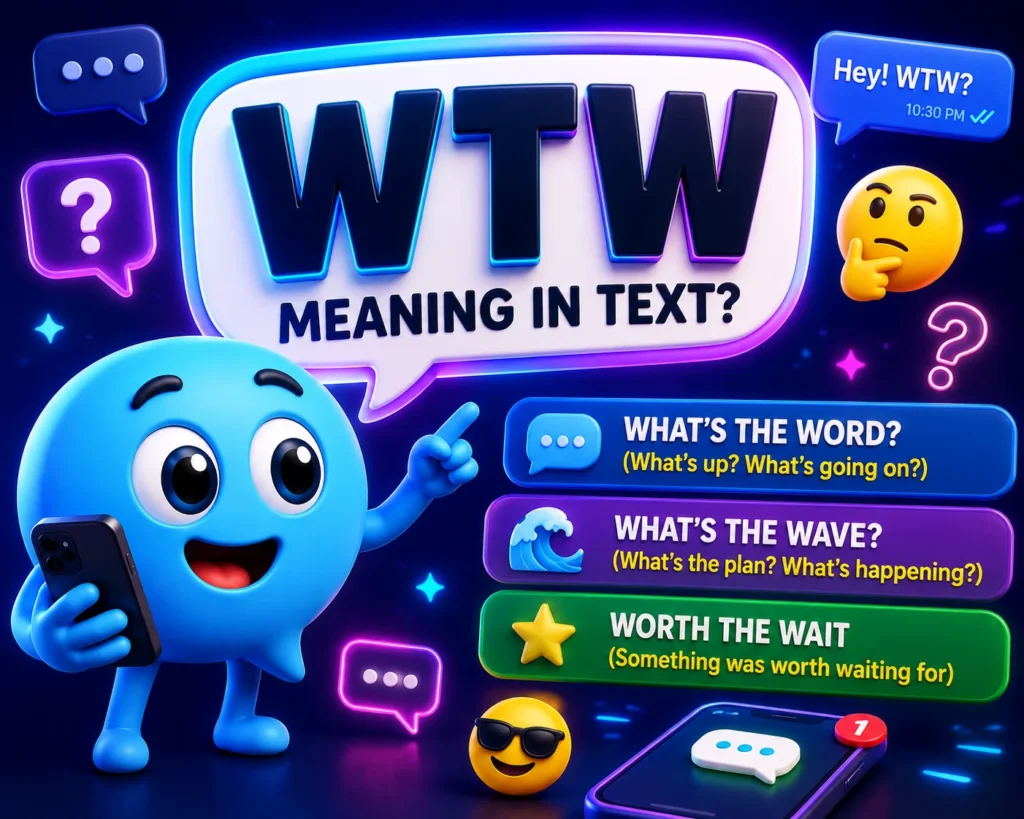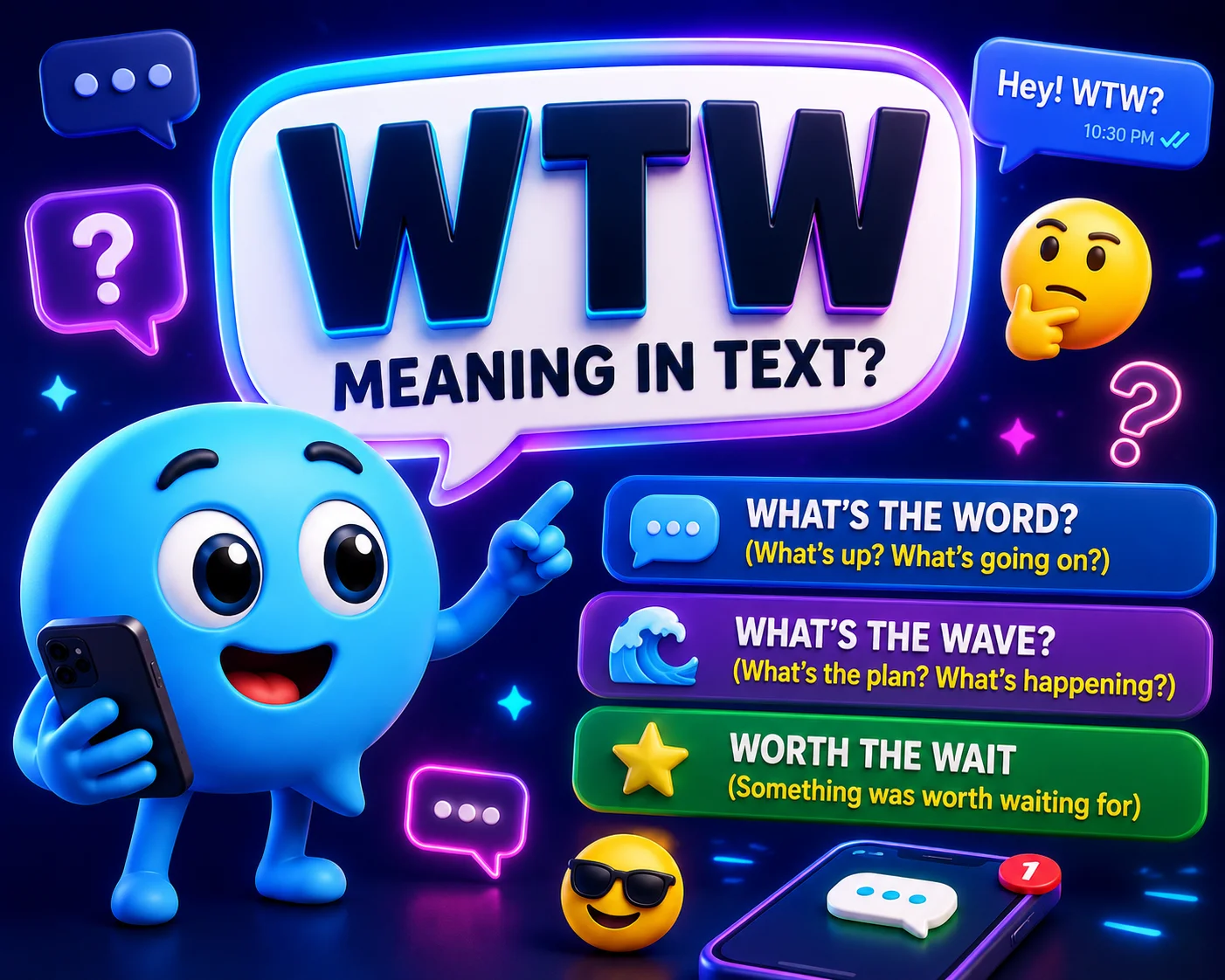
If someone texts WTW, it most commonly means “What’s the Word?”—a casual way of asking what’s going on, what you’re doing, or whether you have plans. That’s what this means when someone texts it to you in most conversations.
People search “WTW meaning in text” because the abbreviation can be confusing if you’ve never seen it before. While “What’s the Word?” is by far the most common texting meaning, WTW can also mean “What’s the Wave?” in some friend groups or, less commonly, “Worth the Wait.” The surrounding conversation almost always tells you which meaning is intended.
What Does WTW Mean in Text?
In texting, WTW usually stands for “What’s the Word?”
It is a slang abbreviation used to:
- Ask what’s happening
- Check if someone is free
- Start a conversation
- Ask about plans
- Find out what’s new
It’s similar to asking:
- What’s up?
- What’s going on?
- What are you doing?
- Any plans?
- What’s happening?
For example:
A: WTW?
B: Just got home. You?
Here, WTW simply means:
“What’s up?”
or
“What are you doing?”
What Does This Mean When Someone Texts It to You?
When someone sends WTW, they’re usually trying to start a conversation.
Depending on the situation, they may be asking:
- What are you doing right now?
- Do you have plans?
- Are you available?
- What’s going on?
- Want to hang out?
Unlike a yes-or-no question, WTW invites an open response.
For example:
A: WTW tonight?
B: Nothing planned yet.
Here the sender wants to know whether you’re free later.
Another example:
A: WTW? Haven’t talked in a while.
B: Just been busy with work.
In this case, the abbreviation is simply a friendly check-in.
Is WTW an Acronym, Abbreviation, or Slang?
WTW is best described as a slang abbreviation.
Although many people casually call it an acronym, it’s primarily used as shorthand for informal spoken phrases.
The most common expansion is:
WTW = What’s the Word?
Other genuine expansions include:
- What’s the Wave?
- Worth the Wait (less common in texting)
The intended meaning depends on context.
Read More: LG Meaning Slang: The Hidden Meaning Most People Miss
All Genuine Meanings of WTW
1. What’s the Word? (Most Common)
This is the meaning you’ll encounter most often in text messages.
“What’s the Word?” is an informal greeting that asks what’s happening or whether someone has plans.
Examples:
- WTW today?
- WTW tonight?
- WTW this weekend?
It’s commonly used among friends before making plans.
2. What’s the Wave?
Some people use WTW to mean:
What’s the Wave?
Here, “wave” means the plan, the move, or what everyone is doing.
Examples:
- WTW after class?
- WTW for tonight?
Although the wording differs, the practical meaning is very similar to “What’s the Word?”
Both ask:
- What’s happening?
- What’s the plan?
- Where’s everyone going?
3. Worth the Wait
Less commonly, WTW can mean:
Worth the Wait
Example:
That movie was WTW.
Meaning:
That movie was worth the wait.
This use is much less common than the first two meanings in everyday texting.
Which Meaning Is Most Common?
For personal text conversations, “What’s the Word?” is overwhelmingly the most common interpretation.
If someone simply sends:
WTW?
They’re almost certainly asking:
- What’s up?
- What’s going on?
- What are you doing?
- Any plans?
Unless the conversation is specifically discussing whether something was delayed, you generally shouldn’t assume “Worth the Wait.”
Why Is WTW So Popular?
WTW has become popular because it’s:
- Quick to type
- Easy to recognize
- Friendly
- Flexible
- A natural conversation starter
Instead of writing:
What are you doing tonight?
Someone can simply send:
WTW tonight?
The abbreviation feels relaxed without sounding abrupt.
Where Is WTW Used?
SMS and iMessage
Traditional texting is where many people first encounter WTW.
Friends often send:
WTW?
as the first message of the day.
It usually means:
What’s going on?
or
Are you free?
On WhatsApp, WTW has the same meaning.
People use it when:
- Checking in
- Making plans
- Starting conversations
- Asking what’s happening
Example:
WTW after work?
Instagram Direct Messages
Instagram DMs frequently contain WTW, especially after someone replies to a Story.
Examples:
WTW tonight?
WTW this weekend?
The abbreviation often leads into making plans.
Snapchat Chats
Snapchat conversations naturally favor short abbreviations.
Examples:
WTW rn?
Here, rn means right now, making the full question:
What’s going on right now?
or
What are you doing right now?
Discord Direct Messages
Among gaming friends and online communities, WTW often asks whether someone wants to join an activity.
Example:
WTW? Hop on.
Meaning:
What’s going on? Want to play?
Is WTW Written Differently Across Platforms?
The meaning stays consistent across messaging platforms.
You’ll commonly see:
- wtw
- WTW
- Wtw
Capitalization does not change the meaning.
People also combine it with other texting abbreviations:
- WTW rn
- WTW later
- yo wtw
- ayoo wtw
These combinations simply provide additional context.
Grammar and Language Role
Part of Speech
WTW functions as an interrogative phrase in texting.
It replaces longer questions such as:
- What’s going on?
- What’s up?
- What are your plans?
Sentence Position
Most commonly, WTW appears at the beginning of a conversation.
Examples:
WTW?
WTW tonight?
It can also appear within a sentence.
Example:
Hey, WTW after work?
Although this is less common than using it as the opening message.
Can WTW Stand Alone?
Yes.
A single message saying:
WTW?
is perfectly natural.
The recipient immediately understands that the sender is asking what’s happening or whether they’re available.
Can It Replace a Full Sentence?
Absolutely.
Instead of writing:
What are you doing today?
Someone may simply send:
WTW?
The abbreviation communicates essentially the same idea.
Capitalization
Both forms are common:
- wtw
- WTW
Lowercase usually feels more casual because many people don’t capitalize text messages.
Uppercase makes the abbreviation slightly more noticeable but does not change its meaning.
Typed Alone or Embedded?
Both are common.
Typed alone:
WTW?
Embedded:
Hey, WTW later?
Lmk WTW tonight.
Formal or Informal?
WTW is entirely informal.
It’s appropriate when texting:
- Friends
- Family
- Partners
- Classmates
- Close coworkers who already communicate casually
It’s generally not appropriate in:
- Business emails
- Professional messaging
- Academic writing
- Customer communication
In those situations, writing out the full question is clearer and more professional.
WTW in Different Tones
Although WTW usually means “What’s the Word?”, the tone changes based on who sends it and why they’re asking. It can be playful, curious, sarcastic, or genuinely concerned.
Funny
Friends often use WTW to start a conversation with a joke.
A: WTW?
B: Trying to convince my cat to pay rent.
A: Any luck?
B: He’s pretending not to hear me.
Sarcastic
Sometimes WTW is used after something unexpected happens.
A: WTW? You disappeared for three days.
B: I was “taking a quick nap.”
A: That’s one legendary nap.
B: I needed it.
Playful
Many people send WTW when they’re hoping to make plans.
A: WTW tonight?
B: Nothing yet. Why?
A: Bowling?
B: Sounds fun.
Serious
The abbreviation can also be a genuine check-in.
A: Hey, WTW? Haven’t heard from you lately.
B: Just dealing with some family stuff.
A: I’m here if you need to talk.
B: Thanks, I appreciate it.
Real Chat Examples
These examples show how WTW appears naturally in everyday text messages and DMs.
1. Friends Planning the Weekend
A: WTW Saturday?
B: I’m free after lunch.
A: Want to go downtown?
B: Sure.
2. Romantic Partners
A: WTW tonight? ❤️
B: I was hoping we’d grab dinner.
A: That sounds perfect.
B: I’ll make a reservation.
3. Classmates
A: WTW after class?
B: Heading to the library.
A: Mind if I join?
B: Not at all.
4. Siblings
A: WTW?
B: Just watching a movie.
A: Save me some popcorn.
B: No promises.
5. Coworkers Who Text Casually
A: WTW after work?
B: A few of us are getting coffee.
A: I’ll come too.
B: Great.
6. Parent and Teen
Parent: WTW? Are you still at practice?
Teen: Yeah, we’re almost done.
Parent: I’ll pick you up in twenty minutes.
Teen: Thanks.
7. Gaming Friends
A: WTW tonight?
B: Ranked matches?
A: I’m ready whenever you are.
B: Give me ten minutes.
8. New Friend
A: Hey! WTW this weekend?
B: Nothing planned yet.
A: Want to check out the new café?
B: I’d like that.
9. Cousins
A: WTW for the holiday?
B: Everyone’s meeting at Grandma’s.
A: I’ll be there around noon.
B: See you then.
10. Neighbor
A: WTW this evening?
B: Just relaxing outside.
A: Want to take a walk?
B: Sure.
11. College Roommates
A: WTW after finals?
B: Road trip?
A: I’m in if everyone else is.
B: Let’s plan it tonight.
How to Reply to WTW
There isn’t a single perfect response. It depends on what you’re doing and what kind of conversation you want to have.
Funny Reply
Just trying to survive Monday.
or
Fighting with my alarm clock.
Serious Reply
I’m working right now. What’s up?
or
Just spending time with family.
Flirty Reply
If the conversation already has a flirty tone, you could reply:
Waiting for you to make plans. 😉
or
Hoping you’d text me.
Neutral or Unbothered Reply
Nothing much. You?
or
Just relaxing.
These responses feel natural and help keep the conversation going.
WTW Compared With Similar Texting Terms
| Term | Meaning | Usage Context | Tone | Popularity | Confusion Risk |
|---|---|---|---|---|---|
| WTW | What’s the Word? / What’s the Wave? | Asking what’s happening or what the plans are | Casual | Very High | Medium |
| WYD | What You Doing? | Asking what someone is doing right now | Casual | Very High | Low |
| WSP | What’s Up? | Casual greeting or conversation starter | Friendly | High | Low |
| HMU | Hit Me Up | Asking someone to contact you | Casual | High | Low |
| HBU | How About You? | Returning a question | Friendly | High | Low |
| TTYL (opposite conversational purpose) | Talk To You Later | Ending a conversation rather than starting one | Friendly | High | Low |
The biggest difference is that WTW often asks about plans or what’s happening, while WYD focuses more specifically on what someone is doing at that moment.
Who Uses WTW?
Teenagers (13–18)
Teenagers use WTW frequently in text messages and group chats to see who’s available or what everyone is doing. It’s especially common before making weekend or evening plans.
Young Adults (18–30)
College students and young professionals commonly use WTW as a quick conversation starter. It appears in one-on-one texts, group chats, and direct messages when checking whether friends are free.
Adults Over 30
Many adults recognize WTW, but they may prefer writing “What’s up?” or “What are you up to?” instead. Those who regularly text younger family members or participate in online communities are more likely to use the abbreviation themselves.
Gen Z vs. Millennials
Gen Z
Gen Z tends to use WTW naturally alongside abbreviations like:
- WYD
- WSP
- LMK
- FR
- NGL
Messages are often short and lowercase:
wtw later
Millennials
Millennials generally understand WTW, but many still type longer questions like:
What’s up?
or
What are you doing tonight?
They’re slightly less likely to rely on abbreviations in every conversation.
Regional Usage
The texting meaning of WTW is most common in the United States, where it appears regularly in SMS, iMessage, and messaging apps. Through online communication and gaming communities, it’s also recognized by many English speakers in Canada and other countries.
The expansion “What’s the Wave?” is more regional and less universally recognized than “What’s the Word?”, but both are used to ask about plans or what’s happening. Regardless of the wording, the conversational purpose is nearly identical.
Where People Actually Use WTW
You’ll most often see WTW in:
- SMS and iMessage — asking friends what they’re doing or whether they’re free.
- WhatsApp — making plans and starting conversations.
- Instagram DMs — checking in after replying to Stories or continuing a chat.
- Snapchat Chats — quick, informal conversations.
- Discord Direct Messages — inviting friends to play games or join voice chat.
Across these platforms, WTW consistently functions as a casual conversation starter.
Origin and Internet Culture
WTW grew out of the broader culture of SMS and instant messaging abbreviations that became widespread in the late 1990s and early 2000s. As texting became faster and more conversational, users shortened common phrases to save time and reduce typing.
The spoken expression “What’s the word?” has existed for decades in informal English as a friendly greeting meaning “What’s happening?” or “What’s new?” Over time, texters reduced it to WTW, making it even quicker to type.
The related phrase “What’s the wave?” emerged in some communities as another way of asking about plans or what everyone is doing. Its abbreviation naturally became WTW as well.
AAVE and Informal Speech
The spoken greeting “What’s the word?” has appeared in various communities for many years, including in some African American Vernacular English (AAVE) contexts. As with many conversational expressions, its use spread through everyday speech and digital communication. In mainstream texting today, most people simply interpret WTW as an informal way to ask “What’s up?” or “What are the plans?”
Role in Internet Culture
Unlike slang that becomes popular because of a single meme or viral trend, WTW gained popularity through everyday conversations. Its usefulness as a quick, friendly conversation starter has helped it remain common across texting apps, even as new slang continues to emerge.
Is WTW Rude or Offensive?
In most conversations, WTW is not rude or offensive. It’s simply an informal way of asking “What’s the Word?” or “What’s the Wave?”—both of which mean something similar to “What’s up?” or “What are the plans?”
Like many texting abbreviations, whether it feels polite depends more on who you’re texting and the context than on the abbreviation itself.
Is It Profanity or Explicit?
No.
WTW does not contain profanity, explicit language, or offensive wording. It’s considered safe for everyday casual texting.
Is It Appropriate for School or Work?
Generally, WTW is best reserved for informal conversations.
It’s appropriate when texting:
- Friends
- Family
- Classmates
- Partners
- Close coworkers who already communicate casually
It’s better to avoid WTW when messaging:
- Your boss
- A teacher
- A client
- Someone you don’t know well
In professional settings, writing “Do you have any plans?” or “Are you available?” is clearer and more appropriate.
Cultural Sensitivity
The abbreviation itself is not culturally sensitive or offensive. While the spoken phrase “What’s the word?” has been used in different English-speaking communities, including some AAVE contexts, WTW is now widely recognized as a general internet texting abbreviation. Using it respectfully in casual conversations is unlikely to cause misunderstandings.
Real-World Observation
One reason WTW has remained popular is that it works as both a greeting and an invitation. Instead of asking a narrow question like “What are you doing?”, it gives the other person room to respond however they like. Someone might answer with their current activity, their weekend plans, or simply “Not much.” That flexibility makes WTW feel natural in texting, especially when friends are deciding whether to hang out, join a game, or just catch up. Unlike many slang terms that fade quickly, WTW continues to be useful because it fits everyday conversation rather than a short-lived trend.
Frequently Asked Questions
What does WTW mean in a text message?
In a text message, WTW most commonly means “What’s the Word?” It’s an informal way of asking what’s happening, what someone is doing, or whether they have plans. In some conversations, it can also mean “What’s the Wave?”, which asks about the plan or where everyone is going.
Is WTW the same as WYD?
Not exactly.
WYD means “What You Doing?”, focusing on what someone is doing at that moment. WTW is broader and often asks what’s happening, what the plans are, or whether someone is free. Although people sometimes use them interchangeably, WTW usually invites a wider conversation.
Is it rude to reply with just “WTW” in a text?
No, especially among friends. Sending “WTW?” by itself is a common way to start a casual conversation. However, if you’re texting someone for the first time or in a professional setting, adding a greeting or a little more context is usually more polite.
What’s the difference between texting WTW and saying it out loud?
When spoken, “What’s the word?” relies on tone and body language to sound friendly or enthusiastic. In text, readers interpret WTW based on the surrounding messages. Adding words like “WTW tonight?” or “Hey, WTW?” often makes your intent even clearer.
Does WTW mean the same thing in a group chat versus a 1-on-1 text?
The meaning stays the same, but the purpose often changes. In a one-on-one conversation, WTW usually asks one person what they’re doing or whether they’re available. In a group chat, it’s more likely to ask what everyone is planning or suggest making plans together.
Can WTW be used in formal conversations?
It’s generally better not to. Because WTW is a casual texting abbreviation, some people may not recognize it, and it can sound too informal in professional communication. Writing out your question is clearer and more appropriate.
Why do people text WTW instead of typing the full question?
People use WTW because it’s quick, familiar, and easy to type. Like many texting abbreviations, it saves time while still conveying the intended meaning. It also matches the fast, conversational style of messaging apps.
Can WTW have other meanings?
Yes. While “What’s the Word?” is the most common texting meaning, WTW can also stand for “What’s the Wave?” or, less commonly, “Worth the Wait.” Looking at the surrounding conversation almost always reveals which meaning is intended.
What does WTW mean on WhatsApp?
On WhatsApp, WTW almost always means “What’s the Word?” People use it to ask what you’re doing, whether you’re free, or if you want to make plans. The meaning is the same as it is in SMS and iMessage.
What should I reply when someone texts WTW?
A natural reply depends on your situation. You might respond with “Just relaxing. You?”, “I’m at work right now.”, or “Nothing much—what’s up?” If you’re free, mentioning your availability can help keep the conversation moving.
Is WTW mostly used by Gen Z?
Yes, WTW is especially popular among Gen Z because it fits the fast-paced style of modern texting. Millennials also recognize it, although many are more likely to type longer phrases such as “What’s up?” or “What are you up to?”
Conclusion
If you’re searching for the WTW meaning in text, the answer is usually simple. In most text messages, WTW stands for “What’s the Word?”—a casual way of asking what’s happening, what you’re doing, or whether you’re available. In some conversations, it may also mean “What’s the Wave?”, while “Worth the Wait” is a much less common texting meaning.
The easiest way to understand WTW is to look at the surrounding conversation. In everyday messaging, it’s almost always a friendly conversation starter rather than something complicated.
Usage Tips
- Use WTW with friends, family, and other casual contacts.
- Reply naturally by saying what you’re doing or sharing your plans.
- Read the context before assuming which meaning is intended.
- Keep it informal, since it’s designed for everyday texting.
Common Mistakes
- Assuming WTW always means “Worth the Wait.”
- Confusing WTW with WYD, even though they ask slightly different questions.
- Using WTW in formal workplace or academic communication.
- Ignoring the surrounding conversation, which usually explains the intended meaning.
When to Use WTW
Use WTW when:
- You’re starting a casual conversation.
- You’re asking whether someone is free.
- You’re making plans with friends.
- You’re chatting through text messages or DMs.
Avoid WTW when:
- Writing professional emails.
- Messaging your boss, teacher, or client.
- Communicating with someone unfamiliar with texting abbreviations.
- A formal tone is expected.