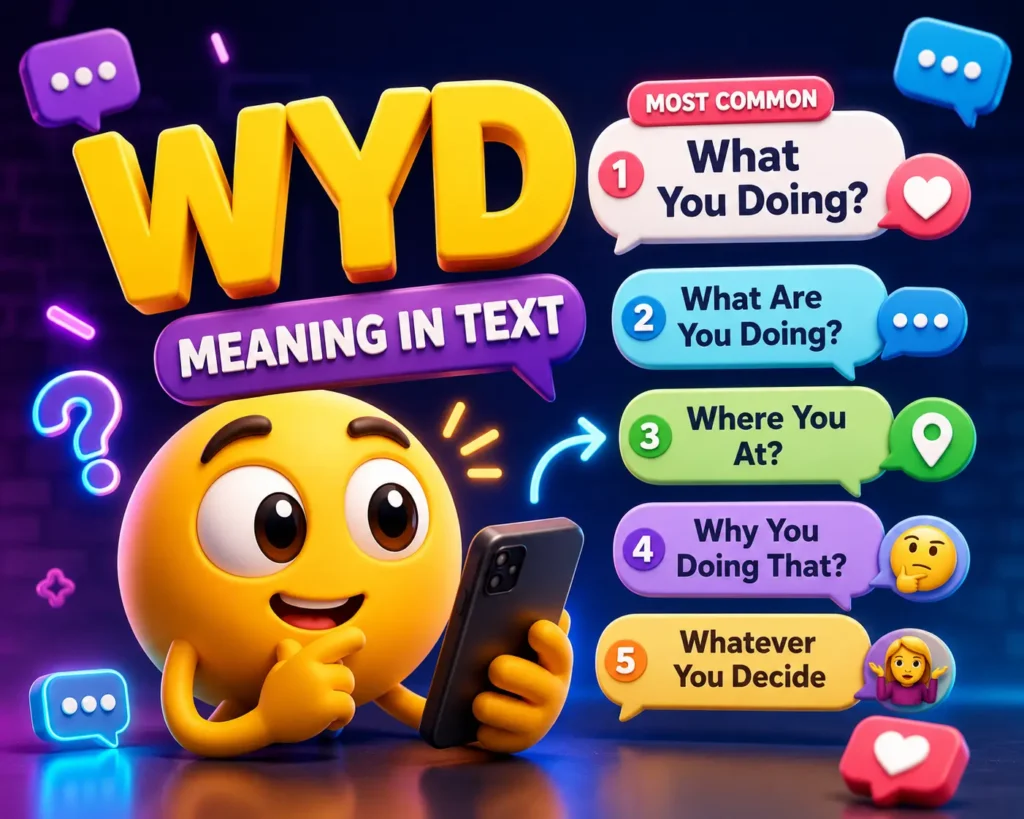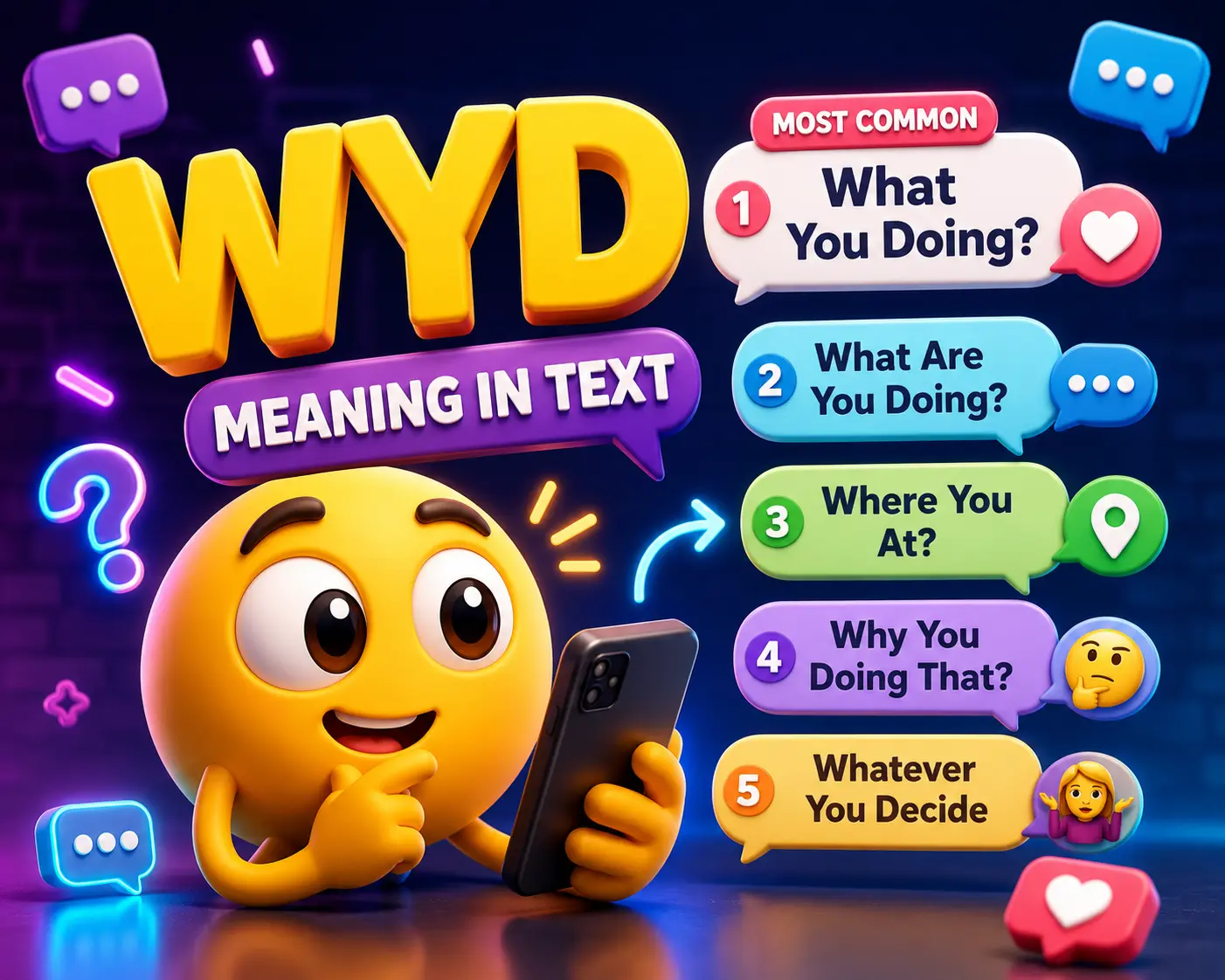
WYD most commonly means “What You Doing?” (or “What Are You Doing?”) in text. When someone texts you WYD, they’re usually asking what you’re doing right now, starting a conversation, or seeing if you’re available to chat or make plans.
Because it’s one of the most common texting abbreviations, many people search for “WYD meaning in text” after receiving it in a message from a friend, crush, coworker, or someone they’ve just met online. While the core meaning stays the same, the tone can range from casual and friendly to playful or even flirty depending on the conversation.
What Does WYD Mean in Text?
WYD is a texting abbreviation and internet slang acronym that stands for:
What You Doing?
In standard English, it translates to:
What are you doing?
The abbreviation drops the word “are” to make the message quicker to type, which is common in texting.
For example:
A: WYD?
B: Just watching Netflix.
Or:
A: WYD later tonight?
B: Nothing planned yet.
In both examples, the sender simply wants to know what the other person is doing.
What Does This Mean When Someone Texts It to You?
When someone sends WYD, they’re usually trying to:
- Start a conversation
- Check if you’re busy
- See whether you’re free to hang out
- Continue an existing chat
- Show interest in talking
The exact intention depends on your relationship with the sender and the surrounding conversation.
Is WYD an Acronym, Abbreviation, or Slang?
WYD is best described as a texting abbreviation and internet slang acronym.
- Full form: What You Doing?
- Standard English: What are you doing?
- Category: Texting shorthand
- Formality: Informal
Although the expanded phrase isn’t grammatically complete by formal writing standards, it’s widely understood in casual digital communication.
All Genuine Meanings of WYD
Unlike some abbreviations with many competing definitions, WYD has one overwhelmingly dominant meaning.
1. What You Doing? (Most Common)
This is the meaning you’ll encounter almost every time.
Examples:
- WYD?
- Hey, wyd?
- wyd rn?
- WYD after work?
- wyd tonight?
In each case, the sender is asking about your current or upcoming activity.
2. What Are You Doing? (Standard English Interpretation)
Some people mentally expand WYD to the grammatically complete version:
What are you doing?
The meaning doesn’t change.
For example:
Text:
WYD?
Equivalent to:
What are you doing?
Does WYD Have Other Meanings?
Outside texting, WYD can occasionally represent organization names, project abbreviations, or technical shorthand in specific industries. However, these are unrelated to internet slang.
If you’re reading a personal message, SMS, WhatsApp chat, or social media DM, WYD almost always means “What You Doing?”
Read More: WTM Meaning in Text: What It Really Means & How to Reply
Where Is WYD Used?
SMS and iMessage
Traditional texting is where WYD became especially popular.
People often send it as a conversation starter because it’s short, casual, and easy to reply to.
Examples:
- WYD?
- wyd rn?
- wyd later?
These messages usually expect a simple answer rather than a long explanation.
On WhatsApp, WYD carries exactly the same meaning.
Friends, classmates, family members, and coworkers may use it when checking in or making spontaneous plans.
Examples include:
- WYD this afternoon?
- Hey, wyd?
- WYD after class?
The abbreviation is common in one-on-one chats and smaller group conversations.
Instagram DMs
In Instagram direct messages, WYD often opens a new conversation.
Someone might reply to your story with:
WYD?
Or:
Hey, wyd tonight?
It’s especially common among younger users chatting casually.
Snapchat
Snapchat conversations are fast and informal, making WYD one of the platform’s most recognizable abbreviations.
You’ll often see messages like:
- wyd 👀
- wyd rn
- wyd lol
The meaning remains identical.
Discord
Discord users frequently type WYD while chatting with gaming friends or online communities.
Examples:
- WYD after this match?
- wyd rn?
- WYD this weekend?
It’s usually a casual conversation starter rather than gaming-specific slang.
X (formerly Twitter)
WYD occasionally appears in replies, quotes, and casual conversations on X, though it’s less common than in private messaging. When it does appear, it still means “What You Doing?” and follows the same informal usage as text messages.
How Is WYD Usually Written?
The abbreviation is remarkably consistent.
You’ll commonly see:
- WYD
- wyd
- Wyd
All three mean exactly the same thing.
Does Capitalization Change the Meaning?
No.
These all carry the same definition:
- WYD
- wyd
- Wyd
However, capitalization can slightly affect tone.
Lowercase (wyd)
Feels relaxed and conversational.
Uppercase (WYD)
May feel slightly more emphatic or simply reflect someone’s typing habits.
Common Variations
You’ll frequently see WYD combined with other abbreviations:
- wyd rn (What are you doing right now?)
- wyd later
- wyd today
- hey wyd
- so wyd
These aren’t different meanings—just natural extensions of the original phrase.
Tone and Context Variations
Although WYD always asks what someone is doing, the emotional tone changes depending on context.
Friendly
A: Hey! WYD?
B: Just making dinner.
A: Nice! Hope it turns out great.
B: Thanks!
Funny
A: WYD?
B: Trying to convince my cat that 3 a.m. isn’t breakfast time.
A: 😂 Any luck?
B: Absolutely not.
Playful
A: WYD tonight?
B: Waiting for someone to invite me out.
A: Perfect timing then.
B: I was hoping you’d say that.
Serious
A: WYD after work?
B: Visiting my grandmother at the hospital.
A: I hope everything goes well.
B: Thank you, I appreciate it.
Grammar and Language Role
Understanding how WYD functions grammatically helps explain why it’s so common in texting.
Part of Speech
WYD functions as an abbreviated interrogative question. It replaces the full sentence:
“What are you doing?”
Sentence Position
It most often appears:
- As an entire message
- At the beginning of a conversation
- Before making plans
- After greeting someone
Examples:
- WYD?
- Hey, wyd?
- WYD after school?
- So, wyd this weekend?
Can WYD Stand Alone?
Yes.
In fact, WYD is most commonly sent as a complete standalone message.
Example:
A: WYD?
B: Just got home.
No additional words are necessary because the abbreviation is universally understood in casual texting.
Can It Appear Mid-Sentence?
Yes.
Examples:
- I was going to ask, wyd tonight?
- Just wondering, wyd after class?
- Hey, tell me what you’re up to—wyd?
Although standalone use is most common, embedding it within a sentence sounds perfectly natural in informal chats.
Formal vs. Informal Register
WYD is highly informal.
It’s appropriate for:
- Friends
- Family
- Dating conversations
- Classmates
- Online gaming friends
- Social media DMs
Avoid using it in:
- Business emails
- Professional messaging
- Academic writing
- Job applications
- Formal customer communication
In those situations, writing “What are you doing?” or another complete question is more appropriate.
Real Chat Examples
Here are realistic examples showing how WYD appears in everyday text conversations. Each conversation reflects a different relationship and situation.
1. Friends Making Plans
A: WYD after work?
B: Nothing yet. Why?
A: Want to grab burgers?
B: Sure, I’m in.
2. Talking to a Crush
A: Hey 😊 wyd?
B: Just watching a movie. You?
A: Thinking about texting you.
B: Well, good choice.
3. Family Conversation
A: WYD right now?
B: Finishing my homework.
A: Dinner will be ready in 20 minutes.
B: I’ll be downstairs soon.
4. Coworkers
A: WYD after the meeting?
B: Working on the quarterly report.
A: Can we review it together later?
B: Absolutely.
5. Gaming Friends
A: WYD tonight?
B: Probably playing Valorant.
A: Save me a spot.
B: You got it.
6. Siblings
A: WYD in my room? 😂
B: Looking for the charger.
A: Ask next time.
B: Sorry!
7. New Online Friend
A: Hey, wyd?
B: Just relaxing after work.
A: Same here. Busy day?
B: Very busy.
8. Long-Distance Relationship
A: WYD rn? ❤️
B: Just got home from class.
A: Want to video call?
B: Give me five minutes.
9. Parent and Teen
A: WYD?
B: At Emma’s house.
A: Don’t forget to be home by nine.
B: I won’t.
10. Neighbor
A: Hey, wyd this afternoon?
B: Cleaning the garage.
A: Need an extra pair of hands?
B: That would be great.
11. Classmates
A: WYD before the exam?
B: Reviewing my notes.
A: Mind if I join you?
B: Not at all.
How to Reply to WYD
Since WYD simply asks what you’re doing, your reply can be as short or detailed as you’d like.
Funny Reply
Trying to remember why I walked into this room. 😂
Serious Reply
I’m finishing some work right now. I’ll text you later.
Flirty Reply
Waiting for you to message me. 😊
Neutral Reply
Just relaxing at home. What’s up?
WYD vs Similar Texting Terms
| Term | Meaning | Usage Context | Tone | Popularity | Confusion Risk |
|---|---|---|---|---|---|
| WYD | What You Doing? | Conversation starter | Casual | Very High | Low |
| WYA | Where You At? | Asking location | Casual | High | Medium |
| HBU | How About You? | Continuing conversation | Friendly | High | Low |
| SUP | What’s Up? | Greeting | Casual | High | Low |
| HMU | Hit Me Up | Invitation to contact | Friendly | High | Medium |
| BRB (opposite context) | Be Right Back | Leaving conversation briefly | Neutral | High | Low |
Who Uses WYD?
Age Groups
Gen Z (approximately ages 13–28)
Gen Z uses WYD extremely frequently in texting, Snapchat, Instagram DMs, Discord, and group chats. It’s often the first message sent to begin a conversation or invite someone to hang out.
Millennials (approximately ages 29–45)
Millennials also use WYD, especially in personal texting and messaging apps. However, they may alternate between the abbreviation and the full phrase “What are you doing?” depending on the situation.
Older Adults
Older generations generally understand WYD but are less likely to use it regularly unless they frequently text younger family members.
Regional Usage
United States
The abbreviation is extremely common across virtually all texting platforms and age groups.
United Kingdom
WYD is widely recognized, although some users simply type the full question instead.
Canada and Australia
Usage is very similar to the United States, especially among younger users.
Global English
Because English internet slang spreads quickly through messaging apps, WYD is understood by English speakers in many countries.
Platform Breakdown
SMS and iMessage
This remains one of the most common places you’ll encounter WYD.
People send it to:
- Start conversations
- Ask if someone is free
- Check on friends
- Make spontaneous plans
WhatsApp users employ WYD exactly the same way as SMS.
Typical examples include:
- WYD?
- wyd rn?
- WYD later tonight?
Instagram DMs
Instagram users often send WYD after viewing someone’s Story or when starting a private conversation.
It usually serves as an easy icebreaker.
Snapchat
Snapchat conversations tend to be brief and casual, making WYD one of the platform’s most common abbreviations.
Discord
Among gaming friends and online communities, WYD is commonly used before starting games, joining voice chat, or simply checking who’s available.
X (formerly Twitter)
WYD occasionally appears in replies and casual conversations, but it’s far more common in direct messaging than in public posts.
Origin and Internet Culture
Where Did WYD Come From?
WYD originated during the rise of SMS texting in the late 1990s and early 2000s. Mobile phones had character limits and numeric keypads, encouraging users to shorten common phrases.
“What are you doing?” naturally became:
- What you doing?
- WYD
The abbreviation spread long before TikTok existed.
Evolution of WYD
As smartphones and messaging apps became popular, WYD moved from basic SMS into:
- Facebook Messenger
- Snapchat
- Instagram DMs
- Discord
- iMessage
Its meaning has remained remarkably consistent over time.
Unlike many internet slang terms, WYD hasn’t shifted dramatically. It still means exactly what it did years ago.
Internet Culture
Today, WYD is often viewed as one of the easiest conversation starters online.
Many memes jokingly portray someone sending:
“wyd?”
late at night to begin a conversation, flirt, or see if another person is awake.
Despite these jokes, the phrase itself remains neutral. Whether it’s friendly, romantic, or purely practical depends entirely on context.
Safety and Appropriateness
Is WYD Rude?
No.
On its own, WYD is neither rude nor disrespectful.
Tone comes from the surrounding conversation rather than the abbreviation itself.
Does It Contain Profanity?
No.
WYD contains no offensive language.
Can You Text It to a Teacher or Boss?
Generally, no.
Because it’s informal internet shorthand, it’s better to write:
“What are you doing later?”
or another complete sentence when communicating professionally.
Cultural Sensitivity
There are no known cultural or offensive meanings associated with WYD in standard English texting.
It is considered safe for everyday casual communication.
Real-World Observation
One reason WYD has remained popular for more than two decades is its flexibility. Unlike abbreviations with very specific meanings, WYD works in almost any casual conversation. Friends use it to check in, partners use it to start chatting, classmates use it before studying together, and family members use it to see if someone is available. In real texting, it’s less about the literal question and more about opening the door to a conversation. Sometimes the sender genuinely wants to know what you’re doing; other times, they’re simply looking for an excuse to talk.
Frequently Asked Questions
What does WYD mean when someone texts you?
When someone texts WYD, they almost always mean “What You Doing?” or “What are you doing?” They’re asking about your current activity or checking whether you’re free to chat. Depending on your relationship, it can also be a casual way to start a conversation or make plans.
Is WYD flirting?
Sometimes, but not always.
If a friend texts WYD, it’s usually just a casual question. However, when a crush or romantic interest sends “WYD?”, especially in the evening or late at night, it can be a way to keep the conversation going or express interest. The surrounding messages provide the real clue.
Can WYD mean anything else?
In everyday texting, WYD almost always means “What You Doing?” Although the letters may represent different phrases in technical, business, or organizational contexts, those meanings are unrelated to internet slang. If you receive WYD in a personal message, the texting meaning is almost certainly the correct one.
Is WYD still popular?
Yes.
Despite being one of the oldest internet abbreviations, WYD remains extremely common on SMS, WhatsApp, Instagram DMs, Snapchat, Discord, and other messaging apps. Its simplicity has helped it remain relevant even as new slang terms appear.
Should I answer WYD with just one word?
You can.
Replies like “Working,” “Relaxing,” “Driving,” or “Nothing much” are completely natural. If you’d like to continue the conversation, it’s often better to answer the question and ask one back, such as “Just watching TV. What about you?”
Is WYD appropriate in professional conversations?
Generally, no.
Because WYD is informal texting shorthand, it’s best reserved for friends, family, and casual conversations. In professional settings, writing the full question—“What are you working on?” or “What are you doing this afternoon?”—sounds more appropriate.
Does capitalization matter?
Not really.
Whether someone writes WYD, wyd, or Wyd, the meaning stays the same. Lowercase often feels more relaxed, while uppercase may simply reflect the sender’s typing style rather than any change in meaning.
Is it rude to reply with just “WYD” in a text?
Not usually.
Sending “WYD?” by itself is one of the most common conversation starters in texting. However, if you haven’t spoken to someone in a long time, adding a greeting like “Hey, WYD?” may sound friendlier.
What’s the difference between texting WYD and saying “What are you doing?” out loud?
The meaning is identical, but the style is different.
WYD is quick, informal, and designed for digital conversations. Saying “What are you doing?” aloud sounds more natural in face-to-face conversations and formal speech.
Does WYD mean the same thing in a group chat vs a 1-on-1 text?
Yes.
The definition doesn’t change. In a group chat, WYD may ask everyone what they’re doing or whether anyone wants to join an activity. In a one-on-one chat, it’s often directed at one person’s current plans or availability.
Why do people text WYD instead of saying hello?
Many people use WYD as a conversation starter because it immediately invites a response. Rather than opening with a simple greeting, asking what someone is doing naturally keeps the conversation moving.
What should I say if I don’t want to answer WYD?
You can respond politely without sharing details.
Replies like “Just keeping busy,” “Nothing much,” or “I’ll tell you later” are perfectly acceptable if you prefer to keep your plans private.
Is WYD only used by Gen Z?
No.
While Gen Z uses it frequently, Millennials and many older smartphone users also recognize and use WYD. It’s one of the few early texting abbreviations that has remained popular across multiple generations.
Conclusion
If someone texts WYD, they’re almost always asking “What You Doing?” It’s one of the most widely recognized texting abbreviations and is used to start conversations, check whether someone is available, or make plans.
Although the abbreviation is simple, its tone depends entirely on the relationship and context. A friend may use it casually, while a romantic interest might use it as a subtle way to begin chatting. Understanding WYD helps you reply naturally and avoid confusion whenever it appears in your messages.
Usage Tips
- Use WYD in casual conversations with friends, family, or people you know.
- Answer honestly but briefly if you want to keep the conversation moving.
- Pair your reply with “What about you?” to make the exchange more engaging.
- Use the full phrase instead of WYD in professional or formal communication.
Common Mistakes
- Assuming WYD is always flirtatious—it often isn’t.
- Confusing WYD with similar abbreviations like WYA or HBU.
- Using it in work emails or formal messages.
- Overthinking capitalization; WYD, wyd, and Wyd all mean the same thing.
When to Use WYD
Use WYD when:
- Chatting with friends or family.
- Starting a casual conversation.
- Seeing if someone is available.
- Making spontaneous plans.
Avoid WYD when:
- Writing business emails.
- Messaging teachers or supervisors.
- Communicating with clients or customers.
- Any situation requiring formal or professional language.