
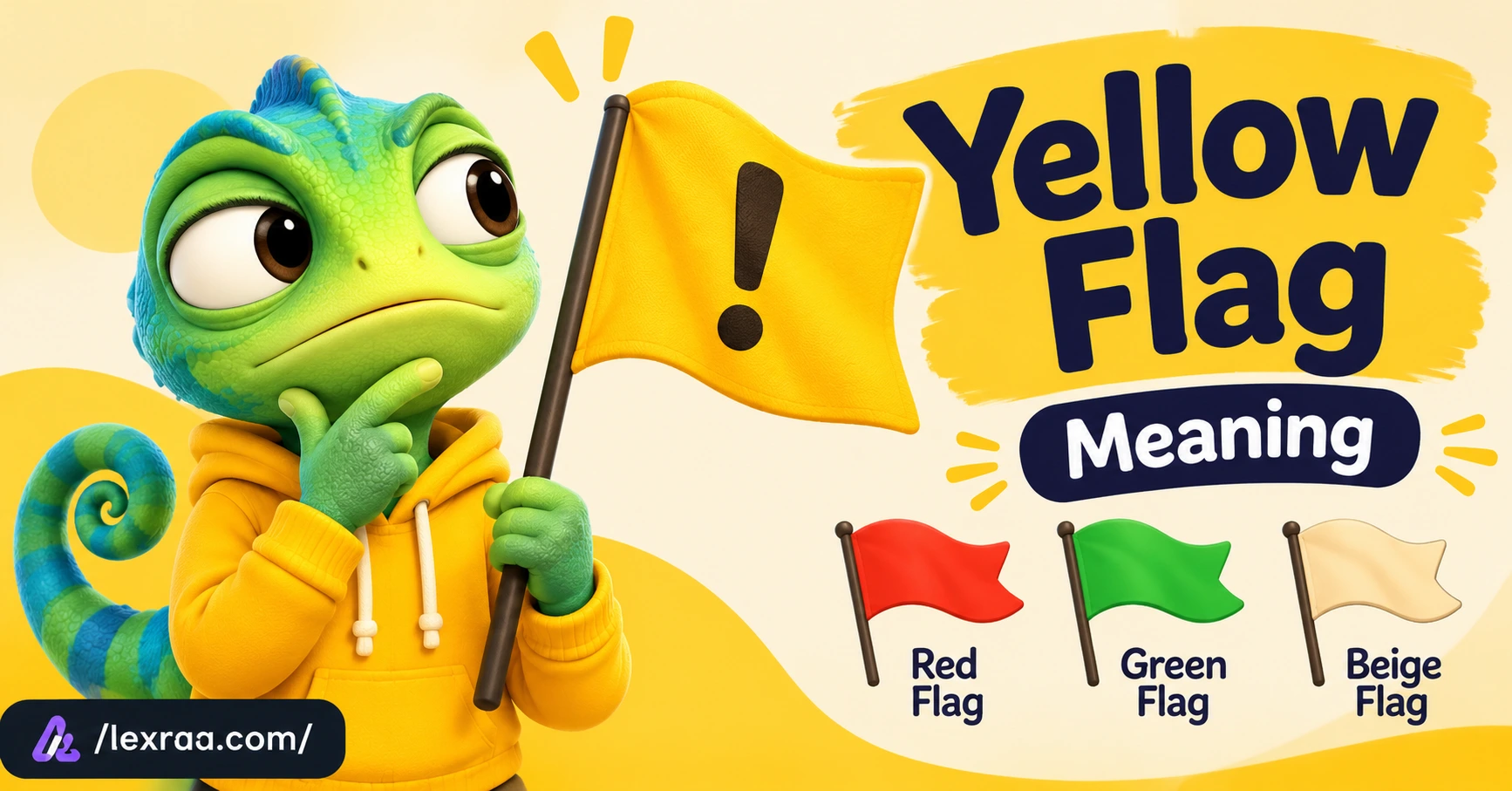
Someone says, “That’s a yellow flag,” after hearing about a date, a friend, or a partner. They are not necessarily saying the person is bad news. In slang, a yellow flag means a behavior or situation that raises a concern and deserves attention, but is not automatically a reason to walk away.
Think of it as a caution signal: slow down, notice what is happening, and find out whether it is a one-time issue or part of a bigger pattern.
The expression is especially useful in dating conversations, but people can also use it when discussing friendships, family dynamics, work situations, and other relationships.
What Does Yellow Flag Mean in Dating?
In dating, a yellow flag is a behavior that makes you pause and consider whether it could become a problem.
For example, someone might cancel a date at the last minute because of work. That may be disappointing, but it does not automatically mean they are unreliable. If they explain what happened, apologize, and arrange another date, the situation may be minor.
Now imagine they repeatedly cancel plans, never suggest another time, and expect you to keep waiting. The repeated behavior deserves more attention.
Common examples of potential yellow flags include:
- Inconsistent communication: Someone is very responsive one week and then disappears without explanation.
- Moving too quickly: A new date wants to make major relationship decisions before you have established trust.
- Difficulty discussing feelings: Someone avoids certain conversations instead of explaining why they feel uncomfortable.
- Occasional jealousy: A person makes an uncomfortable comment about your friendships but listens when you discuss it.
- Different expectations: One person wants to spend nearly every evening together, while the other needs more personal time.
- Trouble keeping plans: Someone frequently changes arrangements but makes a genuine effort to reschedule.
These are examples to consider, not automatic judgments about someone’s character. The circumstances and the person’s response matter.
Yellow Flag vs. Red Flag vs. Green Flag vs. Beige Flag
The different flag colors help people describe how they interpret someone’s behavior.
| Flag | Meaning | General tone |
|---|---|---|
| Yellow flag | A possible concern worth examining | Cautious |
| Red flag | A serious warning sign | Strongly negative |
| Green flag | A positive sign of healthy behavior | Positive |
| Beige flag | An unusual or mildly quirky habit | Neutral or humorous |
Yellow Flag vs. Red Flag
A yellow flag suggests that something needs attention. A red flag signals a more serious concern involving respect, trust, safety, or personal boundaries.
Yellow flag example: Someone occasionally struggles to communicate when stressed but is willing to talk about it afterward.
Red flag example: Someone repeatedly insults you, dismisses your boundaries, or tries to control who you spend time with.
The distinction is not simply how annoying the behavior feels. Its seriousness, repetition, and effect on your well-being matter.
Yellow Flag vs. Green Flag
A green flag is a positive quality that suggests someone may be trustworthy, respectful, or emotionally considerate.
For example:
- Green flag: They listen when you explain that something bothers you.
- Yellow flag: They sometimes interrupt you but are willing to work on it.
- Red flag: They repeatedly dismiss your feelings and refuse to respect your boundaries.
Yellow Flag vs. Beige Flag
A beige flag usually describes an unusual, quirky, or mildly irritating habit that is not necessarily positive or negative.
For example, someone might organize their books by color or always order the same meal at a restaurant. That could be a beige flag because it is simply a personal quirk.
A yellow flag is different because the behavior may affect compatibility, communication, or trust if it continues.
How to Tell Whether a Yellow Flag Is Becoming a Red Flag
One awkward moment does not tell you everything about a person. A more useful approach is to observe what happens after the concern appears.
Consider these three questions:
1. Does it happen repeatedly?
A one-time misunderstanding may be easy to resolve. The same problem happening again and again deserves closer attention.
2. Can you discuss it comfortably?
A person does not have to agree with every concern you raise. However, they should be able to listen without automatically mocking, blaming, or intimidating you.
3. Does their behavior change?
An apology matters more when it is followed by a genuine effort to do better. If someone keeps promising to change but repeats the same harmful behavior, pay attention to the pattern.
There is no official number of incidents that turns a yellow flag into a red flag. The seriousness of the behavior matters, too. Threats, coercion, violence, stalking, and controlling behavior should not be minimized as harmless yellow flags.
Example Conversations Using Yellow Flag
These conversations show how people might use the expression in different situations.
1. Funny: Friends Discussing a New Date
Maya: He said he puts ketchup on every meal.
Lena: Even pizza?
Maya: Apparently, yes. Yellow flag 😂
Lena: I think we need a full investigation.
2. Sarcastic: Group Chat
Ryan: She arrived 30 minutes late and blamed the traffic.
Chris: Was there actually traffic?
Ryan: Not according to the empty roads.
Chris: A little yellow flag there, my friend.
3. Playful: Dating Conversation
Alex: I have a confession. I watch the same movie every weekend.
Taylor: The same one? Every weekend?
Alex: Don’t judge me.
Taylor: Not a red flag, but definitely a yellow flag until I find out which movie.
4. Serious: A Couple Discussing Communication
Nora: I feel like we only talk when something goes wrong.
Ethan: I didn’t realize it felt that way.
Nora: I think we should work on communicating more regularly.
Ethan: That’s fair. I’ll make more of an effort.
5. Family: Talking About a Relative
Sam: Aunt Lisa keeps making plans without checking whether anyone is available.
Jordan: Has anyone told her?
Sam: Not properly. We should probably explain that it causes problems.
Jordan: Agreed. Yellow flag, but maybe an easy conversation can fix it.
6. Coworkers: Office Conversation
Priya: Our new teammate keeps changing the project schedule.
Daniel: Is there a reason?
Priya: Sometimes, but nobody gets told until the last minute.
Daniel: That’s worth discussing before it becomes a bigger problem.
How to Respond When Someone Calls Something a Yellow Flag
If a friend tells you that a behavior is a yellow flag, you can ask what concerns them rather than immediately agreeing or disagreeing.
Here are some natural replies:
- Funny: “Okay, but how yellow are we talking?”
- Serious: “What exactly makes you uncomfortable about it?”
- Neutral: “I can see why you’d want to pay attention to that.”
- Curious: “Do you think it’s a one-time thing or a pattern?”
- Reassuring: “Let’s see how they handle it before making a decision.”
If someone calls your own behavior a yellow flag, you can ask them to explain what they noticed. It gives you an opportunity to understand their perspective without treating every criticism as a personal attack.
Does Yellow Flag Only Apply to Dating?
No. Although dating is a major context for the expression, a yellow flag can describe a possible concern in almost any interpersonal situation.
Friendships: A friend frequently cancels plans but has not explained why.
Work: A manager gives unclear instructions or changes priorities without communicating them properly.
Family: A relative repeatedly makes assumptions about your availability.
Online interactions: Someone you recently met shares personal information very quickly, making you unsure about their boundaries or intentions.
When getting to know someone online, you may also encounter WYLL meaning in text, an abbreviation used to ask what someone looks like.
The common idea is the same: something deserves attention, but you need more information before reaching a conclusion.
Where Did the Term Yellow Flag Come From?
The expression builds on the familiar idea of a flag as a warning signal.
The metaphor is older than modern dating slang. In traffic and other signaling systems, yellow commonly indicates caution rather than an immediate stop. Relationship discussions adapted that familiar idea to describe behavior that deserves a closer look.
Psychologist Roger Kreuz, writing for Psychology Today in July 2025, identified a Reddit discussion titled “What is a ‘yellow flag’ for you in relationships?” in the r/AskWomen community as an early documented example from February 2015.
A July 2024 New York Times article titled “Slow Down if You See These Dating ‘Yellow Flags’” also shows how the expression had become recognizable in mainstream relationship discussions.
There is no verified single person credited with inventing the modern dating expression. Its development appears to be connected to the wider use of red and green flags when discussing relationship behavior.
Positive relationship signals can also involve appreciation and admiration. See WCW meaning in text to understand how people celebrate women they admire.
Is Yellow Flag a Slang Term or an Acronym?
Yellow flag is an informal expression, not an acronym or texting abbreviation. It does not stand for a longer phrase.
People use it as a metaphor to describe a possible warning sign. You may see it in a sentence such as:
- “His reaction was a yellow flag.”
- “That’s a yellow flag for me.”
- “I’m noticing a few yellow flags.”
- “It’s not a red flag yet, but I’d pay attention.”
The expression can also be used literally in sports, racing, and other settings where a yellow flag communicates caution. That literal meaning is separate from its relationship slang use.
Is Yellow Flag Rude or Negative?
Calling something a yellow flag is not necessarily insulting. It usually communicates caution rather than a final judgment.
However, the phrase can sound critical when directed at someone personally. Saying “That behavior is a yellow flag” focuses on a specific action, while saying “You’re a walking yellow flag” sounds more like a judgment about the entire person.
It is generally fine in casual conversations, social-media discussions, and informal messages. In a serious conversation, explaining the actual behavior is often clearer than relying on the label.
It is also important not to use yellow-flag language to minimize genuinely dangerous behavior. A person does not need to wait for a repeated pattern before taking threats, abuse, coercion, or serious boundary violations seriously.
Frequently Asked Questions
1. What does yellow flag mean from a girl or a guy?
The meaning is the same regardless of who uses it. It describes a behavior or situation that raises a concern but does not automatically mean someone is unsuitable as a partner. The expression does not have a separate established meaning based on gender.
2. What does it mean when someone says you’re a yellow flag?
They are saying that something about your behavior makes them pause or feel uncertain. It does not necessarily mean they dislike you or want to end the relationship. Asking which specific behavior concerned them can help clear up the misunderstanding.
3. Can a yellow flag become a red flag?
Yes. A concern can become more serious when the behavior repeats, affects trust or personal boundaries, or continues despite honest conversations. However, some yellow flags can also be resolved through communication and changed behavior.
4. Is a yellow flag a dealbreaker?
Not automatically. It is a reason to pay attention and decide whether the issue matters to your values, expectations, or well-being. Some concerns are manageable differences, while others reveal deeper incompatibilities.
5. What is the opposite of a yellow flag?
There is no exact opposite because yellow means caution rather than a completely negative or positive judgment. A green flag is the closest positive contrast, while a red flag represents a stronger warning.
6. What does a yellow flag mean on social media?
In social-media conversations, it generally has the same meaning as in dating: a behavior or situation that deserves attention. People may use it in posts, comments, and discussions about relationships. The phrase is not exclusive to one app or platform.
7. What is the difference between a yellow flag and the ick?
A yellow flag describes a possible concern about someone’s behavior or compatibility. The ick describes a sudden feeling of lost attraction or discomfort, often triggered by a habit or mannerism. Something can give you the ick without indicating a serious relationship problem.
Final Thoughts
The yellow flag meaning in slang is simple: something deserves attention, but it is not automatically a dealbreaker. It encourages people to slow down, consider the circumstances, and look at what happens next.
The biggest mistake is treating every awkward moment as proof that someone is a bad partner. Pay attention to repeated behavior, communicate your concerns, and take serious safety issues seriously. A yellow flag should encourage thoughtful judgment, not unnecessary suspicion.




1 thought on “Yellow Flag Meaning: What It Means in Dating & Texts”