
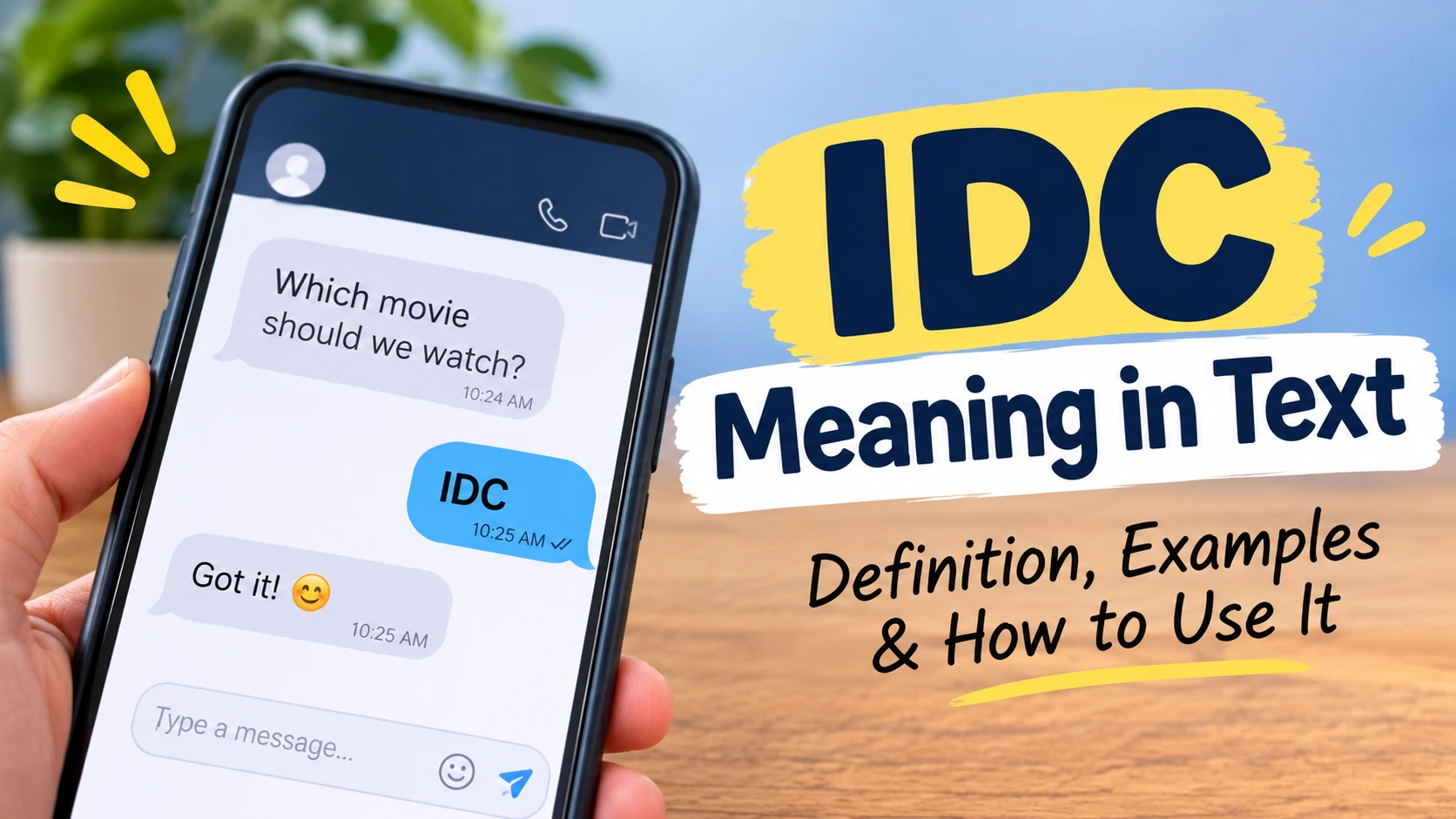
IDC means “I Don’t Care” in text messages and online conversations. It is a common internet abbreviation people use to show that something does not matter to them or that they have no particular preference. Depending on the conversation, IDC can sound casual, indifferent, or dismissive.
What Does IDC Mean in Text?
IDC is an informal initialism formed from the first letters of “I Don’t Care.” People use it in text messages, direct messages, and online conversations when they want to express indifference, show that they have no preference, or indicate that something does not interest them.
For example:
Friend 1: Which movie should we watch tonight?
Friend 2: IDC, you choose.
Here, IDC means the person is happy to let their friend decide.
However, the expression does not always sound friendly. A short response like “IDC” during a serious conversation can make someone feel ignored or dismissed. The surrounding conversation, relationship, and wording help determine its intended tone.
What Does IDC Stand For?
IDC stands for I Don’t Care. It is an abbreviation commonly classified as an internet initialism because people read its individual letters rather than pronounce it as a word.
You may encounter it in different written forms:
- IDC: The uppercase version, often used for emphasis.
- idc: The lowercase version, commonly seen in casual messages.
- Idc: A capitalized version that may appear at the beginning of a sentence.
All three generally communicate the same message.
Different Ways People Use IDC
Although the basic definition stays the same, IDC can communicate different attitudes depending on the situation.
1. Showing That You Have No Preference
Sometimes, people genuinely do not mind which option someone chooses. They use IDC to let the other person make the decision.
For example:
Person A: Should we order pizza or burgers?
Person B: idc, both are fine.
In this situation, the response is casual. The person is not annoyed; they simply have no particular preference.
2. Showing Disinterest
IDC can also indicate that someone is not interested in a particular subject, discussion, or situation.
For example:
Person A: Everyone is talking about the latest celebrity drama.
Person B: IDC about their personal lives.
Here, the person is making it clear that celebrity gossip does not interest them.
3. Expressing a Strong or Defiant Attitude
People sometimes use IDC to show that other people’s opinions will not influence their decisions.
For example:
Person A: Your friends might not like your new hairstyle.
Person B: IDC what they think. I like it.
The expression communicates confidence and independence rather than a lack of information.
4. Sounding Dismissive During an Argument
In a disagreement, IDC can become a blunt response that suggests someone does not want to consider the other person’s feelings or opinions.
For example:
Person A: I spent hours trying to help you with this project.
Person B: IDC anymore. Do whatever you want.
Here, IDC sounds dismissive because the conversation involves something important to the other person.
Real-Life Examples of IDC in Text Conversations
Understanding IDC becomes easier when you see how people use it in everyday conversations. Here are five examples with different situations and tones.
Example 1: Making weekend plans
CASUAL CONVERSATION
Alex: Do you want to go shopping on Saturday or Sunday?
Mia: idc, whichever day works for you.
Meaning: Mia has no preference and is leaving the decision to Alex.
Example 2: Talking about gossip
SHOWING DISINTEREST
Jake: Did you hear what happened between Sam and Olivia?
Ryan: IDC about their drama lol.
Meaning: Ryan is not interested in discussing other people’s personal matters.
Example 3: Responding to criticism
CONFIDENT TONE
Emma: Some people might not like your new profile picture.
Lily: IDC. I think it looks great!
Meaning: Lily does not want other people’s opinions to influence her choice.
Example 4: A disagreement between friends
FRUSTRATED TONE
Noah: You should at least listen to what I’m trying to explain.
Ethan: IDC right now. I’m done arguing.
Meaning: Ethan is frustrated and does not want to continue the discussion.
Example 5: Choosing a place to eat
FRIENDLY GROUP CHAT
Sophie: Italian or Mexican food for dinner?
Olivia: idc 😂 surprise me!
Meaning: Olivia is happy with either choice and wants Sophie to decide.
If someone says “Whatever You Want,” they are giving you the choice; see [WYW meaning in text] for how this expression differs from IDC.
IDC vs. Similar Texting Abbreviations
IDC is sometimes confused with other texting abbreviations because several expressions communicate uncertainty, indifference, or a lack of interest.
However, their meanings are not interchangeable.
| Term | Meaning | Tone | Popularity | Confusion Risk |
|---|---|---|---|---|
| IDC | I Don’t Care | Casual to dismissive | Common | Low |
| IDK | I Don’t Know | Neutral | Common | High |
| IDM | I Don’t Mind | Friendly, flexible | Recognized | High |
| IDGAF | I Don’t Give a F*** | Strong, blunt | Recognized | Medium |
| NVM | Never Mind | Neutral or dismissive | Common | Low |
| I Care | Opposite of I Don’t Care | Concerned, interested | Ordinary phrase | Low |
Popularity descriptions are qualitative, not measured search or usage rankings.
IDC vs. IDK
The difference between IDC and IDK is particularly important.
- IDC: I Don’t Care. You are expressing indifference.
- IDK: I Don’t Know. You are expressing uncertainty or a lack of information.
For example:
- “IDC where we go.” means the destination does not matter to you.
- “IDK where we are going.” means you do not know the destination.
One expresses an attitude, while the other expresses a lack of knowledge.
IDC vs. IDM
IDC and IDM are close in meaning, but they do not communicate exactly the same attitude.
- IDC (I Don’t Care): Something does not matter to you.
- IDM (I Don’t Mind): You are comfortable with an option and have no objection.
For example:
“IDC what we watch” can sound indifferent, while “IDM what we watch” sounds more accommodating.
This distinction is particularly useful when responding to invitations or making plans. If you want to sound friendly rather than uninterested, IDM is often the better choice.
IDC vs. IDGAF
Both expressions communicate a lack of concern, but IDGAF is considerably stronger because it contains profanity.
IDC is generally suitable for informal conversations, whereas IDGAF can sound aggressive or offensive depending on the audience.
IDC vs. NVM
These expressions serve different purposes.
- IDC: Communicates that something does not matter to you.
- NVM: Means “Never Mind” and is used to withdraw a question, request, or previous statement.
For example:
“IDC which movie we watch” expresses no preference.
“NVM, I found the movie” means the person no longer needs help.
Is IDC Rude in Text Messages?
IDC is not automatically rude, but it can sound blunt depending on the conversation.
The important distinction is between expressing flexibility and dismissing someone’s feelings.
Consider these situations:
| Situation | Example | How It Sounds |
|---|---|---|
| Choosing food | IDC, you pick! | Relaxed |
| Discussing gossip | IDC about that drama. | Uninterested |
| Responding to criticism | IDC what they think. | Confident |
| During an argument | IDC what you’re saying. | Dismissive |
| Discussing someone’s feelings | IDC, do whatever you want. | Potentially hurtful |
If someone asks you to choose between two restaurants, IDC might be perfectly understandable.
However, if a friend shares something personal and receives only “IDC” in response, they may interpret it as a lack of concern.
A useful tip: If you mean that either option is acceptable, consider saying “I’m fine with either” or “You can choose.” These expressions communicate flexibility more clearly.
Where Is IDC Used?
IDC is an established abbreviation in digital communication. It is used in:
- Text messages: Quick conversations between friends and family.
- Social media: Informal comments and discussions.
- Direct messages (DMs): Casual conversations with other users.
- Group chats: Expressing no preference when people are making plans.
Its meaning does not fundamentally change between these settings. However, the tone can change depending on the people involved and the subject being discussed.
How Should You Reply When Someone Texts IDC?
Your response should depend on what the other person means. You do not need to treat every IDC message as negative.
Here are three natural ways to respond.
1. When they have no preference
If someone says they do not mind which option you choose, simply make the decision.
Example:
Them: IDC where we eat.
You: Okay, let’s go for pizza!
2. When they sound uninterested
If the conversation is not important to them, you can acknowledge their response without making the discussion unnecessarily complicated.
Example:
Them: IDC about that show.
You: Fair enough, let’s talk about something else.
3. When they sound upset
If someone responds with IDC during a disagreement, avoid immediately assuming what they feel. You can ask for clarification.
Example:
Them: IDC anymore.
You: Are you upset, or would you rather discuss this later?
This gives the other person an opportunity to explain their feelings.
Frequently Asked Questions
1. What does IDC mean in texting?
IDC stands for “I Don’t Care.” It is an informal abbreviation used in text messages and online conversations to express indifference or a lack of preference.
2. What does IDC mean from a girl or boy?
IDC has the same basic meaning regardless of who sends it. It stands for “I Don’t Care.” The intended tone depends on the conversation, not the sender’s gender.
3. Does IDC mean I don’t care or I don’t mind?
IDC means “I Don’t Care,” while IDM means “I Don’t Mind.” Although they can communicate similar ideas, IDM generally sounds more accommodating when discussing choices.
4. What does lowercase idc mean?
Lowercase idc has the same meaning as uppercase IDC: “I Don’t Care.” The difference is mainly a matter of writing style and emphasis.
5. Is IDC a bad word?
No. IDC is not a swear word or inherently offensive expression. However, it can sound rude or dismissive when someone uses it to disregard another person’s feelings.
6. What is the difference between IDC and IDK?
IDC means “I Don’t Care,” whereas IDK means “I Don’t Know.” IDC expresses indifference, while IDK expresses uncertainty or a lack of knowledge.
7. Can I use IDC in professional conversations?
It is generally better to avoid IDC in professional emails, formal messages, and workplace discussions. Expressions such as “Either option works for me” or “I’m happy with your decision” sound more considerate and professional.
Conclusion
IDC means “I Don’t Care” and is commonly used in informal text messages, online chats, and social media conversations. It can express anything from having no particular preference to showing disinterest or frustration.
The most important thing to remember is that IDC does not always carry a negative meaning. Its tone depends on the situation and how someone uses it.
Use it casually when talking with people who understand your communication style, but consider more thoughtful alternatives when discussing serious matters or professional decisions.




1 thought on “IDC Meaning in Text: Definition, Examples & Usage”