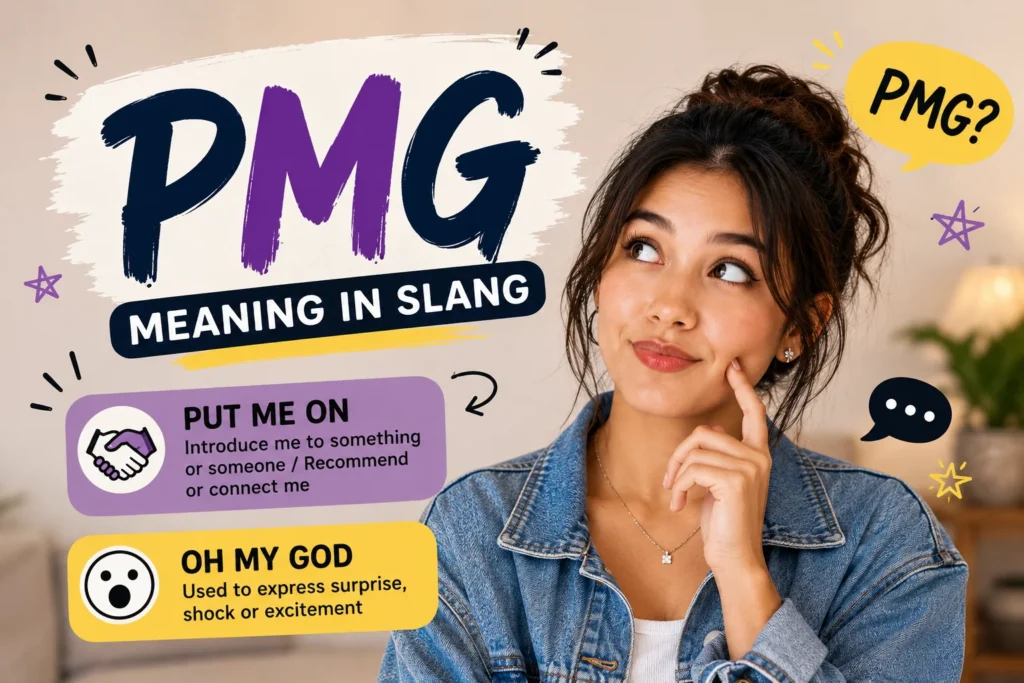
PMG most commonly means “Put Me On” or “Oh My God” in modern slang, depending on the conversation. It’s an informal abbreviation used in texting and on social media to ask for a recommendation or express surprise, excitement, or disbelief.
Many people search for “what does PMG mean in slang” after seeing it in TikTok comments, Snapchat messages, Instagram captions, or text conversations. The confusion comes from the fact that PMG has multiple meanings, including several non-slang definitions used in business, engineering, and other industries. Understanding the context is the key to interpreting it correctly.
What Does PMG Mean in Slang?
In internet slang, PMG has two genuine meanings that appear most often.
PMG = Put Me On
The most common modern slang meaning of PMG is “Put Me On.”
It is a request asking someone to:
- Recommend something
- Introduce you to someone
- Share useful information
- Help you discover something new
- Include you in an opportunity
This meaning is especially popular among younger users on social media.
Example
A: This playlist is amazing.
B: PMG!
A: I’ll send you the link.
Here, PMG means:
“Put me on.”
In other words:
“Show me where you found it.”
Another example:
A: I finally found a great sneaker reseller.
B: PMG!
A: I’ll DM you their page.
The speaker isn’t surprised—they’re asking for the recommendation.
PMG = Oh My God
Another slang meaning of PMG is “Oh My God.”
It serves the same purpose as OMG, expressing:
- Surprise
- Shock
- Excitement
- Disbelief
- Amazement
Although OMG remains far more common, some online communities and friend groups use PMG as a playful variation.
Example
A: I won front-row concert tickets!
B: PMG! That’s incredible!
Here, PMG expresses excitement.
Another example:
A: She replied after two years.
B: PMG… I wasn’t expecting that.
Which Meaning Is More Common?
Among younger social media users today, “Put Me On” is generally the more recognizable slang meaning.
You’ll often see it when someone wants:
- Music recommendations
- Restaurant suggestions
- Fashion advice
- Shopping links
- Gaming tips
- Movie recommendations
Meanwhile, “Oh My God” appears less frequently and is often limited to personal chats or niche online communities.
As with many abbreviations, the surrounding conversation usually makes the intended meaning obvious.
Is PMG an Acronym or Slang?
PMG is an acronym that functions as internet slang.
Each letter represents the first letter of a phrase.
Examples:
- Put Me On
- Oh My God (used by some communities as PMG)
Like abbreviations such as LOL, BRB, and IDK, PMG helps people communicate more quickly in casual digital conversations.
Other Meanings of PMG
Outside internet slang, PMG has several unrelated meanings.
These include:
- Business organizations
- Engineering terms
- Company names
- Government departments
- Educational abbreviations
If you encounter PMG in an email, workplace discussion, or technical document, it probably does not refer to slang.
Always consider the context before assuming its meaning.
How PMG Is Used on Different Platforms
Not every slang term appears equally across every platform. Here’s where you’re most likely to see PMG.
TikTok
TikTok is one of the biggest sources of PMG usage.
The phrase “Put Me On” commonly appears in comments asking creators to recommend:
- Songs
- Clothing brands
- Skincare products
- Restaurants
- Books
- Apps
Example:
PMG to that hoodie.
Meaning:
“Tell me where you got it.”
On Instagram, PMG appears in:
- Comment sections
- Story replies
- Fashion posts
- Food content
- Travel recommendations
Someone might comment:
PMG to this café.
They’re asking for the location or recommendation.
Snapchat
On Snapchat, PMG usually appears in private conversations between friends.
Examples include asking for:
- Music
- Gaming servers
- Streaming shows
- Shopping websites
The “Oh My God” meaning also appears occasionally when reacting to surprising snaps.
In WhatsApp chats, PMG often appears among close friends.
Examples:
- PMG to that movie.
- PMG to your barber.
- PMG, I can’t believe that happened!
Because WhatsApp conversations are personal, both meanings are easy to understand from context.
X (Formerly Twitter)
On X, Put Me On appears most often under viral posts.
Examples include:
- PMG to this artist.
- PMG to this podcast.
- PMG to the original video.
Users are asking the original poster to share the source.
Why Has PMG Become Popular?
Modern internet culture revolves around sharing discoveries.
People constantly recommend:
- New music
- Restaurants
- Fashion brands
- YouTube channels
- Streaming shows
- Productivity apps
- Hidden online stores
Instead of writing:
“Can you recommend it to me?”
many users simply type:
PMG.
It’s short, easy to understand among younger audiences, and fits naturally into fast-moving conversations on social media.
Similarly, the “Oh My God” meaning offers another quick way to react to something surprising, although OMG remains the dominant abbreviation worldwide.
Real Chat Examples of PMG in Slang
The examples below show how PMG is naturally used in conversations. Most use “Put Me On”, since that’s the more common modern slang meaning, while a few demonstrate “Oh My God.”
Example 1: Music Recommendation
A: I’ve been listening to this new artist all week.
B: PMG!
A: I’ll send you their Spotify link.
Example 2: Restaurant Suggestion
A: That burger looks incredible.
B: PMG to that place.
A: It’s called Grill House downtown.
Example 3: Fashion
A: I love your sneakers.
B: Thanks!
A: PMG. Where did you buy them?
B: I’ll text you the store.
Example 4: TikTok Video
A: This skincare routine actually worked.
B: PMG to those products.
A: I’ll post the full list.
Example 5: Gaming
A: We found an amazing Minecraft server.
B: PMG!
A: I’ll send you the invite code.
Example 6: TV Series
A: That show is seriously underrated.
B: PMG.
A: Start with episode one tonight.
Example 7: Unexpected News (Oh My God)
A: I met my favorite actor today.
B: PMG! No way!
A: I even got a photo.
Example 8: Exam Results
A: I passed every subject.
B: PMG! Congratulations!
A: Thank you!
Example 9: Shopping
A: This hoodie was only $25.
B: PMG to that website.
A: I’ll send you the link.
Example 10: Travel
A: We found a hidden beach with almost no tourists.
B: PMG!
A: I’ll share the location.
Example 11: Surprise Announcement
A: They’re bringing the concert to our city.
B: PMG! I’ve been waiting for this.
A: Tickets go on sale Friday.
PMG in Different Tones
Like many internet abbreviations, PMG changes meaning slightly depending on the mood of the conversation.
Funny
A: I accidentally ordered five pizzas.
B: PMG! 😂
A: I clicked the wrong button.
B: Best mistake ever.
Playful
A: This coffee shop has the best desserts.
B: PMG.
A: I knew you’d ask.
B: You know me too well.
Sarcastic
A: You bought another pair of shoes?
B: They were on sale.
A: PMG… another “great investment.”
B: Don’t judge me.
Serious
A: I found a free online course that helped me get certified.
B: PMG.
A: I’ll send you the details.
B: I’d really appreciate it.
Grammar and Language Role
Unlike regular vocabulary words, PMG is an acronym that functions as internet slang.
Part of Speech
PMG acts as an interjection or a standalone expression.
Depending on the meaning, it can express emotion or make a request.
Examples:
Reaction
PMG! That’s amazing.
Request
PMG to that playlist.
Sentence Position
PMG most commonly appears:
- At the beginning of a message
- As a complete reply
- At the end of a sentence
Examples:
PMG!
PMG to that song.
That looks incredible, PMG!
Can PMG Replace a Full Sentence?
Yes.
One advantage of internet abbreviations is that they often replace longer responses.
Instead of saying:
Can you recommend that to me?
People simply write:
PMG.
Likewise, instead of writing:
Oh my God!
Someone may type:
PMG!
Formal vs. Informal Register
PMG belongs almost entirely to informal communication.
| Situation | Appropriate? |
|---|---|
| Text messages | ✅ Yes |
| Snapchat | ✅ Yes |
| TikTok comments | ✅ Yes |
| Instagram DMs | ✅ Yes |
| WhatsApp chats | ✅ Yes |
| Discord | ✅ Yes |
| Work emails | ❌ No |
| Academic writing | ❌ No |
| Business presentations | ❌ No |
Because it’s slang, it’s best used only with people who understand internet abbreviations.
How to Reply to PMG
The best response depends on which meaning the sender intended.
If PMG Means “Put Me On”
Funny Reply
- “Only if you promise not to gatekeep it!”
- “You’ve got good taste—I knew you’d ask.”
- “Welcome to the club.”
Serious Reply
- “Sure, here’s the link.”
- “I’ll send you the details.”
- “Check your messages.”
Flirty Reply
- “I’ll put you on… but you owe me coffee.”
- “Only if you take me with you.”
- “Deal—but don’t forget who recommended it.”
Neutral Reply
- “No problem.”
- “I’ll send it now.”
- “Here you go.”
If PMG Means “Oh My God”
Funny Reply
- “Right?! I couldn’t believe it either.”
Serious Reply
- “It surprised me too.”
Neutral Reply
- “I know.”
- “Crazy, isn’t it?”
Comparison Table
| Term | Meaning | Usage Context | Tone | Popularity | Confusion Risk |
|---|---|---|---|---|---|
| PMG | Put Me On / Oh My God | Texting & social media | Casual | Medium | High |
| OMG | Oh My God | Reaction to surprise | Excited | Very High | Low |
| PMO | Put Me On / Pisses Me Off (context-dependent) | Social media & texting | Casual | High | High |
| LMK | Let Me Know | Asking for information | Neutral | Very High | Low |
| FYI | For Your Information | Sharing information | Neutral | High | Low |
| IDC (opposite sentiment) | I Don’t Care | Showing indifference | Casual | High | Low |
Who Uses PMG?
Teenagers (13–19)
Teenagers are the most frequent users of PMG, especially when asking for recommendations on music, fashion, gaming, or viral trends. The phrase “Put Me On” fits naturally into fast-paced conversations on social media.
Young Adults (20–35)
Young adults commonly use PMG when discussing entertainment, restaurants, travel, fitness, technology, or shopping. It is often used in group chats and comment sections where people exchange recommendations.
Adults Over 35
Older adults are generally less likely to use PMG in slang. Those who do are usually active on social media or communicate regularly with younger family members or colleagues.
Gen Z vs. Millennials
Gen Z
Gen Z primarily uses PMG to mean “Put Me On.” It has become part of online culture where discovering and sharing new content is common. You’ll often see it in TikTok comments, Instagram replies, and Discord chats.
Millennials
Millennials are more likely to recognize OMG than PMG, but many understand Put Me On through social media and music culture. Their usage is generally less frequent than Gen Z’s.
Regional Usage
The slang meaning of PMG is most commonly seen in English-speaking online communities, particularly in the United States, where expressions like “Put Me On” have become popular in casual conversation and digital culture.
Because social media spreads slang quickly, the abbreviation also appears in other English-speaking countries. However, awareness and frequency vary depending on local online communities and individual platforms.
Where You’ll Most Likely See PMG
Today, PMG appears most often on:
- TikTok
- Snapchat
- Discord
- X (formerly Twitter)
- YouTube comments
- Group chats
In most cases, the surrounding conversation makes it clear whether PMG means “Put Me On” or “Oh My God.”
Origin and Internet Culture
Unlike many internet abbreviations that have only one meaning, PMG developed through online communities where short, fast messages became the norm. Today, it is most commonly understood as “Put Me On,” while some users also use it as an alternative way of expressing “Oh My God.” The intended meaning depends entirely on the conversation.
How “Put Me On” Became Popular
The phrase “put me on” has existed in spoken English for years, meaning:
- Introduce me to something.
- Recommend something.
- Connect me with someone.
- Share your source.
As texting and social media encouraged shorter messages, many users began abbreviating the phrase to PMG in comments, group chats, and direct messages.
Instead of typing:
“Can you put me on to that artist?”
people simply write:
“PMG.”
This shorthand became especially common in discussions about:
- Music
- Fashion
- Restaurants
- Skincare
- Gaming
- Movies
- Books
- Travel destinations
The “Oh My God” Meaning
Although OMG remains the dominant abbreviation worldwide, some online communities and private chats use PMG to express surprise or excitement in a similar way.
For example:
PMG! That actually happened?
This meaning is less widespread than Put Me On, but it still appears in casual digital conversations.
PMG in Modern Internet Culture
Today’s internet thrives on sharing recommendations. Whether it’s a viral TikTok song, a hidden café, or a new clothing brand, people constantly ask others to share what they’ve discovered.
Because of this culture, PMG naturally fits into conversations where someone wants access to a recommendation rather than just reacting to it.
You’ll commonly see it beneath:
- Viral TikTok videos
- Instagram Reels
- Fashion posts
- Gaming clips
- Food reviews
- YouTube Shorts
Its simplicity makes it useful in fast-moving comment sections where users want quick replies.
Is PMG Rude or Offensive?
Generally, no.
Does PMG Contain Profanity?
No.
Neither “Put Me On” nor “Oh My God” is considered profanity in standard internet slang.
Can PMG Be Offensive?
Not by itself.
The abbreviation is usually friendly and casual. However, like any slang term, the overall tone of a conversation depends on how it’s used.
For example:
PMG to that playlist!
sounds enthusiastic and polite.
Is PMG Appropriate at School or Work?
In casual conversations, yes.
In professional settings, it’s better to use complete phrases instead of slang abbreviations.
For example:
Instead of:
PMG.
A workplace message might say:
Could you recommend it to me?
This avoids confusion, especially for people unfamiliar with internet slang.
Cultural Notes
PMG does not have a specific cultural origin tied to one country or community in the way some slang terms do. Instead, it reflects the broader internet habit of shortening common phrases for faster communication.
Because abbreviations often evolve differently across online communities, some users may recognize one meaning while others know another. Paying attention to the surrounding conversation helps prevent misunderstandings.
Real-World Observation
One reason PMG has gained traction online is that it solves a common communication need. Social media is built around discovering new music, products, creators, restaurants, and trends. Rather than asking for a full explanation every time, users can simply type “PMG” to request the source or recommendation. At the same time, some people use PMG as an emotional reaction meaning “Oh My God,” showing how internet slang often develops multiple meanings that coexist. In practice, context almost always makes the intended meaning clear.
Frequently Asked Questions
What does PMG mean in slang?
In modern slang, PMG most commonly means “Put Me On,” asking someone to recommend or share something they like. In some conversations, it can also mean “Oh My God,” expressing surprise or excitement. The correct meaning depends on the context.
Is PMG the same as OMG?
Not exactly.
Although some people use PMG to mean “Oh My God,” the much more widely recognized abbreviation is OMG. PMG is less common and may also stand for “Put Me On.”
What does “Put Me On” mean?
“Put Me On” means to introduce someone to something valuable or interesting. It could refer to a song, movie, clothing brand, restaurant, app, or even a useful contact. It’s essentially another way of saying, “Recommend it to me.”
Is PMG popular on TikTok?
Yes.
The “Put Me On” meaning appears frequently in TikTok comments where viewers ask creators to share the names of songs, products, locations, or brands featured in a video.
Is PMG formal?
No.
PMG is an informal internet abbreviation intended for texting and social media. It is generally not appropriate for business emails, academic writing, or professional presentations.
Can PMG have different meanings?
Yes.
Depending on the conversation, PMG may mean “Put Me On” or “Oh My God.” Outside internet slang, it also has many unrelated meanings in business, engineering, education, and other professional fields.
How do I reply to PMG?
If someone uses PMG to mean “Put Me On,” you can simply share the recommendation, link, or information they requested. If they mean “Oh My God,” respond naturally to their reaction, just as you would with OMG.
Should I use PMG instead of OMG?
You can, but remember that OMG is far more widely recognized. If you’re communicating with people who may not know PMG, using OMG or writing the full phrase may be clearer.
What does PMG mean on Snapchat?
On Snapchat, PMG usually means “Put Me On” when asking for recommendations, although some users use it as a reaction meaning “Oh My God.”
What does PMG mean on TikTok?
On TikTok, PMG most often means “Put Me On.” Viewers use it to ask creators where they found a product, song, outfit, or location featured in a video.
Is PMG a real slang term?
Yes.
While it is not as common as abbreviations like LOL, OMG, or BRB, PMG is a genuine internet slang abbreviation used in texting and social media.
Why does PMG have multiple meanings?
Like many abbreviations, PMG evolved in different online communities. Because the same three letters can represent more than one phrase, context determines the intended meaning.
What’s the difference between PMG and PMO?
Although they look similar, they are different abbreviations. PMG commonly means “Put Me On” or “Oh My God,” while PMO can mean “Put Me On” in some contexts or “Pisses Me Off” in others.
Is PMG still used in 2026?
Yes.
PMG continues to appear in texting, group chats, and social media, particularly when users ask for recommendations or react to surprising news.
Conclusion
PMG is a versatile slang abbreviation with two recognized meanings: “Put Me On” and “Oh My God.” While “Put Me On” is the more common modern usage, especially on TikTok and Instagram, “Oh My God” still appears in some casual conversations as an expression of surprise.
Because PMG also has many professional and technical meanings outside internet slang, context is essential. Looking at the surrounding conversation will usually make the intended definition obvious.
Usage Tips
- Use PMG in casual texts and social media conversations.
- Read the context to determine whether it means “Put Me On” or “Oh My God.”
- Use it when asking for recommendations or reacting to surprising news.
- Choose complete phrases in formal communication.
Common Mistakes
- Assuming PMG always has one meaning.
- Using it in business or academic writing.
- Confusing PMG with OMG or PMO.
- Ignoring the surrounding conversation before interpreting it.
When to Use PMG
Use PMG in friendly chats, group messages, TikTok comments, Instagram replies, and other informal online conversations where abbreviations are common.
When to Avoid PMG
Avoid using PMG in professional emails, official documents, presentations, or conversations with people who may not recognize internet slang.