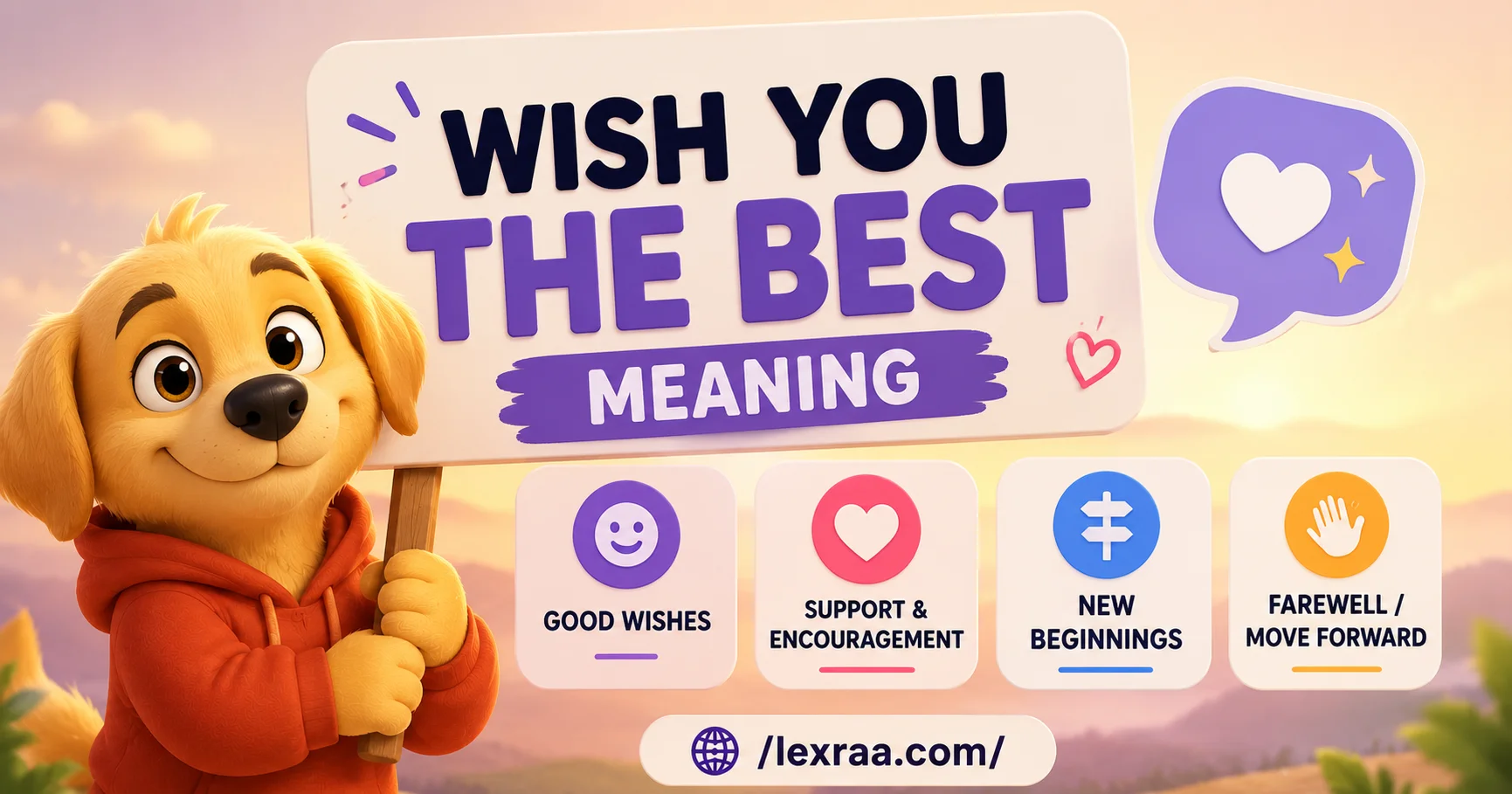
When someone says “I wish you the best,” they mean they hope good things happen to you—such as happiness, success, or good fortune. But depending on the situation, the phrase can sound warmly supportive, politely formal, bittersweet, or like a final goodbye.
That last point is why people often search for the deeper meaning behind it.
If a coworker says it after you get a new job, the message is usually straightforward encouragement. If an ex says it at the end of a breakup, however, people naturally wonder whether it means “I still care about you” or “Goodbye for good.”
The words themselves express goodwill. The context tells you how much emotional distance or closeness sits behind them.
What Does “Wish You the Best” Mean?
At its simplest, “wish you the best” means hoping that someone experiences positive outcomes in the future.
Those positive outcomes might include:
- Happiness
- Success
- Good health
- Good luck
- A successful new beginning
- Personal fulfillment
The phrase belongs to a larger group of English expressions built around wishing someone well. Cambridge defines “wish someone well” as hoping that the person will succeed, while Merriam-Webster defines “all the best” as a way of wishing someone happiness and success.
So when someone says:
“I wish you the best.”
They are essentially saying:
“I hope things go well for you.”
or:
“I hope you have a happy and successful future.”
It is a broad expression, which is exactly why the same sentence can work in a graduation card, a professional email, a friendship farewell, or a difficult breakup.
“Wish You the Best” Is Not Slang or an Acronym
Unlike expressions such as LOL, IMY, or TMI, “wish you the best” is not an acronym, abbreviation, or piece of internet slang.
It is an ordinary English expression of goodwill.
The phrase can be shortened in casual speech from:
“I wish you the best.”
to:
“Wish you the best!”
The missing “I” does not substantially change the meaning. English speakers often omit words in informal messages when the subject is obvious.
For example:
Wish you the best with everything!
This still means:
I wish you the best with everything.
The shorter version simply sounds more conversational.
The Meaning Can Change With Context
The dictionary meaning remains positive, but the social meaning can change dramatically.
Consider these three situations.
After Someone Gets a New Job
“Congratulations! I wish you the best in your new role.”
This is encouragement.
The speaker is expressing support for the person’s future success.
When Someone Moves Away
“I’m going to miss having you around. I wish you the best in your new city.”
This is warm but bittersweet.
The speaker may be sad about the separation while genuinely hoping the other person’s future goes well.
At the End of a Breakup
“I think it’s time for us to move on. I wish you the best.”
This can still be sincere—but it also functions as closure.
The speaker is expressing goodwill while making it clear that the relationship is ending.
That distinction is one of the most useful things to understand about the phrase:
Wishing someone well does not necessarily mean wanting to remain close to them.
You can genuinely hope someone has a wonderful life while deciding that your lives should no longer be connected.
What Does “I Wish You the Best” Mean After a Breakup?
After a breakup, this phrase often has more emotional weight than it does in ordinary conversation.
Usually, it communicates something like:
“I don’t want bad things to happen to you, even though our relationship is ending.”
That can be sincere and compassionate.
It can also be a polite way to close the conversation.
The phrase does not automatically mean the person wants to get back together.
This is where many interpretations go too far. People sometimes treat “I wish you the best” as a hidden romantic signal, but the words themselves do not promise future contact, reconciliation, or continued friendship.
Look at the full message.
Compare:
“I wish you the best. Please don’t contact me anymore.”
with:
“I wish you the best, and I hope someday we can be friends.”
The first clearly creates distance.
The second leaves the possibility of a future connection open.
The phrase is the same. The surrounding language changes its practical meaning.
Can an Ex Say It and Still Care About You?
Yes.
Caring about someone and wanting to continue a relationship are different things.
A person may sincerely care about your happiness while believing that the relationship is no longer healthy or workable.
At the same time, the phrase can sometimes be used because it is socially polite, even when the speaker does not feel deeply emotional about the future.
That means you should avoid two extreme assumptions:
- “They said it, so they definitely still love me.”
- “They said it, so they never cared.”
Neither conclusion can be proven from this phrase alone.
Is “Wish You the Best” Ever a Polite Goodbye?
Very often, yes.
Expressions involving “all the best” are established English farewell formulas. Cambridge notes that “all the best” can be used when saying goodbye or ending a letter, while Dictionary.com records “all the best” as an expression of best wishes and a farewell.
“I wish you the best” works in a similar way.
For example:
It was great working with you. I wish you the best.
The message is positive, but it may also signal the end of a professional relationship.
This is why the phrase can feel slightly more final than:
Good luck!
“Good luck” may refer to one specific upcoming event.
“I wish you the best” often looks further ahead, toward the person’s future in general.
Where Did the Phrase Come From?
There is no clearly documented single moment when someone invented the exact phrase “I wish you the best.”
It would be misleading to create a neat origin story for it.
The expression is built from older, established English patterns of wishing someone well, luck, happiness, or success.
The word “wish” itself has deep roots in English. The American Heritage Dictionary traces it through Middle English to Old English wȳscan, meaning to wish or desire.
Modern English dictionaries also document related constructions such as:
- Wish someone well
- Wish someone luck
- Wish someone happiness
- All the best
- Best wishes
Oxford defines “wish somebody something” as expressing the hope that someone will be happy or lucky, while Cambridge defines “wish someone well” as hoping that someone will succeed.
So the safest explanation is that “wish you the best” developed naturally from long-established English expressions of goodwill.
The exact phrase does not appear to have one identifiable creator, social-media origin, or historical event behind it.
Where Is “Wish You the Best” Used?
This expression is not tied to one app.
Unlike platform-specific internet slang, it can appear almost anywhere people communicate in English.
You may see it in:
- Text messages
- WhatsApp messages
- Instagram DMs
- Facebook messages
- Emails
- Farewell cards
- Professional messages
- Graduation messages
- Breakup conversations
Because it is standard English rather than platform-specific slang, it would be inaccurate to claim that TikTok, Snapchat, Instagram, or another app “owns” the phrase.
The wording may appear in digital communication, but its meaning does not depend on the platform.
10 Examples of “Wish You the Best” in Different Situations
1. Serious and Supportive
Mia: I’m nervous about starting the new job.
Ava: That’s completely normal.
Mia: I hope I made the right decision.
Ava: I think you’ll do great. I really wish you the best.
Here, the phrase expresses genuine encouragement.
2. Funny
Jake: I’m finally attempting to cook dinner tonight.
Sam: Should I call the fire department now?
Jake: Have some faith in me.
Sam: I wish you the best—and your kitchen even more 😂
The phrase is sincere in structure but used humorously.
3. Playful
Emma: I’m deleting social media for a whole month.
Nora: A whole month?
Emma: Yes. New me.
Nora: Bold decision. Wish you the best with that 😭
Here, the tone is playful and slightly teasing.
4. Sarcastic
Chris: I’m going to finish this entire project tonight.
Leo: You haven’t started it yet.
Chris: Details don’t matter.
Leo: Well, I wish you the best with that plan.
Tone matters here. The speaker may not genuinely believe the plan will succeed.
5. A Friend Moving Away
Daniel: I can’t believe I’m leaving next week.
Ryan: The city won’t be the same without you.
Daniel: I’ll come back to visit.
Ryan: You better. I wish you the best out there.
This combines affection with a farewell.
6. A Coworker Leaving
Sarah: Friday is my last day here.
James: We’re really going to miss you.
Sarah: I’ve loved working with everyone.
James: Congratulations on the new opportunity. I wish you the best.
This sounds professional, warm, and appropriate.
7. Family Encouragement
Son: My interview is tomorrow morning.
Mom: You’ve prepared for this.
Son: I hope you’re right.
Mom: I believe in you. I wish you the very best.
Adding “very” increases the warmth and emphasis.
8. Dating Relationship
Taylor: I don’t think we’re looking for the same things.
Morgan: I understand.
Taylor: I hope you find what you’re looking for.
Morgan: Thank you. I wish you the best too.
Here, the phrase helps end the situation respectfully.
9. A Breakup
Alex: I know this conversation is painful.
Jordan: Yeah, but I understand your decision.
Alex: I genuinely hope you’re happy.
Jordan: I wish you the best too.
The phrase communicates goodwill without necessarily suggesting future reconciliation.
10. A Group Chat Farewell
Nina: Today was my last day at university!
Group: Congratulations!!! 🎉
Nina: Thank you all for everything.
Maya: Go do amazing things. We wish you the best!
The phrase becomes collective encouragement when a group uses it.
How to Reply When Someone Says “Wish You the Best”
Your reply depends on whether the message feels encouraging, formal, emotional, or final.
A Warm Reply
Thank you so much. That really means a lot.
This works when you want to acknowledge genuine kindness.
A Reciprocal Reply
Thank you. I wish you the best too.
This is the simplest response when you want to return the goodwill.
A Professional Reply
Thank you for your kind wishes. I truly appreciate it.
This works well in a workplace or formal setting.
A Funny Reply
Thanks! I’ll need all the help I can get 😂
This keeps the conversation light.
A Neutral Reply
Thank you. I appreciate that.
This is useful when you want to be polite without making the conversation overly emotional.
After a Breakup
Thank you. I genuinely wish you happiness too.
This can acknowledge the other person’s message while maintaining maturity and closure.
“Wish You the Best” Compared With Similar Expressions
| Term | Meaning | Tone | Popularity | Confusion Risk |
|---|---|---|---|---|
| Wish you the best | Hope good things happen to you | Warm, supportive, sometimes final | Very common | Medium |
| Wish you well | Hope things go well for you | Neutral and sincere | Common | Low |
| All the best | Good wishes and success | Friendly, often farewell-like | Very common | Low |
| Best wishes | Positive hopes for someone’s future | Polite and formal-friendly | Very common | Low |
| Good luck | Hope you succeed in a specific situation | Encouraging and casual | Extremely common | Low |
| Take care | Look after yourself | Warm, sometimes farewell-like | Very common | Medium |
| I wish you ill | Hope bad things happen to someone | Hostile | Uncommon | Low |
“Wish You the Best” vs. “Good Luck”
These phrases overlap, but they are not identical.
Good luck is often connected to a specific event:
Good luck on your exam!
Wish you the best is broader:
I wish you the best in your future.
The second phrase can include happiness, success, relationships, health, and general life outcomes.
“Wish You the Best” vs. “Take Care”
“Take care” focuses more on the person’s immediate well-being.
“I wish you the best” focuses more broadly on what happens next in their life.
Both can function as farewells, which is why they sometimes appear together:
Take care, and I wish you the best.
Is “Wish You the Best” Sincere or Fake?
It can be either—but the phrase alone cannot tell you which.
This is an important distinction that generic explanations often miss.
A person can sincerely say:
“I wish you the best.”
and genuinely hope your life goes well.
Another person may use exactly the same phrase because it is a socially appropriate way to end an uncomfortable conversation.
Language does not give us direct access to someone’s private feelings.
Instead, look at:
- Their relationship with you
- What happened before they said it
- The rest of their message
- Their actions
- Whether the conversation is ending
- Their usual communication style
Context can suggest sincerity, but it cannot guarantee it.
That is especially true after a breakup, where people may use polite language to reduce conflict even while experiencing complicated emotions.
Is It Rude?
No. “Wish you the best” is not rude or offensive.
It is generally considered a polite and positive expression.
However, the situation can affect how it sounds.
For example:
“I disagree with your decision, but I wish you the best.”
This can sound respectful despite disagreement.
But if someone says:
“Well… I wish you the best.”
after an argument, the phrase may feel cold or dismissive because of the timing and tone.
The words themselves remain polite. The emotional interpretation comes from context.
Is It Safe for School and Work?
Yes.
“Wish you the best” is generally appropriate for:
- Teachers
- Students
- Coworkers
- Managers
- Clients
- Professional contacts
For example:
We wish you the best in your future endeavors.
This is a common professional-style expression.
The phrase can also be made more casual:
Wish you the best with everything!
Or more formal:
I sincerely wish you every success in your future endeavors.
That flexibility makes it useful across different communication settings.
Who Uses This Phrase?
Unlike newer internet slang, “wish you the best” is used across age groups.
There is no strong basis for describing it as exclusively Gen Z, Millennial, American, British, or associated with one particular demographic.
It is standard English that can be understood across many English-speaking contexts.
People may differ in how often they use it. Some prefer:
- All the best
- Best wishes
- Good luck
- Take care
- Wishing you well
But these are differences in personal or cultural communication style rather than evidence that one generation “owns” the phrase.
Why Does This Phrase Work So Well?
“Wish you the best” is powerful because it is emotionally generous without being overly specific.
You do not need to know exactly what someone wants from life to wish them success, happiness, or a positive future.
That flexibility makes the phrase useful during transitions—new jobs, graduations, moves, farewells, and relationship endings.
It also allows people to express goodwill while maintaining boundaries.
That is why the same sentence can sound deeply caring and still communicate:
“Our paths are going in different directions.”
Few short expressions balance kindness and distance so efficiently.
Frequently Asked Questions
What does “wish you the best” mean from a guy?
The basic meaning does not change based on the sender’s gender. It means he hopes good things happen to you. Whether the message is friendly, romantic, supportive, or a goodbye depends on your relationship and the surrounding conversation.
What does “wish you the best” mean from a girl?
It generally means that she hopes you experience happiness, success, or positive outcomes. The phrase itself does not automatically indicate romantic interest or rejection. Context is more important than the sender’s gender.
Does “I wish you the best” mean goodbye?
Sometimes. The phrase is commonly used during farewells and can signal that someone is moving on or ending a conversation. However, it can also be used simply to encourage someone who is beginning something new.
Does “wish you the best” mean they still care?
It can. Someone may genuinely care about your happiness while no longer wanting the same relationship with you. However, the phrase alone cannot prove the depth of someone’s feelings.
Is “I wish you the best” passive-aggressive?
Not by itself. In a sincere message, it is a positive expression of goodwill. However, sarcasm, timing, punctuation, and the surrounding conversation can make almost any polite phrase sound passive-aggressive.
What does “I wish you nothing but the best” mean?
It means the speaker is emphasizing that they want only positive things for your future. “Nothing but the best” strengthens the expression and often sounds especially warm or emotionally significant.
Is “wish you the best” correct English?
Yes. Both “I wish you the best” and the shorter “Wish you the best” are understandable and natural. The shorter version is more informal because it omits the subject “I.”
Can you say “wish you the best” in an email?
Yes. It works well in personal and professional emails, particularly when someone is leaving a job, starting a new opportunity, graduating, or moving on. For a more formal tone, you might write, “I wish you every success in your future endeavors.”
Final Thoughts
“Wish you the best” means hoping that good things happen to someone in the future.
Most of the time, it expresses kindness, support, encouragement, or goodwill. But the phrase can also carry an additional meaning when used during a farewell or breakup: you want positive things for the person, even if you are no longer going to share the next part of their journey.
That is why context matters so much.
From a friend, it may mean:
“I’m cheering for you.”
From a coworker, it may mean:
“I hope your next opportunity goes well.”
From an ex, it may mean:
“I hope you’re happy, but this relationship is ending.”
And sometimes, it simply means exactly what it says:
“I hope life treats you well.”
The best way to interpret the phrase is not to search for a hidden meaning inside the words alone. Look at the relationship, the timing, and everything else the person says.
That will usually tell you far more than the phrase itself.