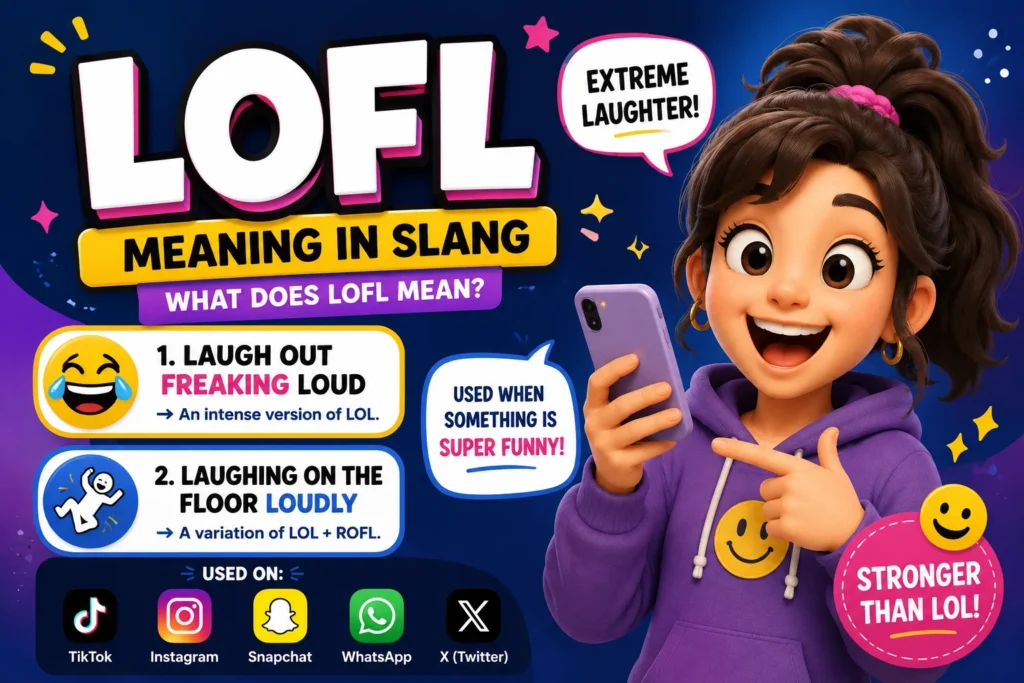
LOFL most commonly means “Laugh Out Freaking Loud” (or the uncensored version “Laugh Out Fking Loud”**) in internet slang. It’s an exaggerated version of LOL, used to show that something is much funnier than ordinary laughter. Some people also interpret LOFL as “Laughing on the Floor Loudly,” although that meaning is far less common.
If you’ve received a text saying “LOFL 😂” or spotted it in a comment section, you may have wondered whether it’s just another version of LOL or something different. The confusion is understandable because LOFL isn’t as widely recognized as other laughter acronyms. Understanding the context makes it much easier to identify which meaning the sender intended.
What Does LOFL Mean in Slang?
The primary slang meaning of LOFL is:
LOFL = Laugh Out Freaking Loud
In texting and online conversations, LOFL expresses very strong laughter. It’s used when someone finds a joke, meme, video, or story much funnier than something that would only earn a simple LOL.
Some people also use the uncensored expansion:
Laugh Out Fking Loud**
The stronger wording simply adds emphasis. It isn’t meant to change the meaning—it only makes the reaction sound more intense.
For example:
A: I accidentally sent my shopping list to the entire office group chat.
B: LOFL 😂 That’s something I would do.
Here, LOFL tells the sender:
“That was unbelievably funny.”
It functions much like:
- LOL
- LMAO
- ROFL
- LMFAO
The main difference is that LOFL is much less common than these better-known abbreviations.
What Emotion Does LOFL Express?
People usually type LOFL when they want to communicate:
- Extreme amusement
- Uncontrollable laughter
- Surprise mixed with humor
- A stronger reaction than LOL
Instead of writing:
“That made me laugh.”
They might simply reply:
“LOFL 😂”
The acronym saves time while making the reaction feel more expressive.
Is LOFL an Acronym, Abbreviation, or Slang?
Technically, LOFL is an acronym because each letter represents a word:
- L = Laugh
- O = Out
- F = Freaking (or the uncensored alternative)
- L = Loud
When used in online conversations, it also functions as internet slang, since people recognize it as informal digital language rather than standard English.
Unlike abbreviations that shorten a single word, LOFL creates an entire phrase from its initials.
You’ll most often see it in:
- Text messages
- Group chats
- Meme pages
- Gaming chats
- Social media comments
- Online communities
Because it’s informal internet language, it’s generally not suitable for professional emails, academic writing, or business communication.
Why Do People Use LOFL Instead of LOL?
LOL has been around for decades, but frequent internet users often look for different ways to emphasize their reactions.
Typing LOFL suggests that something was funnier than an ordinary joke.
For example:
LOL
“I laughed.”
LOFL
“I laughed really hard.”
It’s similar to how people choose between:
- LOL
- LMAO
- ROFL
- LMFAO
Each expression communicates laughter, but the level of intensity changes.
Many people also enjoy using less common acronyms because they feel more expressive or stand out in conversations.
Other Meanings of LOFL
Although “Laugh Out Freaking Loud” is the primary slang meaning, LOFL has another genuine interpretation that appears occasionally online.
Laughing on the Floor Loudly
Some users expand LOFL as:
Laughing on the Floor Loudly
This version combines ideas from two familiar expressions:
- LOL (Laugh Out Loud)
- ROFL (Rolling on the Floor Laughing)
Instead of suggesting someone is literally on the floor, it’s simply another exaggerated way of saying something is extremely funny.
Example:
A: Did you watch the blooper video?
B: LOFL 😂 I couldn’t stop laughing.
Although you’ll still encounter this expansion on some websites and discussion boards, it’s far less common than Laugh Out Freaking Loud.
How LOFL Is Used on Social Media
While LOFL isn’t as widespread as LOL or LMAO, it does appear on several platforms where quick reactions are common.
TikTok
TikTok users occasionally write LOFL in comment sections under funny videos, memes, and prank clips.
Example:
“LOFL 😂 That ending caught me completely off guard.”
Most users still prefer LOL or LMAO, but LOFL appears from time to time among people who enjoy using less common reaction acronyms.
On Instagram, LOFL is mainly used in:
- Direct Messages (DMs)
- Reels comments
- Meme pages
- Story replies
Example:
“LOFL 😂 I watched this three times.”
It’s often paired with laughing emojis to emphasize the reaction.
Snapchat
Snapchat conversations are usually casual and fast-moving, making short reaction acronyms a natural fit.
Example:
A: Look what my brother accidentally texted Mom.
B: LOFL 😂
In this context, the acronym simply means:
“That’s hilarious.”
Friends often use LOFL in WhatsApp chats after someone shares:
- Funny photos
- Voice notes
- Memes
- Family stories
- Embarrassing moments
Example:
“LOFL 😂 Grandma’s joke was actually funny.”
Although LOL remains far more common, LOFL still appears among users who like stronger expressions of laughter.
X (formerly Twitter)
On X, LOFL occasionally appears in replies to humorous tweets, sports highlights, and viral posts.
Example:
“LOFL 😂 That plot twist was perfect.”
Because tweets move quickly, short reaction acronyms work well when users want to express laughter without writing a long reply.
Where You’ll Most Often See LOFL
Although LOFL isn’t nearly as common as LOL, ROFL, or LMAO, you may still encounter it in informal online spaces.
You’re most likely to see it in:
- Text messages
- Group chats
- TikTok comments
- Instagram DMs
- Instagram Reels comments
- Snapchat conversations
- WhatsApp chats
- Gaming communities
- Meme pages
In almost every case, LOFL simply means the sender thought something was extremely funny and wanted to express a stronger reaction than an ordinary LOL.
Real Chat Examples of LOFL in Slang
The best way to understand LOFL is to see how people naturally use it in everyday conversations. In nearly every example below, LOFL means “Laugh Out Freaking Loud” and expresses stronger amusement than a simple LOL.
Friends Talking After Class
A: I walked into the wrong classroom and sat there for ten minutes.
B: LOFL 😂 Seriously?
A: I didn’t realize until the teacher called attendance.
B: That’s the funniest thing I’ve heard today.
Family Group Chat
A: Dad tried using the TV remote to answer his phone.
B: LOFL 😂
A: He didn’t even notice.
B: Classic Dad moment.
Instagram DM
A: Did you watch that cat video I sent?
B: LOFL! I replayed it three times.
A: The ending gets me every time.
B: Same here.
Gaming Chat
A: I accidentally eliminated myself instead of the other team.
B: LOFL 😂 That’s impressive.
A: My teammates won’t let me forget it.
B: They definitely shouldn’t.
WhatsApp Conversation
A: My little brother wore two different shoes to school.
B: LOFL! Did anyone tell him?
A: Not until lunchtime.
B: That’s priceless.
TikTok Comments
A: I wasn’t expecting that ending.
B: LOFL 😂
A: It gets funnier every time.
B: Instant favorite.
Best Friends
A: Guess who locked their keys inside the car again?
B: LOFL…
A: Don’t laugh.
B: Too late.
Office Chat
A: I sent the unfinished document by mistake.
B: LOFL, but I’m glad you caught it quickly.
A: I nearly had a heart attack.
B: At least it’s fixed now.
Movie Night
A: That comedy was way better than I expected.
B: LOFL during almost every scene.
A: Same.
B: We need to watch the sequel.
Siblings
A: Mom just discovered internet memes.
B: LOFL 😂
A: She’s sending one every five minutes.
B: We’re never escaping this.
School Friends
A: I answered the teacher’s question before realizing I was muted.
B: LOFL.
A: Everyone saw me talking to myself.
B: That’s happened to all of us.
LOFL in Different Tones
Although LOFL always expresses laughter, the tone changes depending on the conversation.
Funny
A: I slipped on the last stair but somehow stayed standing.
B: LOFL 😂 That’s actually impressive.
A: I looked like a cartoon character.
B: I wish someone had recorded it.
Here, LOFL shows genuine amusement without being mean-spirited.
Sarcastic
A: My alarm didn’t go off again.
B: LOFL… because your mornings are always an adventure.
A: Thanks for the support.
B: You’re welcome.
The laughter is playful and lightly sarcastic.
Playful
A: I beat you at the game again.
B: LOFL, keep dreaming.
A: The scoreboard says otherwise.
B: Best two out of three?
This tone is friendly and competitive.
Serious
Although LOFL is mainly used for humor, it can soften an embarrassing story between close friends.
A: I accidentally called my teacher “Mom.”
B: LOFL, but honestly, that happens more often than you think.
A: I wanted to disappear.
B: You’ll laugh about it later.
Grammar and Language Role
Knowing how LOFL functions grammatically helps you use it naturally.
Part of Speech
LOFL usually acts as an interjection or reaction acronym.
Its purpose is to express an emotional response rather than describe an object or action.
Example:
LOFL! That was hilarious.
It works much like:
- LOL
- LMAO
- ROFL
Sentence Position
People commonly place LOFL at the:
Beginning
LOFL! I wasn’t expecting that.
Middle
That’s, LOFL, one of the funniest videos today.
(This placement is less common.)
End
That joke was amazing, LOFL.
The beginning and end of a message are the most natural positions.
Can LOFL Replace a Full Sentence?
Yes.
Unlike CFS, LOFL can stand alone as a complete response.
Examples:
LOFL 😂
LOFL!
LOFL I’m crying.
Sometimes the acronym alone communicates enough emotion without any additional words.
Formal vs. Informal Register
| Situation | Appropriate? |
|---|---|
| Text messages | ✅ Yes |
| WhatsApp chats | ✅ Yes |
| Instagram DMs | ✅ Yes |
| Snapchat | ✅ Yes |
| TikTok comments | ✅ Yes |
| Gaming chats | ✅ Yes |
| Casual online conversations | ✅ Yes |
| Business emails | ❌ No |
| Academic writing | ❌ No |
| Professional reports | ❌ No |
Because LOFL is internet slang, it’s intended for informal communication rather than professional writing.
How to Reply to LOFL
When someone sends LOFL, they’re usually telling you they found something extremely funny. Your reply can match the mood of the conversation.
Funny Reply
- “I knew you’d laugh!”
- “Mission accomplished. 😂”
- “I’ve got even funnier ones.”
Serious Reply
- “Glad it made your day.”
- “I needed that laugh too.”
- “Happy you enjoyed it.”
Flirty Reply
If the conversation already has a playful or romantic tone:
- “I like making you LOFL.”
- “Your laugh is my favorite reaction.”
These replies work best between people who already have that kind of relationship.
Neutral Reply
- “Haha, thanks.”
- “I thought it was funny too.”
- “Glad you liked it.”
- “Exactly!”
Comparison Table
| Term | Meaning | Usage Context | Tone | Popularity | Confusion Risk |
|---|---|---|---|---|---|
| LOFL | Laugh Out Freaking Loud | Texting, memes, chats | Very humorous | Medium-Low | Medium |
| LOL | Laugh Out Loud | Everyday texting | Casual | Very High | Very Low |
| LMAO | Laughing My Ass Off | Informal chats | Strong laughter | Very High | Low |
| ROFL | Rolling on the Floor Laughing | Internet slang | Exaggerated laughter | High | Low |
| LMFAO | Laughing My Freaking Ass Off | Casual online conversations | Extremely humorous | Medium | Medium |
| SMH | Shaking My Head | Disapproval or disbelief | Serious or disappointed | Very High | Very Low |
SMH provides a useful contrast because it expresses frustration or disbelief rather than laughter.
Who Uses LOFL?
Teenagers (13–19)
Teenagers occasionally use LOFL in text messages, gaming chats, and meme communities. However, many still prefer more familiar reactions like LOL or LMAO.
Young Adults (20–35)
Young adults who spend time in online communities sometimes use LOFL as an alternative to common laughter acronyms. It often appears in conversations about funny videos, social media posts, or gaming moments.
Adults Over 35
Many older internet users recognize LOFL, but they’re generally more likely to use LOL because it’s been part of online communication for decades.
Gen Z vs. Millennials
Gen Z
Gen Z is more likely to experiment with different reaction acronyms. While LOFL isn’t among the most popular choices, some users enjoy using it because it feels more expressive and less predictable than LOL.
Millennials
Millennials usually recognize LOFL, but many stick with LOL, LMAO, or emojis in daily conversations. When they do use LOFL, it’s often for extra emphasis or nostalgia.
Regional Usage
There is no verified evidence that LOFL originated in any one English-speaking country. Instead, it developed as part of broader internet culture and can be understood by English speakers in many regions.
You’ll occasionally see LOFL used in:
- United States
- United Kingdom
- Canada
- Australia
- Other English-speaking online communities
Its usage is influenced more by internet habits than by geography.
Where You’re Most Likely to See LOFL
Although LOFL is less common than LOL or LMAO, it still appears in casual online conversations, especially where people react to humorous content.
You’re most likely to encounter it in:
- Text messages
- WhatsApp chats
- Instagram DMs
- TikTok comments
- Snapchat conversations
- Gaming chats
- Meme pages
- Group chats among friends
In nearly every case, LOFL signals one simple idea: the sender found something extremely funny and wanted to express stronger laughter than a standard “LOL.”
Origin and Internet Culture
Unlike well-known internet acronyms such as LOL and ROFL, LOFL has never had a single universally accepted expansion. Instead, it developed organically in online conversations as users experimented with stronger ways to express laughter.
The most widely recognized interpretation today is “Laugh Out Freaking Loud” (or the uncensored version “Laugh Out Fking Loud”*). This meaning follows the same pattern as other internet abbreviations by adding extra emphasis to an existing acronym.
A less common interpretation is “Laughing on the Floor Loudly.” This version blends the ideas behind LOL (Laugh Out Loud) and ROFL (Rolling on the Floor Laughing). While you’ll occasionally find this definition on slang websites and discussion forums, it appears much less frequently in modern online conversations.
Is LOFL Connected to AAVE?
There is no verified evidence that LOFL originated from African American Vernacular English (AAVE) or any specific cultural community. Instead, it belongs to the broader tradition of internet shorthand that became popular through chat rooms, instant messaging, forums, and later social media.
LOFL in Meme Culture
Although LOFL isn’t as common as LOL, LMAO, or ROFL, it still appears in meme pages, gaming communities, and comment sections where users want to exaggerate how funny they found something.
Examples include:
“LOFL 😂 I wasn’t ready for that ending.”
“LOFL. This meme gets funnier every time.”
In these situations, the acronym acts as a quick emotional reaction rather than a literal statement.
How LOFL Has Evolved
Early internet users relied heavily on acronyms because typing was slower on feature phones, early messaging apps, and online chat rooms. While LOL quickly became the dominant abbreviation for laughter, other variations such as ROFL, LMAO, and eventually LOFL emerged as users looked for stronger or more expressive reactions.
Today, LOFL remains a niche acronym. It’s recognized by some internet users but is far less common than mainstream laughter abbreviations.
Is LOFL Rude or Offensive?
Generally, no.
The meaning depends on which expansion the sender intends.
Does LOFL Contain Profanity?
If someone means “Laugh Out Freaking Loud,” there’s no profanity.
If they mean the uncensored version, the phrase contains a mild swear word used only for emphasis. In many online conversations, people replace it with “freaking” or censor it with asterisks.
Can LOFL Be Offensive?
The acronym itself isn’t offensive.
However, like any laughter reaction, using LOFL when someone is discussing a serious problem or sharing bad news could seem insensitive.
Context matters much more than the acronym itself.
Is LOFL Appropriate for School or Work?
Among friends, LOFL is generally harmless.
In professional emails, school assignments, or formal documents, it’s better to avoid internet slang altogether and use standard language instead.
Cultural Sensitivity
The slang meaning of LOFL isn’t associated with any particular culture, ethnicity, or community. It’s simply an informal internet expression used to communicate laughter.
Real-World Observation
One reason reaction acronyms continue to survive is that they instantly communicate emotion without requiring a full sentence. While emojis now play a major role in digital conversations, abbreviations like LOL, LMAO, and LOFL still help people show exactly how funny they found something. Although LOFL isn’t as common as the biggest laughter acronyms, it appeals to users who enjoy using slightly different expressions or who want to add extra emphasis without typing a longer response.
Frequently Asked Questions
What does LOFL mean in texting?
In texting, LOFL most commonly means “Laugh Out Freaking Loud.” It’s a stronger version of LOL and is used when someone finds something especially funny. Some people also interpret it as “Laughing on the Floor Loudly,” although that meaning is less common.
Is LOFL the same as LOL?
Not exactly. LOL means “Laugh Out Loud,” while LOFL expresses a much stronger reaction. Think of LOFL as an intensified version of LOL rather than a completely different expression.
What does LOFL mean on TikTok?
On TikTok, LOFL occasionally appears in comments under funny videos, memes, or prank clips. Users type it to show they laughed much harder than they would with a simple LOL. However, LOL and LMAO remain more common.
What does LOFL mean on Snapchat?
On Snapchat, LOFL is usually sent as a reaction to funny photos, videos, or chats between friends. It’s simply another way of saying that something was hilarious.
Is LOFL still popular?
LOFL is recognized but relatively uncommon. Most internet users today prefer LOL, LMAO, or ROFL. Even so, you’ll still encounter LOFL in niche online communities, gaming chats, and text conversations.
Can I use LOFL in professional communication?
It’s best not to. Because LOFL is informal internet slang, it may confuse readers or seem unprofessional in workplace emails or business documents. Writing your reaction in plain English is usually a better choice.
Why do people search for LOFL meaning?
Many people come across LOFL in a text message, meme, or social media comment and realize it’s different from LOL. They search for the meaning to understand whether it’s another laughter acronym or something entirely different.
Does LOFL always contain a swear word?
No. Many people expand the acronym as “Laugh Out Freaking Loud,” which avoids profanity. Others use the uncensored version, but both convey the same idea of laughing very hard.
What does LOFL stand for in slang?
In internet slang, LOFL most commonly stands for “Laugh Out Freaking Loud.” It’s used to express stronger laughter than a standard LOL.
What is the difference between LOFL and ROFL?
ROFL means “Rolling on the Floor Laughing,” while LOFL usually means “Laugh Out Freaking Loud.” Both express intense laughter, but they use different phrases to emphasize the reaction.
Is LOFL more popular than LOL?
No. LOL is still by far the most widely used laughter acronym. LOFL is much less common and is considered a niche alternative.
Can LOFL replace LOL?
Yes, in casual conversations. Many people use LOFL when they want to emphasize that something was funnier than an ordinary joke. However, because it’s less familiar, LOL is generally understood by a wider audience.
Is LOFL appropriate for children?
The “Laugh Out Freaking Loud” version is generally family-friendly, although it’s still informal internet slang. If someone uses the uncensored expansion, parents and teachers may prefer children avoid it in school settings.
Why isn’t LOFL as common as LOL?
LOL became the standard internet abbreviation for laughter decades ago and remains universally recognized. LOFL never reached the same level of popularity, so it’s mostly used by smaller groups of internet users looking for a stronger or less common reaction.
Conclusion
LOFL most commonly means “Laugh Out Freaking Loud” in internet slang, with the uncensored version using a stronger word for emphasis. It’s an exaggerated form of LOL, used when something is genuinely hilarious. Although some people interpret LOFL as “Laughing on the Floor Loudly,” that meaning is much less common.
Because LOFL isn’t as widely recognized as LOL, LMAO, or ROFL, understanding the conversation’s context is important. In casual texts, group chats, and social media comments, it’s almost always used as an enthusiastic reaction to something funny.
Usage Tips
- Use LOFL in casual text messages and social media conversations.
- Think of it as a stronger alternative to LOL.
- Pair it with emojis like 😂 or 🤣 if you want to emphasize the joke.
- Remember that not everyone recognizes LOFL, so use it where internet slang is expected.
Common Mistakes
- Assuming LOFL is more popular than LOL or LMAO.
- Using it in professional emails or formal writing.
- Confusing LOFL with ROFL, even though they have different expansions.
- Forgetting that some people interpret the “F” differently depending on the context.
When to Use LOFL
Use LOFL when responding to a funny joke, meme, video, or story among friends. It’s best suited for informal conversations where internet slang feels natural.
When to Avoid LOFL
Avoid using LOFL in business communication, academic writing, or serious conversations. If clarity or professionalism is important, write out your reaction instead of relying on an acronym.
I prefer this response