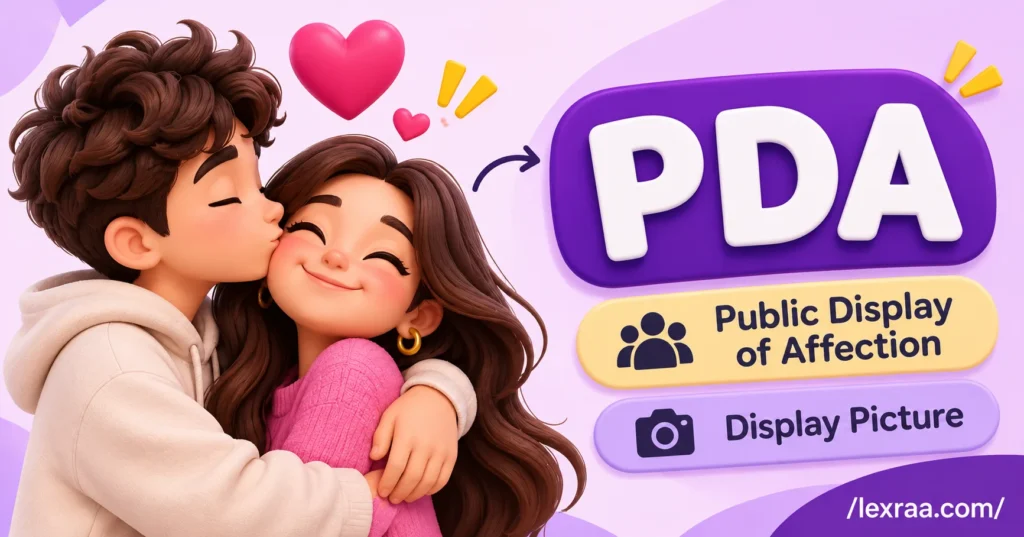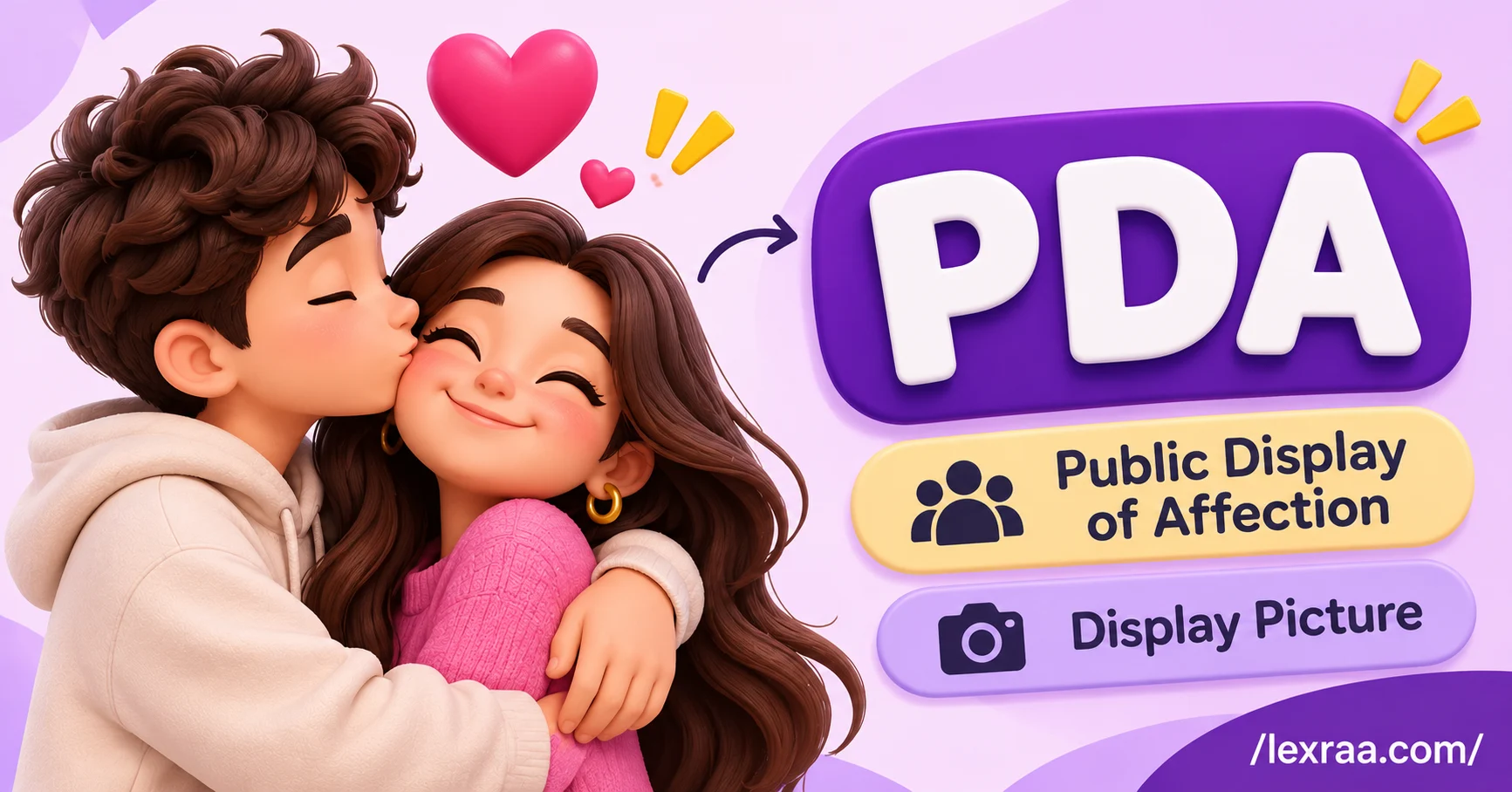
PDA stands for public display of affection. It describes people showing affection where others can see them, such as holding hands, hugging, cuddling, or kissing in public. In texts, the term can sound affectionate, teasing, approving, or critical depending on the situation.
You might hear someone say, “They were doing so much PDA at the restaurant,” or see a friend joke, “PDA alert!” Both comments refer to affection being shown openly rather than kept private.
PDA is an established abbreviation, not a newly invented internet expression. People use it in everyday speech as well as messages and online conversations.
What Does PDA Stand For?
PDA stands for Public Display of Affection. It describes affectionate behavior shown in front of other people, most often between romantic partners.
The word “public” is important. A couple holding hands while walking through a shopping mall, kissing goodbye outside a restaurant, or cuddling on a park bench may be described as showing PDA.
It does not automatically mean intense or sexual behavior. Even a simple hug or a kiss can count, depending on the setting and the people observing it.
PDA is an initialism because each letter represents a word and people pronounce the letters separately: “P-D-A.”
How People Use PDA in Texts and Online Conversations
In a message, PDA usually refers to affection someone has noticed, experienced, or is discussing. The abbreviation can do more than simply describe what happened; it can also communicate the sender’s reaction.
1. Teasing a couple
Friends may use PDA to joke about a couple who are being especially affectionate around everyone else.
Example: “You two are giving us a whole PDA show 😂”
2. Showing approval
Someone might use PDA positively when they think a couple’s affection is sweet.
Example: “That little goodbye kiss was cute. I love a bit of PDA.”
3. Expressing discomfort
Not everyone enjoys seeing romantic affection in public. Someone may use PDA to explain why a particular situation made them uncomfortable.
Example: “I don’t mind holding hands, but too much PDA makes me awkward.”
4. Discussing relationship preferences
A person may ask whether their date or partner is comfortable with PDA before showing affection in public.
Example: “Are you okay with PDA, or do you prefer keeping that stuff private?”
5. Commenting on a public moment
People may also use the term when talking about a couple they saw at a party, school event, restaurant, or other shared space.
The meaning stays the same in each case. What changes is the speaker’s attitude toward the affection.
What Counts as PDA?
PDA can cover a range of affectionate gestures. Whether people consider an action appropriate depends on the setting, personal boundaries, and local social expectations.
| Action | Could it count as PDA? |
|---|---|
| Holding hands in public | Yes |
| Hugging a romantic partner | Yes |
| Kissing in a public place | Yes |
| Cuddling on a park bench | Yes |
| Putting an arm around a partner | Yes |
| Sitting close together | Sometimes, depending on context |
| Posting a romantic couple photo | Often described casually as public affection, though the traditional meaning focuses on behavior in public |
| Having a private conversation at home | No, not public |
There is no universal rule that defines exactly how much affection is too much. One couple may consider holding hands perfectly natural, while another may prefer not to show any romantic affection around other people.
It is also worth separating public affection from public oversharing. A couple holding hands is a visible gesture; sharing intimate details about their relationship is a different kind of behavior.
Is PDA Always Romantic?
PDA most commonly refers to romantic affection, particularly between couples. However, the broader words “public display of affection” can describe other visible expressions of care too.
For example, a parent hugging a child in a public place is an affectionate gesture. Friends may also hug or link arms when greeting each other. People can describe these actions as public affection in a broad, literal sense, although the abbreviation PDA is most strongly associated with romantic couples.
The surrounding situation helps establish what someone means. If a friend says, “Those two are doing PDA again,” the likely reference is a couple showing romantic affection—not ordinary friendliness.
People often use affectionate expressions when talking about their partners. For example, LOML meaning in text refers to someone described as the love of their life, while PDA describes affection shown publicly.
Example Conversations: PDA in Different Tones
These conversations show how the same abbreviation can sound sweet, funny, sarcastic, or serious.
1. Playful: Friends teasing a couple
Mia: You and Alex were holding hands the entire movie.
Sam: Is that a problem?
Mia: No, just saying the PDA was noticeable 😂
Sam: Let us be happy in peace!
Here, PDA is friendly teasing. Mia is pointing out the couple’s affection without necessarily criticizing them.
2. Funny: A family group chat
Dad: Your sister and her boyfriend were hugging at the airport for ten minutes.
Mom: That’s called saying goodbye.
Dad: I know. I just wasn’t prepared for that much PDA.
Sister: Next time we’ll send you a calendar invitation.
The joke comes from Dad exaggerating an ordinary affectionate moment.
3. Sarcastic: Coworkers after a party
Jamie: Did you see those two at the office party?
Taylor: The couple near the dance floor?
Jamie: Yes. That was a lot of PDA for a work event.
Taylor: I was trying very hard to focus on the dessert table.
In this example, PDA carries a mildly critical tone because the setting is a workplace gathering.
4. Serious: Discussing relationship boundaries
Riley: Can I ask how you feel about PDA?
Morgan: I’m okay with holding hands, but I don’t like kissing in front of a crowd.
Riley: That’s completely fine. I don’t want you to feel uncomfortable.
Morgan: Thanks. I just prefer keeping some moments private.
Here, PDA is part of a genuine conversation about personal comfort and boundaries.
5. Sweet: A dating conversation
Jordan: I liked walking around with you today.
Casey: Me too. Even the little hand-holding moments?
Jordan: Especially those.
Casey: Then I guess we’re both okay with a little PDA.
This is a positive, affectionate use of the abbreviation.
How to Reply When Someone Mentions PDA
PDA is usually a comment about affection rather than a direct question. Your reply can match the sender’s tone.
| Situation | Possible reply |
|---|---|
| A friend teases you about PDA | “We’re just happy, okay? 😂” |
| Someone says a couple’s PDA was cute | “Honestly, they looked adorable.” |
| Someone complains about PDA | “Everyone has different comfort levels.” |
| Your partner asks if you like PDA | “I’m comfortable with a little affection in public.” |
| Someone makes an awkward comment | “Let’s not make a big deal out of it.” |
| You want to keep affection private | “I prefer saving that for when we’re alone.” |
If the conversation is about your relationship, an honest answer is more useful than pretending to enjoy or dislike PDA just to fit in.
PDA vs. Similar Terms
PDA is sometimes mentioned alongside relationship and internet abbreviations, but these terms do not all describe the same thing.
| Term | Meaning | Tone | Popularity | Confusion Risk |
|---|---|---|---|---|
| PDA | Public Display of Affection | Neutral, playful, or critical | Established everyday abbreviation | Low when relationship context is clear |
| LOML | Love of My Life | Affectionate | Common in informal online language | Medium |
| OTP | One True Pairing | Enthusiastic, fandom-related | Established fandom term | Medium |
| IRL | In Real Life | Neutral | Widely recognized internet abbreviation | Low |
| TMI | Too Much Information | Humorous or disapproving | Widely recognized | Medium |
| DPA | No standard opposite meaning to PDA | — | — | High if mistyped |
There is no exact opposite abbreviation for PDA. Someone who prefers privacy might say they are not comfortable with public affection, but that is a description rather than a standard antonym.
A useful distinction is that PDA describes the visible affection itself, while LOML identifies a loved person and OTP describes a favorite fictional or real-life pairing.
Is PDA Rude or Inappropriate?
PDA is not a swear word or an inherently insulting expression. It is a neutral abbreviation that can be used positively, jokingly, or critically.
Calling a couple’s behavior PDA does not automatically mean you disapprove. A friend might say “PDA alert” while smiling, or someone might complain about “too much PDA” because they feel uncomfortable watching public kissing.
The setting matters. Holding hands or giving a quick goodbye hug is generally accepted in many everyday situations, while more intimate behavior may be unwelcome in workplaces, classrooms, religious settings, or family gatherings.
PDA is not automatically sexual or explicit. To understand labels used for adult or workplace-inappropriate content, see our guide to NSFW meaning.
It is also important not to use the term as an excuse to shame people. Couples have different comfort levels, and cultural expectations about public affection vary. A respectful conversation focuses on the situation and shared boundaries rather than making assumptions about someone’s relationship.
What Is the Origin of PDA?
PDA is an abbreviation of the straightforward phrase “public display of affection.” The exact person who first coined the expression or abbreviation is not clearly established.
The phrase was already being used in print decades ago. A 1967 issue of a high-school newspaper, for example, used “Public Display of Affection” to discuss couples showing affection in school hallways. This confirms that the expression was in circulation by that time, but it does not identify its first use.
PDA also has a separate historical meaning in technology: personal digital assistant, a handheld electronic organizer used before smartphones became common. That meaning is now mostly associated with older devices and technology discussions.
There is no reliable reason to attribute the public-affection meaning to one particular social-media app or generation. It predates modern social platforms.
Other Meanings of PDA
Although public display of affection is the relevant meaning in slang and relationship conversations, the same letters appear in other fields.
- Personal Digital Assistant: An older handheld computing device used for tasks such as managing contacts, calendars, and notes.
- Patent Ductus Arteriosus: A medical term for a heart-related condition involving a blood vessel that normally closes after birth.
- Presidential Drawdown Authority: A U.S. government and defense term used in discussions about providing military equipment from existing stockpiles.
These are not alternative slang meanings. If PDA appears in a medical report, technology article, or government news story, the subject will usually make the intended definition clear.
Conversations about attraction and appearance can include abbreviations such as WYLL, which asks someone what they look like.
Frequently Asked Questions
1. What does PDA mean in a relationship?
In a relationship, PDA means showing affection toward your partner where other people can see it. Examples include holding hands, hugging, kissing, or cuddling in public. When someone asks whether you like PDA, they are usually asking how comfortable you are with visible affection.
2. Does PDA mean kissing?
Kissing can be PDA, but it is not the only form. Holding hands, hugging, and other affectionate gestures can also count. The term covers a range of public expressions of affection, not just passionate kissing.
3. Is holding hands considered PDA?
Yes, holding hands in a public place is commonly considered a form of PDA. It is generally a less intimate example than kissing or prolonged cuddling. Whether people notice or comment on it depends on the setting.
4. What does “no PDA” mean?
“No PDA” means that public displays of affection are not allowed or are discouraged in a particular place. You might see the rule at a school, workplace, event, or other shared environment. It usually means people should avoid visible romantic gestures there.
5. What does “PDA alert” mean?
“PDA alert” is a playful way to point out that a couple is being affectionate in front of others. Friends may use it when they notice a couple holding hands, kissing, or cuddling. Depending on the delivery, it can be affectionate teasing rather than a serious complaint.
6. Can PDA be used for friends or family?
The full phrase can describe affection between friends or family members because they can show care publicly too. However, PDA in everyday conversation usually brings romantic couples to mind. The surrounding context makes the intended meaning clearer.
7. Is PDA an acronym or an abbreviation?
PDA is an initialism formed from the first letters of “Public Display of Affection.” People pronounce each letter separately rather than saying it as one word. It is also commonly called an abbreviation.
8. Is PDA still used today?
Yes. Dictionaries continue to list public display of affection as a current meaning, and recent online articles use it in texting and relationship contexts. However, that does not prove it is trending on a particular app or more popular among one age group.
Final Thoughts
PDA means public display of affection—showing affection where other people can see it. It can describe anything from holding hands to kissing, and its tone can be sweet, playful, neutral, or disapproving.
The main mistake to avoid is assuming PDA always means intense or sexual behavior. A simple hug can count, too. When discussing relationships, use the term naturally, respect different comfort levels, and remember that what feels romantic to one couple may feel too public to another.